Within Ecuador Panics
How Painted Pigs Frightened Guayaquil
Harmless pig graffiti became a supposed code for murder and rape as email, television and official precautions amplified the story.
On this page
- What the pig symbols really were
- How email and television spread the threat
- Schools, police and the cost of precaution
Page outline Jump by section
Introduction
In late 2004, Guayaquil experienced one of Ecuador’s clearest examples of a modern rumour panic. A series of simple pig-shaped graffiti, created as part of an art project, became the focus of a rapidly spreading belief that violent gang members had marked homes and neighbourhoods for murder, rape or intimidation. The rumour was false, but it spread with remarkable speed through chain emails, television news coverage and everyday conversation. Schools altered their routines, anxious parents kept children at home, police investigated the drawings and the artist eventually erased his own work to calm the city. The episode remains an instructive case of how an ordinary image can become invested with terrifying meaning when it matches existing fears about crime and social insecurity.
What the pig symbols really were
The painted pigs were not gang symbols at all. They were the work of Guayaquil graphic artist Daniel Adum, who had begun spraying stylised pigs around the city as part of an evolving artistic and political project that he later called Chanchocracia (“Pigocracy”). The images appeared in black, red and white on walls in neighbourhoods including Urdesa and along the road to Samborondón.[El Universo]eluniverso.comEl UniversoLas figuras de los cerdos fueron borradas de las calles de Guayaquil | Seguridad | Noticias | El UniversoDecember 9, 2004…
Before the rumour took hold, the drawings attracted little attention. Their meaning was intentionally ambiguous, encouraging curiosity rather than providing an obvious explanation. Once fear spread, however, that ambiguity became an advantage for the rumour. People began interpreting the different colours as a secret code rather than as elements of an artwork.[El Universo]eluniverso.comOpen source on eluniverso.com.
When Adum publicly identified himself as the creator, the supposed mystery collapsed. He later documented the affair in a book on the project and described how an artistic intervention unexpectedly became a city-wide social experiment in fear.[El Universo]eluniverso.comEl Universo Chanchocracia tiene su libro | Comunidad | Guayaquil | El UniversoEl UniversoChanchocracia tiene su libro | Comunidad | Guayaquil | El UniversoDecember 6, 2012…
How email and television turned graffiti into a threat
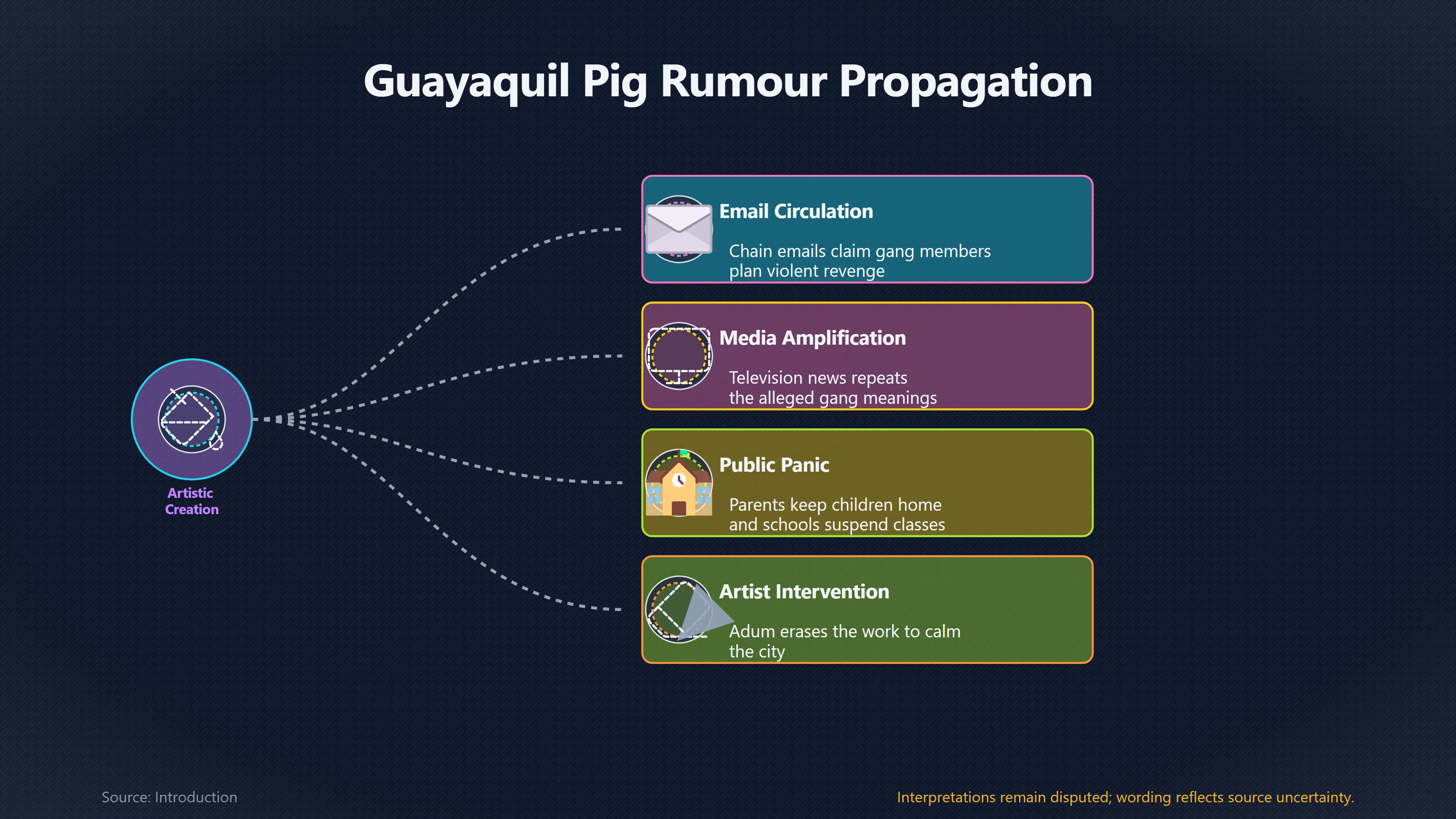
The panic did not begin with the paintings themselves. It was driven by a chain email that claimed two leaders of the Latin Kings gang had recently been killed in Spain by a wealthy man from Guayaquil. According to the message, gang members had travelled to Ecuador to take revenge by killing 400 people. The pigs supposedly identified future victims: black meant death, red meant rape and white meant fear or a warning. No credible evidence ever supported these claims.[El Universo]eluniverso.comEl UniversoPolicía investiga el origen de grafitis | Seguridad | Noticias | El UniversoDecember 7, 2004…
The email circulated at a time when chain messages were widely trusted and were often forwarded without verification. Instead of remaining an internet rumour, the story crossed into mainstream media. Television news programmes repeated or discussed the alleged meanings of the symbols, sometimes displaying footage of youth gangs alongside the graffiti. This visual association encouraged viewers to treat the rumour as credible even though journalists had no evidence that the paintings were connected to criminal organisations.[El Universo]eluniverso.comEl Universo Cosas de chanchos | Televisión | Entretenimiento | El UniversoEl UniversoCosas de chanchos | Televisión | Entretenimiento | El UniversoDecember 9, 2004…
Local newspapers also reported the public alarm and the police investigation. While many reports noted that experts doubted any connection between the graffiti and gangs, the extensive coverage itself reinforced the impression that the threat might be genuine. The rumour therefore gained authority simply by becoming news.[El Universo]eluniverso.comEl UniversoPolicía investiga el origen de grafitis | Seguridad | Noticias | El UniversoDecember 7, 2004…
Why the rumour seemed believable
The painted pig scare succeeded because it fitted existing anxieties rather than because the evidence was convincing.
Several conditions made the story persuasive:
- Guayaquil already had a reputation for organised crime and gang violence.
- The Latin Kings were widely known in both Ecuador and Spain, making the rumoured international revenge plot sound superficially plausible.
- Samborondón and nearby affluent districts already viewed themselves as potential targets for crime.
- The symbols appeared in public places without explanation, encouraging speculation.
- Multiple information channels—email, television, newspapers and conversation—appeared to confirm one another even though they often relied on the same unsupported rumour.[researchgate.net]researchgate.netResearch Gate(PDF) More City, Less Citizenship. Urban Renewal in GuayaquilResearch Gate(PDF) More City, Less Citizenship. Urban Renewal in Guayaquil
Researchers have pointed to this case as an example of how urban rumours gain force by attaching themselves to genuine social concerns. Rather than inventing entirely new fears, they reinterpret familiar symbols through the lens of existing insecurity.[ResearchGate]researchgate.netResearch Gate(PDF) More City, Less Citizenship. Urban Renewal in GuayaquilResearch Gate(PDF) More City, Less Citizenship. Urban Renewal in Guayaquil
Schools, police and the cost of precaution
Although no murders or organised attacks followed the appearance of the pigs, the rumour produced real consequences.
Parents became frightened enough to keep children away from schools, particularly those located along the Samborondón corridor where many of the graffiti appeared. Some educational institutions suspended classes or cancelled activities while awaiting clarification. Private security measures increased in some neighbourhoods as residents treated the rumour as a genuine warning.[El Universo]eluniverso.comEl UniversoPolicía investiga el origen de grafitis | Seguridad | Noticias | El UniversoDecember 7, 2004…
Police investigated the origin of the paintings and publicly examined the possibility of gang involvement. As the inquiry progressed, officials increasingly concluded that the images were more likely to be the work of an artist than a criminal organisation. Once Adum came forward, he erased many of the pigs himself, helping to bring the panic to an end.[eluniverso.com]eluniverso.comEl UniversoLas figuras de los cerdos fueron borradas de las calles de Guayaquil | Seguridad | Noticias | El UniversoDecember 9, 2004…
The episode demonstrates that even false rumours can impose genuine economic and social costs. Time, police resources, school disruption and public anxiety were all consumed by responding to a threat that never existed.
What the episode reveals about collective fear
The painted pig rumour is best understood as a rumour panic rather than evidence of hidden gang communication. Historians and social scientists have treated it as a case study in the interaction between urban insecurity, media amplification and public interpretation.
One striking feature is that no single institution invented the panic. Instead, different actors unintentionally reinforced it. Anonymous email writers introduced the story, television gave it wider visibility, journalists reported the public reaction, schools responded to worried parents and police investigations signalled that the matter deserved attention. Each response appeared to validate the previous one, creating a self-reinforcing cycle despite the lack of supporting evidence.[researchgate.net]researchgate.netResearch Gate(PDF) More City, Less Citizenship. Urban Renewal in GuayaquilResearch Gate(PDF) More City, Less Citizenship. Urban Renewal in Guayaquil
Scholars examining Guayaquil’s politics and urban culture have argued that the incident exposed deep social divisions. The rumour spread most intensely in wealthier districts where fears of gangs and violent crime were already embedded in everyday life. The paintings became a screen onto which broader anxieties about security, class and public space were projected.[ResearchGate]researchgate.netResearch Gate(PDF) More City, Less Citizenship. Urban Renewal in GuayaquilResearch Gate(PDF) More City, Less Citizenship. Urban Renewal in Guayaquil

Why the painted pig rumour still matters
The Guayaquil pig scare occupies a distinctive place in Ecuador’s history of collective belief because it illustrates how quickly harmless symbols can acquire frightening meanings when they resonate with existing fears. Unlike a genuine gang campaign or criminal conspiracy, the event ended not with arrests or violence but with the revelation that the supposed warning signs had been an art project all along.
It also anticipated many features of later misinformation crises. An unsupported claim circulated rapidly through digital communication, traditional media amplified it before verification, institutions adopted precautionary measures and the public interpreted ordinary objects through a framework of danger. Long before social media became dominant, Guayaquil demonstrated how rumours can spread across multiple communication systems and create real-world consequences even after the underlying story proves false.[vistazo.com]vistazo.comwww.vistazo.com Las Fake News que inundaron las protestas en Ecuadorwww.vistazo.com Las Fake News que inundaron las protestas en Ecuador
Amazon book picks
Further Reading
Books and field guides related to How Painted Pigs Frightened Guayaquil. Use these as the next step if you want deeper reading beyond the article.
Extraordinary Popular Delusions and the Madness of Crowds
Rating: 4.0/5 from 5 Google Books ratings
Directly illuminates the dynamics behind the Guayaquil panic.
The Wisdom of Crowds:Why the Many Are Smarter Than the Few an...
Contrasts productive and destructive group decision-making.

Endnotes
1.
Source: researchgate.net
Title: Research Gate(PDF) More City, Less Citizenship. Urban Renewal in Guayaquil
Link:https://www.researchgate.net/publication/301302901_More_City_Less_Citizenship_Urban_Renewal_in_Guayaquil
2.
Source: dokumen.pub
Title: race ethnicity and power in ecuador the manipulation of mestiza 9781626371569
Link:https://dokumen.pub/race-ethnicity-and-power-in-ecuador-the-manipulation-of-mestiza-9781626371569.html
Source snippet
Race, Ethnicity, and Power in Ecuador: The Manipulation of Mestiza 9781626371569 - DOKUMEN.PUB...
3.
Source: researchgate.net
Link:https://www.researchgate.net/publication/28115685_Jovenes_en_Guayaquil_de_las_ciudadelas_fortaleza_a_la_limpieza_del_espacio_publico
4.
Source: vistazo.com
Title: www.vistazo.com Las Fake News que inundaron las protestas en Ecuador
Link:https://www.vistazo.com/actualidad/nacional/las-fake-news-que-inundaron-las-protestas-en-ecuador-LCVI158201
5.
Source: eluniverso.com
Link:https://www.eluniverso.com/2004/12/09/0001/10/009889AF3BBB434E99481A5333EAA0EF.html/
Source snippet
El UniversoLas figuras de los cerdos fueron borradas de las calles de Guayaquil | Seguridad | Noticias | El UniversoDecember 9, 2004...
Published: December 9, 2004
6.
Source: eluniverso.com
Link:https://www.eluniverso.com/2005/01/22/0001/262/8FD4A144320343C29C71CFF144FF1B4C.html/
7.
Source: eluniverso.com
Link:https://www.eluniverso.com/2012/12/08/1/1380/proyecto-arte-callejero-daniel-adum-recoge-libro.html
8.
Source: eluniverso.com
Title: El Universo Chanchocracia tiene su libro | Comunidad | Guayaquil | El Universo
Link:https://www.eluniverso.com/2012/12/06/1/1534/chanchocracia-tiene-libro.html/
Source snippet
El UniversoChanchocracia tiene su libro | Comunidad | Guayaquil | El UniversoDecember 6, 2012...
Published: December 6, 2012
9.
Source: eluniverso.com
Link:https://www.eluniverso.com/2004/12/07/0001/10/5C7FF3DCCC8B437083ABB4851930C518.html/?outputType=amp
Source snippet
El UniversoPolicía investiga el origen de grafitis | Seguridad | Noticias | El UniversoDecember 7, 2004...
Published: December 7, 2004
10.
Source: eluniverso.com
Title: El Universo Cosas de chanchos | Televisión | Entretenimiento | El Universo
Link:https://www.eluniverso.com/2004/12/09/0001/1069/6B677D409438447FA59AFDFC577F345B.html
Source snippet
El UniversoCosas de chanchos | Televisión | Entretenimiento | El UniversoDecember 9, 2004...
Published: December 9, 2004
12.
Source: eluniverso.com
Title: Policía investiga el origen de grafitis | Seguridad | Noticias | El Universo
Link:https://www.eluniverso.com/2004/12/07/0001/10/5C7FF3DCCC8B437083ABB4851930C518.html
Additional References
13.
Source: youtube.com
Title: This happened in Guayaquil / LA CHANCHOCRACIA
Link:https://www.youtube.com/watch?v=gfAXK_CZXvI
Source snippet
Atrevimiento a la no-idea -- Dare to create the un-idea | Daniel Adum Gilbert | TEDxQuito...
14.
Source: infobae.com
Link:https://www.infobae.com/america/america-latina/2022/04/02/la-historia-de-como-30-chanchos-pintados-en-las-calles-aterrorizaron-a-una-ciudad-sudamericana/
15.
Source: infobae.com
Link:https://www.infobae.com/america/america-latina/2022/04/02/la-historia-de-como-30-chanchos-pintados-en-las-calles-aterrorizaron-a-una-ciudad-sudamericana/?outputType=amp-type
16.
Source: youtube.com
Link:https://www.youtube.com/watch?v=NQ1Yn8auRLQ
Source snippet
Documental Chanchofobia...
17.
Source: infobae.com
Title: The story of how 30 pigs painted in the streets terrorized a South American city
Link:https://www.infobae.com/en/2022/04/02/the-story-of-how-30-pigs-painted-in-the-streets-terrorized-a-south-american-city/?outputType=amp-type
18.
Source: pure.ups.edu.ec
Title: ups.edu.ec El Grafiti como Crítica Social en Guayaquil
Link:https://pure.ups.edu.ec/es/publications/graffiti-as-social-criticism-in-guayaquil/
19.
Source: youtube.com
Title: De Contrabando capítulo 39
Link:https://www.youtube.com/watch?v=LMtVylFuex0
20.
Source: youtube.com
Title: La chanchocracia
Link:https://www.youtube.com/watch?v=ZAlGzTlclww
Source snippet
DeContrabando capítulo 39 - Daniel Adum Gilbert - Sinceptual...
21.
Source: infobae.com
Title: Hacemos Periodismo
Link:https://www.infobae.com/br/2022/04/02/a-historia-de-como-30-porcos-pintados-nas-ruas-aterrorizaram-uma-cidade-sul-americana/
22.
Source: infobae.com
Title: Hacemos Periodismo
Link:https://www.infobae.com/fr/2022/04/02/lhistoire-de-la-facon-dont-30-porcs-peints-dans-les-rues-ont-terrorise-une-ville-damerique-du-sud/
Topic Tree