Within Congo Belief Panics
Was Kitawala Really a Secret Congolese Network?
Colonial officials turned a loose religious current into the image of a coordinated underground conspiracy.
On this page
- How Watch Tower ideas changed in Congo
- Why local communities adopted Kitawala
- How officials exaggerated unity and danger
Page outline Jump by section
Introduction
Kitawala is often described as a secretive anti-colonial movement that spread through the Democratic Republic of the Congo during the Belgian colonial period. That description contains some truth but also reflects a powerful colonial fear. While many Kitawala communities rejected aspects of colonial rule and operated discreetly to avoid repression, modern historians argue that Belgian officials increasingly portrayed a wide range of local religious groups as parts of a single underground conspiracy. The image of a vast hidden network was often stronger in colonial intelligence files than in the movement itself. Recent research suggests that Kitawala was better understood as a loose family of religious, healing and prophetic communities that adapted biblical ideas to local conditions rather than as a centrally directed organisation.[ohio.edu]ohioopen.library.ohio.eduOpen Library"Unruly Ideas: A History of Kitawala in Congo" by Nicole EggersOhio Open Library"Unruly Ideas: A History of Kitawala in Congo" by Nicole Eggers…
Understanding this distinction matters because it shows how governments can mistake decentralised religious movements for coordinated conspiracies, especially when those movements challenge political authority or offer alternative sources of legitimacy.
How Watch Tower ideas changed in Congo
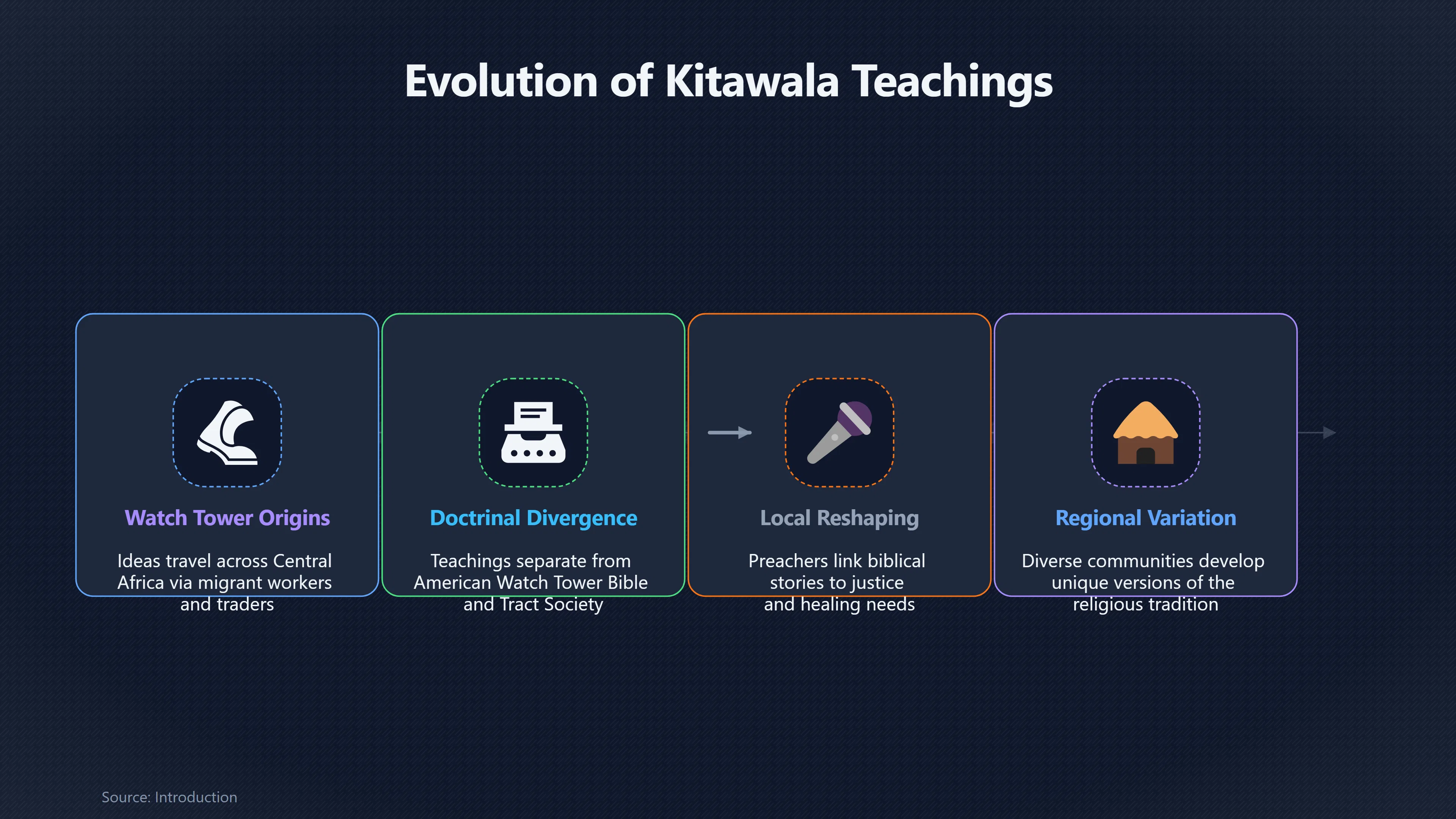
Kitawala did not begin as a single Congolese organisation. It emerged from ideas associated with the Watch Tower movement that travelled across Central Africa through migrant workers, traders, evangelists and mining communities during the 1920s. By the time these teachings reached the Belgian Congo, they had already diverged considerably from the doctrines of the American Watch Tower Bible and Tract Society.[Cambridge University Press & Assessment]cambridge.orgCambridge University Press & AssessmentFREED SLAVES, MISSIONARIES, AND RESPECTABILITY: THE EXPANSION OF THE CHRISTIAN FRONTIER FROM ANGOL…
Once established in Congo, local preachers reshaped these teachings to address everyday concerns. Biblical stories about the coming Kingdom of God were linked with questions of justice, healing, morality and freedom from oppressive authority. Different regions developed different versions of Kitawala, often with little direct contact between them. Some communities stressed spiritual healing, others separation from colonial institutions, and others resistance to exploitative labour systems. Modern scholarship therefore describes Kitawala as an evolving religious tradition rather than a uniform organisation.[Taylor & Francis Online]tandfonline.comTaylor & Francis OnlineFull article: Authority that is customary: Kitawala, customary chiefs, and the plurality of power in Congolese his…
This diversity is important because colonial officials frequently assumed that similar beliefs proved the existence of central leadership. Later archival and oral research has found little evidence that all Kitawala groups answered to a single command structure.[Bibliovault]bibliovault.orgUnruly Ideas: A History of Kitawala in Congo (9780821426074): Nicole Eggers - BiblioVault…
Why local communities adopted Kitawala
Kitawala spread because it addressed practical as well as spiritual needs.
Many Congolese lived under forced labour, racial discrimination, heavy taxation and intrusive colonial administration. Kitawala offered an alternative moral community that challenged claims that colonial power was natural or divinely sanctioned. It also promoted healing practices, mutual support and a belief that worldly injustice would eventually be overturned by God’s kingdom.[Ohio Open Library]ohioopen.library.ohio.eduOpen Library"Unruly Ideas: A History of Kitawala in Congo" by Nicole EggersOhio Open Library"Unruly Ideas: A History of Kitawala in Congo" by Nicole Eggers…
The movement was particularly attractive in mining districts and other areas where migrant workers were separated from traditional community structures. Informal religious networks could travel more easily than formal institutions, allowing ideas to spread through personal relationships rather than official churches. This pattern made Kitawala appear elusive to colonial administrators even when its organisation remained highly local.[Cambridge University Press & Assessment]cambridge.orgCambridge University Press & AssessmentFREED SLAVES, MISSIONARIES, AND RESPECTABILITY: THE EXPANSION OF THE CHRISTIAN FRONTIER FROM ANGOL…
Although some Kitawala groups became involved in local confrontations or protests, historians increasingly argue that these episodes should not be treated as evidence that every Kitawala community belonged to a revolutionary underground. The movement’s goals and practices varied substantially between regions and across time.[Bibliovault]bibliovault.orgUnruly Ideas: A History of Kitawala in Congo (9780821426074): Nicole Eggers - BiblioVault…
Why officials exaggerated unity and danger
Belgian colonial authorities regarded any independent African religious movement with suspicion, particularly one operating outside missionary control. As Kitawala expanded, officials increasingly described it as a secret organisation coordinating resistance across vast areas of the colony. Intelligence reports often linked scattered local incidents into a single narrative of conspiracy.[Africabib]africabib.orgAfrica Bib | Le mouvement Kitawala au Congo BelgeAfricaBib | Le mouvement Kitawala au Congo Belge…
Several factors encouraged this interpretation:
- Kitawala members sometimes met discreetly because public meetings risked arrest.
- The movement spread through personal networks rather than recognised church structures.
- Colonial officials struggled to distinguish between separate prophetic movements that shared some biblical language.
- Opposition to taxes, compulsory labour or colonial chiefs was interpreted as evidence of coordinated political planning rather than locally rooted grievances.[IDEAS/RePEc]ideas.repec.orgOpen source on repec.org.
As a result, officials often merged diverse communities into the imagined picture of a single hidden organisation extending across Central Africa. The movement’s very decentralisation made it appear more mysterious, since the absence of obvious leadership encouraged speculation about invisible leaders directing events from behind the scenes.[Taylor & Francis Online]tandfonline.comTaylor & Francis OnlineFull article: Authority that is customary: Kitawala, customary chiefs, and the plurality of power in Congolese his…
The evidence for a hidden network
Some features of Kitawala genuinely encouraged secrecy. Colonial authorities periodically banned the movement, imprisoned adherents and forced meetings underground. In those circumstances, members often concealed their identities or gathered away from official scrutiny. Such behaviour reflected survival under repression rather than proof of a continent-wide conspiracy.[Bokundoli]bokundoli.orgPartie 5 – Chapitre 2: La gestion belge du CongoPartie 5 – Chapitre 2: La gestion belge du Congo - Bokundoli…
Modern historians distinguish between several different realities:
- Shared religious ideas spread widely across Central Africa.
- Local congregations often operated independently.
- Personal connections between travelling workers and preachers transmitted beliefs.
- No convincing evidence has emerged for a permanent central command directing all Kitawala communities across the Congo.[Bibliovault]bibliovault.orgUnruly Ideas: A History of Kitawala in Congo (9780821426074): Nicole Eggers - BiblioVault…
Nicole Eggers’ extensive archival and oral research argues that Kitawala’s history is better understood through changing local interpretations of power, healing and morality than through the colonial image of an organised revolutionary conspiracy. Rather than uncovering a hidden headquarters, her work reveals numerous communities adapting shared ideas in different ways over many decades.[Bibliovault]bibliovault.orgUnruly Ideas: A History of Kitawala in Congo (9780821426074): Nicole Eggers - BiblioVault…

Why the colonial scare mattered
The belief that Kitawala formed a secret underground network had important consequences regardless of whether it accurately reflected reality.
Colonial governments introduced bans, surveillance, imprisonment, forced relocations and specialised policing aimed at suppressing what they believed was a coordinated threat. Because officials interpreted many independent religious activities through the same conspiratorial framework, people associated with quite different local movements could become targets of suspicion.[africabib.org]africabib.orgAfrica Bib | Le mouvement Kitawala au Congo BelgeAfricaBib | Le mouvement Kitawala au Congo Belge…
The scare also influenced later historical writing. Early colonial accounts often became the foundation for descriptions of Kitawala as a disciplined revolutionary organisation. More recent scholarship has revisited these archives alongside oral testimony and concluded that colonial records frequently reflected official anxieties as much as they documented events.[Cambridge University Press & Assessment]cambridge.orgUniversity Press & Assessment Nicole EggersUnruly Ideas: A History of Kitawala in Congo. Athens, OH: Ohio University Press, 2023. New African Histories series. 291 pp. $34.95. Pape…
What this episode reveals about colonial moral panics
Kitawala illustrates how states can transform a decentralised religious current into the image of a coordinated hidden enemy. Independent congregations sharing similar beliefs became, in official eyes, evidence of a secret network stretching across the colony.
That does not mean every colonial concern was entirely imaginary. Some Kitawala groups did encourage resistance to colonial rule, and a few became involved in violent episodes or local rebellions. However, modern research suggests these events should not be projected onto every Kitawala community. The movement’s history is more accurately described as a changing collection of local religious responses to colonial rule than as a single clandestine organisation directing events throughout the Congo.[cambridge.org]cambridge.orgCambridge University Press & AssessmentFREED SLAVES, MISSIONARIES, AND RESPECTABILITY: THE EXPANSION OF THE CHRISTIAN FRONTIER FROM ANGOL…
Amazon book picks
Further Reading
Books and field guides related to Was Kitawala Really a Secret Congolese Network?. Use these as the next step if you want deeper reading beyond the article.


Christianity in Africa
Context for independent Christian movements including Kitawala.
Endnotes
1.
Source: ohioopen.library.ohio.edu
Title: Open Library”Unruly Ideas: A History of Kitawala in Congo” by Nicole Eggers
Link:https://ohioopen.library.ohio.edu/oupress/25/
Source snippet
Ohio Open Library"Unruly Ideas: A History of Kitawala in Congo" by Nicole Eggers...
2.
Source: africabib.org
Title: Africa Bib | Aperçu sur la formation historique du Kitawala
Link:https://www.africabib.org/rec.php?RID=189917369
Source snippet
AfricaBib | Aperçu sur la formation historique du Kitawala...
3.
Source: cambridge.org
Link:https://www.cambridge.org/core/journals/journal-of-african-history/article/freed-slaves-missionaries-and-respectability-the-expansion-of-the-christian-frontier-from-angola-to-belgian-congo/EAD031979C400AFB36D8A4FF8E6268B2
Source snippet
Cambridge University Press & AssessmentFREED SLAVES, MISSIONARIES, AND RESPECTABILITY: THE EXPANSION OF THE CHRISTIAN FRONTIER FROM ANGOL...
4.
Source: bibliovault.org
Link:https://www.bibliovault.org/BV.book.epl?ISBN=9780821426074
Source snippet
Unruly Ideas: A History of Kitawala in Congo (9780821426074): Nicole Eggers - BiblioVault...
5.
Source: ideas.repec.org
Link:https://ideas.repec.org/a/taf/rjeaxx/v14y2020i1p24-42.html
6.
Source: africabib.org
Title: Africa Bib | Le mouvement Kitawala au Congo Belge
Link:https://www.africabib.org/rec.php?RID=192701169
Source snippet
AfricaBib | Le mouvement Kitawala au Congo Belge...
7.
Source: africabib.org
Title: Africa Bib | Sociétés secrètes et mouvements prophétiques au Congo Belge
Link:https://www.africabib.org/rec.php?RID=192757776
Source snippet
AfricaBib | Sociétés secrètes et mouvements prophétiques au Congo Belge...
8.
Source: bokundoli.org
Title: Partie 5 – Chapitre 2: La gestion belge du Congo
Link:https://bokundoli.org/doc/histoire-generale-du-congo-15/
Source snippet
Partie 5 – Chapitre 2: La gestion belge du Congo - Bokundoli...
9.
Source: cambridge.org
Title: University Press & Assessment Nicole Eggers
Link:https://www.cambridge.org/core/journals/african-studies-review/article/nicole-eggers-unruly-ideas-a-history-of-kitawala-in-congo-athens-oh-ohio-university-press-2023-new-african-histories-series-291-pp-3495-paper-isbn-9780821426081/D15AD0603311D0208FB8BE8631C85164
Source snippet
Unruly Ideas: A History of Kitawala in Congo. Athens, OH: Ohio University Press, 2023. New African Histories series. 291 pp. $34.95. Pape...
10.
Source: bibliovault.org
Link:https://www.bibliovault.org/BV.book.epl?ISBN=9780821426081
11.
Source: africabib.org
Link:https://www.africabib.org/rec.php?RID=192013734
12.
Source: tandfonline.com
Link:https://www.tandfonline.com/doi/full/10.1080/17531055.2019.1708544
Source snippet
Taylor & Francis OnlineFull article: Authority that is customary: Kitawala, customary chiefs, and the plurality of power in Congolese his...
Additional References
13.
Source: youtube.com
Title: The Colonizers Threatened By This Black Spiritual Figure
Link:https://www.youtube.com/watch?v=O4M_A4qVf6g
Source snippet
Kitawala movement Congo 🇨🇩 Tata Gonda, new religions in Democratic Republic of Congo 🇨🇩 #congo Kumakonda African Expeditions...
14.
Source: youtube.com
Title: The Assassination of Patrice Lumumba: Looking Back after 60 Years
Link:https://www.youtube.com/watch?v=ukgHXcJx88s
Source snippet
Belgian Colonial Rule and the Rise of African Spiritual Resistance in Congo...
15.
Source: youtube.com
Title: Belgian Colonial Rule and the Rise of African Spiritual Resistance in Congo
Link:https://www.youtube.com/watch?v=ZjAngvBAHoA
Source snippet
THE MOVING STORY OF CONGOLESE PROPHET SIMON KIMBANGU...
16.
Source: youtube.com
Title: THE MOVING STORY OF CONGOLESE PROPHET SIMON KIMBANGU
Link:https://www.youtube.com/watch?v=wmFXl0VTyeE
Source snippet
The Colonizers Threatened By This Black Spiritual Figure - Simon Kimbangu...
17.
Source: persee.fr
Link:https://www.persee.fr/doc/assr_0003-9659_1971_num_31_1_2037_t1
18.
Source: youtube.com
Link:https://www.youtube.com/watch?v=5_BweSNZ7Vc
Source snippet
The Assassination of Patrice Lumumba: Looking Back after 60 Years...
19.
Source: researchgate.net
Title: (PDF) Kitawala de Léon Debertry: un échantillon du roman colonial belge
Link:https://www.researchgate.net/publication/371286371_Kitawala_de_Leon_Debertry_un_echantillon_du_roman_colonial_belge
20.
Source: jw.org
Title: Democratic Republic of Congo (Kinshasa)
Link:https://www.jw.org/en/library/books/2004-Yearbook-of-Jehovahs-Witnesses/Democratic-Republic-of-Congo-Kinshasa/
21.
Source: ensie.nl
Link:https://www.ensie.nl/winkler/kitawala
22.
Source: library-archives.canada.ca
Link:https://library-archives.canada.ca/eng/services/services-libraries/theses/Pages/item.aspx?idNumber=1019472604
Topic Tree