When Belief Became Danger in Angola
Angola’s history of collective fear and contested belief is not dominated by a single famous “mass hysteria” episode. Its clearest cases instead involve children accused of witchcraft, prophetic Christian movements treated as political threats, and the deadly confrontation between police and followers of José Julino Kalupeteka at Mount Sumi in 2015.
Page outline Jump by section
Introduction
The evidence also demands care. Belief in witchcraft is not itself the same as panic or violence, and an unconventional church is not automatically a “cult”. In Angola, hostile labels have sometimes hidden child abuse, but they have also helped authorities portray independent religious communities as irrational or subversive. The central question is therefore not whether Angolans held unusual beliefs. It is how particular beliefs became attached to fear, punishment and political power—and who suffered when accusations were treated as facts.[unicef.org]unicef.orgChildren Accused of WitchcraftThe impact of accusations of witchcraft against children in Angola. an analysis from the human rights perspective…Read more…
Children accused of witchcraft
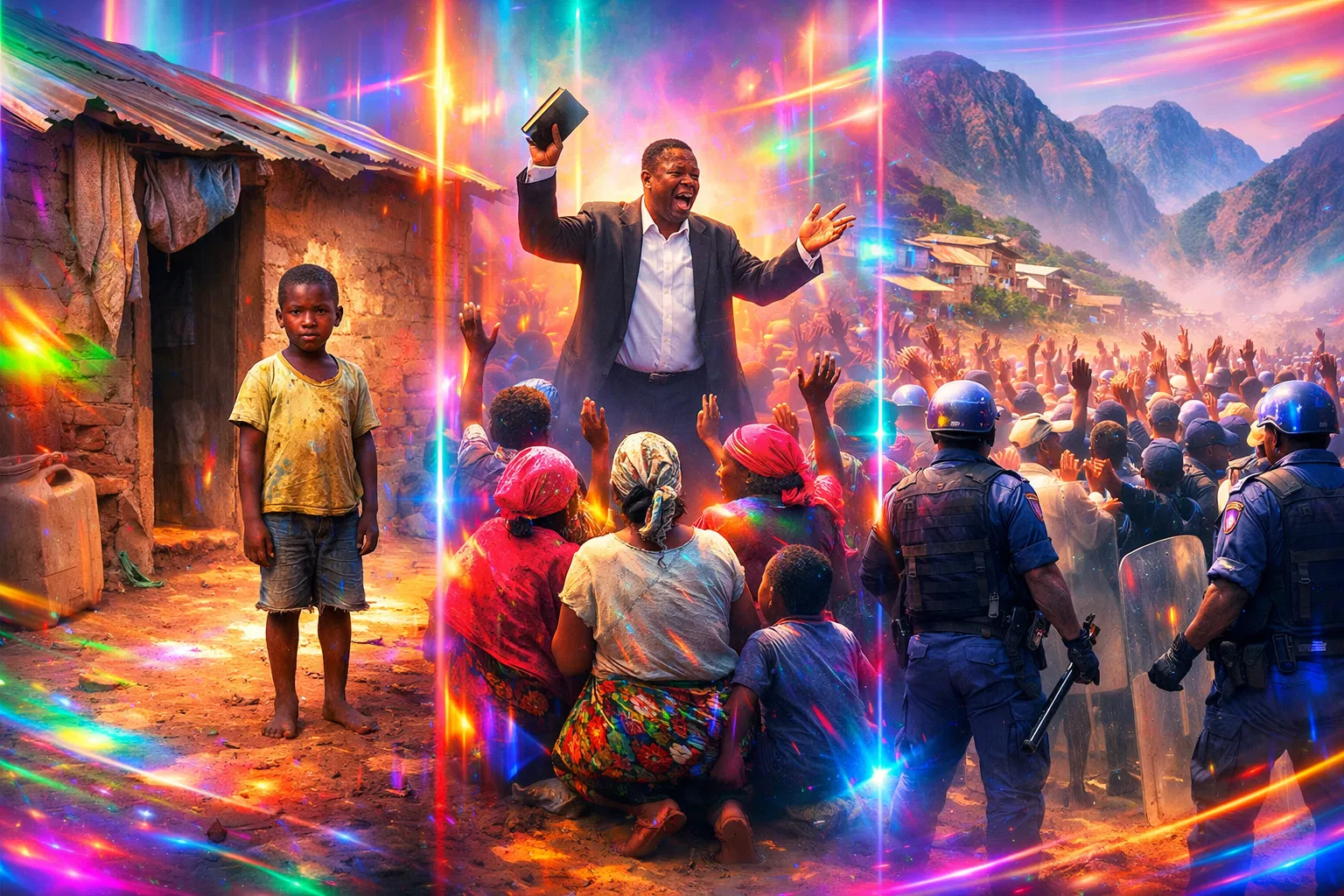
The most thoroughly documented Angolan panic concerns children denounced as witches or as carriers of dangerous supernatural powers. Reports from the early 2000s described children being expelled from their families, beaten, starved, restrained or subjected to violent attempts at deliverance. In M’banza Congo, the capital of northern Zaire Province, at least 23 boys were reported to be living in a Catholic orphanage in 2004 after relatives rejected them on such grounds. Other children ended up on the streets or in institutions because their communities continued to fear them.[thenewhumanitarian.org]thenewhumanitarian.orgThe New Humanitarian Children victims of witchcraft accusationsThe New HumanitarianChildren victims of witchcraft accusationsJanuary 27, 2004 — 27 Jan 2004 — In some areas of Angola the belief in witc…
These were not conventional witch trials conducted by a central court. Accusations usually emerged inside households, neighbourhoods or churches and were enforced informally. A child might be blamed for illness, death, unemployment, marital conflict or persistent poverty. Once relatives accepted the supernatural explanation, ordinary behaviour could be reinterpreted as evidence: nightmares, defiance, bed-wetting, illness, unusual appearance or simply being unwanted in a reconstituted family. The accusation could therefore operate as both a sincere belief and a means of excluding a dependent whom a struggling household no longer wished—or felt able—to support.[unicef.org]unicef.orgChildren Accused of WitchcraftThe impact of accusations of witchcraft against children in Angola. an analysis from the human rights perspective…Read more…
Why the accusations spread
Angola’s long civil war ended in 2002 after decades of violence and displacement. Families had been separated, communities uprooted and large numbers of children orphaned or left in unstable households. Rapid urbanisation placed further pressure on housing, employment and extended-family support. Research on child-witch accusations in Angola and elsewhere in Central and West Africa connects their growth with precisely this combination of war, poverty, displacement, disease and weakened social protection.[unicef.org]unicef.orgChildren Accused of WitchcraftThe impact of accusations of witchcraft against children in Angola. an analysis from the human rights perspective…Read more…
The accusations also expressed tensions within changing families. Children traditionally expected to obey older relatives were growing up amid urban life, disrupted kinship networks and new ideas about childhood and individual rights. Scholars have argued that accusations could become a distorted way of managing conflicts over authority: an assertive, traumatised or difficult child was no longer merely disobedient but imagined as secretly powerful enough to ruin adults’ lives.[European Parliament]europarl.europa.euOpen source on europa.eu.
Some independent pastors and spiritual healers reinforced the fear by claiming to identify hidden witches or demonic possession. Deliverance ceremonies could include fasting, confinement, beatings or the forced ingestion of substances. Yet it would be misleading to blame “African tradition” alone. The phenomenon often combined older ideas about invisible harm with newer Pentecostal language about demons, spiritual warfare and exorcism. Churches also played opposing roles: while some leaders amplified accusations, Catholic organisations and other religious groups sheltered children and campaigned against abuse.[ReliefWeb-2009.state.gov]reliefweb.intangola witchcraft excuse child abuseAngola: "Witchcraft" an excuse for child abuse12 Dec 2006 — A disturbing trend that has emerged in Angola in recent years: Child…
Belief, abuse and the law
A human-rights approach distinguishes between holding a supernatural belief and harming an accused person. International guidance does not generally propose criminalising belief in witchcraft. It calls instead for prosecution of assault, torture, abandonment, unlawful confinement and killing, regardless of the explanation offered for them. This distinction protects freedom of religion while refusing to treat alleged supernatural danger as a defence for violence.[OHCHR]ohchr.orgaccusations of witchcraft and ritual attacksHarmful practices related to accusations of witchcraft and ritual attacks have contribut…
United Nations bodies repeatedly pressed Angola to act. The UN Committee on the Rights of the Child called in 2004 for immediate measures against the mistreatment of accused children, including prosecutions and education involving community leaders. A later review by the UN Special Rapporteur on freedom of religion or belief noted legal gaps while welcoming proposals that would make violence against children easier for public prosecutors to pursue even when relatives refused to complain.[OHCHR]ohchr.orgGovernment of AngolaGovernment of Angola
Authorities did sometimes intervene. Religious groups accused of abusive exorcisms were prohibited from operating, and church leaders were prosecuted in some cases. Public agencies, civil-society organisations and religious bodies also ran awareness campaigns. Nevertheless, reports of abuse have persisted. In 2025, Angola’s National Children’s Institute said it had received more than 100 reports involving alleged child witchcraft, while a particularly severe Luanda case drew renewed attention to torture carried out under a religious justification. That continuity suggests that legal prohibition alone cannot remove a belief sustained by family crisis, fear and economic insecurity.[Macau Business]macaubusiness.comangola institute receives over 100 reports of child witchcraftangola institute receives over 100 reports of child witchcraft
Prophets, independence and colonial fear
Angola’s religious history also contains movements that were described as dangerous “sects” largely because colonial officials feared their social and political potential. The most important example is the Christian movement founded by Simão Toko, an Angolan preacher whose followers developed an independent church outside European missionary control.
The movement emerged among Angolans in the Belgian Congo in the late 1940s. Its followers remembered a 1949 prayer gathering as a moment of spiritual renewal and believed that Christianity in Africa should no longer depend upon colonial churches. Belgian authorities detained members and deported many to Portuguese-controlled Angola. Portuguese officials then dispersed followers across distant settlements and labour sites in an effort to break up what they considered a threatening movement.[dokumen.pub]dokumen.pubOpen source on dokumen.pub.
Tokoist belief contained a strong expectation of moral and historical transformation. Simão Toko’s persecution, imprisonment and exile were interpreted by believers as part of a prophetic mission through which Angola would eventually be freed from injustice. Scholars describe this as a millenarian element—not necessarily a prediction that the physical world would end on a fixed date, but a conviction that the present oppressive order would be overturned and replaced by a radically better one.[ResearchGate]researchgate.netResearch Gate Ideologies of place, time and belonging in an AngolanResearch Gate Ideologies of place, time and belonging in an Angolan
From the colonial viewpoint, a large African-led church operating beyond mission supervision looked inseparable from nationalism. Religious independence implied social organisation, communication networks and loyalty to an Angolan leader rather than to Portuguese institutions. Yet treating Tokoism simply as a disguised rebellion misses its religious substance, while calling it a “cult” repeats the language of officials who wanted to discredit it. It is better understood as an indigenous prophetic Christian movement whose spiritual message inevitably acquired political significance under colonial rule.[degruyterbrill.com]degruyterbrill.comOpen source on degruyterbrill.com.
This history established a recurring pattern. Religious movements could be tolerated when they remained administratively obedient, but portrayed as irrational, foreign-controlled or subversive when they developed independent leadership. After independence, Angola’s one-party government also interfered with churches, promoted atheistic rhetoric and publicly attacked religious leaders who criticised the state. Formal religious tolerance therefore coexisted with a long institutional habit of treating uncontrolled religious organisation as a security problem.[CMI - Chr. Michelsen Institute]cmi.no8283 angola religion and repressionMichelsen InstituteAngola: Religion and repressionby I Amundsen · 2022 · Cited by 3 — Officially, according to the Constitution of Angola…
Mount Sumi: belief, confrontation and disputed deaths
That pattern reached its most violent modern expression at Mount Sumi in Huambo Province on 16 April 2015. Several thousand followers of José Julino Kalupeteka had gathered there for a retreat. Kalupeteka led the Light of the World congregation, a millenarian breakaway from the Seventh-day Adventist tradition that he had formed after leaving or being expelled from the established church. His followers lived apart from wider society for periods and were taught to accept personal sacrifice and reject what the movement regarded as a corrupt social order.[CMI - Chr. Michelsen Institute]cmi.no8283 angola religion and repressionMichelsen InstituteAngola: Religion and repressionby I Amundsen · 2022 · Cited by 3 — Officially, according to the Constitution of Angola…
Government accounts accused the movement of encouraging behaviour harmful to public order, including keeping children away from school and vaccination programmes. President José Eduardo dos Santos later described it as a threat to peace and national unity. Such claims may have reflected real conflicts between the community and public authorities, but they also placed a marginal religious movement inside Angola’s familiar political language of destabilisation and rebellion.[IRB-CISR]irb-cisr.gc.caOpen source on gc.ca.
Police entered the Mount Sumi camp intending to arrest Kalupeteka. Nine police officers were reportedly killed during the confrontation. Security forces then opened fire and pursued members through the settlement. The government initially said that 13 civilians had died. The opposition party UNITA alleged that more than 1,000 people had been killed, while other witnesses and investigators spoke of scores or hundreds. Burnt structures, bullet damage and bloodstains were observed at the site, but access restrictions and the absence of a transparent independent investigation made a reliable final toll impossible to establish.[reuters.com]reuters.comopposition says 1000 killed in angola clash with religious sect idUSKBN0NI1GFopposition says 1000 killed in angola clash with religious sect idUSKBN0NI1GF
The enormous gap between the official and opposition figures became part of the episode itself. In a freer information environment, casualty lists, hospital records, forensic evidence and testimony might have narrowed the dispute. Instead, state-dominated reporting largely repeated the government’s account, while independent journalists and political opponents circulated far higher estimates. Human Rights Watch asked whether a massacre had occurred and called for an impartial investigation; critics argued that the state’s control of information made both verification and public accountability exceptionally difficult.[hrw.org]hrw.orgHuman Rights Watch Dispatches: Was There a Massacre in Huambo, Angola?Human Rights Watch Dispatches: Was There a Massacre in Huambo, Angola?
Kalupeteka and ten followers were subsequently tried. In 2016 he received a 28-year prison sentence, while several other members received lengthy terms. The charges included killing and attempting to kill police officers, resistance, civil disobedience and weapons offences. The proceedings established criminal responsibility in the deaths of officers but did not resolve the larger question of how many followers security forces killed or whether the force used against the community was proportionate.[Human Rights Watch]hrw.orgHuman Rights Watch Dispatches: Was There a Massacre in Huambo, Angola?Human Rights Watch Dispatches: Was There a Massacre in Huambo, Angola?
Was it a cult tragedy?
Calling Mount Sumi a “cult massacre” may appear convenient, but it quietly prejudges two different questions. The first concerns the movement itself: whether followers experienced coercion, deprivation, medical neglect or isolation under Kalupeteka’s authority. The second concerns the state’s conduct: whether police lawfully contained a violent confrontation or carried out a much larger killing and concealment operation.
Evidence that a leader held apocalyptic beliefs or imposed strict rules does not settle the second question. Nor does possible state violence prove that every criticism of the movement was fabricated. A careful account must hold both possibilities open: followers may have belonged to a highly controlling millenarian community, and the Angolan security services may still have used unlawful or grossly disproportionate force against them. The uncertainty survives not because every story is equally credible, but because authorities failed to permit the level of independent scrutiny needed to distinguish them.[cmi.no]cmi.no8283 angola religion and repressionMichelsen InstituteAngola: Religion and repressionby I Amundsen · 2022 · Cited by 3 — Officially, according to the Constitution of Angola…
Why religious scares become political
Angola’s constitution defines the state as secular and protects freedom of religion, but religious organisations have long faced demanding recognition rules. In 2023, the government estimated that 88 religious groups were registered while more than 1,200 remained unregistered. Lack of recognition can restrict a community’s ability to build places of worship and operate openly, even though some unregistered congregations continue to meet in practice.[State Department]2021-2025.state.govOpen source on state.gov.
This regulatory imbalance encourages broad official categories such as “illegal sects”. The term can cover very different phenomena: a harmless congregation without sufficient paperwork, a financially exploitative ministry, a church using abusive exorcisms, or a separatist community genuinely refusing health and education requirements. When these differences are collapsed, administrative non-compliance begins to look like evidence of dangerous belief.
The problem is especially acute in a country shaped by colonial repression and civil war. Governments accustomed to viewing independent organisation through a security lens may interpret withdrawal from elections, censuses, schools or vaccination as the early signs of rebellion. Religious communities, meanwhile, may interpret routine state intervention through memories of persecution. Each side’s fear can confirm the other’s: isolation produces suspicion, suspicion produces coercive enforcement, and coercion strengthens the community’s belief that worldly authorities are hostile.
Media freedom determines whether that cycle can be challenged. Independent reporting can expose genuine abuse inside a religious movement without endorsing state repression. It can also investigate security-force violence without idealising a charismatic leader. At Mount Sumi, restricted access and sharply partisan coverage left the public with incompatible narratives rather than an agreed factual record.[The Guardian]theguardian.comangolan sect police shootings world press freedom dayangolan sect police shootings world press freedom day
What Angola’s cases do—and do not—show
Angola offers strong evidence of witchcraft accusation panics and the political stigmatisation of religious movements. It offers much less reliable evidence of classic mass psychogenic illness: contagious fainting, convulsions or other bodily symptoms spreading through a school or workplace without an identifiable physical cause. Applying “mass hysteria” loosely to every collective belief would therefore confuse several distinct processes.
The country’s principal cases are better separated as follows:
- Child-witch accusations were patterns of scapegoating and persecution, intensified by hardship and sometimes legitimised through abusive religious practices.
- Tokoism was a prophetic Christian movement treated as politically dangerous by colonial authorities, not a simple outbreak of irrational crowd behaviour.
- The Light of the World congregation was a separatist millenarian movement involved in a violent confrontation whose scale and aftermath remain disputed.
- Mount Sumi’s casualty controversy became an information crisis as well as a religious and political one, because restricted reporting prevented a shared account from emerging.
These distinctions matter because “hysteria” can dismiss real beliefs, real grievances and real violence as mere emotional contagion. Children accused of witchcraft were not suffering from a collective medical syndrome; they were being selected as explanations for misfortune. Tokoists were not simply swept up in a rumour; they formed a durable church under colonial repression. Mount Sumi was not only a panic about an apocalyptic group; it was an armed encounter followed by unresolved allegations of mass killing.
The lasting lesson
The most important thread connecting Angola’s cases is the creation of a dangerous outsider. In one setting, the outsider was a child believed to possess hidden powers. In another, it was an African-led church imagined by colonial officials as a seedbed of revolt. At Mount Sumi, it was an isolated congregation represented either as a murderous anti-state sect or as the victim of a state massacre.
Once a person or group is placed in that category, ambiguous evidence acquires a threatening meaning. A child’s difficult behaviour becomes proof of sorcery. A prophet’s promise of liberation becomes evidence of sedition. Refusal to participate in state institutions becomes preparation for rebellion. Violence then appears defensive to those carrying it out, because they believe they are acting against an extraordinary and concealed danger.
Angola’s experience consequently warns against two opposite errors. One is romanticising every alternative religious movement and ignoring coercion, medical neglect or abuse committed in the name of faith. The other is accepting official language such as “sect”, “witch” or “threat to national unity” as though it were neutral description. The sounder approach is to investigate harmful acts directly, protect vulnerable individuals and preserve enough religious and journalistic freedom for accusations to be tested rather than merely repeated.
Amazon book picks
Further Reading
Books and field guides related to When Belief Became Danger in Angola. Use these as the next step if you want deeper reading beyond the article.

The fortunes of Africa
Explains Angola's postwar conditions that shaped these accusations.
The fate of Africa
Provides essential political and social context for post-independence Angola.
African religions and philosophy
Explains African religious worldviews underlying witchcraft and spiritual belief.
Endnotes
1.
Source: unicef.org
Title: Children Accused of Witchcraft
Link:https://www.unicef.org/nigeria/media/1326/file/%20Children-accused-of-witchcraft-in-Africa.pdf.pdf
Source snippet
The impact of accusations of witchcraft against children in Angola. an analysis from the human rights perspective...Read more...
2.
Source: ohchr.org
Link:https://www.ohchr.org/sites/default/files/2022-12/PAP-Guidelines-EN.pdf
Source snippet
accusations of witchcraft and ritual attacksHarmful practices related to accusations of witchcraft and ritual attacks have contribut...
3.
Source: cmi.no
Title: 8283 angola religion and repression
Link:https://www.cmi.no/publications/8283-angola-religion-and-repression
Source snippet
Michelsen InstituteAngola: Religion and repressionby I Amundsen · 2022 · Cited by 3 — Officially, according to the Constitution of Angola...
4.
Source: reliefweb.int
Title: angola witchcraft excuse child abuse
Link:https://reliefweb.int/report/angola/angola-witchcraft-excuse-child-abuse
Source snippet
Angola: "Witchcraft" an excuse for child abuse12 Dec 2006 — A disturbing trend that has emerged in Angola in recent years: Child...
5.
Source: unhcr.org
Link:https://www.unhcr.org/4d346eab9.pdf
6.
Source: unhcr.org
Link:https://www.unhcr.org/au/sites/en-au/files/legacy-pdf/4981ca712.pdf
7.
Source: 2001-2009.state.gov
Link:https://2001-2009.state.gov/g/drl/rls/irf/2007/90081.htm
8.
Source: ohchr.org
Title: Government of Angola
Link:https://www.ohchr.org/Documents/Issues/Religion/FU-Angola.pdf
9.
Source: dokumen.pub
Link:https://dokumen.pub/a-prophetic-trajectory-ideologies-of-place-time-and-belonging-in-an-angolan-religious-movement-9781782382737.html
10.
Source: jstor.org
Link:https://www.jstor.org/stable/3512757
11.
Source: researchgate.net
Title: Research Gate Ideologies of place, time and belonging in an Angolan
Link:https://www.researchgate.net/publication/286799548_A_prophetic_trajectory_Ideologies_of_place_time_and_belonging_in_an_Angolan_religious_movement
12.
Source: irb-cisr.gc.ca
Link:https://www.irb-cisr.gc.ca/en/country-information/rir/Pages/index.aspx?doc=457959
13.
Source: reuters.com
Title: opposition says 1000 killed in angola clash with religious sect idUSKBN0NI1GF
Link:https://www.reuters.com/article/world/opposition-says-1000-killed-in-angola-clash-with-religious-sect-idUSKBN0NI1GF/
14.
Source: cmi.no
Title: 1549 massacre
Link:https://www.cmi.no/news/1549-massacre
15.
Source: 2021-2025.state.gov
Link:https://2021-2025.state.gov/reports/2023-report-on-international-religious-freedom/angola/
16.
Source: cmi.no
Title: 8283 angola religion and repression
Link:https://www.cmi.no/publications/file/8283-angola-religion-and-repression.pdf
17.
Source: state.gov
Link:https://www.state.gov/report/custom/7a92a139c6/
18.
Source: 2021-2025.state.gov
Link:https://2021-2025.state.gov/report/custom/7ee409dcbc/
19.
Source: researchgate.net
Link:https://www.researchgate.net/publication/331751545_The_Dynamics_of_Rumor-Panics_about_Satanic_Cults
20.
Source: brill.com
Link:https://brill.com/display/book/edcoll/9789004382022/BP000009.xml?language=en&srsltid=AfmBOopq5Cret58RXy6je1oI-Ym3PruwgaA_K2wI-zJHlDCj5tysE7RR
21.
Source: brill.com
Link:https://brill.com/downloadpdf/journals/ssm/28/3-4/article-p217_2.pdf?srsltid=AfmBOoq8LmkZC5dnb-aZbv-xBCt2mIpGn598LPHX4-2fZ9HDMGsgRFCL
22.
Source: thenewhumanitarian.org
Title: The New Humanitarian Children victims of witchcraft accusations
Link:https://www.thenewhumanitarian.org/report/48287/angola-children-victims-witchcraft-accusations
Source snippet
The New HumanitarianChildren victims of witchcraft accusationsJanuary 27, 2004 — 27 Jan 2004 — In some areas of Angola the belief in witc...
Published: January 27, 2004
23.
Source: europarl.europa.eu
Link:https://www.europarl.europa.eu/RegData/etudes/note/join/2013/433714/EXPO-DROI_NT%282013%29433714_EN.pdf
24.
Source: macaubusiness.com
Title: angola institute receives over 100 reports of child witchcraft
Link:https://macaubusiness.com/angola-institute-receives-over-100-reports-of-child-witchcraft/
25.
Source: berghahnbooks.com
Title: the life of a religious movement steps in a trajectory
Link:https://www.berghahnbooks.com/blog/the-life-of-a-religious-movement-steps-in-a-trajectory
26.
Source: degruyterbrill.com
Link:https://www.degruyterbrill.com/document/doi/10.1525/9780520325869-003/pdf?licenseType=restricted&srsltid=AfmBOorYIGQ9YtwVXQ0tCfNuH0d-fa8nLCJjmrXMQMqR8TQEYqtjNtSx
27.
Source: japantimes.co.jp
Title: angola allegedly killed 1000 civilians raid anti government sect
Link:https://www.japantimes.co.jp/news/2015/05/06/world/angola-allegedly-killed-1000-civilians-raid-anti-government-sect/
28.
Source: hrw.org
Title: Human Rights Watch Dispatches: Was There a Massacre in Huambo, Angola?
Link:https://www.hrw.org/news/2016/01/19/dispatches-was-there-massacre-huambo-angola
29.
Source: theguardian.com
Title: angolan sect police shootings world press freedom day
Link:https://www.theguardian.com/global-development/2015/may/01/angolan-sect-police-shootings-world-press-freedom-day
30.
Source: Wikipedia
Title: Mass psychogenic illness
Link:https://en.wikipedia.org/wiki/Mass_psychogenic_illness
31.
Source: ebsco.com
Link:https://www.ebsco.com/research-starters/social-sciences-and-humanities/mass-hysteria
32.
Source: irb-cisr.gc.ca
Link:https://irb-cisr.gc.ca/en/country-information/rir/Pages/index.aspx?doc=412007
33.
Source: healthline.com
Title: mass hysteria
Link:https://www.healthline.com/health/mental-health/mass-hysteria
34.
Source: theguardian.com
Title: carol morley the falling mass hysteria is a powerful group activity
Link:https://www.theguardian.com/film/2015/mar/29/carol-morley-the-falling-mass-hysteria-is-a-powerful-group-activity
Additional References
35.
Source: youtube.com
Title: Investigating Witchcraft Crimes with Dr Keith Silika
Link:https://www.youtube.com/watch?v=o75Z0mKdEjc
Source snippet
Leo Igwe "Ending Witch Hunts in the 21st Century Requires a Global Approach"...
36.
Source: amnesty.org
Link:https://www.amnesty.org/es/wp-content/uploads/2021/06/afr120081997en.pdf
37.
Source: facebook.com
Title: urgent action call for the immediate release of activist serrote jose de oliveir
Link:https://www.facebook.com/AmnestyZW/posts/urgent-action-call-for-the-immediate-release-of-activist-serrote-jose-de-oliveir/1444354104388116/
38.
Source: facebook.com
Link:https://www.facebook.com/kenny.kaburu/posts/mass-hysteria-in-schools-unraveling-the-mystery-in-the-wake-of-the-recent-incide/10161348093679697/
39.
Source: apothecaries.org
Link:https://www.apothecaries.org/wp-content/uploads/2019/06/Mass-psychogenic-illness-and-how-to-respond.pdf
40.
Source: africasacountry.com
Link:https://africasacountry.com/2015/06/peace-deployed-as-a-weapon-in-angola
41.
Source: religionlink.com
Link:https://religionlink.com/reporting-on/reporting-on-new-religious-movements-nrms/
42.
Source: ebsco.com
Link:https://www.ebsco.com/research-starters/communication-and-mass-media/satanic-panic
43.
Source: britsoccrim.org
Link:https://www.britsoccrim.org/volume3/004.pdf
44.
Source: theologicalstudies.net
Link:https://theologicalstudies.net/wp-content/uploads/2022/08/53.1.1.pdf
Topic Tree
Follow this branch
Related pages 192
- Antigua and Barbuda
- Argentina Belief Scares
- Azerbaijan Belief
- Bahrain Beliefs
- North Korea
- +187 more in sidebar