Within Cambodia Belief Panics
Why Did Cambodian Factory Workers Faint Together?
Cambodia's garment-factory faintings emerged from a mix of physical strain, fear, workplace pressure and culturally familiar spirit beliefs.
On this page
- What happened during the factory outbreaks
- How physical strain and fear interacted
- Why spirit beliefs mattered to workers
Page outline Jump by section
Introduction
During the rapid expansion of Cambodia’s export garment industry, repeated episodes of mass fainting became one of the country’s most unusual and closely studied forms of contagious workplace distress. Hundreds of workers sometimes collapsed in the same factory over the course of a day, with dizziness, weakness, breathlessness, trembling and temporary loss of consciousness spreading from one employee to another. While early media reports often portrayed these events as mysterious or irrational, research has shown that no single explanation fits every outbreak. Instead, the strongest evidence points to an interaction between physically demanding working conditions, psychological contagion and culturally meaningful beliefs about spirits and disturbed places. Understanding these episodes matters because they reveal how workplace stress, health, history and belief can become intertwined rather than acting as separate causes.[PubMed]pubmed.ncbi.nlm.nih.govPub Med Mass fainting in garment factories in CambodiaMass fainting in garment factories in Cambodia - PubMed…

What happened during the factory outbreaks?
Mass fainting became a recurring feature of Cambodia’s garment sector from the late 2000s onwards, particularly as factories employing thousands of mostly young women expanded to meet international demand for clothing. Outbreaks often began with one worker becoming dizzy or collapsing. Others nearby then reported similar symptoms, and the number of affected workers could rise rapidly.
Although individual incidents differed, common symptoms included:
- dizziness and weakness;
- headaches and nausea;
- rapid breathing or breathlessness;
- shaking or trembling;
- temporary loss of consciousness;
- apparent spirit possession in some cases.
Investigations frequently searched for toxic gases, chemical leaks or food poisoning. Sometimes environmental problems such as poor ventilation or unpleasant fumes were identified and corrected. In many other cases, however, investigators found no single physical exposure capable of explaining why dozens or even hundreds of workers became ill in such a short period. That pattern led researchers to consider the episodes as examples of mass psychogenic illness—a recognised phenomenon in which genuine physical symptoms spread through a socially connected group without one infectious or toxic cause explaining the entire outbreak. Importantly, this does not mean the symptoms were imagined or deliberately produced.[PubMed]pubmed.ncbi.nlm.nih.govPub Med Mass fainting in garment factories in CambodiaMass fainting in garment factories in Cambodia - PubMed…
How physical strain and fear interacted
Researchers increasingly argue that the Cambodian outbreaks cannot be understood by choosing between “real illness” and “mass hysteria”. Instead, several pressures often combined to lower workers’ resilience before the contagious element began.
Many garment workers were young migrants from rural provinces who worked long hours in hot, crowded production halls. Some experienced inadequate nutrition, dehydration, anaemia or fatigue, especially during periods of heavy overtime. Heat stress and monotonous repetitive work could further increase physical vulnerability.[Better Work]betterwork.orgBetter WorkBetter Factories Cambodia "One Change" Campaign Helps to Address Fainting Challenges - Better WorkMarch 12, 2013…
When one employee collapsed, colleagues immediately became alert to their own bodily sensations. In a tightly packed workplace where workers knew each other well and shared similar pressures, anxiety could spread quickly. Witnessing another person’s collapse could alter breathing patterns, increase dizziness and trigger further fainting among people who were already exhausted or worried.
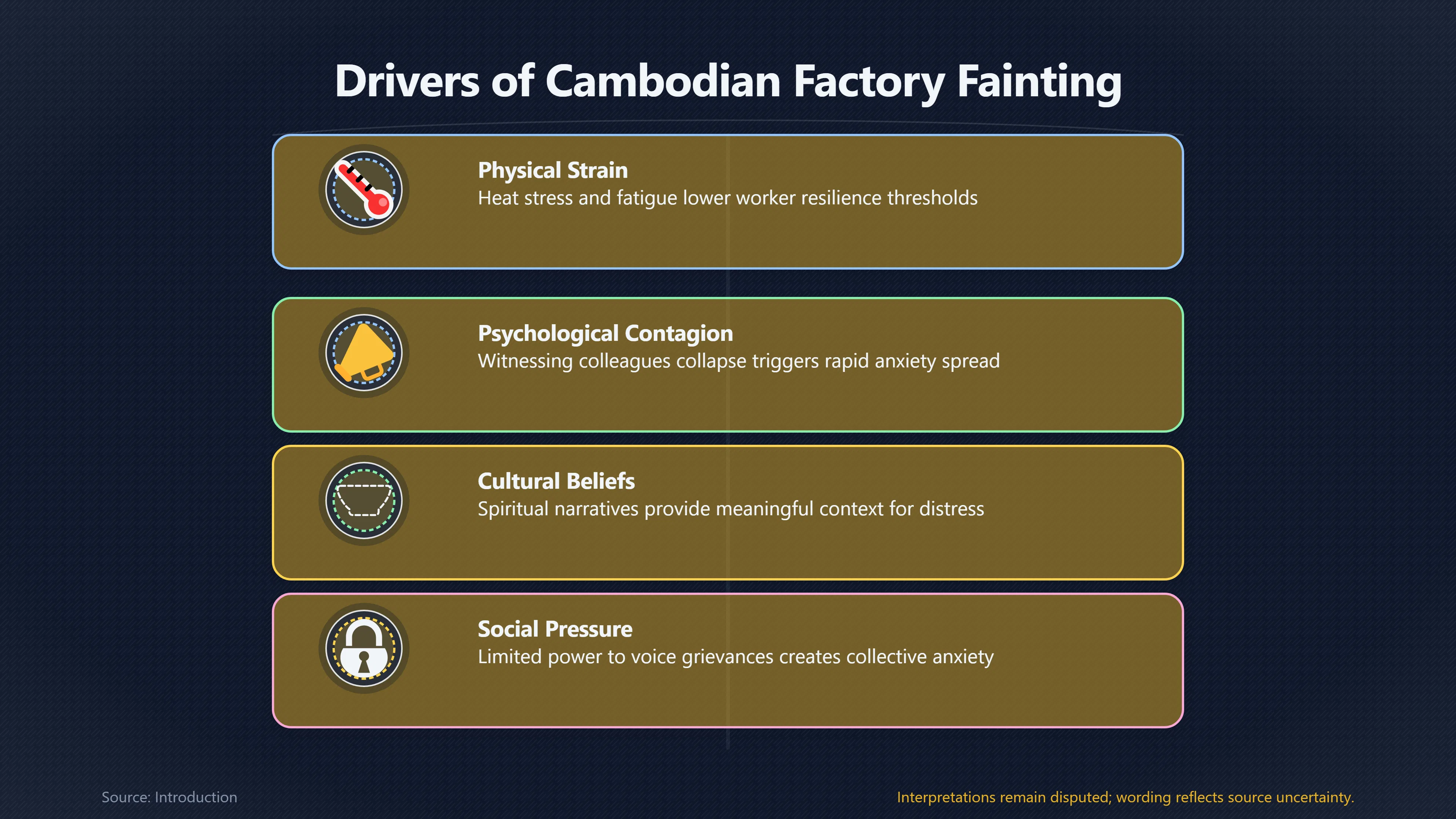
Rather than replacing physical explanations, psychological contagion appears to have amplified existing vulnerability. Researchers therefore describe the episodes as layered events in which:
- physical strain reduced the threshold for illness;
- fear and uncertainty heightened attention to symptoms;
- witnessing other workers collapse encouraged rapid spread through the workforce.
This interaction explains why outbreaks could grow rapidly even when no dangerous chemical or infectious disease was identified.[PubMed]pubmed.ncbi.nlm.nih.govPub Med Mass fainting in garment factories in CambodiaMass fainting in garment factories in Cambodia - PubMed…
Why spirit beliefs mattered to workers
One of the most distinctive features of Cambodia’s factory faintings is the role played by locally meaningful spiritual beliefs. These explanations were not simply colourful folklore added afterwards. For many workers they provided the most convincing account of why particular factories experienced repeated outbreaks.
Ethnographic research conducted between 2010 and 2015 found at least one mass fainting episode in 34 of 48 factories studied, with nine episodes explicitly linked to spirit-possession narratives. Workers, monks, health staff and managers described several recurring themes:
- factories built on former Khmer Rouge killing sites or places associated with violent death;
- guardian spirits angered because land had been disturbed;
- factories opened without appropriate rituals;
- fatal workplace accidents creating spiritually dangerous locations;
- dreams, unusual events or possession experiences interpreted as warnings before outbreaks.
Within these belief systems, fainting was not viewed as random illness but as evidence that relationships between people, land and spirits had become unbalanced. Ritual ceremonies performed by Buddhist monks or local religious specialists were therefore intended to restore harmony rather than replace medical treatment.[PubMed]pubmed.ncbi.nlm.nih.govPub Med Mass fainting in garment factories in CambodiaMass fainting in garment factories in Cambodia - PubMed…
These interpretations also reflected Cambodia’s wider historical landscape. Many industrial zones occupy land marked by civil war, forced displacement or Khmer Rouge violence. For some workers, memories of these histories remained embedded in particular places, making spiritual explanations socially meaningful rather than irrational anomalies.[Monash University]research.monash.eduUniversity Mass fainting in garment factories in CambodiaMonash UniversityMass fainting in garment factories in Cambodia - Monash University…
Were the faintings a form of protest?
Some researchers have suggested that mass fainting also functioned, consciously or unconsciously, as a way of expressing distress in workplaces where employees had limited power to challenge difficult conditions directly.
This interpretation does not claim that workers deliberately staged illness. Instead, it argues that genuine bodily symptoms developed within an environment characterised by:
- production targets and deadline pressure;
- insecure employment;
- limited opportunities to voice grievances safely;
- economic dependence on factory work;
- social inequalities between foreign management and local employees.
Ethnographic studies found that workers themselves often linked outbreaks with broader tensions inside factories, while some scholars interpret the episodes as expressions of collective anxiety or protest that emerged through culturally familiar forms rather than organised industrial action. The evidence suggests this social dimension may have operated alongside, rather than instead of, physiological and psychological mechanisms.[PMC]pmc.ncbi.nlm.nih.govOpen source on nih.gov.
How factories and public health officials responded
As the outbreaks became more frequent, Cambodian authorities, factory owners, labour organisations and international partners increasingly treated fainting as a workplace welfare issue rather than dismissing it as simple superstition.
The International Labour Organization’s Better Factories Cambodia programme launched its “One Change” campaign in 2012, encouraging factories to adopt practical improvements that could reduce known risk factors. Suggested measures included:
- improving worker nutrition;
- reducing heat stress;
- improving hygiene;
- strengthening communication between workers and supervisors;
- training staff in appropriate responses when fainting occurred;
- introducing exercise breaks to reduce fatigue and monotony.
The programme deliberately recognised that fainting could involve multiple interacting causes rather than assuming one universal explanation. Its emphasis was on prevention through healthier working conditions while acknowledging the importance of workers’ own cultural understandings of illness.[Better Work]betterwork.orgBetter WorkBetter Factories Cambodia "One Change" Campaign Helps to Address Fainting Challenges - Better WorkMarch 12, 2013…
Researchers studying the phenomenon have likewise argued that culturally responsive public health works better than approaches that ridicule spiritual beliefs. When workers believe that spirits are involved, respectful engagement with those beliefs can improve trust while medical staff simultaneously investigate environmental hazards, nutrition and occupational health.[PubMed]pubmed.ncbi.nlm.nih.govPutting the Spirit into Culturally Responsive Public Health: Explaining Mass Fainting in Cambodia - PubMed…

Why the factory faintings remain important
Cambodia’s garment factory outbreaks are now among the best documented modern examples of contagious workplace distress anywhere in the world. They demonstrate that collective illness cannot always be separated neatly into physical, psychological or cultural categories.
The strongest evidence suggests that these episodes emerged from several interacting forces:
- demanding industrial working conditions;[feliciaray.com]feliciaray.comBill Clinton set out to alleviate harsh working conditions in Cambodia’s factorDecades After Nike Promised Sweatshop Reforms, Workers in This Factory Were Still Fainting | Felicia Ray OwensMay 1, 2025 — Media reports…
- heat, fatigue and nutritional stress;
- fear spreading through closely connected groups;
- culturally meaningful interpretations involving spirits and sacred places;
- wider memories of violence, displacement and contested land;
- unequal workplace relationships that heightened anxiety.
For historians, psychologists, anthropologists and occupational health specialists, the Cambodian cases illustrate why apparently strange episodes deserve careful investigation rather than dismissal. They show that people experiencing mass psychogenic illness suffer genuine symptoms, even when no single poison, infection or mechanical fault explains the pattern. At the same time, they remind us that local beliefs are not merely decorative background but part of how communities understand distress, organise responses and make sense of events that would otherwise appear inexplicable.[nih.gov]pubmed.ncbi.nlm.nih.govPub Med Mass fainting in garment factories in CambodiaMass fainting in garment factories in Cambodia - PubMed…
Amazon book picks
Further Reading
Books and field guides related to Why Did Cambodian Factory Workers Faint Together?. Use these as the next step if you want deeper reading beyond the article.


The Spirit Catches You and You Fall Down
Helps explain differing interpretations of illness and possession.

Endnotes
1.
Source: research.monash.edu
Title: University Mass fainting in garment factories in Cambodia
Link:https://research.monash.edu/en/publications/mass-fainting-in-garment-factories-in-cambodia/
Source snippet
Monash UniversityMass fainting in garment factories in Cambodia - Monash University...
2.
Source: pmc.ncbi.nlm.nih.gov
Link:https://pmc.ncbi.nlm.nih.gov/articles/PMC6338711/
3.
Source: research.monash.edu
Title: putting the spirit into culturally responsive public health expla
Link:https://research.monash.edu/en/publications/putting-the-spirit-into-culturally-responsive-public-health-expla
5.
Source: pubmed.ncbi.nlm.nih.gov
Title: Pub Med Mass fainting in garment factories in Cambodia
Link:https://pubmed.ncbi.nlm.nih.gov/28398195/
Source snippet
Mass fainting in garment factories in Cambodia - PubMed...
6.
Source: betterwork.org
Link:https://betterwork.org/better-factories-cambodia-one-change-campaign-helps-to-address-fainting-challenges/
Source snippet
Better WorkBetter Factories Cambodia "One Change" Campaign Helps to Address Fainting Challenges - Better WorkMarch 12, 2013...
Published: March 12, 2013
7.
Source: pubmed.ncbi.nlm.nih.gov
Link:https://pubmed.ncbi.nlm.nih.gov/29956053/
Source snippet
Putting the Spirit into Culturally Responsive Public Health: Explaining Mass Fainting in Cambodia - PubMed...
8.
Source: feliciaray.com
Title: Bill Clinton set out to alleviate harsh working conditions in Cambodia’s factor
Link:https://feliciaray.com/decades-after-nike-promised-sweatshop-reforms-workers-in-this-factory-were-still-fainting/
Source snippet
Decades After Nike Promised Sweatshop Reforms, Workers in This Factory Were Still Fainting | Felicia Ray OwensMay 1, 2025 — Media reports...
Published: May 1, 2025
9.
Source: betterwork.org
Link:https://www.betterwork.org/cambodia/
Additional References
10.
Source: link.springer.com
Link:https://link.springer.com/article/10.1007/s10943
Source snippet
Putting the Spirit into Culturally Responsive Public Health: Explaining Mass Fainting in Cambodia | Journal of Religion and Healt...
11.
Source: ilo.org
Title: International Labour Organization Better Factories of Cambodia
Link:https://www.ilo.org/resource/project-document/better-factories-cambodia-midterm-cluster-evaluation
Source snippet
International Labour OrganizationBetter Factories of Cambodia - Midterm Cluster Evaluation | International Labour Organization...
12.
Source: propublica.org
Title: nike factory cambodia fainting
Link:https://www.propublica.org/article/nike-factory-cambodia-fainting
Source snippet
Workers Fainted at Nike Clothing Factory Despite a Vow to Reform — ProPublicaMay 1, 2025 — Workers have fainted for years inside Cambodia...
Published: May 1, 2025
13.
Source: sciencedirect.com
Title: ScienceDirect Mass fainting in Cambodian garment factories
Link:https://www.sciencedirect.com/science/article/pii/S2590113319300082
Source snippet
Mass fainting in Cambodian garment factories - ScienceDirect...
14.
Source: youtube.com
Title: VICE News Daily: Beyond The Headlines
Link:https://www.youtube.com/watch?v=nh5WcKHL02A
Source snippet
Worker's Information Centre - Supporting garment workers in Cambodia...
Published: April 4, 2014
15.
Source: researchgate.net
Link:https://www.researchgate.net/publication/326043075_Putting_the_Spirit_into_Culturally_Responsive_Public_Health_Explaining_Mass_Fainting_in_Cambodia
16.
Source: theguardian.com
Link:https://www.theguardian.com/business/2017/jun/25/female-cambodian-garment-workers-mass-fainting
17.
Source: khmerization.blogspot.com
Link:https://khmerization.blogspot.com/2012/07/ilo-better-factories-cambodia-announces.html
18.
Source: readkong.com
Link:https://www.readkong.com/page/pioneering-a-new-approach-to-improving-working-conditions-3212842
19.
Source: youtube.com
Title: On Mass Hysteria by Laia Abril
Link:https://www.youtube.com/watch?v=3rKUyWX49y4
Source snippet
Marijuana laws, spirits cause mass hysteria, moto madness! #ForRiel...
Topic Tree