Within Palau Beliefs
Why Did Japan Fear Modekngei?
Japanese officials repeatedly arrested Modekngei leaders because independent worship and loyalty networks appeared politically dangerous.
On this page
- Arrests and interrogations under Japanese rule
- How religious gatherings became political suspicions
- Resistance, nationalism and the limits of colonial records
Page outline Jump by section
Introduction
Japanese colonial officials did not suppress Modekngei simply because it was an unfamiliar religion. Their concern was that an independent religious movement with its own leaders, meeting places and networks of loyalty might become a focus for political resistance in Japanese-ruled Palau. Although later writers sometimes described Modekngei as an anti-colonial movement, the historical evidence is more complicated. Colonial authorities repeatedly arrested leaders, interrogated followers and disrupted gatherings because they viewed the movement as a potential security problem, even though historians disagree over whether it was actually organised for political resistance.[illinois.edu]libsysdigi.library.illinois.eduLibrary Systems Digital Collections LI E) R.A FLY OF THE UN IVERSITY or ILLI NOI5…

The episode illustrates a broader pattern found across colonial empires: governments often treated independent religious organisations as possible centres of opposition, especially when officials could not easily understand their beliefs, language or internal organisation. In Palau, this administrative suspicion shaped the history of Modekngei as much as the movement’s own teachings.
Why did Japanese officials become suspicious?
When Japan took control of Palau during the First World War, it sought to build an orderly colonial administration that closely supervised education, labour, public gatherings and political authority. Any organisation operating outside official structures attracted attention.
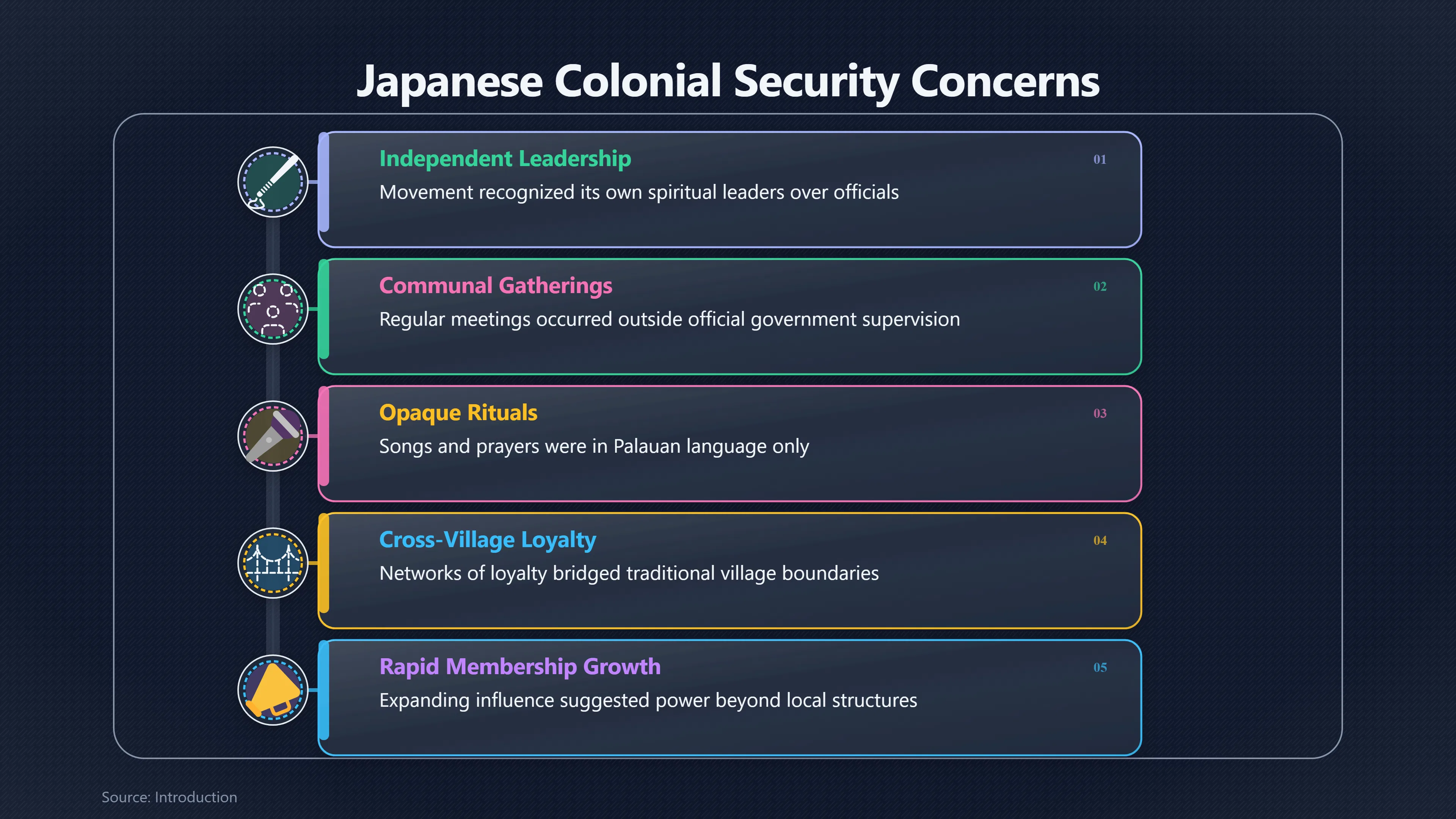
Modekngei presented several features that colonial officials considered potentially dangerous:
- it recognised its own respected religious leaders rather than colonial officials or missionaries;
- followers met regularly in communal gatherings;
- teachings were transmitted through songs, ritual and oral instruction that Japanese officials often could not understand;
- the movement strengthened networks of loyalty that crossed village boundaries.
None of these characteristics necessarily indicated political rebellion. Nevertheless, from the viewpoint of a colonial government determined to prevent unrest, they resembled the kinds of organisations that elsewhere had supported nationalist or millenarian resistance. Officials therefore tended to interpret religious independence through a security lens rather than a purely religious one.[ProQuest]proquest.comPro Quest Modekngei: A New Religion in Belau, MicronesiaModekngei: A New Religion in Belau, Micronesia - ProQuest…
Arrests and interrogations under Japanese rule
Historical accounts consistently report that Japanese authorities repeatedly intervened against Modekngei leaders during the interwar period.
Researchers describe arrests, imprisonment and intensive questioning of prominent figures connected with the movement. Some meeting places were destroyed or closed, while public religious activity came under close observation. A frequently cited summary by John Useem, later reproduced in studies of Palauan leadership, states that the Japanese administration regarded Modekngei as a threat, jailed leaders and razed meeting places in an effort to weaken the organisation. At the same time, Useem concluded that there is little evidence the movement mounted an effective organised resistance to Japanese colonial reforms.[Library Systems Digital Collections]libsysdigi.library.illinois.eduLibrary Systems Digital Collections LI E) R.A FLY OF THE UN IVERSITY or ILLI NOI5…
Oral histories collected decades later broadly support the picture of official repression. One Palauan elder recalled that the Japanese government prohibited Modekngei, that a relative who was a leader was sent into exile, and that officials did not understand what believers were saying during their prayers and songs. Such recollections provide valuable local perspectives, although, like all oral testimony, they reflect memories recorded long after the events themselves.[Minpaku Repository]minpaku.repo.nii.ac.jpMinpaku Repository Oral histories of Palauan eldersMinpaku RepositoryOral histories of Palauan eldersApril 18, 2026…
How religious gatherings became political suspicions
The Japanese administration was not necessarily reacting to evidence of an imminent uprising. Instead, officials often treated uncertainty itself as a security problem.
Several features of Modekngei contributed to official anxiety:
- Private meetings: Gatherings outside direct government supervision could be interpreted as secret political assemblies.
- Unfamiliar language: Ritual songs and prayers in Palauan were largely opaque to Japanese officials, making it difficult for them to distinguish ordinary worship from political discussion.
- Independent authority: Charismatic religious leaders commanded respect that did not depend upon colonial institutions.
- Rapid growth: Expanding membership suggested the movement possessed influence beyond traditional village structures.
Colonial governments frequently preferred organisations that could be monitored through recognised churches or official administrative hierarchies. Modekngei fit neither category, making surveillance more difficult and suspicion more likely.[ProQuest]proquest.comPro Quest Modekngei: A New Religion in Belau, MicronesiaModekngei: A New Religion in Belau, Micronesia - ProQuest…
Was Modekngei really an anti-colonial movement?
This remains one of the principal historical debates.
Earlier scholarship often interpreted Modekngei primarily as a form of non-violent resistance against Japanese rule. That interpretation was influenced partly by the obvious fact that colonial authorities repeatedly suppressed the movement, encouraging later observers to assume it must have been politically organised.[Wikipedia]WikipediaOpen source on wikipedia.org.
More recent work by anthropologist Machiko Aoyagi challenges that simple narrative. Drawing on extensive interviews with Palauan followers and detailed analysis of Modekngei hymns and theology, she argues that the movement should first be understood as a genuine religion rather than a political organisation disguised as one. According to Aoyagi, its earliest development was driven primarily by spiritual concerns and efforts to integrate Palauan traditions with Christian ideas, not by a programme of anti-Japanese activism.[ProQuest]proquest.comPro Quest Modekngei: A New Religion in Belau, MicronesiaModekngei: A New Religion in Belau, Micronesia - ProQuest…
These interpretations are not completely incompatible. A movement may begin with religious aims yet still acquire political significance when colonial authorities treat it as a threat. Suppression itself can strengthen a group’s symbolic association with cultural independence.
Resistance, nationalism and the limits of the colonial record
Much of the surviving written evidence comes from colonial officials, missionaries and later outside researchers. Each source reflects particular priorities.
Colonial reports naturally focused on maintaining public order and therefore tended to describe organisations in terms of administrative risk. Missionary accounts sometimes viewed Modekngei as a religious rival. Oral histories, meanwhile, often emphasise injustice experienced by believers and preserve memories absent from official archives. Historians therefore compare multiple kinds of evidence rather than relying exclusively on any single record.[proquest.com]proquest.comPro Quest Modekngei: A New Religion in Belau, MicronesiaModekngei: A New Religion in Belau, Micronesia - ProQuest…
This imbalance also explains why it is difficult to determine precisely how many arrests occurred or exactly what Japanese investigators believed at different moments. The available evidence demonstrates repeated suppression, but it does not always reveal whether individual officials genuinely expected rebellion or were acting according to broader colonial policies that treated independent social organisations as inherently suspect.
Why the episode still matters
The Japanese suppression of Modekngei is significant less because it documents a failed rebellion than because it shows how colonial governments could transform unfamiliar religious movements into perceived security threats.
Modern scholarship generally avoids describing Modekngei simply as a “cult” or as an anti-colonial conspiracy. Instead, it is increasingly understood as an indigenous Palauan religion whose independent organisation made colonial authorities uneasy. The repeated arrests, interrogations and restrictions reveal more about the anxieties of colonial rule than about any proven revolutionary programme.
Within Palau’s history, the episode therefore stands as an example of how political suspicion can reshape the treatment of minority religious movements. Rather than demonstrating a classic case of mass hysteria, it illustrates a colonial security scare in which administrative fear, limited cultural understanding and concerns over independent authority combined to produce sustained official repression.[proquest.com]proquest.comPro Quest Modekngei: A New Religion in Belau, MicronesiaModekngei: A New Religion in Belau, Micronesia - ProQuest…

Amazon book picks
Further Reading
Books and field guides related to Why Did Japan Fear Modekngei?. Use these as the next step if you want deeper reading beyond the article.

The anthropology of religion, magic, and witchcraft
Explains official reactions to unfamiliar religions.

Endnotes
1.
Source: proquest.com
Title: Pro Quest Modekngei: A New Religion in Belau, Micronesia
Link:https://www.proquest.com/scholarly-journals/modekngei-new-religion-belau-micronesia/docview/201679283/se-2
Source snippet
Modekngei: A New Religion in Belau, Micronesia - ProQuest...
2.
Source: Wikipedia
Link:https://en.wikipedia.org/wiki/Modekngei
3.
Source: youtube.com
Link:https://www.youtube.com/watch?v=XJSbtydSiAo
Source snippet
Modekngei | Wikipedia audio article...
4.
Source: youtube.com
Title: Modekngei | Wikipedia audio article
Link:https://www.youtube.com/watch?v=SG6YRFc_dWw
Source snippet
Japan's Forgotten Micronesian Colonies...
5.
Source: libsysdigi.library.illinois.edu
Title: Library Systems Digital Collections L
Link:https://libsysdigi.library.illinois.edu/oca/Books2008-08/leadershipcultur501forc/leadershipcultur501forc.pdf
Source snippet
I E) R.A FLY OF THE UN IVERSITY or ILLI NOI5...
6.
Source: minpaku.repo.nii.ac.jp
Title: Minpaku Repository Oral histories of Palauan elders
Link:https://minpaku.repo.nii.ac.jp/record/1116/files/SER87_002.pdf
Source snippet
Minpaku RepositoryOral histories of Palauan eldersApril 18, 2026...
Published: April 18, 2026
7.
Source: minpaku.repo.nii.ac.jp
Link:https://minpaku.repo.nii.ac.jp/records/3266
8.
Source: religion.fandom.com
Link:https://religion.fandom.com/wiki/Modekngei
Additional References
9.
Source: jstage.jst.go.jp
Link:https://www.jstage.jst.go.jp/article/jahss/7/2/7_79/_article/-char/en
Source snippet
of Nationality and Human Insecurity: A Case Study on the Securitised Japanese Nationality of Koreans during the Colonial EraAugust 28, 20...
10.
Source: jstage.jst.go.jp
Title: jst.go.jp Japanese Journal of Cultural Anthropology
Link:https://www.jstage.jst.go.jp/browse/jjcanth/81/2/_contents/-char/en
Source snippet
Journal of Cultural AnthropologyFebruary 23, 2018 — (View PDF for the rest of the abstract) View full abstract Download PDF (1424K) Speci...
Published: February 23, 2018
11.
Source: scribd.com
Title: Lost Histories Recovering The Lives of Japan’s Col
Link:https://www.scribd.com/document/992413925/Lost-Histories-Recovering-the-Lives-of-Japan-s-Col-Part-II
Source snippet
(Part II) | PDF | MicronesiaJanuary 1, 2019 — he wrote he could not help but feel concerned.163 Kitamura lamented that Ngiraked’s pitiful...
Published: January 1, 2019
12.
Source: cambridge.org
Link:https://www.cambridge.org/core/journals/asia-pacific-journal/article/reconsidering-the-passage-of-the-1925-peace-preservation-law-at-its-centennial/B4F9F3E74832FBD90400A795AF28D5E0
Source snippet
Reconsidering the Passage of the 1925 Peace Preservation Law at its Centennial | Asia-Pacific Journal | Cambridge CoreJune 17, 2025 — REC...
Published: June 17, 2025
13.
Source: worldatlas.com
Title: Religious Beliefs In Palau
Link:https://www.worldatlas.com/articles/religious-beliefs-in-palau.html
Source snippet
Editorial credit: photosounds / Shutterstock.com. A small church in Palau. Editorial credit: photosounds / Shutterstock.com. The island na...
14.
Source: palau.emb-japan.go.jp
Link:https://www.palau.emb-japan.go.jp/bilateral/history_j.htm
15.
Source: jstage.jst.go.jp
Link:https://www.jstage.jst.go.jp/article/kyoyobukiyo/47/0/47_17/_article/-char/en
16.
Source: ndlsearch.ndl.go.jp
Link:https://ndlsearch.ndl.go.jp/books/R000000004-I9770247
17.
Source: cir.nii.ac.jp
Link:https://cir.nii.ac.jp/crid/1390282680781758080?lang=en
18.
Source: cir.nii.ac.jp
Link:https://cir.nii.ac.jp/crid/1390572174773874304?lang=en
Topic Tree