Within Georgia
How the Gldani Attack Unleashed Wider Violence
The Gldani assault began a wider campaign in which minority Christians were beaten, raided and denied effective police protection.
On this page
- The 1999 raid and its victims
- How attacks spread across Georgia
- Why police inaction mattered
Page outline Jump by section
Introduction
The Gldani attacks were the turning point in Georgia’s most serious modern campaign of anti-religious violence. Beginning with the assault on a peaceful Jehovah’s Witness meeting in the Tbilisi district of Gldani on 17 October 1999, the attacks evolved into a nationwide pattern of raids, beatings, intimidation and destruction of religious literature directed at minority Christian communities. Although the violence was carried out by organised groups led by the defrocked Orthodox priest Basili (Vasili) Mkalavishvili and later by other militants, the campaign became especially significant because police and prosecutors repeatedly failed to intervene or hold perpetrators accountable. Human rights organisations and later the European Court of Human Rights concluded that official inaction allowed a local assault to become a broader episode of religious persecution fuelled by fears of supposedly dangerous “sects”.[Human Rights Watch]hrw.orgHuman Rights WatchMemorandum to the U.S. Government on Religious Violence in the Republic of Georgia | Human Rights WatchAugust 28, 2001…
The 1999 raid and its victims
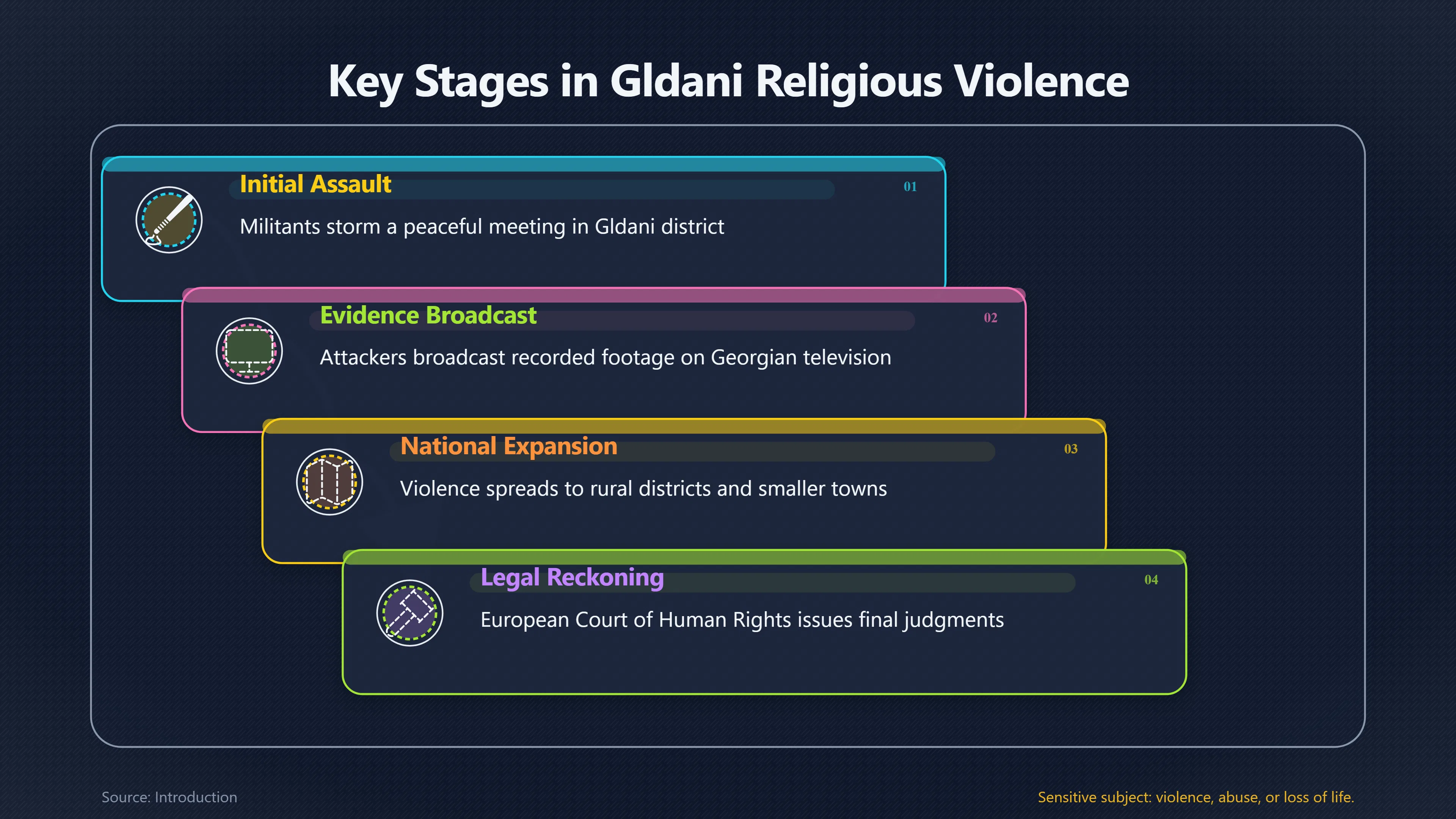
The attack began during a Jehovah’s Witness religious meeting attended by around 120 worshippers in Gldani, a northern district of Tbilisi. Witnesses described a large group of followers of Basili Mkalavishvili storming the gathering armed with sticks and other improvised weapons. Worshippers were beaten, chased and threatened, while religious publications were destroyed. At least sixteen people required hospital treatment, several with serious injuries. Video footage recorded by the attackers themselves was later broadcast by Georgian television and became important evidence that the violence had been organised rather than spontaneous.[Human Rights Watch]hrw.orgHuman Rights WatchGeorgia Lets Attacks on Religious Believers Go Unpunished | Human Rights WatchSeptember 5, 2000…
The victims belonged primarily to the Jehovah’s Witnesses, but the incident immediately acquired wider symbolic importance. Campaigners against minority religions had already portrayed Jehovah’s Witnesses as an alien “sect” undermining Georgian traditions. The Gldani assault transformed this hostile rhetoric into direct physical violence that could be repeated elsewhere with little apparent risk of punishment.[Human Rights Watch]hrw.orgHuman Rights WatchMemorandum to the U.S. Government on Religious Violence in the Republic of Georgia | Human Rights WatchAugust 28, 2001…
A particularly controversial aspect of the aftermath was the judicial response. Rather than focusing on those who organised the assault, prosecutors brought criminal charges against two of the victims, while those responsible for the attack escaped meaningful accountability. Human Rights Watch described this reversal of victim and offender as one of the clearest signs that the justice system was failing to protect religious freedom.[Human Rights Watch]hrw.orgHuman Rights WatchGeorgia Lets Attacks on Religious Believers Go Unpunished | Human Rights WatchSeptember 5, 2000…
How attacks spread across Georgia
The Gldani raid proved to be the beginning rather than the end of the violence. Between 1999 and 2004, dozens of attacks targeted Jehovah’s Witnesses, Baptists, Pentecostals, Hare Krishna devotees and other minority religious communities. Many incidents followed a recognisable pattern:
- Religious meetings were interrupted by organised mobs.
- Worshippers were beaten or publicly humiliated.
- Religious books and literature were confiscated or burned.
- Journalists and human rights observers covering the attacks were themselves assaulted.
- Threats discouraged minority congregations from meeting openly.
Human Rights Watch documented a sharp increase in incidents after early 2001, noting that violence spread well beyond Tbilisi into smaller towns and rural districts. While Mkalavishvili’s followers remained responsible for many attacks, similar tactics were increasingly adopted by other nationalist groups, local clergy and even neighbours who had absorbed the language of the anti-sect campaign.[Human Rights Watch]hrw.orgHuman Rights WatchMemorandum to the U.S. Government on Religious Violence in the Republic of Georgia | Human Rights WatchAugust 28, 2001…
The campaign therefore became more than the work of one charismatic extremist. It evolved into a broader social movement in which rumours about destructive “sects” encouraged local communities to view minority believers as legitimate targets rather than fellow citizens exercising legal rights.

Why police inaction mattered
The violence became a national crisis largely because many attacks occurred in front of police officers who failed to intervene. Human Rights Watch documented numerous examples in which officers stood aside while assaults took place, refused to register complaints or, in some cases, appeared to assist attackers.
One documented incident involved police allegedly opening the gate to private property before an attacking mob entered. In other cases, officers dispersed minority religious meetings themselves or confiscated religious literature instead of protecting those under attack. These actions blurred the distinction between state authority and vigilante violence.[Human Rights Watch]hrw.orgHuman Rights WatchMemorandum to the U.S. Government on Religious Violence in the Republic of Georgia | Human Rights WatchAugust 28, 2001…
The atmosphere of impunity also encouraged attacks beyond religious gatherings. Journalists reporting on trials involving Mkalavishvili’s supporters were beaten, human rights defenders monitoring proceedings were assaulted outside court buildings, and lawyers representing victims faced intimidation. Court security personnel frequently failed to intervene despite violence occurring within or immediately outside judicial institutions.[Human Rights Watch]hrw.orgHuman Rights WatchGeorgia Lets Attacks on Religious Believers Go Unpunished | Human Rights WatchSeptember 5, 2000…
This pattern mattered because it signalled that violence against unpopular religious minorities would not necessarily attract criminal consequences. Rather than isolated failures, investigators increasingly identified a systemic unwillingness to enforce existing laws protecting freedom of religion.
The moral panic behind the violence
The Gldani attacks are widely studied as an example of religious moral panic rather than evidence that minority religious groups posed a genuine public threat.
Several factors reinforced one another:
- National identity: Following the collapse of the Soviet Union, Orthodox Christianity became closely associated with Georgian national identity.
- Fear of foreign influence: Minority churches with international links were portrayed as foreign organisations seeking to weaken Georgia.
- Hostile media and political rhetoric: Campaigns against “sects” frequently relied on claims of brainwashing, family destruction or hidden political agendas without substantiated evidence.
- Weak institutions: Police, prosecutors and courts often proved unwilling or unable to restrain organised violence.
Importantly, the panic did not arise because secret criminal activity by minority churches had been uncovered. Instead, investigators found that ordinary religious practices—holding meetings, distributing literature and evangelising—were increasingly reinterpreted through a lens of suspicion. The label “sect” became a powerful political and cultural accusation that justified exclusion in the minds of many participants.[Human Rights Watch]hrw.orgHuman Rights WatchMemorandum to the U.S. Government on Religious Violence in the Republic of Georgia | Human Rights WatchAugust 28, 2001…

Legal accountability and later significance
Pressure from Georgian human rights organisations, international observers, the Council of Europe and foreign governments gradually increased. Over time, the Georgian authorities began taking stronger action against those responsible, and the most intense period of organised mob violence subsided after 2003–2004.
The longer legal reckoning continued through the European Court of Human Rights. In cases arising from the Gldani attack, the Court found that Georgia had violated fundamental rights by failing to protect worshippers from religiously motivated violence and by failing to conduct effective investigations. The judgments reinforced the principle that governments are responsible not only for avoiding direct persecution but also for protecting minorities against organised private violence when authorities know such attacks are occurring.[JW.ORG]jw.orgECH R Accepts Georgia’s Admission of Human Rights ViolationsECH R Accepts Georgia’s Admission of Human Rights Violations
Today, the Gldani attacks remain the defining example of modern religious persecution in independent Georgia. They illustrate how rumours about dangerous “sects”, combined with institutional passivity, can transform prejudice into sustained campaigns of violence. Rather than representing spontaneous outbreaks of mass hysteria, they demonstrate how moral panic, nationalist rhetoric and failures of law enforcement can reinforce one another until discrimination becomes organised persecution.
Amazon book picks
Further Reading
Books and field guides related to How the Gldani Attack Unleashed Wider Violence. Use these as the next step if you want deeper reading beyond the article.

The Righteous Mind
First published 2012. Subjects: Political psychology, Social psychology, Ethics, Religious Psychology, nyt:combined-print-and-e-book-nonf...

Imagined communities
First published 1983. Subjects: Nationalism, History, Nationalisme, Nacionalismo, Histoire.

The Orthodox Church in the history of Russia
First published 1998. Subjects: Church history, History, Influence, Orthodox Eastern Church, Russkai︠a︡ pravoslavnai︠a︡ t︠s︡erkovʹ.

Moral panics
First published 1998. Subjects: Public opinion, Deviant behavior in mass media, Social problems in mass media, Social problems, Deviant b...
Endnotes
1.
Source: jw.org
Title: ECH R Accepts Georgia’s Admission of Human Rights Violations
Link:https://www.jw.org/en/news/region/georgia/human-rights-violations-case/
2.
Source: jw.org
Title: The European Court of Human Rights Accepts Georgia’s Admission of Guilt
Link:https://www.jw.org/en/news/region/georgia/echr-accepts-georgias-admission-of-guilt/
Source snippet
October 24, 2017 — THE EUROPEAN COURT OF HUMAN RIGHTS ACCEPTS GEORGIA’S ADMISSION OF GUILT English The European Court of Human Rights Acc...
Published: October 24, 2017
3.
Source: jw.org
Title: Victims of Violence Vindicated
Link:https://www.jw.org/en/library/magazines/wp20080301/Victims-of-Violence-Vindicated/
Source snippet
March 1, 2008 — VICTIMS OF VIOLENCE VINDICATED English Victims of Violence Vindicated /assets/ct/a63ae92c98/images/syn_placeholder_sqr.pn...
Published: March 1, 2008
4.
Source: jw.org
Title: Article 10 states
Link:https://www.jw.org/en/library/magazines/g20020122/Religious-Persecution-in-Georgia-How-Much-Longer/
Source snippet
Religious Persecution in Georgia—How Much Longer?January 22, 2002 — On May 20, 1999, Georgia adopted the European Convention for the Prot...
Published: January 22, 2002
5.
Source: hrw.org
Link:https://www.hrw.org/news/2001/08/28/memorandum-us-government-religious-violence-republic-georgia
Source snippet
Human Rights WatchMemorandum to the U.S. Government on Religious Violence in the Republic of Georgia | Human Rights WatchAugust 28, 2001...
Published: August 28, 2001
6.
Source: hrw.org
Link:https://www.hrw.org/legacy/wr2k1/europe/georgia.html
Source snippet
Human Rights Watch World Report 2001: Georgia:Human Rights DevelopmentsThe police and other authorities actively participated in some of...
7.
Source: hrw.org
Link:https://www.hrw.org/news/2000/09/05/georgia-lets-attacks-religious-believers-go-unpunished-0
Source snippet
Human Rights WatchGeorgia Lets Attacks on Religious Believers Go Unpunished | Human Rights WatchSeptember 5, 2000...
Published: September 5, 2000
8.
Source: hrw.org
Title: georgia memo full
Link:https://www.hrw.org/legacy/backgrounder/eca/georgia/georgia_memo_full.htm
Source snippet
Government on Religious Violence in the Republic of Georgia (Human Rights Watch August 2001)August 29, 2001 — Memorandum to the U.S. Gove...
Published: August 29, 2001
9.
Source: hrw.org
Link:https://www.hrw.org/news/2000/09/05/georgia-lets-attacks-religious-believers-go-unpunished
Source snippet
Human Rights WatchGeorgia Lets Attacks on Religious Believers Go Unpunished | Human Rights WatchSeptember 5, 2000...
Published: September 5, 2000
10.
Source: hrw.org
Title: “Georgian authorities have indulged the perpe
Link:https://www.hrw.org/news/2001/11/08/georgia-shevardnadze-must-end-religious-violence
Source snippet
Georgia: Shevardnadze Must End Religious Violence | Human Rights WatchNovember 8, 2001 — "This is a basic violation of freedom of religio...
Published: November 8, 2001
11.
Source: hrw.org
Link:https://www.hrw.org/legacy/wr2k2/europe9.html
Source snippet
Human Rights Watch World Report 2002: Europe & Central Asia: GeorgiaGEORGIA Image Image Human Rights Developments Image Image Defending H...
Additional References
12.
Source: csce.gov
Title: Unpunished Religious Persecution in the Republic of Georgia
Link:https://www.csce.gov/statements/unpunished-religious-persecution-republic-georgia/
Source snippet
President, as a member of the Commission on Security and Cooperation in Europe, I have followed closely human rights developments in the...
13.
Source: youtube.com
Title: Escaping Jehovah’s Witnesses: Inside the dangerous world of a brutal religion
Link:https://www.youtube.com/watch?v=gDwHdj7plWo
Source snippet
Buddhist Monks Confronted by Angry Christian Protesters...
14.
Source: youtube.com
Title: Interview with Georgian Prime Minister Lado Gurgenidze
Link:https://www.youtube.com/watch?v=-BMSjuRckqw
Source snippet
Escaping Jehovah's Witnesses: Inside the dangerous world of a brutal religion...
15.
Source: youtube.com
Title: Jehovah’s Witness material destroyed by religious group
Link:https://www.youtube.com/watch?v=P-Z_z4doe1Q
Source snippet
Malkhaz Songhulashvili // Малхаз Сонгулашвили...
16.
Source: youtube.com
Title: Malkhaz Songhulashvili // Малхаз Сонгулашвили
Link:https://www.youtube.com/watch?v=j-xaD372b_Q
Source snippet
Interview with Georgian Prime Minister Lado Gurgenidze...
17.
Source: youtube.com
Title: Buddhist Monks Confronted by Angry Christian Protesters
Link:https://www.youtube.com/watch?v=PyMHGm25wVk
Topic Tree