When Fear and Faith Swept Through Spain
Spains history of collective fear and contagious belief is not one continuous story of national mass hysteria.
Page outline Jump by section
Introduction
The most revealing Spanish cases also challenge familiar stereotypes. The Spanish Inquisition could be violently intolerant towards religious minorities, yet some of its officials became unusually sceptical about witchcraft evidence. Apparition movements were not simply outbreaks of credulity: they also expressed conflict over modernisation inside Catholicism. Media panics often began with genuine crimes or social problems, but then expanded beyond the available evidence. Spain therefore shows why mass hysteria is usually too crude a label. The better questions are who made a claim, how it travelled, which institutions validated or resisted it, and who suffered when fear hardened into certainty.
Witch panics and the limits of the Inquisition
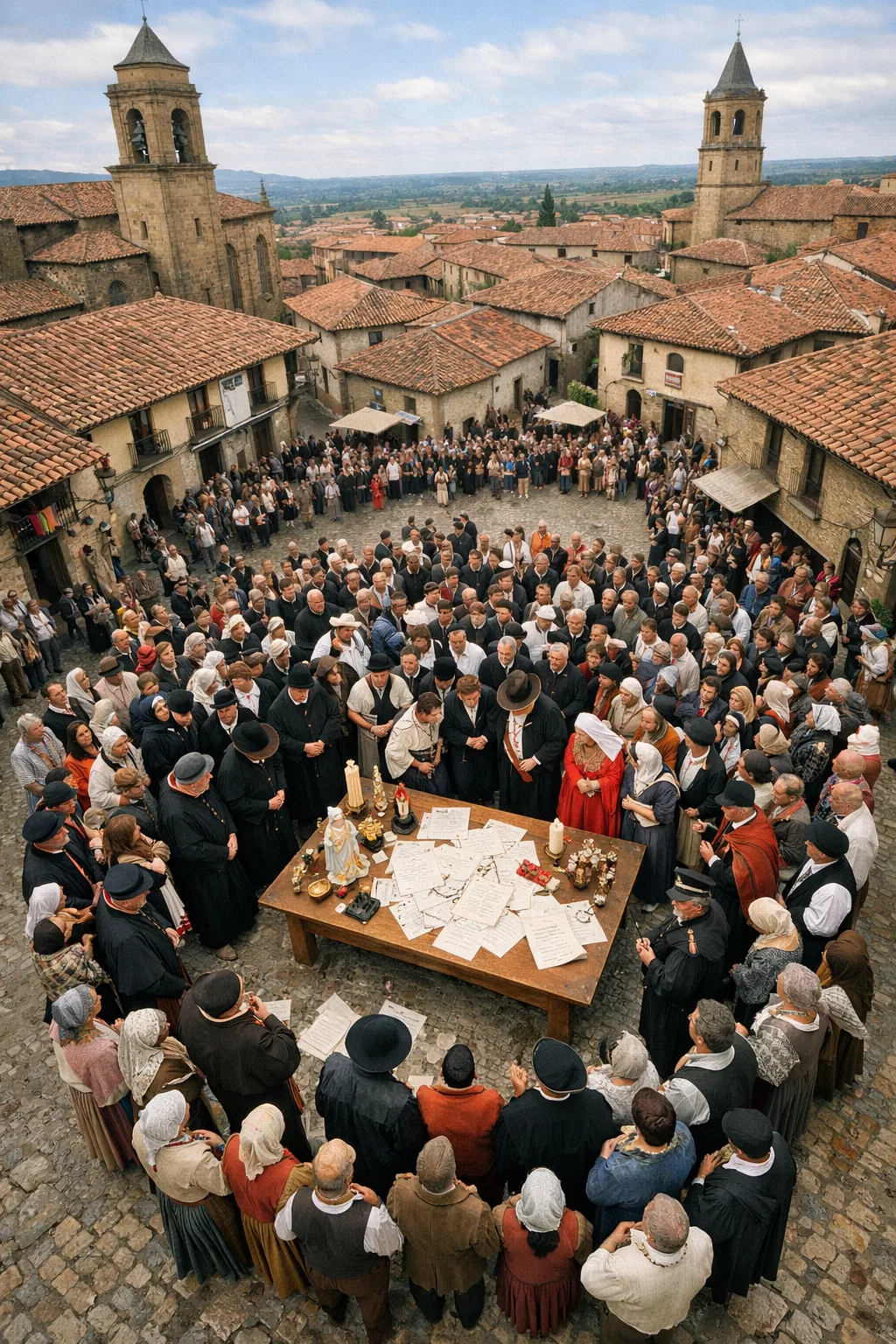
The best-known Spanish witch panic began near Zugarramurdi and Urdax in Navarre, close to the French border, in 1608. A young woman returning from the French Basque region spoke of nocturnal witch gatherings. Accusations multiplied through families and villages, while children denounced supposed abductors and neighbours confessed under communal pressure. The Inquisitions tribunal at Logroo eventually prosecuted a large group, and an elaborate public ceremony in 1610 presented the alleged conspiracy as a terrifying reality. Several defendants were executed, while others had already died in custody.[uam.es]repositorio.uam.esBiblos-e Archive Revising the Rules for Prosecuting Spanish WitchesBiblos-e ArchiveRevising the Rules for Prosecuting Spanish WitchesNovember 11, 2013 by JS Amelang Cited by 7 The witch hunt began i…
The accusations contained the familiar European imagery of the witch hunt: pacts with the Devil, magical flight, animal transformations, poisoned crops and secret assemblies. Yet the panic was also shaped by local conditions. It crossed a frontier where a severe witch hunt had recently taken place in France; stories moved between villages through preaching, gossip, interrogation and public confession. Once officials treated childrens claims and mutually reinforcing testimony as credible, the investigation generated further evidence for its own assumptions.[Biblos-e Archive]repositorio.uam.esBiblos-e Archive Revising the Rules for Prosecuting Spanish WitchesBiblos-e ArchiveRevising the Rules for Prosecuting Spanish WitchesNovember 11, 2013 by JS Amelang Cited by 7 The witch hunt began i…
What happened next makes the Spanish case unusual. Alonso de Salazar Fras, one of the inquisitors, travelled through the affected region and tested the allegations rather than merely collecting confessions. He compared statements, looked for physical proof and found that accounts contradicted one another. Substances said to be magical failed practical tests, while supposed journeys and gatherings could not be independently established. His conclusion was not that fearful villagers were lying in every instance, but that suggestion, preaching, interrogation and expectation had created a self-reinforcing persecution.[Brill]brill.comTHE SALAZAR DOCUMENTSthe Basque Witch Persecution. Basque witch persecution / edited by Gustav Henningsen. Includes bibliographical…
Salazars findings helped produce stricter rules in 1614. Accusations were to require corroboration, confessions were not to be accepted uncritically, and officials were warned against public discussion that might spread further claims. Historians often present these reforms as an early institutional recognition that witch panics could manufacture their own evidence. They did not make the Inquisition humane in any general sense, nor did they end all Spanish witchcraft prosecutions, but they greatly reduced the likelihood of another inquisitorial mass trial on the Basque model.[uam.es]repositorio.uam.esBiblos-e Archive Revising the Rules for Prosecuting Spanish WitchesBiblos-e ArchiveRevising the Rules for Prosecuting Spanish WitchesNovember 11, 2013 by JS Amelang Cited by 7 The witch hunt began i…
This relative restraint did not protect everyone. In Catalonia, many persecutions were conducted by local secular courts rather than by the Inquisition. During the intense hunts of the early seventeenth century, suspectsoverwhelmingly womenwere tortured and hanged after being blamed for storms, illness, livestock deaths and other misfortunes. The distribution of authority therefore mattered: central inquisitorial caution could be bypassed by local judges acting amid village pressure and economic distress.[smithsonianmag.com]smithsonianmag.comSmithsonian Magazine Spain's Centuries-Long Witch Hunt Killed 700 WomenSmithsonian Magazine Spain's Centuries-Long Witch Hunt Killed 700 Women
Catalonias parliament formally rehabilitated hundreds of people condemned for witchcraft in a 2022 resolution. The gesture reflected a modern interpretation of the hunts as gendered persecution and scapegoating rather than the discovery of a real supernatural conspiracy. It also corrected the misleading idea that Spain largely escaped the European witch craze. Large parts of the country saw fewer executions than some northern European regions, but Navarre and Catalonia experienced severe and locally devastating panics.[Smithsonian Magazine]smithsonianmag.comSmithsonian Magazine Spain's Centuries-Long Witch Hunt Killed 700 WomenSmithsonian Magazine Spain's Centuries-Long Witch Hunt Killed 700 Women
Apparitions in a changing Catholic country
Reported visions of the Virgin Mary have repeatedly attracted crowds in modern Spain, especially during periods when religious authority appeared threatened or uncertain. These episodes should not automatically be called frauds, delusions or mass psychogenic illness. An apparition claim may involve private religious experience, collective expectation, pilgrimage, commercial development, clerical conflict and political symbolism without producing a single shared hallucination.
At San Sebastin de Garabandal in Cantabria, four girls reported encounters with an angel and the Virgin Mary between 1961 and 1965. Visitors watched the girls enter apparent ecstatic states, walk through the village and deliver warnings about sin, punishment and a future miraculous sign. The events drew clergy, doctors, photographers and pilgrims, even though the local Catholic authorities did not authenticate the supernatural claims.[wikipedia.org]WikipediaGarabandal apparitionsGarabandal apparitions
Garabandal took place as the Second Vatican Council was transforming Catholic worship and the Churchs relationship with modern society. To supporters, the messages offered divine confirmation that repentance and traditional devotion remained urgent. To sceptics, the setting encouraged suggestion: a small group of adolescents, intense adult attention, repeated anticipation and a stream of visitors ready to interpret ambiguous behaviour as miraculous. The continuing pilgrimage tradition shows that official non-approval does not necessarily end belief; it can instead create a long-running culture of disputed evidence and promised future vindication.[ResearchGate]researchgate.netOpen source on researchgate.net.
A more consequential movement began at El Palmar de Troya in Andalusia in 1968, when four girls reported seeing a beautiful woman near a tree. Further visionaries appeared, crowds arrived and the site became a centre of conservative Catholic prophecy. Clemente Domnguez emerged as the leading figure, claiming messages that condemned the reforms associated with the Second Vatican Council and portrayed the mainstream Church as compromised by modernism.[jstor.org]jstor.orgOpen source on jstor.org.
The Palmarian movement eventually developed into an independent church with its own clergy, doctrines and papal succession. After the death of Pope Paul VI in 1978, Domnguez declared that he had been mystically chosen as pope. The group built a fortified religious complex and increasingly separated its members from ordinary Catholic life. Scholars describe this not simply as an apparition craze but as an organisation formed by the convergence of charismatic authority, anti-modern Catholic traditionalism, apocalyptic expectation and a network of patrons and pilgrims.[diva-portal.org]diva-portal.orgOpen source on diva-portal.org.
Calling the Palmarian Church a cult can obscure more than it explains unless the term is defined. Critics and former members have used it to emphasise authoritarian leadership, strict behavioural rules and social isolation. Religious-studies scholars more often describe it as a new religious movement or an independent traditionalist church, while still examining coercive practices and concentrated authority. The neutral language does not excuse harm; it prevents the label from replacing analysis.
Garabandal and El Palmar also demonstrate that authorities do not control belief merely by refusing approval. Official caution may limit institutional endorsement, but believers can create parallel channels of validation through testimony, photographs, relics, prophecy newsletters, pilgrimage networks and claims that scepticism itself fulfils the prediction that the visionaries will be persecuted.
Aliens by post: the Ummo affair
Spains most distinctive UFO belief system did not begin with a dramatic abduction or a publicly displayed spacecraft. It grew through documents. From the mid-1960s, Spanish UFO enthusiasts received typed letters said to come from inhabitants of a planet called Ummo. The texts discussed science, philosophy, politics, sexuality and the structure of an extraterrestrial society, often in a detailed, bureaucratic style.[encyclopedia.com]encyclopedia.comOpen source on encyclopedia.com.
The letters entered an existing Madrid contactee scene associated with Fernando Sesma and meetings of the Society of the Friends of Space. Their apparent technical sophistication made them more persuasive than a simple sighting report. Recipients could study, circulate and debate the documents, while every new instalment expanded the fictional world and answered objections raised by earlier material. In this sense, Ummo functioned less like a momentary panic than a collaborative mystery sustained through an information network.[Encyclopedia.com]encyclopedia.comOpen source on encyclopedia.com.
Photographs of a supposed craft at San Jos de Valderas in 1967 strengthened public interest, although investigators later identified major reasons to treat the material as fabricated. In the 1990s, Jos Luis Jordn Pea claimed responsibility for much of the deception. His confession did not settle every argument about authorship, but the known methods, manufactured evidence and dependence on a small social circle support the broad conclusion that Ummo was an elaborate hoax rather than evidence of extraterrestrial contact.[Ignacio Darnaude Rojas-Marcos.]ignaciodarnaude.esOpen source on ignaciodarnaude.es.
The affair survived exposure because it offered more than a testable claim about aliens. The documents supplied an alternative society from which readers could criticise nuclear danger, authoritarianism, religion and modern consumer life. Like many contactee movements, Ummo turned the imagined extraterrestrial into a moral observer of humanity. Disproof of individual photographs or authors therefore did not necessarily remove the cultural or spiritual appeal of the larger story.
Ummo is a useful warning against assuming that contagious belief always requires irrational crowds. It spread among educated enthusiasts through reading groups, correspondence and technical discussion. The weakness lay not in a lack of intelligence but in a closed evidential system: anonymous letters validated earlier letters, believers interpreted inconsistencies as security measures, and the sheer volume of detail was mistaken for independent proof.
Crime television and the Alcsser panic
The murders of Miriam Garca, Toi Gmez and Desire Hernndez, three teenagers from Alcsser in Valencia, were real crimes, not an invented danger. They disappeared in November 1992 while travelling to a nightclub, and their bodies were found 75 days later. Miguel Ricart was convicted; Antonio Angls remained a fugitive. The moral panic arose from how television and parts of the press transformed the case into a national spectacle about predatory strangers, teenage behaviour and hidden evil.[EL PAS English]english.elpais.comEL PAS English Makers of Netflix's 'Alcsser Murders': We saw that evil wasEL PAS English Makers of Netflix's 'Alcsser Murders': We saw that evil was
Television programmes broadcast from Alcsser, interviewed grieving relatives and neighbours, repeated disturbing forensic claims and competed for emotional immediacy. Boundaries between reporting, entertainment and participation in the investigation became dangerously blurred. The crime was presented not only as a specific attack but as evidence that ordinary public space had become unknowably threatening, particularly for adolescent girls.[emerald.com]emerald.comOpen source on emerald.com.
Rumours of additional perpetrators, powerful protection networks, ritual abuse and recorded snuff killings flourished alongside justified criticism of investigative errors. These theories were compelling partly because they converted procedural confusion into intentional concealment. Every missing document or disputed forensic detail could be interpreted as evidence of a larger conspiracy. Yet criticism of the police investigation and belief in a satanic or elite criminal network are not the same proposition; the first does not establish the second.
Feminist writer Nerea Barjola has argued that the media narrative operated as a form of sexual terror: the victims journey, clothing, nightlife and decision to hitchhike were repeatedly discussed in ways that warned other girls to restrict their movements. In this interpretation, the panic disciplined female freedom by presenting safety as a reward for obedience, even though responsibility lay with the offenders rather than with the victims presence in public space.[liberreview.com]liberreview.comOpen source on liberreview.com.
The Alcsser coverage helped change Spanish television. It became a lasting example of what can happen when grief is treated as content, speculation is broadcast before verification and the demand for revelation outpaces the available evidence. Later documentaries have revisited the case partly as crime history and partly as a study of the media system that grew around it.[us.es]idus.us.esOpen source on us.es.
Digital scares and new targets
Modern Spanish moral panics travel through a different media system, but their structure remains recognisable. A real event, such as an assault or neighbourhood conflict, is detached from its specific circumstances and presented as proof that an entire social group is dangerous. Emotionally charged claims circulate faster than corrections, while repeated exposure creates the impression of a widespread pattern even when the underlying evidence is weak.
Research published in 2025 examined Spanish disinformation that linked immigration with crime. Using a database of fact-checked hoaxes, the authors found that familiar moral-panic dynamics had moved into a digital environment: migrants were portrayed as a threatening group, isolated events were generalised, and misleading material was repeatedly adapted to current controversies. Social platforms did not invent the underlying fear, but they increased its speed, repetition and ability to move between political actors, influencers and ordinary users.[Springer]link.springer.comOpen source on springer.com.
Common false or distorted narratives have included miscaptioned videos, crimes assigned to migrants without evidence, fabricated government benefits and claims that authorities deliberately conceal offenders identities. European media-monitoring organisations documented a rise in such narratives in Spain during 2024. The immediate harm falls on migrants and racialised communities, but there is also a wider cost: police statements, statistics and legitimate reporting are treated as untrustworthy whenever they fail to confirm the panic.[EDMO]edmo.eudisinformation narratives on migration during the summer in spaindisinformation narratives on migration during the summer in spain
These scares are not purely imaginary responses to a problem-free society. Spain has real debates about housing, border management, labour, integration and public safety. A moral-panic analysis does not require denying those pressures. It asks whether claims are proportionate, whether individual offenders are treated as representatives of millions of people, and whether proposed responses address the actual problem or merely punish a symbolic enemy.
What Spains cases have in common
Spains witch trials, apparition movements, UFO correspondence and media scares differ too much to fit one diagnosis. Witch hunts involved judicial persecution. Garabandal was a disputed devotional movement. The Palmarian Church became an organised breakaway religion. Ummo was an extended hoax and belief network. Alcsser began with an atrocious crime but generated speculation far beyond the established facts. Anti-migrant disinformation combines political conflict with platform-driven repetition.
Several recurring mechanisms nevertheless connect them.
Uncertainty invites organised explanation. Failed crops, religious change, an unsolved element in a murder case or rapid demographic change creates demand for a story that identifies a hidden cause.
Authorities can amplify as well as suppress belief. Courts produced witch confessions; television legitimised rumour by broadcasting it; religious rejection sometimes strengthened a movements sense of persecution. Salazars investigation is memorable precisely because he interrupted this pattern by testing claims instead of counting accusations.
Children and women are repeatedly placed at the centre. Children appeared as visionaries, witnesses or accusers, while women were prosecuted as witches or warned through crime coverage to limit their behaviour. Their testimony could be romanticised, doubted, manipulated or used to support wider struggles over morality and authority.
Evidence becomes circular inside closed systems. Confessions confirm other confessions, anonymous letters authenticate previous letters, and official denial is treated as proof of conspiracy. The belief becomes harder to challenge because contrary information is reclassified as part of the threat.
Real suffering is easily obscured by spectacle. Witch suspects were tortured and killed; crime victims and their families were exposed to intrusive media; members of authoritarian religious groups may experience isolation; minorities targeted by rumours face harassment and discrimination. A humane history keeps those consequences in view rather than treating the episodes as collections of entertaining oddities.
Spains most important contribution to the history of collective fear may be the lesson associated with Salazar: repeated testimony is not necessarily independent evidence, especially when witnesses share stories, expectations and interrogators. That principle remains relevant well beyond witchcraft. It applies whenever institutions mistake circulation for confirmation and public intensity for proof.
Amazon book picks
Further Reading
Books and field guides related to When Fear and Faith Swept Through Spain. Use these as the next step if you want deeper reading beyond the article.
Extraordinary Popular Delusions and the Madness of Crowds
Rating: 4.0/5 from 5 Google Books ratings
Frames recurring episodes of mass belief and social contagion relevant to the article's themes.

The witch
Explains the evolution of witch beliefs and persecutions that illuminate the Spanish cases.
The Spanish Inquisition
Provides essential historical context for witch trials, religious authority, and skepticism in Spain.
The Basque
First published 1999. Subjects: History, Basques, Nonfiction, Geschichte, Nationalismus.
Endnotes
1.
Source: resolve.cambridge.org
Link:https://resolve.cambridge.org/core/services/aop-cambridge-core/content/view/8EBBFDAF851A2220D7E0E9A3063E57FA/9780511523434c12_p255-275_CBO.pdf/witchcraft_the_forgotten_offense.pdf
Source snippet
Cambridge University Press & AssessmentWitchcraft: the forgotten offenseJust as the Moriscos were being expelled, the most famous witchcr...
2.
Source: brill.com
Link:https://brill.com/edcollbook/title/8436?srsltid=AfmBOopw-rT0bYBtf5SctKdPwzZcbFxAll0hx61xNWI4X4KYE9DfrNoc
Source snippet
Inquisitor Alonso de Salazar Fras and Others on the...The abducters denounced by the "child-witches" were subjected to violence an...
3.
Source: brill.com
Link:https://brill.com/downloadpdf/edcollbook/title/8436.pdf?srsltid=AfmBOopheVvEB5A02riVnqNPJCwu_imjVlsPGyTengYzIGFNXd6iJ0sv
Source snippet
THE SALAZAR DOCUMENTSthe Basque Witch Persecution. Basque witch persecution / edited by Gustav Henningsen. Includes bibliographical...
4.
Source: brill.com
Title: B9789047404668 s011
Link:https://brill.com/display/book/edcoll/9789047404668/B9789047404668_s011.pdf?srsltid=AfmBOooujt4SggMB9EemyJDFAt0FtaY_asxHDnHamvMmjMOXKIfO4WCt
Source snippet
24. Map of Salazar's journey of visitation (WA). The...Salazar published the Edict of Grace in Santesteban set up his office for witc...
5.
Source: researchgate.net
Link:https://www.researchgate.net/publication/254958023_The_Salazar_Documents_Inquisitor_Alonso_de_Salazar_FrA-as_and_Others_on_the_Basque_Witch_Persecution_review
Source snippet
ResearchGate(PDF) The Salazar Documents: Inquisitor Alonso de...The Salazar Documents: Inquisitor Alonso de Salazar Fras and Others on...
6.
Source: resolve.cambridge.org
Title: the mediterranean inquisitions of early modern europe
Link:https://resolve.cambridge.org/core/services/aop-cambridge-core/content/view/965FBA0322E937A692A6B719A13F8334/9781139054843c16_p283-301_CBO.pdf/the-mediterranean-inquisitions-of-early-modern-europe.pdf
Source snippet
Cambridge University Press & AssessmentThe Mediterranean Inquisitions of early modern EuropeDespite occasional failures, as in Catalonia...
7.
Source: Wikipedia
Title: Witch trials in Catalonia
Link:https://en.wikipedia.org/wiki/Witch_trials_in_Catalonia
8.
Source: Wikipedia
Title: Garabandal apparitions
Link:https://en.wikipedia.org/wiki/Garabandal_apparitions
9.
Source: garabandal.org
Link:https://www.garabandal.org/story.shtml
10.
Source: researchgate.net
Link:https://www.researchgate.net/publication/326888639_The_awaited_miracle_reflections_of_Marian_apparitions_in_Garabandal_Spain
11.
Source: jstor.org
Link:https://www.jstor.org/stable/10.1525/nr.2013.17.2.40
12.
Source: uu.diva-portal.org
Link:https://uu.diva-portal.org/smash/record.jsf?pid=diva2%3A797229
13.
Source: diva-portal.org
Link:https://www.diva-portal.org/smash/record.jsf?pid=diva2%3A1098857
14.
Source: encyclopedia.com
Link:https://www.encyclopedia.com/science/encyclopedias-almanacs-transcripts-and-maps/ummo-hoax
15.
Source: Wikipedia
Link:https://en.wikipedia.org/wiki/Alc%C3%A0sser_Girls
16.
Source: emerald.com
Link:https://www.emerald.com/books/edited-volume/12888/chapter/83261200/Intersections-between-Journalistic-Documentary-and
17.
Source: citylights.com
Link:https://citylights.com/true-crime-strange-phenomena/sexist-microphysics-of-power-alcasser/
18.
Source: netflix.com
Link:https://www.netflix.com/title/80213115
19.
Source: link.springer.com
Link:https://link.springer.com/article/10.1007/s10610-025-09620-5
20.
Source: researchgate.net
Link:https://www.researchgate.net/publication/391160641_Disinformation_Linking_Migration_and_Crime_in_Spain_Classic_Moral_Panics_in_a_New_Digital_Ecosystem
21.
Source: edmo.eu
Title: disinformation narratives on migration during the summer in spain
Link:https://edmo.eu/publications/disinformation-narratives-on-migration-during-the-summer-in-spain/
22.
Source: Wikipedia
Title: Basque witch trials
Link:https://en.wikipedia.org/wiki/Basque_witch_trials
23.
Source: Wikipedia
Title: Mass psychogenic illness
Link:https://en.wikipedia.org/wiki/Mass_psychogenic_illness
24.
Source: Wikipedia
Title: List of mass panic cases
Link:https://en.wikipedia.org/wiki/List_of_mass_panic_cases
25.
Source: Wikipedia
Title: Alonso de Salazar Fras
Link:https://en.wikipedia.org/wiki/Alonso_de_Salazar_Fr%C3%ADas
26.
Source: Wikipedia
Title: Tanganyika laughter epidemic
Link:https://en.wikipedia.org/wiki/Tanganyika_laughter_epidemic
27.
Source: Wikipedia
Title: Palmarian Catholic Church
Link:https://en.wikipedia.org/wiki/Palmarian_Catholic_Church
28.
Source: Wikipedia
Title: Witch trials in Spain
Link:https://en.wikipedia.org/wiki/Witch_trials_in_Spain
29.
Source: cambridge.org
Link:https://www.cambridge.org/core/journals/the-british-journal-of-psychiatry/article/protean-nature-of-mass-sociogenic-illness/2BDC2262E104B8A33F3DD49773DA0D8B
30.
Source: cambridge.org
Link:https://www.cambridge.org/core/journals/revista-de-historia-economica-journal-of-iberian-and-latin-american-economic-history/article/numeracy-of-religious-minorities-in-spain-and-portugal-during-the-inquisition-era/F0B49AE7BA5AFA17406F3A6C734EA949
31.
Source: cambridge.org
Link:https://www.cambridge.org/core/books/women-who-threw-corn/magic-in-the-1520s-and-1530s/5FA0488E3ECA77C9CC7CE6358C8D4F5C
32.
Source: cambridge.org
Link:https://www.cambridge.org/core/books/mercenaries-of-knowledge/growing-up-under-the-pax-hispanica/582045EB33910067CD51D0EBAC44B47A
33.
Source: assets.cambridge.org
Title: 9781107031166 index
Link:https://assets.cambridge.org/97811070/31166/index/9781107031166_index.pdf
34.
Source: cambridge.org
Link:https://www.cambridge.org/core/books/cambridge-history-of-christianity/bibliography/C20BA3041AABF459DF42A9CB5373CD52
35.
Source: cambridge.org
Title: Static diasporas (Part 1)
Link:https://www.cambridge.org/core/books/muslims-of-medieval-latin-christendom-c10501614/static-diasporas/61D3FCC291728DC4B937E7C25F9468CA
36.
Source: cambridge.org
Link:https://www.cambridge.org/core/books/cambridge-encyclopedia-of-stage-directors/dictionary/12AE1C4AE572F3848C05665504CADE2F
37.
Source: brill.com
Link:https://brill.com/display/book/edcoll/9789047404668/front-1.pdf?srsltid=AfmBOoqFQnWEg1yBQnkdXeGndS-a47prLEmvoC6MUzyvgAZp2Rfm6wNj
38.
Source: brill.com
Link:https://brill.com/display/book/edcoll/9789004257917/B9789004257917_008.pdf?srsltid=AfmBOoqMvZvRCC4oRp-SfHdOYEcFj_QUbBoF19s1nzxHmdyJtBp6m99Z
39.
Source: brill.com
Title: article p95 1
Link:https://brill.com/downloadpdf/journals/jemh/17/2/article-p951.pdf?srsltid=AfmBOorf2QZTRfPjoLEciMeCtOkCFYauk-6L-8WZ7dJW5sHf3odlCIu
40.
Source: brill.com
Link:https://brill.com/display/serial/CBTR?srsltid=AfmBOoonDX_YlZEVvyvwXEZ2ymjlsVEItGqF7kTa57AlHBAF0KDy2sZ-
41.
Source: brill.com
Link:https://brill.com/display/book/9789047404897/back-7.pdf?srsltid=AfmBOooRbrcg8wYtKrq1lUmNjwNyEh6FGZBTc8orx1cjp5ZEy2mbbNlJ
42.
Source: brill.com
Link:https://brill.com/view/book/edcoll/9789004417250/BP000004.xml?srsltid=AfmBOopz47MERqC96zt59g2xAO0MA832H68JAw1WfTWIeNrCA1bYM2Y2
43.
Source: brill.com
Link:https://brill.com/display/book/9789004305106/B9789004305106_014.pdf?srsltid=AfmBOoruL1WC9ziOgWn-kmHDXKHivlklQ35DgUDZ-oaZlGxKWyDuUwnu
44.
Source: researchgate.net
Link:https://www.researchgate.net/publication/259732044_Fighting_the_Modern_with_the_Virgin_Mary_The_Palmarian_Church
45.
Source: researchgate.net
Link:https://www.researchgate.net/publication/390690795_Moral_panics_in_social_media_times_Disinformation_and_panic_about_what_others_say_and_read_on_the_internet
46.
Source: diva-portal.org
Link:https://www.diva-portal.org/smash/get/diva2%3A1601028/FULLTEXT02
47.
Source: parliament.scot
Title: Petition PE2122
Link:https://www.parliament.scot/~/media/committ/9661/Petition-PE2122
48.
Source: history.com
Title: mysterious illnesses mass hysteria
Link:https://www.history.com/articles/mysterious-illnesses-mass-hysteria
49.
Source: repositorio.uam.es
Title: Biblos-e Archive Revising the Rules for Prosecuting Spanish Witches
Link:https://repositorio.uam.es/bitstreams/224113d6-177b-498b-9884-02a522feaae6/download
Source snippet
Biblos-e ArchiveRevising the Rules for Prosecuting Spanish WitchesNovember 11, 2013 by JS Amelang Cited by 7 The witch hunt began i...
Published: November 11, 2013
50.
Source: smithsonianmag.com
Title: Smithsonian Magazine Spain’s Centuries-Long Witch Hunt Killed 700 Women
Link:https://www.smithsonianmag.com/history/spain-centuries-long-witch-hant-killed-700-women-180981018/
51.
Source: theguardian.com
Title: catalonia expected to pardon up to 1000 people accused of witchcraft
Link:https://www.theguardian.com/world/2022/jan/26/catalonia-expected-to-pardon-up-to-1000-people-accused-of-witchcraft
52.
Source: ignaciodarnaude.es
Link:https://ignaciodarnaude.es/ficha/2482/
53.
Source: english.elpais.com
Title: EL PAS English Makers of Netflix’s ‘Alcsser Murders’: We saw that evil was
Link:https://english.elpais.com/elpais/2019/06/17/inenglish/1560787282_167070.html
54.
Source: idus.us.es
Link:https://idus.us.es/bitstreams/bd6d7c64-5cab-4f33-953e-fad7500cf291/download
55.
Source: liberreview.com
Link:https://liberreview.com/the-sexist-microphysics-of-power-the-alcasser-case-and-the-construction-of-sexual-terror-by-nerea-barjola-translated-by-emily-mack/
56.
Source: scribd.com
Link:https://www.scribd.com/document/57380934/Ummo
57.
Source: theguardian.com
Title: carol morley the falling mass hysteria is a powerful group activity
Link:https://www.theguardian.com/film/2015/mar/29/carol-morley-the-falling-mass-hysteria-is-a-powerful-group-activity
58.
Source: theguardian.com
Title: was ripon school gripped by mass psychogenic illness
Link:https://www.theguardian.com/science/2015/nov/14/was-ripon-school-gripped-by-mass-psychogenic-illness
59.
Source: smithsonianmag.com
Title: visit site biggest witch trial history 180959946
Link:https://www.smithsonianmag.com/travel/visit-site-biggest-witch-trial-history-180959946/
60.
Source: reddit.com
Title: The Ummo Affair
Link:https://www.reddit.com/r/UFOs/comments/1h3jxnl/the_ummo_affair_a_very_complicated_ufo_hoax/
61.
Source: schooloffaith.com
Link:https://schooloffaith.com/rosary-archive/garabandal
62.
Source: sajp.org.za
Link:https://sajp.org.za/index.php/sajp/article/view/1671/2648
63.
Source: e-travelmag.com
Link:https://www.e-travelmag.com/spain/zugarramurdi/
64.
Source: digpodcast.org
Link:https://digpodcast.org/2025/09/28/inquisition/
65.
Source: atlasobscura.com
Title: el palmar de troya
Link:https://www.atlasobscura.com/places/el-palmar-de-troya
66.
Source: nick-rider.com
Title: palmar de troya
Link:https://www.nick-rider.com/blog/palmar-de-troya/
Additional References
67.
Source: youtube.com
Title: Why didn’t Spain burn thousands of witches like the rest of Europe?
Link:https://www.youtube.com/watch?v=kpLHHQIuliw
Source snippet
The Witches of Spain: True Stories from Zugarramurdi and Healers the Inquisition Could Not Silence...
68.
Source: youtube.com
Link:https://www.youtube.com/watch?v=35qty0-iH2U
Source snippet
The Spanish Inquisition: Spain's "Black Legend"...
69.
Source: youtube.com
Title: The Spanish Inquisition: Spain’s “Black Legend”
Link:https://www.youtube.com/watch?v=7hqdvyXHhwI
Source snippet
El Palmar de Troya: Episode 1 - Blessed Art Thou | #0...
70.
Source: historysnob.com
Link:https://www.historysnob.com/war-and-historical-events/20-chilling-cases-mass-hysteria-throughout-history
71.
Source: palmarianchurch.org
Link:https://www.palmarianchurch.org/39th-report-on-the-website-of-the-holy-palmarian-church/
72.
Source: palmarianchurch.org
Link:https://www.palmarianchurch.org/82nd-report-on-the-website-of-the-holy-palmarian-church/
73.
Source: antoniapuyo.squarespace.com
Link:https://antoniapuyo.squarespace.com/s/REVOLVER_OLALLA_G_VALDERICEDA_EN.pdf
74.
Source: semanticscholar.org
Link:https://www.semanticscholar.org/paper/Disinformation-Linking-Migration-and-Crime-in-Moral-Aguerri-Mir%C3%B3-Llinares/6b254735388633e46379fc71641e60f5e21b8e19
75.
Source: scribd.com
Link:https://www.scribd.com/document/375938126/The-Enigma-of-Palmar-de-Troya-NOOCR
76.
Source: aph.gov.au
Link:https://www.aph.gov.au/DocumentStore.ashx?id=9d7726b7-ae8c-4326-b556-feba185ec66f
Topic Tree
Follow this branch
Related pages 192
- Antigua and Barbuda
- Argentina Belief Scares
- Azerbaijan Belief
- Bahrain Beliefs
- North Korea
- +187 more in sidebar