When Fear in the Marshall Islands Was Rational
The Marshall Islands has no well-documented equivalent of the Salem witch trials, a European dancing plague or a large modern outbreak of mass psychogenic illness.
Page outline Jump by section
Introduction
The central question is therefore not why Marshallese people succumbed to “mass hysteria”, but how genuine danger became entangled with uncertainty, religious interpretation, rumour, stigma and distrust of authority. Traditional spirit beliefs and Christian prophecy shaped how some people understood misfortune, yet the strongest evidence points towards rational alarm intensified by colonial secrecy and repeated official failures. Calling this history a panic without qualification would risk turning victims of real harm into the problem.
Why classic cult and witch-panic labels fit poorly
Marshallese society possessed a rich spiritual world before Christian missions became dominant in the nineteenth century. Traditional religion included ancestral beings, spirits, divination, healing and specialists believed capable of communicating with powers beyond ordinary human experience. Elements of this older worldview survived Christianisation, sometimes blending with biblical practice rather than disappearing altogether. The Micronesian Seminar’s historical account notes that many Marshallese Christians continued to recognise aspects of the former spirit world and occasionally adapted older divinatory customs to Christian forms.[micsem.org]micsem.orgOpen source on micsem.org.
That continuity should not be mistaken for evidence of organised witch persecution or a dangerous “cult”. Belief in spirits, prophecy or supernatural causation is common across religious cultures and does not by itself produce collective violence. Available historical and ethnographic sources do not reveal a sustained Marshallese witch-hunt, a nationwide possession panic or a charismatic millenarian movement comparable with the better-known movements of Melanesia.
The distinction from Melanesian “cargo cults” is especially important. That disputed label was developed largely for movements in places such as Papua New Guinea and Vanuatu, where colonial observers described prophetic expectations of ancestral return, social transformation or access to foreign goods. The Marshall Islands belongs to Micronesia, not Melanesia, and there is little evidence for a Marshallese movement matching the standard cargo-cult model. Applying the term simply because islanders encountered missionaries, soldiers and imported wealth would be geographically careless and would repeat a colonial habit of treating unfamiliar Pacific responses as irrational.
Modern religious life is overwhelmingly Christian and denominationally varied. Government reporting describes substantial Congregational, Assemblies of God, Roman Catholic, Latter-day Saint and other Christian communities, alongside much smaller religious minorities. This is better understood as a complex national religious landscape than as a collection of cults.[State Department]2021-2025.state.govDepartment Marshall IslandsState DepartmentMarshall Islands - United States Department of StateMajor religious groups include the United Church of Christ (formerly…
Nuclear fallout created fear grounded in fact
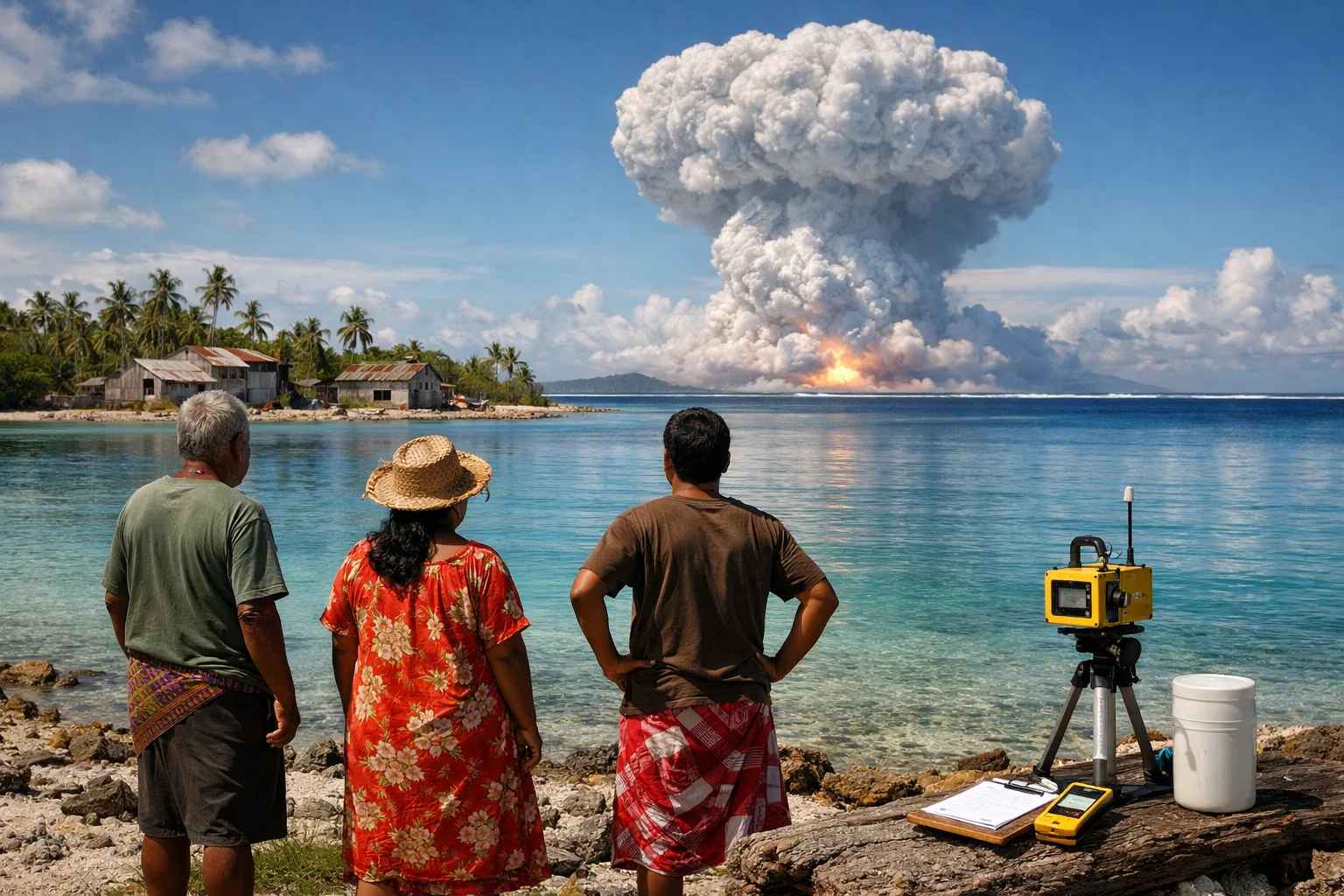
The decisive episode began with the United States nuclear-testing programme. Between 1946 and 1958, the US conducted 67 nuclear weapons tests in the Marshall Islands, mainly around Bikini and Enewetak atolls. People from those atolls were relocated before testing, often after assurances that displacement would be temporary or serve a greater international purpose. The resulting explosions and fallout contaminated land and marine environments across parts of the northern Marshall Islands.[GAO]gao.govgao 24 104082GAO-24-104082, NUCLEAR WASTE: Changing Conditions May Affect Future Management of Contamination Deposited Abroad during U.S. Cold War…
On 1 March 1954, the Castle Bravo thermonuclear test produced a yield of about 15 megatons. Fallout travelled over inhabited islands, including Rongelap and Utrik. Residents described a white, powder-like material falling from the sky; children reportedly played in it before its danger was understood. Evacuation did not occur until roughly two days later. People subsequently experienced skin injury, hair loss, nausea and other symptoms associated with radiation exposure.[energy.gov]ehss.energy.govChapter 12: The MarshalleseChapter 12: The Marshallese
This was not a rumour panic triggered by an unexplained cloud. The cloud carried radioactive material, and the physical danger was later confirmed through medical monitoring and environmental measurement. A 2024 report by the US Government Accountability Office concluded that fallout contamination remains measurable on several atolls and that some locations are still uninhabitable. It also recorded disagreement between the US and Marshallese governments over how many atolls should be officially recognised as affected.[GAO]gao.govgao 24 104082GAO-24-104082, NUCLEAR WASTE: Changing Conditions May Affect Future Management of Contamination Deposited Abroad during U.S. Cold War…
The uncertainty surrounding radiation nevertheless created conditions in which fear could spread far beyond what ordinary people could personally verify. Radiation cannot be seen, smelt or tasted. A seemingly healthy coconut, fish or patch of soil may carry contamination. Safety therefore depends on scientific measurement and trustworthy communication. Where officials delay warnings, revise exposure estimates or disagree over acceptable risk, everyday life becomes saturated with doubt.
That doubt affected basic decisions:
- whether locally grown food was safe to eat;
- whether a family should return to an ancestral island;
- whether illness or pregnancy loss might be connected to fallout;
- whether official monitoring programmes were designed primarily to help residents or study them;
- whether apparently “clean” land might become unsafe again through erosion, storms or changing water conditions.
Fear in such circumstances is not evidence of collective delusion. It is a predictable response to an invisible hazard combined with an unequal colonial relationship.
Medical secrecy turned uncertainty into distrust
After Castle Bravo, US agencies began long-term medical observation of exposed Marshallese populations. One programme was designated Project 4.1. American official histories acknowledge that questions later arose about whether the Marshallese had been treated principally as patients, research subjects or both, and whether meaningful consent had been obtained. The Advisory Committee on Human Radiation Experiments examined the programme during the 1990s as part of a wider investigation into Cold War radiation research.[ehss.energy.gov]ehss.energy.govChapter 12: The MarshalleseChapter 12: The Marshallese
For affected communities, the distinction was deeply personal. Medical teams took blood, conducted examinations and followed health outcomes over many years. Yet participants were not always given information in forms they could readily understand, while the broader scale of fallout remained contested. This helped produce a durable suspicion that the exposure had been anticipated or that islanders had deliberately been left in place as experimental subjects.
The strongest documentary evidence does not establish that Castle Bravo was detonated for the purpose of exposing Marshallese people. The fallout resulted from a test whose yield and radiological consequences were disastrously misjudged, followed by an inadequate emergency response. However, the later scientific use of exposed communities, weak consent procedures and institutional secrecy made darker interpretations understandable. A responsible account must distinguish an unproven claim of intentional exposure from the documented fact that researchers gathered valuable data from people harmed by a US weapons programme.
The damage to trust continued after attempted resettlement. Some Bikini residents returned during the late 1960s and early 1970s after official assurances and rehabilitation work. Monitoring later showed rising internal exposure to radioactive caesium, and the community was removed again. Such reversals taught residents that a declaration of safety could be temporary, mistaken or based on assumptions that did not match local diets and living practices.[GAO]gao.govgao 24 104082GAO-24-104082, NUCLEAR WASTE: Changing Conditions May Affect Future Management of Contamination Deposited Abroad during U.S. Cold War…
In 2024, the Government Accountability Office recommended that the US Department of Energy develop a sustained, understandable and transparent communication strategy in partnership with the Marshall Islands government. That recommendation itself reflects a continuing institutional problem: decades after the tests, scientific information has not always produced public confidence.[GAO]gao.govgao 24 104082GAO-24-104082, NUCLEAR WASTE: Changing Conditions May Affect Future Management of Contamination Deposited Abroad during U.S. Cold War…
Birth defects, stigma and the language of horror
Among the most painful parts of Marshallese nuclear memory are accounts of miscarriages, stillbirths and severely malformed babies. Marshallese women and campaigners have used expressions translated into English as “jellyfish babies”, “grape babies” and other vivid descriptions. These terms entered journalism, testimony and anti-nuclear advocacy as ways of describing pregnancies that families often concealed or buried quickly.[icanw.org]icanw.orgICANThe Impact of Nuclear Weapons on ChildrenICANThe Impact of Nuclear Weapons on Children
The testimony is culturally important, but it requires careful handling. Individual congenital conditions are difficult to reconstruct retrospectively, particularly where diagnoses were absent, medical records incomplete or families silenced by shame. Not every later illness or pregnancy loss can be conclusively attributed to radiation on an individual basis. At the same time, uncertainty about each case does not erase the well-established exposure, the recognised relationship between ionising radiation and certain health risks, or the collective trauma experienced by women.
Silence itself became part of the social history. Birth abnormalities could be associated with stigma, fear of contamination or the belief that an affected family had somehow become permanently damaged. Some survivors avoided discussing their experiences with children and grandchildren. A 2025 United Nations stakeholder report described limited public understanding of the nuclear legacy as a consequence of government secrecy, social stigma and intergenerational trauma, noting that younger Marshallese sometimes learned the fuller history only while studying abroad.[United Nations Digital Library System]digitallibrary.un.orgited Nations Digital Library Systemited Nations Digital Library System
This is an example of how a real technological disaster can generate patterns that superficially resemble a social scare: frightening stories circulate, certain families feel marked, people avoid places associated with danger, and uncertainty passes between generations. The crucial difference is that the originating hazard was genuine and remains partly unresolved.
Fear of returning home
Rongelap illustrates the conflict between scientific risk assessments and lived confidence. Residents were removed after the 1954 fallout and returned in 1957, although contamination and health monitoring continued. By the 1980s, many islanders no longer trusted assurances that remaining on the atoll was safe. In 1985, Greenpeace helped evacuate residents who wished to leave.[Greenpeace]greenpeace.orgOpen source on greenpeace.org.
From a narrow technical perspective, arguments about return often concern dose limits, soil treatment, imported food and the varying contamination of particular islands. From a community perspective, return also means asking people to raise children in a place where previous assurances failed. It requires them to depend on continuing monitoring and sometimes to change customary food practices to reduce exposure.
Describing reluctance to return as “radiophobia” can therefore be misleading. The term implies an excessive or pathological fear of radiation, yet Marshallese anxiety arose from direct exposure, involuntary displacement and contradictory official decisions. Even when scientists judge a particular exposure level acceptably low, residents may reasonably apply a stricter standard to ancestral land on which they expect families to live indefinitely.
The dispute also concerns who has the authority to define safety. The US government has generally limited formal recognition to four heavily affected atolls, while Marshallese representatives have argued for a broader understanding of fallout and harm. The difference influences compensation, medical eligibility and national memory as well as environmental policy.[GAO]gao.govgao 24 104082GAO-24-104082, NUCLEAR WASTE: Changing Conditions May Affect Future Management of Contamination Deposited Abroad during U.S. Cold War…
Climate change and modern apocalyptic language
Climate change has added a second form of existential fear. The Marshall Islands consists largely of low coral atolls vulnerable to coastal flooding, erosion, saltwater intrusion and damage to freshwater supplies. A World Bank study projected that under modelled sea-level-rise conditions, 40 per cent of buildings in Majuro could be endangered and 96 per cent of the city could face frequent flooding.[World Bank]worldbank.orgWorld BankMarshall Islands: New Climate Study Visualizes…29 Oct 2021 — Rising sea levels in the atoll nation of Marshall Islands are p…
Public discussion therefore often uses language that sounds apocalyptic: islands disappearing, a country becoming uninhabitable, or an entire culture losing its physical homeland. Such language is not simply religious prophecy. It condenses scientific projections, visible flooding, political advocacy and the emotional difficulty of imagining national life without secure land.
Christian belief does, however, shape some interpretations. Research in the Marshall Islands has examined literal readings of the biblical covenant with Noah, in which God promises never again to destroy the Earth by flood. Some respondents have reasoned that complete destruction by rising water cannot occur because it would contradict that promise. Others interpret climate change through end-times narratives, divine judgement or a theology of stewardship and collective responsibility.[American Meteorological Society Journals]journals.ametsoc.orgOpen source on ametsoc.org.
These views should not be reduced to simple climate denial. Pacific research has identified several uses of the Noah story: it can provide reassurance against predictions of destruction, present Noah as a model of preparation, or frame the rainbow as a call to preserve creation. The same scripture can support fatalism, emotional resilience or practical adaptation.[Wiley Online Library]rgs-ibg.onlinelibrary.wiley.comOpen source on wiley.com.
Nor does religion necessarily outweigh education and direct experience. A comparative survey of students in the Marshall Islands and Kiribati found that education had a stronger influence on perceptions of climate change than religion or culture. This cautions against assuming that a highly Christian population will automatically reject environmental science.[J-STAGE]jstage.jst.go.jpJ-STAGEInfluence of Religion, Culture and Education on PerceptionJ-STAGEInfluence of Religion, Culture and Education on Perception
Marshallese churches and faith networks have also participated in climate advocacy, prayer, disaster support and anti-nuclear campaigning. In this setting, religion is not merely a source of fearful prophecy. It is also a language for endurance, justice, responsibility and resistance.

When does justified fear become a social panic?
A social panic involves more than widespread anxiety. It usually includes exaggerated claims, rapid amplification, a threatening person or group cast as the cause, pressure for disproportionate action and a breakdown in the relationship between evidence and response. By that standard, neither Marshallese fear of radioactive contamination nor concern about sea-level rise can be dismissed as a moral panic.
There are still panic-like mechanisms worth recognising.
Invisible threats encourage rumour. Radiation and future sea-level rise cannot always be judged through unaided observation. People must interpret specialist measurements, projections and conflicting institutional claims.
Secrecy magnifies worst-case explanations. When governments withhold records or communicate poorly, suspicions that would otherwise remain marginal become plausible.
Stigma attaches danger to bodies and places. Exposed women, children with illnesses and residents of contaminated atolls may be treated as if they themselves carry a mysterious taint.
Repeated displacement creates cultural dread. Fear concerns not only illness or flooding but the loss of land, graves, chiefly ties, food traditions and the possibility of remaining a people with a territory.
Religious narratives organise uncertainty. Biblical stories can make catastrophe emotionally comprehensible, but they can lead towards preparation, denial, activism or hope rather than producing one uniform response.
The most serious amplification did not come from sensational local media inventing an enemy. It came from the gap between official reassurance and lived experience. When authorities first say that relocation will be brief, later declare a place safe, and eventually reverse themselves, distrust becomes socially contagious because it has repeatedly been rewarded.
What remains culturally important
The Marshall Islands complicates popular ideas about hysteria. Collective fear is often described as a population losing touch with reality. Here, reality was obscured by technical complexity, secrecy and colonial power. Communities had strong reasons to fear what they could not see, and later evidence confirmed much of the underlying danger.
The country’s experience also shows why the word “cult” must be used sparingly. Traditional divination, spirit belief, biblical prophecy and intense church life are not proof of manipulation or irrationality. No major Marshallese movement has been convincingly documented as a classic cargo cult, nationwide apocalyptic sect or organised witch panic. The more revealing story is how ordinary religious and cultural ideas helped people interpret extraordinary disruption.
Nuclear memory remains politically active through demands for fuller disclosure, compensation, environmental repair and education. The Marshall Islands established a National Nuclear Commission in 2017 to pursue a national strategy for nuclear justice, while United Nations bodies continue to examine the human-rights consequences of displacement, illness and contamination.[United Nations Digital Library System]digitallibrary.un.orgOpen source on un.org.
Climate change now reactivates many of the same fears: outsiders once again debate whether islands are safe, how long communities can remain and whether migration should be treated as inevitable. The historical lesson is not that Marshallese people are unusually vulnerable to panic. It is that collective anxiety becomes most enduring when a population faces genuine danger but lacks control over the institutions defining its future.
Amazon book picks
Further Reading
Books and field guides related to When Fear in the Marshall Islands Was Rational. Use these as the next step if you want deeper reading beyond the article.
The Uninhabitable Earth
Relevant to the Marshall Islands' continuing climate-related fears.

Before the fallout
First published 1998. Subjects: Social aspects, Science, Moral and ethical aspects, Atomic bomb, History.
Endnotes
1.
Source: gao.gov
Title: gao 24 104082
Link:https://www.gao.gov/assets/gao-24-104082.pdf
Source snippet
GAO-24-104082, NUCLEAR WASTE: Changing Conditions May Affect Future Management of Contamination Deposited Abroad during U.S. Cold War...
2.
Source: micsem.org
Link:https://micsem.org/article/religion-in-the-marshall-islands/
3.
Source: micsem.org
Link:https://www.micsem.org/pubs/books/Summoning-the-Powers-Beyond.pdf
Source snippet
SUMMONiNG THE POwERS BEyONDChapter 6: The Religion of the Marshall Islands 1. these religious functionaries control the system of prophec...
4.
Source: 2021-2025.state.gov
Title: Department Marshall Islands
Link:https://2021-2025.state.gov/reports/2023-report-on-international-religious-freedom/marshall-islands/
Source snippet
State DepartmentMarshall Islands - United States Department of StateMajor religious groups include the United Church of Christ (formerly...
5.
Source: ehss.energy.gov
Title: Chapter 12: The Marshallese
Link:https://ehss.energy.gov/ohre/roadmap/achre/chap12_3.html
6.
Source: icanw.org
Title: ICANThe Impact of Nuclear Weapons on Children
Link:https://www.icanw.org/children
7.
Source: digitallibrary.un.org
Title: ited Nations Digital Library System
Link:https://digitallibrary.un.org/record/4091017/files/A_HRC_WG.6_50_MHL_3-EN.pdf
8.
Source: greenpeace.org
Link:https://www.greenpeace.org/international/story/75199/a-defining-moment-in-history-40-years-ago-the-marshall-islands-fought-to-protect-their-future-and-defied-the-us/
9.
Source: rgs-ibg.onlinelibrary.wiley.com
Link:https://rgs-ibg.onlinelibrary.wiley.com/doi/10.1002/geo2.68
10.
Source: jstage.jst.go.jp
Title: J-STAGEInfluence of Religion, Culture and Education on Perception
Link:https://www.jstage.jst.go.jp/article/jdr/14/9/14_1297/_pdf
11.
Source: gao.gov
Link:https://www.gao.gov/products/nsiad
12.
Source: gao.gov
Title: nsiad 92 229
Link:https://www.gao.gov/assets/nsiad-92-229.pdf
13.
Source: gao.gov
Link:https://www.gao.gov/assets/rced-00-67.pdf
14.
Source: gao.gov
Link:https://www.gao.gov/assets/a250660.html
15.
Source: gao.gov
Title: psad 79 54
Link:https://www.gao.gov/assets/psad-79-54.pdf
16.
Source: gao.gov
Link:https://www.gao.gov/assets/a233465.html
17.
Source: gao.gov
Title: nsiad 00 216
Link:https://www.gao.gov/assets/nsiad-00-216.pdf
18.
Source: gao.gov
Title: rced 87 134
Link:https://www.gao.gov/assets/rced-87-134.pdf
19.
Source: gao.gov
Title: gao 02 70
Link:https://www.gao.gov/assets/gao-02-70.pdf
20.
Source: energy.gov
Title: Hewlettand Holl Atomsfor Peaceand War Complete
Link:https://www.energy.gov/sites/prod/files/2013/08/f2/HewlettandHollAtomsforPeaceandWarComplete.pdf
21.
Source: history.com
Title: salem witch trials hysteria factors
Link:https://www.history.com/articles/salem-witch-trials-hysteria-factors
22.
Source: research.fit.edu
Link:https://research.fit.edu/media/site-specific/researchfitedu/coast-climate-adaptation-library/pacific-islands/melanesia/Bertana.–2020.–The-Impact-of-Faith-Based-Narratives-on-Climate-Change-Adaptation-in-Narikoso%2C-Fiji.pdf
23.
Source: worldbank.org
Link:https://www.worldbank.org/en/news/press-release/2021/10/29/marshall-islands-new-climate-study-visualizes-confronting-risk-of-projected-sea-level-rise
Source snippet
World BankMarshall Islands: New Climate Study Visualizes...29 Oct 2021 — Rising sea levels in the atoll nation of Marshall Islands are p...
24.
Source: ahf.nuclearmuseum.org
Title: Nuclear Museum Marshall Islands
Link:https://ahf.nuclearmuseum.org/ahf/location/marshall-islands/
Source snippet
In 1954, as a result of the Castle Bravo test, many residents...Read more...
25.
Source: theamericanscholar.org
Title: after the fallout
Link:https://theamericanscholar.org/after-the-fallout/
26.
Source: greenpeace.org.au
Link:https://www.greenpeace.org.au/article/tracing-radiation-through-the-marshall-islands-reflections-from-a-greenpeace-nuclear-specialist/
27.
Source: journals.ametsoc.org
Link:https://journals.ametsoc.org/view/journals/wcas/15/3/WCAS-D-22-0117.1.xml
28.
Source: journals.ametsoc.org
Link:https://journals.ametsoc.org/downloadpdf/view/journals/wcas/15/3/WCAS-D-22-0117.1.pdf
29.
Source: digitallibrary.un.org
Link:https://digitallibrary.un.org/record/4087118/files/A_HRC_59_46_Add.1-AR.pdf
30.
Source: sk.sagepub.com
Title: marshall islands
Link:https://sk.sagepub.com/ency/edvol/globalreligion/chpt/marshall-islands
31.
Source: Wikipedia
Title: Cargo cult
Link:https://en.wikipedia.org/wiki/Cargo_cult
32.
Source: ebsco.com
Link:https://www.ebsco.com/research-starters/religion-and-philosophy/cargo-cult
33.
Source: digitallibrary.un.org
Link:https://digitallibrary.un.org/record/4063176/files/A_HRC_57_L.14-EN.pdf
34.
Source: digitallibrary.un.org
Title: A HRC 21 NGO 107 EN
Link:https://digitallibrary.un.org/record/733958/files/A_HRC_21_NGO_107-EN.pdf
35.
Source: ejournal.uinsgd.ac.id
Link:https://ejournal.uinsgd.ac.id/index.php/rpj/article/view/2366
36.
Source: library.eshikshya.org
Title: Cargo cults
Link:https://library.eshikshya.org/kiwix/content/wikipedia_en_all_maxi_2023-05/A/Cargo_cults
37.
Source: ajol.info
Link:https://www.ajol.info/index.php/ehass/article/view/300729/282755
38.
Source: books.openedition.org
Link:https://books.openedition.org/pacific/159?lang=en
39.
Source: thearda.com
Title: Millenarian Movement
Link:https://www.thearda.com/us-religion/history/timelines/entry?eid=23&etype=3
Additional References
40.
Source: facingsouth.org
Title: long road nuclear justice marshallese people
Link:https://www.facingsouth.org/2021/04/long-road-nuclear-justice-marshallese-people
Source snippet
The long road to nuclear justice for the Marshallese people2 Apr 2021 — Women who had been exposed to the fallout gave birth to children...
41.
Source: youtube.com
Title: Nuclear Tests Changed Life Forever in the Marshall Islands
Link:https://www.youtube.com/watch?v=3V_lK1fYE5Y
Source snippet
Sinking States: What the World Owes the Marshall Islands...
42.
Source: youtube.com
Link:https://www.youtube.com/watch?v=TFZu3imK1JA
Source snippet
Nuclear Tests Changed Life Forever in the Marshall Islands...
43.
Source: academia.edu
Link:https://www.academia.edu/5368224/Apocalyptic_and_Millenarian_Movements
44.
Source: academia.edu
Link:https://www.academia.edu/1425842/In_darkness_and_secrecy_the_anthropology_of_assault_sorcery_and_witchcraft_in_Amazonia
45.
Source: researchgate.net
Link:https://www.researchgate.net/publication/272955145_The_Gendered_Politics_of_Witchcraft_and_Sorcery_Accusations_among_the_Maisin_of_Papua_New_Guinea
46.
Source: researchgate.net
Link:https://www.researchgate.net/publication/329708387_Three_stories_of_Noah_Navigating_religious_climate_change_narratives_in_the_Pacific_Island_region
47.
Source: researchgate.net
Link:https://www.researchgate.net/publication/371337136_Association_of_Religious_End_Time_Beliefs_with_Attitudes_toward_Climate_Change_and_Biodiversity_Loss
48.
Source: facebook.com
Link:https://www.facebook.com/LivingInVanuatuNews/posts/a-cargo-cult-in-vanuatu-has-been-waiting-for-an-american-named-john-frum-since-t/1336087085387303/
49.
Source: facebook.com
Link:https://www.facebook.com/groups/CulturalAnthropologyatVUW/posts/1689416427846537/
Topic Tree
Follow this branch
Related pages 192
- Antigua and Barbuda
- Argentina Belief Scares
- Azerbaijan Belief
- Bahrain Beliefs
- North Korea
- +187 more in sidebar