Within Nauru
Why Did Australia's Border Panic Move to Nauru?
Australian politics turned boat arrivals into a national emergency and made Nauru the physical stage for that fear.
On this page
- How boat arrivals became a moral panic
- Why detention was moved offshore
- Refugee distress, political messaging and public harm
Page outline Jump by section
Introduction
Australia’s use of Nauru as an offshore detention site did not arise simply from geography or migration management. It emerged from a political climate in which irregular boat arrivals were increasingly portrayed as an urgent national crisis requiring extraordinary measures. From the early 2000s onwards, successive Australian governments argued that preventing asylum seekers from reaching the mainland was essential to protecting national borders, disrupting people-smuggling networks and preventing deaths at sea. Critics, however, argue that this framing transformed a relatively small number of maritime arrivals into a moral panic, allowing exceptional policies that would have been difficult to justify under ordinary circumstances. Nauru became the physical location where this politics of deterrence was enacted, making the island central to one of the most controversial chapters in Australia’s modern history.[Amnesty International]amnesty.orgAmnesty InternationalAustralia: Island of Despair: Australia’s “processing” of refugees on Nauru - Amnesty InternationalOctober 17, 2016…
How boat arrivals became a moral panic
A moral panic develops when a social issue is presented as posing a threat far greater than the available evidence suggests, encouraging demands for exceptional responses. Many political scientists, media researchers and sociologists have argued that Australia’s debate over asylum seekers fits many features of this pattern, although the label remains contested.
Boat arrivals represented only a small proportion of Australia’s overall migration programme, yet political rhetoric increasingly depicted them as evidence that Australia had “lost control” of its borders. Election campaigns repeatedly focused on stopping the boats, while headlines emphasised border breaches, people smugglers and fears of uncontrolled migration. Individual tragedies at sea, including fatal sinkings, reinforced public anxiety and enabled governments to argue that harsh deterrence would ultimately save lives by discouraging dangerous voyages.[Amnesty International]amnesty.orgAmnesty InternationalAustralia: Island of Despair: Australia’s “processing” of refugees on Nauru - Amnesty InternationalOctober 17, 2016…
Several political moments strengthened this narrative:
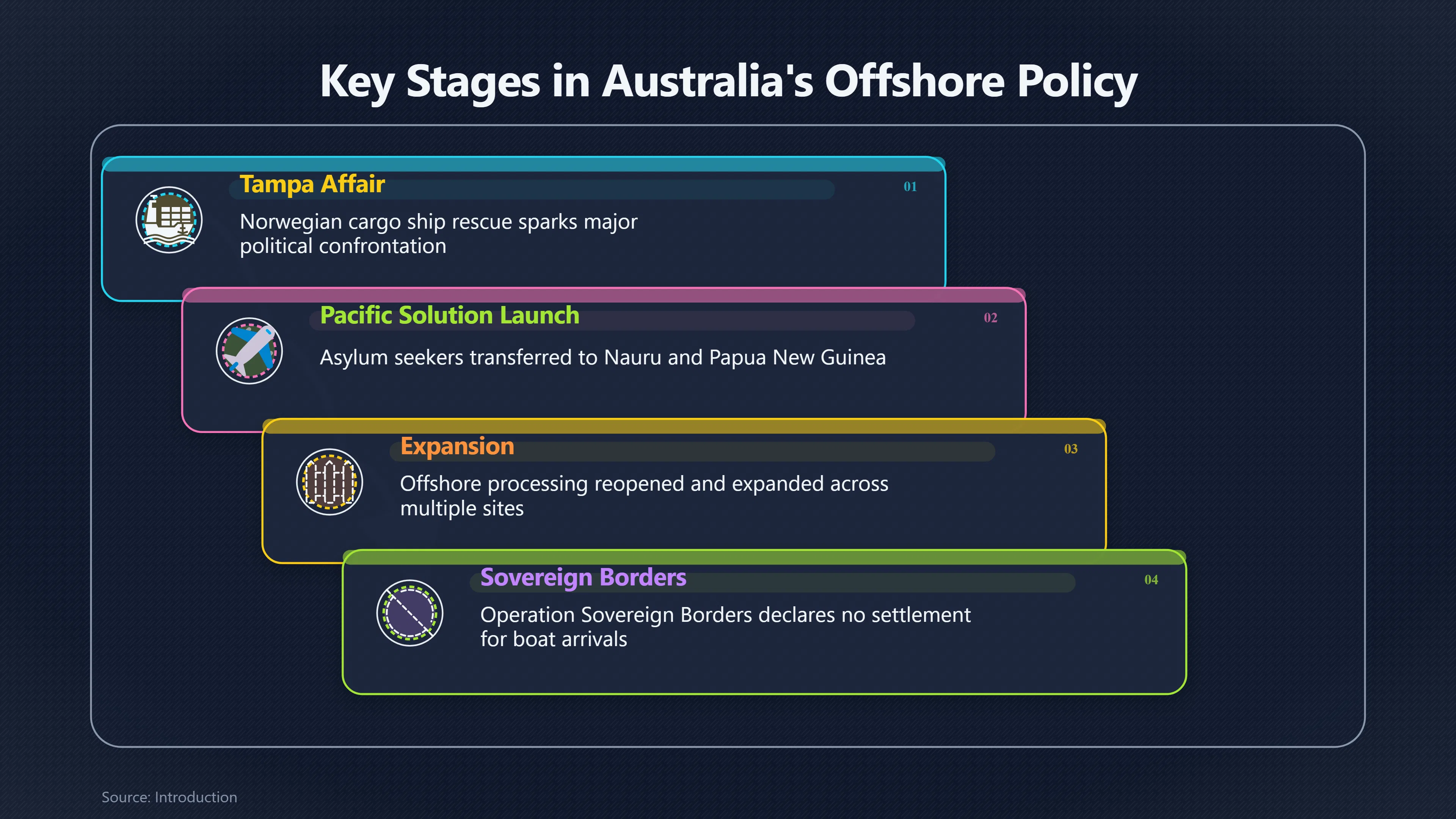
- The 2001 Tampa affair, when the rescue of asylum seekers by a Norwegian cargo ship became a major political confrontation.
- The introduction of the original “Pacific Solution”, under which asylum seekers were transferred to Nauru and Papua New Guinea rather than processed on the Australian mainland.
- The reopening and expansion of offshore processing from 2012 and the introduction of Operation Sovereign Borders in 2013, accompanied by the declaration that anyone arriving by boat would never be permanently settled in Australia.[Amnesty International]amnesty.orgAmnesty InternationalAustralia: Island of Despair: Australia’s “processing” of refugees on Nauru - Amnesty InternationalOctober 17, 2016…
Supporters viewed these measures as firm border management. Critics argued that they relied on presenting asylum seekers primarily as a security threat rather than people seeking refugee protection under international law.
Why detention was moved offshore
Nauru’s role was not accidental. Offshore processing allowed Australia to separate asylum seekers physically and legally from its mainland while maintaining substantial financial and administrative involvement.
The Australian Government argued that offshore processing achieved several objectives simultaneously. It was intended to remove any perceived incentive for people to attempt dangerous sea crossings, disrupt people-smuggling businesses, and demonstrate that irregular maritime arrival would not lead to settlement in Australia. Governments of different political parties broadly maintained this deterrence strategy, although they differed over aspects of its implementation.[UNHCR]unhcr.orgDetaining asylum seekers and refugees in offshore detention centres subject to international obligations, despite High Court decisio…
Critics argued that offshore processing also had an important symbolic function. The remoteness of Nauru reduced media access, limited public visibility and reinforced the political message that Australia would enforce an exceptionally hard border. Human rights organisations have repeatedly argued that deterrence, rather than refugee assessment itself, became the defining purpose of the system. Amnesty International concluded that successive governments openly promoted offshore processing as a demonstration of border control and as a warning to future arrivals.[Amnesty International]amnesty.orgAmnesty InternationalAustralia: Island of Despair: Australia’s “processing” of refugees on Nauru - Amnesty InternationalOctober 17, 2016…
The policy also generated continuing legal debate. Australia’s High Court upheld aspects of the government’s authority under Australian law to transfer asylum seekers offshore, but UNHCR consistently maintained that Australia retained responsibility under international refugee and human rights law because it exercised substantial control over the arrangements.[UNHCR]unhcr.orgDetaining asylum seekers and refugees in offshore detention centres subject to international obligations, despite High Court decisio…
Refugee distress, political messaging and public harm
One of the clearest distinctions in this history is between collective political fear and the experiences of the people detained on Nauru.
The widespread psychological suffering reported among detainees was not an example of mass hysteria. Medical researchers, psychiatrists, humanitarian organisations and official inquiries have instead linked high rates of depression, anxiety, self-harm, suicide attempts and trauma to prolonged uncertainty, indefinite detention, isolation and harsh living conditions. These findings describe documented mental health consequences rather than contagious irrational belief.[Amnesty International]amnesty.orgAmnesty InternationalAustralia: Island of Despair: Australia’s “processing” of refugees on Nauru - Amnesty InternationalOctober 17, 2016…
Numerous investigations documented allegations including:
- prolonged detention without a clear future;
- inadequate medical care;
- serious impacts on children’s mental health and development;
- reports of violence, intimidation and sexual abuse;
- lasting psychological harm after release or resettlement.[amnesty.org]amnesty.orgAmnesty InternationalAustralia: Island of Despair: Australia’s “processing” of refugees on Nauru - Amnesty InternationalOctober 17, 2016…
Human rights organisations described the regime as deliberately punitive, while Australian governments consistently defended it as an unfortunate but necessary deterrent that had contributed to ending large-scale boat arrivals and reducing deaths during maritime journeys. This disagreement remains one of the central disputes surrounding the policy.[Amnesty International]amnesty.orgAmnesty InternationalAustralia: Island of Despair: Australia’s “processing” of refugees on Nauru - Amnesty InternationalOctober 17, 2016…
Why Nauru became the symbol of Australia’s border debate
For many observers outside Australia, Nauru ceased to be known primarily as a small Pacific republic and instead became internationally associated with offshore detention.
This association had profound consequences for the island itself. Nauru’s economy became increasingly tied to Australian funding connected with detention arrangements after the decline of phosphate mining. At the same time, the country’s international reputation became closely linked to Australia’s asylum policies rather than its own independent political or cultural history.
The detention system also attracted sustained criticism from international organisations. UNHCR repeatedly argued that offshore arrangements did not remove Australia’s obligations under the Refugee Convention, while the UN Human Rights Committee ruled in 2025 that Australia remained responsible for arbitrary detention and associated human rights violations affecting people transferred to Nauru because of Australia’s continuing control and influence over the processing system.[UNHCR]unhcr.orgUN ruling on Australia’s responsibility for people transferred to Nauru | UNHCR Australia…

Why this remains culturally important
Australia’s offshore detention policy continues to shape debates well beyond migration law because it illustrates how political narratives can transform a manageable policy challenge into an enduring national emergency.
For scholars of moral panic, Nauru represents a case in which fears about sovereignty, security and migration became concentrated onto a single remote location. Whether one supports or opposes offshore processing, the episode demonstrates how political messaging can reshape public perceptions of risk and justify exceptional state powers.
For Nauru, the consequences were equally significant. The island became internationally recognised less for its own society than as the stage upon which Australia’s border politics were performed. Understanding this relationship helps explain why Nauru occupies such a prominent place in discussions of modern moral panics: not because the island itself generated collective fear, but because it became the setting through which another country’s anxieties about migration were expressed and institutionalised.
Amazon book picks
Further Reading
Books and field guides related to Why Did Australia's Border Panic Move to Nauru?. Use these as the next step if you want deeper reading beyond the article.

No Friend But the Mountains
Although centred on Manus rather than Nauru, it gives a powerful first-person account of the prison-like offshore detention system, refug...

Dark Victory
Directly explains how asylum-seeker boat arrivals were framed as a national emergency and converted into political advantage, providing e...

Undesirables
Takes readers inside Australia's Nauru detention centre and documents daily conditions, distress, self-harm, unrest and the human consequ...
Offshore: Behind the Wire on Manus and Nauru
Explains why offshore processing was re-established, how the centres on Nauru and Manus operated, what detainees and staff experienced, a...
Endnotes
1.
Source: amnesty.org
Link:https://www.amnesty.org/en/documents/asa12/4934/2016/en/
Source snippet
Amnesty InternationalAustralia: Island of Despair: Australia’s “processing” of refugees on Nauru - Amnesty InternationalOctober 17, 2016...
Published: October 17, 2016
2.
Source: unhcr.org
Link:https://www.unhcr.org/au/news/news-releases/detaining-asylum-seekers-and-refugees-offshore-detention-centres-subject
Source snippet
Detaining asylum seekers and refugees in offshore detention centres subject to international obligations, despite High Court decisio...
3.
Source: unhcr.org
Link:https://www.unhcr.org/au/news/stories/un-ruling-australia-s-responsibility-people-transferred-nauru
Source snippet
UN ruling on Australia’s responsibility for people transferred to Nauru | UNHCR Australia...
4.
Source: amnesty.org
Title: Australia: Appalling abuse, neglect of refugees on Nauru
Link:https://www.amnesty.org/en/latest/press-release/2016/08/australia-abuse-neglect-of-refugees-on-nauru/
5.
Source: amnesty.org.au
Link:https://www.amnesty.org.au/submission-offshore-processing-and-resettlement-arrangements/
Source snippet
Amnesty International AustraliaSubmission: Offshore processing and resettlement arrangements - Amnesty International Australia...
Additional References
6.
Source: hrlc.org.au
Link:https://www.hrlc.org.au/news/senate-inquiry-hears-renewed-calls-to-dismantle-offshore-processing-following-evidence-of-abuse-corruption/
Source snippet
Human Rights Law CentreMay 5, 2026 — SENATE INQUIRY HEARS RENEWED CALLS TO DISMANTLE OFFSHORE PROCESSING FOLLOWING EVIDENCE OF ABUSE, COR...
Published: May 5, 2026
7.
Source: theguardian.com
Link:https://www.theguardian.com/australia-news/2025/jan/10/australia-violated-rights-of-asylum-seekers-on-nauru-un-watchdog-rules
Source snippet
This decision came from two cases involving 25 refugees and asylum seekers who suffered years of detention under harsh and inhumane condi...
8.
Source: hrw.org
Link:https://www.hrw.org/news/2026/03/02/australia-offshore-detention-cruel-costly
Source snippet
Australia: Offshore Detention Cruel, Costly | Human Rights WatchMarch 1, 2026 — March 1, 2026 7:30PM EST | News Release AUSTRALIA: OFFSHO...
Published: March 1, 2026
9.
Source: youtube.com
Link:https://www.youtube.com/watch?v=V2PdudG2jtc
Source snippet
The Tampa affair, 20 years on: the roots of Australia's hardline asylum seeker and refugee policy...
10.
Source: youtube.com
Title: Child refugees detained on Nauru Island talk to CNN
Link:https://www.youtube.com/watch?v=EdTHUOumoMQ
Source snippet
Lunchbox/Soapbox: Mark Isaacs: Nauru: An insider's account of Australia's offshore detention policy...
11.
Source: youtube.com
Link:https://www.youtube.com/watch?v=_SoghjAo8eg
Source snippet
Manus and Nauru: The Inside Story...
12.
Source: doi.org
Link:https://doi.org/10.1111%2Flsi.12088
13.
Source: cambridge.org
Link:https://www.cambridge.org/core/services/aop-cambridge-core/content/view/D3A9800810240940C55B95990E4A2971/S0897654600003671a.pdf/new_deterrence_scripts_in_australias_rejuvenated_offshore_detention_regime_for_asylum_seekers.pdf
14.
Source: prio.org
Link:https://www.prio.org/publications/13041
15.
Source: researchprofiles.canberra.edu.au
Link:https://researchprofiles.canberra.edu.au/en/publications/freedom-of-speech-under-the-southern-crossit-arrived-and-departed/
Topic Tree