When Fear and Belief Took Hold in Poland
Poland’s history of collective fear and contagious belief is not one continuous story of “mass hysteria”. It is a set of very different episodes: early modern witch prosecutions, miracle crowds under communist rule, antisemitic rumours that became murderous, millenarian religious movements, and post-1989 scares about supposedly dangerous “sects”.
Page outline Jump by section
Introduction
The central pattern is not that Poles were unusually credulous. Extraordinary beliefs became powerful when they gave familiar form to deeper pressures: war, disease, failed harvests, political repression, rapid social change, religious conflict or anxiety about children. Institutions then shaped the consequences. Courts turned neighbourhood suspicions into witch trials. Police participation helped a false ritual-murder story become the Kielce pogrom. Communist officials treated miracle gatherings as political threats, while Catholic leaders sometimes discouraged unapproved apparitions themselves. After 1989, a genuinely more diverse religious market was often described through the alarmist language of “sects” and “brainwashing”.[rcin.org.pl]rcin.org.plWitch-Hunts in Poland, 16th-18th Centuries · Show content · Download… trials - Poland - history 1500-1800 witchcraft - Poland - histor…
When accusations of witchcraft became law
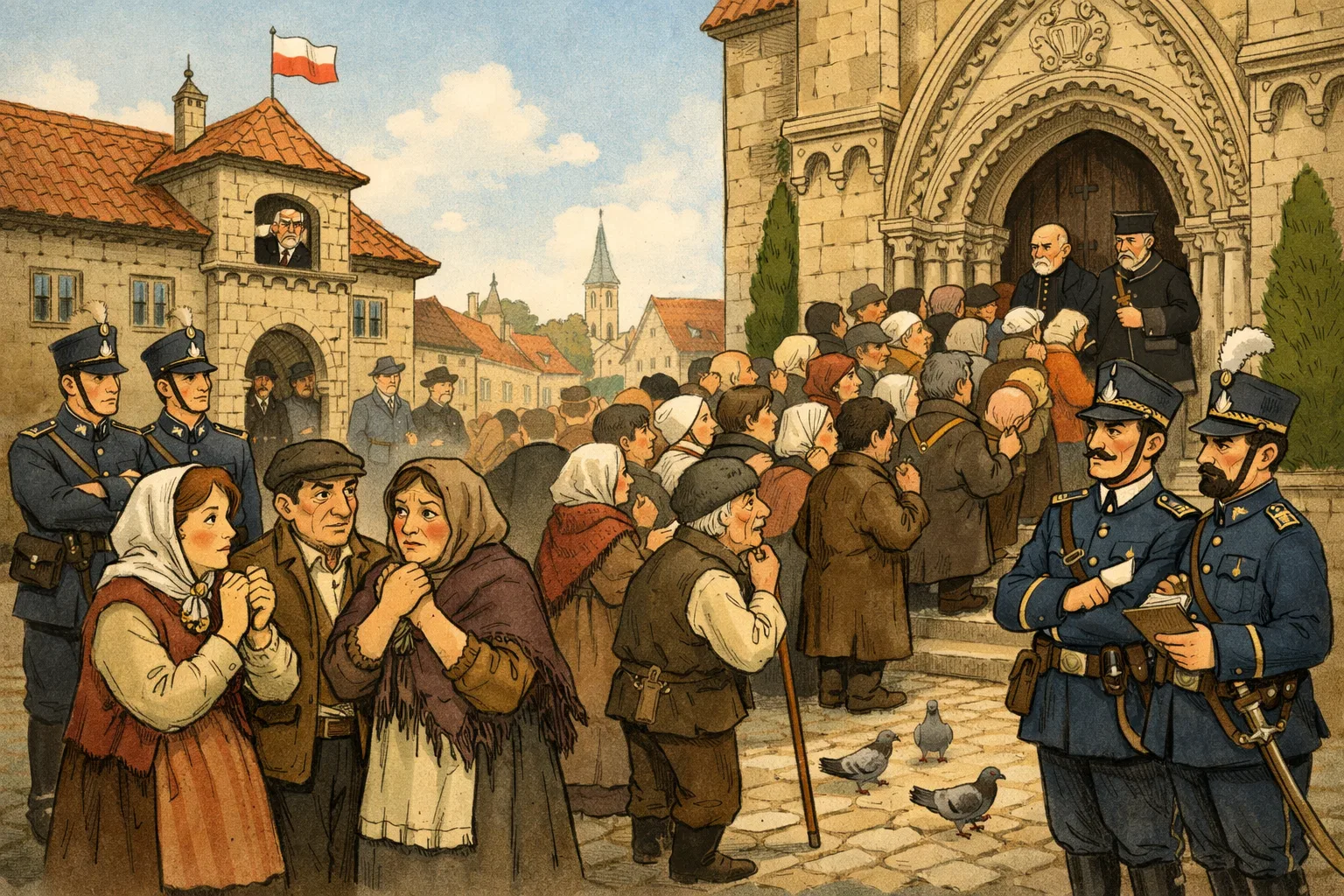
Polish witch-hunting developed later than in several parts of western and central Europe. Prosecutions became most intense from roughly the later seventeenth century into the early eighteenth, although cases varied considerably between regions. The Polish–Lithuanian Commonwealth had no single, centrally directed witch hunt. Trials were conducted by a patchwork of municipal courts, ecclesiastical authorities and courts on privately owned estates, producing uneven procedures and incomplete records.[rcin.org.pl]rcin.org.plWitch-Hunts in Poland, 16th-18th Centuries · Show content · Download… trials - Poland - history 1500-1800 witchcraft - Poland - histor…
Most accusations began with ordinary misfortune. A neighbour’s child became ill, livestock died, milk spoiled, a storm damaged crops or a quarrel was followed by unexplained sickness. Suspicion frequently fell on someone already caught in a tense relationship with the accuser. Learned ideas about pacts with the Devil and witches’ gatherings could enter later, particularly when judges, clergy or interrogators forced local allegations into the framework of Christian demonology. Witch prosecution was therefore not simply a spontaneous peasant panic. It was a process in which community suspicion, legal authority and elite theories of supernatural crime reinforced one another.[researchgate.net]researchgate.net309669047 Witchcraft in Early Modern PolandWitchcraft in Early Modern Poland, 1500–1800October 17, 2013 — This comprehensive study examines Polish demonology in relatio…
Women formed the majority of defendants, but the familiar image of every accused person as an elderly, isolated woman is misleading. Historian Wanda Wyporska’s research in Greater Poland shows a more varied population, including younger and married women and a meaningful minority of men. Some defendants were acquitted, and not every court accepted an allegation. This matters because “witch panic” can suggest an entire society abandoning reason at once, whereas surviving records reveal contested decisions, procedural differences and people who resisted accusations as well as those who promoted them.[Witchcraft in Poland]witchcraftinpoland.comOpen source on witchcraftinpoland.com.
Older claims that tens of thousands of people were executed in Poland are no longer accepted by most specialists. The documentary record is fragmentary, so any national total remains an estimate, but modern scholarship places the number far below the once-repeated figure of 40,000. Even commonly cited estimates of several thousand deaths should be treated as approximate rather than as a complete count.[rcin.org.pl]rcin.org.plWitch-Hunts in Poland, 16th-18th Centuries · Show content · Download… trials - Poland - history 1500-1800 witchcraft - Poland - histor…
The Doruchów story and the making of a national myth
Doruchów is often presented as Poland’s final great witch trial: fourteen women supposedly executed in 1775, shocking parliament into abolishing witch-burning the following year. The story is vivid, memorable and repeated widely. Its evidential basis, however, is doubtful.
Historian Jacek Wijaczka argues that the famous 1775 account is a later literary construction. The only securely documented witchcraft proceeding in Doruchów occurred in 1762, while the detailed narrative of fourteen victims appeared much later in a text associated with a writer known to have created historical fabrications. The 1776 abolition of torture and the death penalty for witchcraft was real, but there is no sound basis for treating it simply as parliament’s reaction to the alleged Doruchów massacre.[Omega]omega.umk.plOpen source on umk.pl.
The episode is important precisely because the legend is revealing. It turns a complicated legal decline into a clean Enlightenment morality tale: superstition causes an atrocity, public horror follows, and rational reform ends the persecution. The historical reality was slower. Central authorities tried to restrict local courts, scepticism grew, and legal reform reduced the machinery of prosecution, yet popular violence and informal accusations could survive beyond formal abolition. Later retellings compressed that uneven change into one dramatic turning point.
The blood libel that became the Kielce pogrom
On 4 July 1946, a false story about a missing Christian child helped trigger the murder of Jewish Holocaust survivors in Kielce. The boy had returned after being away from home and claimed that Jews had held him captive. His story revived the blood libel: the old antisemitic falsehood that Jews abduct and kill Christian children for religious purposes. Although the physical details of the building contradicted his account, the accusation spread through the city.[Holocaust Encyclopedia]encyclopedia.ushmm.orgHolocaust Encyclopedia Kielce PogromHolocaust Encyclopedia Kielce Pogrom
This was not simply an uncontrolled civilian crowd suddenly gripped by an irrational rumour. Police officers, soldiers and civilians took part in the violence at the Jewish community building on Planty Street. At least 42 Jews were killed and more than 40 were injured, making Kielce the deadliest antisemitic outbreak in post-war Poland. The involvement of uniformed personnel gave the rumour institutional force: a supposed threat that should have been investigated sceptically was instead treated as plausible and acted upon.[Holocaust Encyclopedia]encyclopedia.ushmm.orgOpen source on ushmm.org.
The panic drew strength from much more than one child’s allegation. Jewish survivors were returning to homes, businesses and communities devastated by the Holocaust. Property disputes, entrenched antisemitism, economic hardship, political instability and hostility towards the new communist order all shaped the atmosphere. Jews could be falsely associated both with ritual danger and with communist power, contradictory images that nevertheless served the same purpose of marking them as outsiders. The blood libel supplied a culturally familiar script through which these tensions could be turned into immediate violence.
Calling Kielce “mass hysteria” would obscure responsibility. The rumour was false and emotionally contagious, but the result was a pogrom involving identifiable perpetrators and institutions. It belongs in the history of collective belief because it shows how an inherited accusation can become socially effective even without evidence. It belongs equally in the history of antisemitism, state failure and post-Holocaust violence.[Holocaust Encyclopedia]encyclopedia.ushmm.orgOpen source on ushmm.org.
The consequences extended far beyond the city. The massacre destroyed hopes among many Jewish survivors that they could rebuild their lives safely in Poland and accelerated emigration from the country. In this case, a fabricated fear produced permanent demographic and cultural change.[Holocaust Encyclopedia]encyclopedia.ushmm.orgaftermath of pogrom in kielceaftermath of pogrom in kielce
Miracles under communist surveillance
Religious apparitions and miracle reports were unusually sensitive events in communist Poland. A claim that an image had wept or that the Virgin Mary had appeared could attract thousands of people, create an alternative centre of authority and expose the limits of state atheism. Yet these events should not be reduced either to proven miracles or to mindless crowd delusions. They were social gatherings in which private devotion, rumour, political frustration and institutional rivalry met.
A major early example occurred at Lublin Cathedral in July 1949, when worshippers reported that an image of the Virgin Mary appeared to shed tears, described by some witnesses as blood. News circulated rapidly and large numbers travelled to the cathedral. For believers, the event could signify divine compassion or warning. For the Stalinist authorities, a huge unscheduled religious gathering looked like disruption, clerical manipulation and a challenge to the regime’s control of public space.[ptr.edu.pl]ptr.edu.plauthorities on the study of miracles is the fate of the article, which describe miracles in Polish…Read more…
The authorities tried to restrict information, manage the crowd and portray the episode as political exploitation by the clergy. The Catholic hierarchy’s response was more complicated than a simple confrontation between faith and atheism. Church leaders could be cautious about unverified miracles, partly because uncontrolled devotion might weaken episcopal authority or expose believers to state repression. Researchers of post-war apparitions warn against assuming that every sceptical Church statement was merely forced by communist pressure. Senior clergy could genuinely doubt a claim while still opposing the state’s antireligious campaign.[Academia]academia.eduPDF) Apparitions of the Mother of God in Socialist PolandPDF) Apparitions of the Mother of God in Socialist Poland
Similar tensions appeared at Zabłudów in 1965, where a 14-year-old girl reported seeing the Virgin Mary. The episode drew pilgrims and secret-police attention, leaving surveillance photographs and official documentation. The state treated the gathering as a problem of order and political influence, while Catholic and Orthodox institutions faced the difficult question of how to respond to an apparition they had not authenticated.[ResearchGate]researchgate.netResearch Gate Cuda w Polsce Ludowej. Studium przypadku prywatnegoResearch Gate Cuda w Polsce Ludowej. Studium przypadku prywatnego
Oława became the most prominent late communist and post-communist apparition movement. Beginning in 1983, Kazimierz Domański reported messages from the Virgin Mary and later from Jesus. Pilgrims travelled to the site, printed materials and audio cassettes circulated the messages, and an organised religious community developed around the claimant. Apocalyptic warnings and political themes became increasingly important, particularly during the uncertainties surrounding the collapse of communism and the difficult transition that followed.[Culture.pl]culture.plbetween faith the new age polands spiritual 1990sbetween faith the new age polands spiritual 1990s
The Church did not recognise the Oława apparitions and took unusually strong action against participation in the associated organisation. That response demonstrates why “miracle panic” is not always a struggle between believers and secular sceptics. Established religious authorities may resist a popular revelation because it creates competing leadership, bypasses formal investigation or promotes teachings they consider unsound.[SAV]sav.skTatiana Zachar PodolinskáTatiana Zachar Podolinská
These gatherings also reveal a key feature of collective belief: people did not necessarily attend because they were fully convinced. Some came to pray, others to observe, seek healing, join relatives, express opposition to the state or simply see what everyone was discussing. A crowd can enlarge a claim’s importance without every member sharing the same interpretation.

The post-1989 fear of “sects”
The end of communist rule brought freedom of association, increased contact with global religious movements and a rapid expansion of alternative spirituality. Alongside established churches appeared meditation groups, imported new religions, alternative healers, occult publishing, UFO belief, esoteric workshops and New Age practices. This diversity arrived during a period of unemployment, consumer change, weakened institutions and uncertainty about Poland’s identity.[Culture.pl]culture.plbetween faith the new age polands spiritual 1990sbetween faith the new age polands spiritual 1990s
Public discussion frequently compressed this varied landscape into the category of the “sect”. In its broadest polemical use, the word could include minority religions, occult practices, yoga, alternative medicine, charities or organisations linked only loosely to non-mainstream spirituality. Anti-cult campaigners warned that manipulative groups were using psychological control to separate young people from their families. Some families undoubtedly faced painful conflicts, and some organisations could be authoritarian or exploitative. The broader claim that unconventional belief itself demonstrated “brainwashing”, however, encouraged moral panic rather than careful assessment of conduct.[cesnur.org]cesnur.orgOpen source on cesnur.org.
Researchers interpret the panic partly as a struggle over national identity. Catholicism had served as a powerful marker of Polish resistance under communist rule. After 1989, religious pluralism therefore raised more than theological questions: it challenged assumptions about the connection between being Polish, being Catholic and belonging to the moral community. Labelling a movement a “sect” could place it outside all three.[Knowledge Bank]kb.osu.eduThe proposed research constitutes an attempt to demonstrate…
The term also created a distortion of scale. Poland did gain many new registered communities, but their social reach varied enormously, and numerous groups remained very small. Official registration did not prove that a movement was safe, dangerous, orthodox or fraudulent; it established a legal identity. Conversely, unfamiliarity was not evidence of coercion. Recent statistical publications continue to treat Poland’s religious minorities as a diverse field of legally organised communities rather than one undifferentiated “cult” problem.[Statistics Poland]stat.gov.plwyznania religijnewyznania religijne
Antrovis and Poland’s UFO-apocalypse scare
Antrovis became the most notorious Polish example of a UFO-based new religious movement. Founded in Wrocław by Edward Mielnik, it combined extraterrestrial narratives, alternative healing, Christian elements, Polish messianism and catastrophic expectations. Its teachings placed Slavic peoples within a cosmic history and warned of a coming transformation or evacuation connected with beings from space.[Wikipedia]WikipediaOpen source on wikipedia.org.
The movement became a focus of national alarm after reports linked it to missing young people and to the belief that chosen followers might leave Earth. Its themes seemed especially disturbing after the 1997 Heaven’s Gate deaths in the United States, which made any UFO religion appear potentially suicidal. International reporting explicitly compared Antrovis with Heaven’s Gate, even though reliable evidence about Antrovis’s activities, membership and alleged crimes was often far less clear than the publicity suggested.[RadioFreeEurope/RadioLiberty]rferl.orgRadio Free Europe/Radio Liberty Suicides Spark New Debate Over Menace Of CultsRadio Free Europe/Radio Liberty Suicides Spark New Debate Over Menace Of Cults
Antrovis therefore sits at the boundary between a legitimate subject for concern and a media-amplified cult scare. Millenarian beliefs, estrangement from families or rejection of medical treatment can create real risks. Yet several dramatic allegations attached to the movement circulated through press reports and anti-cult literature without decisive judicial confirmation. Later critics also noted that some Polish “sect” reports continued listing Antrovis after the organisation was believed to have dissolved, illustrating how a frightening label can outlive the group that inspired it.[Wikipedia]WikipediaOpen source on wikipedia.org.
The case also reflects the atmosphere of the 1990s. Communism had collapsed, but stable prosperity and trust had not arrived immediately. Cosmic rescue, national destiny and hidden knowledge offered a grand explanation for disorientating change. At the same time, newspapers and campaigners could turn a small movement into a symbol of everything thought dangerous about the new freedom.
How to distinguish belief, panic and persecution
Poland’s cases become clearer when they are separated by mechanism rather than gathered under one dramatic label.
Witch trials involved accusations of harmful magic converted into legal prosecution. Fear mattered, but so did torture, judicial procedure, local conflict and the authority of demonological ideas.
Miracle and apparition movements centred on claimed supernatural communication. Their growth could involve religious devotion, political protest, pilgrimage networks and media circulation without constituting illness or mass delusion.
Moral panics about “sects” enlarged selected dangers into a general threat posed by loosely defined outsiders. The key question is not whether every criticised group was harmless, but whether evidence about particular abuses was replaced by sweeping claims about minority belief.
Rumour panics such as Kielce spread through a false accusation, but their violence depended upon existing prejudice and the actions of officials and citizens. Describing such events as spontaneous irrationality can excuse the people and institutions that made the rumour lethal.
Mass psychogenic illness, by contrast, refers to real physical symptoms spreading through a group without an identified toxic or infectious cause, usually in a setting of fear or stress. No comparably well-documented Polish episode dominates the historical record covered here. The term should therefore not be used as a loose synonym for witch-hunting, miracle belief, political panic or mob violence.
Across the Polish cases, stories spread most powerfully when they were already culturally legible. A dead animal could be understood through witchcraft; a tear-like mark through Marian devotion; a missing child through an old antisemitic lie; a strange religion through fears of “brainwashing”; political upheaval through apocalypse or cosmic rescue. Rumour supplied the immediate story, but war, repression, prejudice, institutional rivalry and rapid change supplied the conditions in which people acted upon it.
Why these episodes still matter
These histories remain culturally important because they show that collective belief is never only about whether a claim was objectively true. The decisive questions are who was authorised to interpret it, which communication networks carried it, what older fears it activated and whether institutions restrained or intensified the response.
Polish witch-trial legends still shape popular ideas about superstition and Enlightenment reform, even when cases such as Doruchów prove less certain than later storytelling suggests. Communist-era apparitions remain part of the memory of religious resistance, but they also reveal conflict within Catholicism over who may declare a miracle. The post-1989 “sect” scare continues to influence how minority religions are described. Kielce remains the gravest warning: a demonstrably false belief can have historical power when prejudice, public authority and violence converge.
The most useful lesson is therefore not that crowds are naturally irrational. People interpret uncertainty through narratives available to them, while courts, churches, police, governments and media determine which narratives gain force. Poland’s record contains sincere faith, opportunism, fear, coercion, resistance and mythmaking—sometimes within the same episode.
Amazon book picks
Further Reading
Books and field guides related to When Fear and Belief Took Hold in Poland. Use these as the next step if you want deeper reading beyond the article.
Europe's inner demons
Provides broad context for witch trials and moral panics affecting Poland.
The witch-hunt in early modern Europe
Explains legal and social dynamics behind witch persecutions.
Endnotes
1.
Source: rcin.org.pl
Link:https://rcin.org.pl/dlibra/publication/26327/edition/14465?language=en
Source snippet
Witch-Hunts in Poland, 16th-18th Centuries · Show content · Download... trials - Poland - history 1500-1800 witchcraft - Poland - histor...
2.
Source: ptr.edu.pl
Link:https://www.ptr.edu.pl/images/PR_ang_2016/3_Maciej%20Krzywosz_2.pdf
Source snippet
authorities on the study of miracles is the fate of the article, which describe miracles in Polish...Read more...
3.
Source: researchgate.net
Title: 309669047 Witchcraft in Early Modern Poland 1500 1800
Link:https://www.researchgate.net/publication/309669047_Witchcraft_in_Early_Modern_Poland
Source snippet
Witchcraft in Early Modern Poland, 1500–1800October 17, 2013 — This comprehensive study examines Polish demonology in relatio...
Published: October 17, 2013
4.
Source: rcin.org.pl
Link:https://rcin.org.pl/Content/25646
Source snippet
B riggs, Witches and Neighbours, London 1996, which opened a new stage in the process of...Read more...
5.
Source: Wikipedia
Title: Witch trials in Poland
Link:https://en.wikipedia.org/wiki/Witch_trials_in_Poland
6.
Source: academia.edu
Title: (PDF) Apparitions of the Mother of God in Socialist Poland
Link:https://www.academia.edu/44997950/Apparitions_of_the_Mother_of_God_in_Socialist_Poland_in_the_Early_Years_of_the_Cold_War
7.
Source: researchgate.net
Title: Research Gate Cuda w Polsce Ludowej. Studium przypadku prywatnego
Link:https://www.researchgate.net/publication/322936726_Cuda_w_Polsce_Ludowej_Studium_przypadku_prywatnego_objawienia_maryjnego_w_Zabludowie_Miracles_in_the_Polish_People%27s_Republic_A_case_study_of_the_private_Marian_apparition_in_Zabludow
8.
Source: culture.pl
Title: between faith the new age polands spiritual 1990s
Link:https://culture.pl/en/article/between-faith-the-new-age-polands-spiritual-1990s
9.
Source: uwb.academia.edu
Title: Maciej Krzywosz
Link:https://uwb.academia.edu/MaciejKrzywosz
10.
Source: sav.sk
Title: Tatiana Zachar Podolinská
Link:https://www.sav.sk/uploads/monography/40/80/chapter/fulltext/1124110704%20Tutr.%20The%20Reception%20of%20Recent%20Marian%20Apparitions.pdf
11.
Source: cesnur.org
Link:https://www.cesnur.org/conferences/riga2000/koscianska.htm
12.
Source: researchgate.net
Link:https://www.researchgate.net/publication/348107752Why_are_the_Raelians_and_other_new_religious_movements_not_considered%27religions%27_in_Poland_A_comparative_analysis_of_the_definitions_of_religion_used_by_the_Supreme_Administrative_Court_in_the_sociol
13.
Source: Wikipedia
Link:https://en.wikipedia.org/wiki/Antrovis
14.
Source: Wikipedia
Title: Satanic panic
Link:https://en.wikipedia.org/wiki/Satanic_panic
15.
Source: Wikipedia
Title: List of mass panic cases
Link:https://en.wikipedia.org/wiki/List_of_mass_panic_cases
16.
Source: Wikipedia
Title: List of Marian apparitions
Link:https://en.wikipedia.org/wiki/List_of_Marian_apparitions
17.
Source: Wikipedia
Title: Doruchów witch trial
Link:https://en.wikipedia.org/wiki/Doruch%C3%B3w_witch_trial
18.
Source: Wikipedia
Title: Blood libel
Link:https://en.wikipedia.org/wiki/Blood_libel
19.
Source: Wikipedia
Title: Moral panic
Link:https://en.wikipedia.org/wiki/Moral_panic
20.
Source: Wikipedia
Link:https://en.wikipedia.org/wiki/Frankism
21.
Source: Wikipedia
Title: Kielce pogrom
Link:https://en.wikipedia.org/wiki/Kielce_pogrom
22.
Source: Wikipedia
Title: History of Poland (1945–1989)
Link:https://en.wikipedia.org/wiki/History_of_Poland_%281945%E2%80%931989%29
23.
Source: researchgate.net
Link:https://www.researchgate.net/publication/375085489The%27Satanic_Panic%27_exploring_the_influence_of_film_in_formulating_narratives_surrounding_the_lived_religion_of_the_Occult_and_its_practitioners
24.
Source: researchgate.net
Link:https://www.researchgate.net/publication/292145151_Deconstructing_a_Modern_Witch_Hunt_Satanic_Cults_Ritual_Abuse_and_Moral_Panic
25.
Source: researchgate.net
Link:https://www.researchgate.net/publication/326888159_New_religious_movements_and_their_perception_as_conflict_religious_groups_the_case_of_the_Czech_Republic
26.
Source: researchgate.net
Link:https://www.researchgate.net/publication/369738583_The_Impact_of_Climate_Change_on_Witch_Trials_Myth_or_Reality_The_Example_of_Royal_Prussia_in_the_Sixteenth-Eighteenth_Centuries
27.
Source: researchgate.net
Link:https://www.researchgate.net/publication/322909058_Sociological_aspect_of_miracles_and_apparitions_in_contemporary_Poland
28.
Source: researchgate.net
Link:https://www.researchgate.net/publication/290199763_New_Religious_Movements_Countermovements_Moral_Panics_and_the_Media
29.
Source: researchgate.net
Link:https://www.researchgate.net/publication/349006561_APPARITIONS_OF_THE_MOTHER_OF_GOD_IN_SOCIALIST_POLAND_IN_THE_EARLY_YEARS_OF_THE_COLD_WAR
30.
Source: researchgate.net
Title: 302325563 New Religious Movements and the State in Poland
Link:https://www.researchgate.net/publication/302325563_New_Religious_Movements_and_the_State_in_Poland
31.
Source: academia.edu
Title: Witch Hunts in Poland 16th 18th Centuries
Link:https://www.academia.edu/111352406/Witch_Hunts_in_Poland_16th_18th_Centuries
32.
Source: academia.edu
Link:https://www.academia.edu/30559904/New_Religious_Movements_Countermovements_Moral_Panics_and_the_Media
33.
Source: academia.edu
Title: Figure 2
Link:https://www.academia.edu/figures/20888770/figure-2-apparitions-of-the-mother-of-god-in-socialist
34.
Source: academia.edu
Link:https://www.academia.edu/27970364/Religious_Revival_in_Poland_New_Religious_Movements_and_the_Roman_Catholic_Church
35.
Source: history.com
Title: what was satanic panic 1980s
Link:https://www.history.com/articles/what-was-satanic-panic-1980s
36.
Source: czasopisma.ignatianum.edu.pl
Link:https://czasopisma.ignatianum.edu.pl/rfi/article/download/2025.3104.19/3328/
38.
Source: cesnur.org
Title: london nespor
Link:https://www.cesnur.org/2008/london_nespor.htm
39.
Source: culture.pl
Title: regions of untamed thought an interview with olga drenda
Link:https://culture.pl/en/article/regions-of-untamed-thought-an-interview-with-olga-drenda
40.
Source: culture.pl
Link:https://culture.pl/en/article/does-jacob-frank-hold-the-key-to-polish-culture
41.
Source: cejsh.icm.edu.pl
Title: bwmeta1.element.ojs doi 10 18778 1644 857X 22 02 03
Link:https://cejsh.icm.edu.pl/cejsh/element/bwmeta1.element.ojs-doi-10_18778_1644-857X
42.
Source: espace.library.uq.edu.au
Link:https://espace.library.uq.edu.au/view/UQ%3A297653
43.
Source: encyclopedia.ushmm.org
Link:https://encyclopedia.ushmm.org/content/en/article/the-kielce-pogrom-a-blood-libel-massacre-of-holocaust-survivors
44.
Source: kb.osu.edu
Link:https://kb.osu.edu/bitstreams/420a64ef-2695-5afb-8d29-a3fcaa6ea979/download
Source snippet
The proposed research constitutes an attempt to demonstrate...
45.
Source: witchcraftinpoland.com
Link:https://witchcraftinpoland.com/
46.
Source: omega.umk.pl
Link:https://omega.umk.pl/docstore/download/UMK4343ed86b286466e9126910e563d6eda/file.pdf?entityType=article
47.
Source: encyclopedia.ushmm.org
Title: Holocaust Encyclopedia Kielce Pogrom
Link:https://encyclopedia.ushmm.org/content/en/timeline-event/holocaust/after-1945/kielce-pogrom
48.
Source: encyclopedia.ushmm.org
Title: aftermath of pogrom in kielce
Link:https://encyclopedia.ushmm.org/content/en/film/aftermath-of-pogrom-in-kielce
49.
Source: jstor.org
Link:https://www.jstor.org/stable/45275298
50.
Source: stat.gov.pl
Title: wyznania religijne 2022 2024
Link:https://stat.gov.pl/files/gfx/portalinformacyjny/pl/defaultaktualnosci/5500/5/4/1/wyznania_religijne_2022_2024.pdf
51.
Source: rferl.org
Title: Radio Free Europe/Radio Liberty Suicides Spark New Debate Over Menace Of Cults
Link:https://www.rferl.org/a/1084222.html
52.
Source: abw.gov.pl
Link:https://www.abw.gov.pl/ftp/foto/Wydawnictwo/terroryzm/nr8/T-SAP_-8-_CALOSC.pdf
53.
Source: abw.gov.pl
Link:https://abw.gov.pl/ftp/foto/Wydawnictwo/terroryzm/TERRORYZM_Nr_1_-_04_04_2022.pdf
54.
Source: abw.gov.pl
Title: PBW 26
Link:https://abw.gov.pl/ftp/foto/Wydawnictwo/PBW/pbw26/PBW_26.pdf
55.
Source: abw.gov.pl
Link:https://www.abw.gov.pl/ftp/foto/Wydawnictwo/terroryzm/nr6/T-SAP_-6-8_10_2024-_lekki.pdf
56.
Source: archiwum.ipn.gov.pl
Link:https://archiwum.ipn.gov.pl/download/1/561691/Aparatrepresji18303c.pdf
57.
Source: archiwum.ipn.gov.pl
Link:https://archiwum.ipn.gov.pl/download/1/611425/PiS372021.pdf
58.
Source: czasopisma.ltn.lodz.pl
Link:https://czasopisma.ltn.lodz.pl/Meluzyna/article/download/3768/3344
59.
Source: journals.ltn.lodz.pl
Link:https://journals.ltn.lodz.pl/Meluzyna/article/download/3768/3344/7103
60.
Source: newspapers.ushmm.org
Title: 1946 false rumor causes bloody riot in poland 53506
Link:https://newspapers.ushmm.org/historical-article/1946-false-rumor-causes-bloody-riot-in-poland-53506
61.
Source: journals.umcs.pl
Link:https://journals.umcs.pl/f/article/download/11082/8598
62.
Source: portalswiatowid.udsc.gov.pl
Link:https://portalswiatowid.udsc.gov.pl/api/file/enqyjE53269_Kurdystan_Iracki_i_jego_spoleczenstwo_pdf.pdf
63.
Source: apcz.umk.pl
Link:https://apcz.umk.pl/SIT/article/download/41856/36607/121139
64.
Source: agad.gov.pl
Title: Miscellanea t 29
Link:https://agad.gov.pl/wp-content/uploads/2023/06/Miscellanea-t_29.pdf
65.
Source: jeziorki.blogspot.com
Link:https://jeziorki.blogspot.com/2015/04/lublin-pearl-of-polands-east.html
Additional References
66.
Source: zapiskihistoryczne.pl
Link:https://www.zapiskihistoryczne.pl/files/issues/ad272b893afe4b4b93b174f7bd0cb15c_ZH_2017_2_08_ENG_Wijaczka_N-bd.pdf
Source snippet
Witch Trials at the Assize Court in Kowalewo (Pomorskie)...by J WIJACZKA — About witch trials in Grudziądz see: Jacek Wijaczka, Procesy...
67.
Source: youtube.com
Link:https://www.youtube.com/watch?v=l1_bXXREvyI
Source snippet
4 80 Years After the Kielce Pogrom: Voices of the Survivors | A Lecture by Prof. Joanna Tokarska-Bakir...
68.
Source: youtube.com
Link:https://www.youtube.com/watch?v=onVS9R_g2io
Source snippet
5 6 STRANGEST CULTS IN POLISH HISTORY...
69.
Source: rsisinternational.org
Link:https://rsisinternational.org/journals/ijriss/Digital-Library/volume-5-issue-6/268-279.pdf
70.
Source: facebook.com
Link:https://www.facebook.com/DioceseBR/posts/communist-regimes-in-the-countries-of-central-and-eastern-europe-and-the-former-/1281294920808853/
71.
Source: reddit.com
Link:https://www.reddit.com/r/AskHistorians/comments/12jvlg0/did_people_actually_worry_about_the_occult_during/
72.
Source: echoesandreflections.org
Link:https://echoesandreflections.org/wp-content/uploads/2024/10/Readings_about_Poland_10_7_24.pdf
73.
Source: rcpsych.ac.uk
Link:https://www.rcpsych.ac.uk/docs/default-source/members/sigs/spirituality-spsig/resources/james-pandarakalam-marian-apparitions-and-discarnate-existence-x.pdf?sfvrsn=2b16df55_2
74.
Source: instagram.com
Link:https://www.instagram.com/p/DavM5EdJ5lb/
75.
Source: ebsco.com
Link:https://www.ebsco.com/research-starters/communication-and-mass-media/satanic-panic
Topic Tree
Follow this branch
Related pages 192
- Antigua and Barbuda
- Argentina Belief Scares
- Azerbaijan Belief
- Bahrain Beliefs
- North Korea
- +187 more in sidebar