When Fear and Belief Reshaped Latvia
Latvia’s history of collective fear and unusual belief is not dominated by one famous outbreak of “mass hysteria”.
Page outline Jump by section
Introduction
These cases should not be collapsed into a single diagnosis. Witch trials involved persecution backed by law and coercive interrogation. Religious revivals could be genuine popular movements that authorities treated as threats. Modern “cult” controversies often reflected real questions about manipulation and religious freedom, but also hostile labelling. The meteorite affair was neither delusion nor mental illness: it was a deliberately manufactured rumour that briefly mobilised the public, media, scientists and emergency services. Together, the episodes show how fear spreads when local beliefs, unequal power, social upheaval and apparently authoritative information reinforce one another.
Witchcraft became a language of power
The most important Latvian material in this field comes from the witch persecutions of the sixteenth and seventeenth centuries. Present-day Latvia was then divided among changing political jurisdictions within the wider Baltic region, commonly described in surviving sources as Livonia or Courland. Courts, churches and landowners were largely controlled by Baltic German elites, while most indigenous Latvian-speaking inhabitants were peasants, many living under forms of serfdom.
This social divide shaped the prosecutions. Clergy and judges brought with them learned Christian ideas about demonic witchcraft: secret agreements with the Devil, nocturnal gatherings and organised attacks on Christian society. Rural accusations were often narrower and more practical. Neighbours suspected particular people of damaging crops, livestock, health or household prosperity through harmful magic. During formal proceedings, officials could force these local suspicions into the more elaborate demonological framework found in European witch-hunting manuals.[Wikipedia]WikipediaWitch trials in Latvia and EstoniaWitch trials in Latvia and Estonia
The surviving record is fragmentary. Many peasants fell under private estate courts, whose proceedings were poorly preserved or never recorded in detail. Historians can therefore identify documented trials without confidently calculating the total number of accusations or executions in the territory that became Latvia. Latvian scholar Sandis Laime has also shown that later knowledge of the trials developed through a mixture of court history, language study and folklore research, with nineteenth- and early twentieth-century writers sometimes preserving material that had already been reshaped as legend.[ResearchGate]researchgate.netResearchGate(PDF) Research of Witch Persecution in Latvia: A Shared…11 Mar 2019 — The article provides an overview into Latvian resear…
The first reported witch burnings in the Latvian area are associated with Grobiņa in 1559. A better-known Riga case occurred in 1574, when a woman named Katrīna was accused after quarrels, illnesses and the death of a baby were interpreted as evidence that her words and actions had magical force. She was executed by burning. Such cases reveal the familiar mechanism of a witch panic: ordinary misfortune becomes personalised, earlier disputes acquire sinister meaning, and each new allegation makes previous suspicions seem more credible.[Riga Sights - Tours in Latvia]rigasights.comRiga SightsTours in LatviaRiga Witch TrialsThe first known witch burnings in Latvia occurred Grobiņa in 1559. In 1574, a Latvian woman named Katrīna…
Yet the Latvian and wider Livonian prosecutions do not fit the popular image of vast crowds of women swept away by a single frenzy. Surviving Baltic cases were often small, involving one person or a handful of defendants. Men appear frequently among the accused, particularly where beliefs about werewolves, healing or ritual specialists were involved. The main engines were local grievance, judicial coercion and elite efforts to impose religious conformity—not an undifferentiated population suddenly losing touch with reality.[Wikipedia]WikipediaWitch trials in Latvia and EstoniaWitch trials in Latvia and Estonia
The werewolf who opposed the Devil
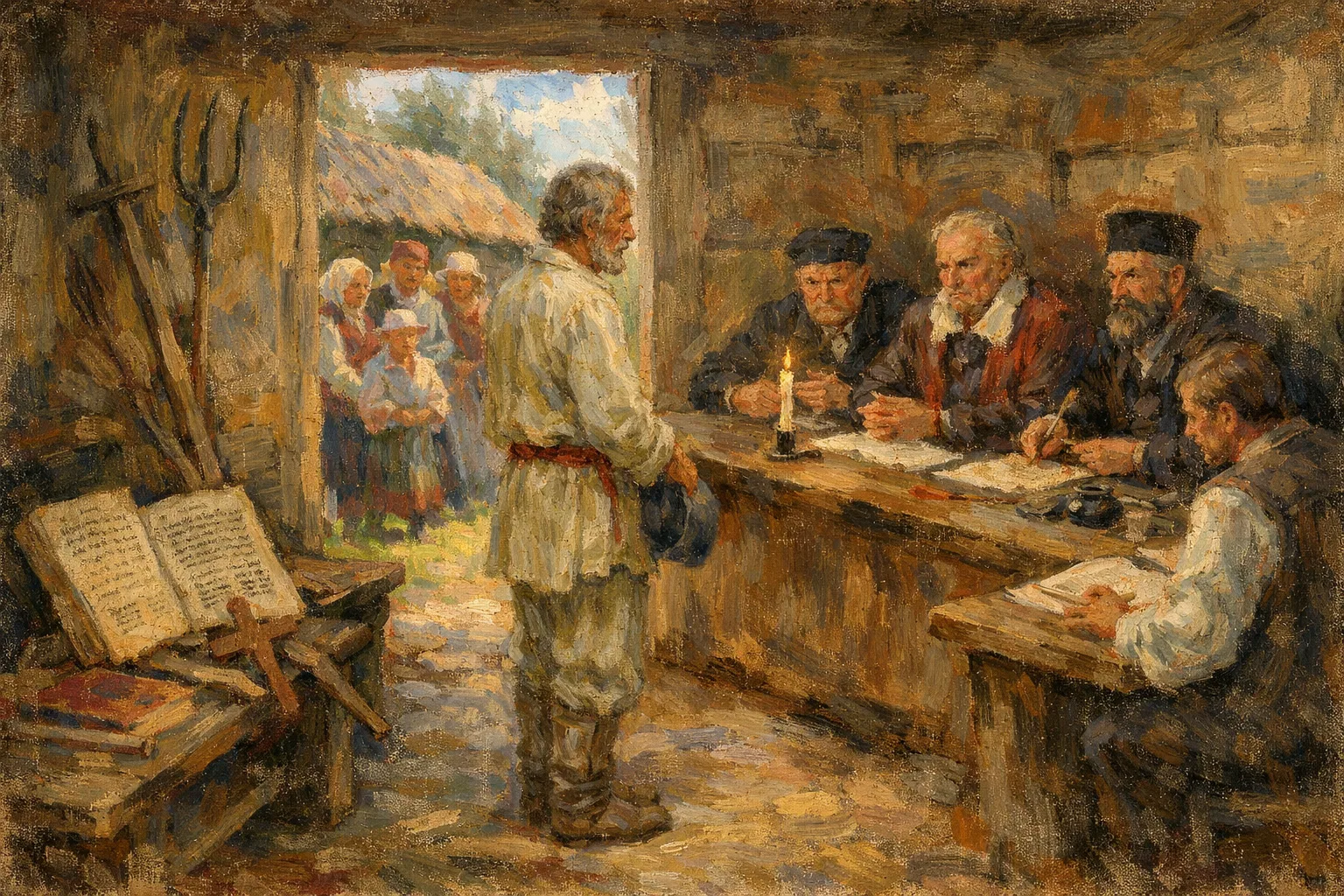
The most remarkable surviving case is the 1692 trial of an elderly peasant commonly known as Thiess of Kaltenbrun. He appeared before a court at Jürgensburg, in Swedish Livonia, in a district now associated with Latvia. Unlike defendants who denied supernatural accusations, Thiess freely described himself as a werewolf. His explanation, however, overturned the judges’ assumptions.
Thiess said that he and other werewolves were servants of God who travelled to Hell at particular times of year. There they fought witches who had stolen grain, livestock and the fertility of the fields. If the werewolves failed, he claimed, the harvest would suffer. Werewolves were therefore not agents of Satan in his account; they defended the community against Satanic forces. A surviving transcript preserves the clash between his story and the court’s repeated attempts to make it conform to orthodox Christian teaching.[University of Chicago Press]press.uchicago.eduUniversity of Chicago Press Old Thiess,University of Chicago PressOld Thiess,February 28, 2020 — This trial transcript was filed in the Hofger- Archiv Kriminalakte n. 30 v. J…
The case is valuable because it shows that “belief in witchcraft” was not one coherent system. Judges knew an elite demonology in which transformation into a wolf implied diabolical corruption. Thiess presented something closer to a seasonal battle for agricultural abundance. His testimony combined Christian figures, folk cosmology and the practical concerns of a farming society. The court could not simply accept this alternative theology, but neither did it produce convincing evidence that Thiess belonged to an organised secret group.
He was punished for superstition, idolatry and contempt towards the clergy rather than executed as the leader of a murderous werewolf cult. Later scholars made Thiess famous by comparing his account with other European traditions of visionary battles, fertility guardians and night-travelling spirits. Those comparisons are suggestive, but historians disagree about how much can safely be reconstructed from one pressured courtroom encounter. The transcript is strong evidence for what Thiess told the judges; it is much weaker evidence for the existence of a structured, ancient werewolf religion.[University of Chicago Press]press.uchicago.eduUniversity of Chicago Press Old Thiess,University of Chicago PressOld Thiess,February 28, 2020 — This trial transcript was filed in the Hofger- Archiv Kriminalakte n. 30 v. J…
This distinction matters because modern retellings often turn Thiess into either a fantasy hero or proof of a surviving pagan order. The documented case is stranger and more revealing. A peasant used the authorities’ own supernatural language while rejecting their moral categories. His “werewolves” were not monsters but guardians, and the court’s problem was less uncontrolled panic than an inability to tolerate a competing explanation of good, evil and misfortune.
A revival that frightened landlords
During the eighteenth century, another form of contagious belief spread through Vidzeme: the Moravian or Herrnhutian Christian revival. Missionaries connected with the renewed Moravian Church began working in Livonia during the late 1720s and found an unusually receptive audience among Latvian peasants. They emphasised personal conversion, emotional religious experience, mutual fellowship, literacy and direct engagement with Christian teaching.
The movement expanded in communities marked by war, poverty and serfdom. Moravian preachers addressed peasants with a degree of spiritual equality that contrasted with the rigid social hierarchy of the estates. Meetings, testimonies and handwritten religious texts helped participants create networks outside the ordinary channels controlled by landlords and established clergy. Europeana’s account of the surviving manuscript culture describes the movement as both a religious awakening and an expansion of writing among people who had previously enjoyed little access to literary participation.[Europeana]europeana.euOpen source on europeana.eu.
To followers, this was renewal. To many Baltic German landlords and Lutheran authorities, it looked dangerously like an independent movement among a subordinated population. The imperial government prohibited Moravian activity between 1743 and 1764, although networks continued informally. Suspicion was directed not simply at unusual doctrine but at unsupervised gatherings, emotional solidarity and the possibility that peasants might develop loyalties beyond the manor and official church.[Helda]helda.helsinki.fiOpen source on helsinki.fi.
The Moravian episode is sometimes described in language resembling later “cult scares”, but that label is misleading. There is no need to portray participants as hypnotised or irrational to explain the movement’s growth. It offered dignity, education, community and a religious interpretation of suffering. Nor was elite alarm entirely imaginary: any autonomous organisation among serfs had social and political implications. The panic lay in the authorities’ tendency to treat spiritual independence as a possible threat to the whole established order.
Its longer legacy was substantial. Moravian manuscript practices encouraged literacy and autobiographical writing, while the communities helped prepare the ground for later Latvian cultural self-organisation. A movement once restricted as socially disruptive subsequently became part of the history of Latvian education and national awakening.[Europeana]europeana.euOpen source on europeana.eu.
The post-Soviet “cult” problem
The restoration of Latvian independence in 1991 opened a religious landscape that had been constrained by Soviet state atheism. Foreign missionaries, charismatic churches, esoteric teachers and new spiritual associations entered public view alongside revived Lutheran, Catholic, Orthodox, Jewish and indigenous religious traditions. Rapid change made these groups highly visible, particularly when they used unfamiliar styles of recruitment, worship or leadership.
Research on new religious movements in Latvia found that public knowledge was heavily mediated by newspapers and other mass media. One study surveyed hundreds of Latvian articles from the late Soviet and post-independence periods, reflecting how strongly public understandings of minority religions depended on journalistic classification. Controversies generated an organised anti-cult response, while public attitudes towards new movements remained broadly negative even after the most active anti-cult organisations declined in the mid-2000s.[VDU]vdu.ltNew religious movements in LatviaNew religious movements in Latvia
Some concern was reasonable. Religious language does not excuse fraud, coercion, abuse or exploitative leadership, and unfamiliar organisations should not be shielded from ordinary criminal and civil law. The difficulty is that “cult” can become a catch-all term covering everything from a controlling organisation to a merely unpopular denomination. European legal discussions have repeatedly warned that the word carries pejorative assumptions and has no simple legal definition; “new religious movement” is usually more neutral when no specific wrongdoing has been established.[European Parliament]europarl.europa.euEuropean Parliament Cults in EuropeEuropean Parliament Cults in Europe
Latvia’s modern legal position reflects the tension between freedom and regulation. Constitutional jurisprudence treats inward belief as an absolute right while allowing outward religious activity to be restricted by law for purposes such as public order and the rights of others. Religious organisations may register with the state, although newer groups have historically faced requirements and distinctions not applied in exactly the same way to long-established traditions. Recent religious-freedom reporting records the continuing registration of new groups rather than a general state ban on unconventional religion.[tiesa.gov.lv]satv.tiesa.gov.lv2010 50 03 Spriedums ENG2010 50 03 Spriedums ENG
The Latvian experience therefore resembles a moral panic more than a single cult crisis. The feared object was a changing category of outsiders: foreign missionaries, charismatic leaders, esoteric organisations or small communities described as psychologically dangerous. The most responsible approach is to ask about demonstrable conduct—financial control, isolation, threats, deception or abuse—rather than treating theological novelty as evidence of criminality.
The meteorite that was dug with shovels
On 25 October 2009, reports emerged that a meteorite had struck a field near Mazsalaca in northern Latvia. Video showed a burning crater, and the apparently dramatic impact attracted journalists, local spectators and official attention. Police, firefighters, military personnel and scientific specialists attended the site, while radiation checks and other precautions reflected the possibility that an unknown object had genuinely fallen from the sky.
The story spread because it supplied several persuasive signals at once: physical damage, flames, eyewitness excitement, amateur-looking footage and an emergency response. Yet scientists quickly noticed contradictions. A genuine impact of the reported scale should have produced visible atmospheric evidence and scattered material around the crater. Instead, grass remained around parts of the hole, no meteorite fragments were found, and the burning substance at the bottom did not resemble the aftermath of a natural impact. Latvian investigators concluded that the crater had been made artificially.[WIRED]wired.comDid a Meteorite, or Nerdy Hoaxsters, Strike Latvia?Did a Meteorite, or Nerdy Hoaxsters, Strike Latvia?
Two days later, the telecommunications company Tele2 admitted that the “meteorite” was a publicity stunt. People working for the campaign had dug the hole and placed combustible material inside it. The company said it wanted to distract attention from Latvia’s economic crisis, but officials objected that emergency resources had been used and the public had been made to feel unsafe. Tele2 offered to reimburse state costs, while the Interior Ministry announced that it would end its business relationship with the company.[Wikipedia]Wikipedia2009 Latvian meteorite hoax2009 Latvian meteorite hoax
Calling the event mass hysteria would be inaccurate. Most people responded reasonably to limited and misleading evidence, and the authorities had a duty to investigate a possible impact or explosion. The episode is better classified as a manufactured rumour panic: private actors created apparently authentic evidence, online video accelerated circulation, news coverage expanded the audience, and official precautions unintentionally strengthened the story’s credibility.
The rapid debunking is as important as the deception. Scientists examined material evidence, compared the scene with the known behaviour of meteorites and publicly explained the inconsistencies. The scare lasted only while the fabricated signs could survive contact with expert investigation. It remains a compact Latvian example of how a spectacle can move from staged event to media certainty, public concern and institutional response before its commercial purpose is revealed.

What Latvia’s cases have in common
Latvia’s episodes differ greatly, but several recurring mechanisms connect them.
Misfortune seeks an agent. In witchcraft accusations, unexplained illness, failed harvests or dead livestock were assigned to malicious neighbours. Naming a responsible person made uncertainty feel manageable, but it also exposed socially vulnerable people to interrogation and punishment.
Authorities shape the belief they investigate. Early modern judges did not merely record peasant ideas; they pressed defendants towards recognised Christian stories about Satan. In the Mazsalaca affair, the deployment of emergency services did not create the hoax, but it made an uncertain report look more credible until specialists completed their examination.
Social hierarchy determines who can define reality. Baltic German courts and landlords could classify Latvian practices as superstition, witchcraft or disorder. Established churches could treat independent peasant devotion as dangerous enthusiasm. In the post-Soviet period, journalists, officials, established religions and anti-cult campaigners possessed far greater power to label minority movements than those movements had to define themselves.
Periods of transition create openings for both belief and alarm. Confessional conflict encouraged witch prosecution; serfdom and religious inequality helped the Moravian revival spread; the collapse of Soviet controls produced both religious experimentation and fear of new movements; economic crisis formed the backdrop to a publicity stunt designed to seize national attention.
These patterns do not prove that Latvia is unusually prone to collective delusion. On the contrary, the evidence warns against using “mass hysteria” as a loose explanation. The better questions are who introduced a claim, which institutions certified it, what evidence was available, whose interests were threatened and whether alleged dangers were demonstrated or merely repeated.
Why the stories still matter
The Latvian cases remain culturally important because they sit at the boundary between folklore and documented history. Witch legends preserve memories of persecution but can also simplify the legal record. Thiess has become an emblem of resistant folk belief, although his courtroom testimony cannot establish everything later writers have claimed for it. The Moravian revival demonstrates how a movement condemned as disruptive can later be remembered as a source of literacy and collective identity.
Modern cases add a different warning. “Cult” language can identify serious fears about manipulation, yet it can also stigmatise harmless religious minorities. A fake meteorite can create genuine public expenditure and anxiety without requiring widespread irrationality. In both situations, dramatic labels obscure the more useful task of tracing evidence and responsibility.
Latvia’s history of panics and contagious belief is therefore not a catalogue of bizarre episodes. It is a history of contested authority: courts translating folk fears into crimes, peasants developing beliefs outside elite control, media deciding which minorities appear dangerous, and experts trying to separate real hazards from stories that merely look convincing.
Amazon book picks
Further Reading
Books and field guides related to When Fear and Belief Reshaped Latvia. Use these as the next step if you want deeper reading beyond the article.

The Penguin history of Europe
Provides wider historical setting for Baltic developments.

Endnotes
1.
Source: Wikipedia
Title: Witch trials in Latvia and Estonia
Link:https://en.wikipedia.org/wiki/Witch_trials_in_Latvia_and_Estonia
2.
Source: researchgate.net
Link:https://www.researchgate.net/publication/331647153_Research_of_Witch_Persecution_in_Latvia_A_Shared_Field_of_History_and_Folkloristics
Source snippet
ResearchGate(PDF) Research of Witch Persecution in Latvia: A Shared...11 Mar 2019 — The article provides an overview into Latvian resear...
3.
Source: rigasights.com
Title: Riga Sights
Link:https://www.rigasights.com/riga-witches/
Source snippet
Tours in LatviaRiga Witch TrialsThe first known witch burnings in Latvia occurred Grobiņa in 1559. In 1574, a Latvian woman named Katrīna...
4.
Source: europeana.eu
Link:https://www.europeana.eu/nl/exhibitions/herrnhutian-manuscripts/expanding-the-writing-community
5.
Source: Wikipedia
Title: History of Latvia
Link:https://en.wikipedia.org/wiki/History_of_Latvia
6.
Source: vdu.lt
Title: New religious movements in Latvia
Link:https://www.vdu.lt/cris/bitstreams/4650bee4-77c0-4e9d-901d-b302663ecf30/download
7.
Source: satv.tiesa.gov.lv
Title: 2010 50 03 Spriedums ENG
Link:https://www.satv.tiesa.gov.lv/wp-content/uploads/2010/07/2010-50-03_Spriedums_ENG.pdf
8.
Source: state.gov
Title: 547499 LATVIA 2023 INTERNATIONAL RELIGIOUS FREEDOM REPORT
Link:https://www.state.gov/wp-content/uploads/2024/04/547499-LATVIA-2023-INTERNATIONAL-RELIGIOUS-FREEDOM-REPORT.pdf
9.
Source: 2021-2025.state.gov
Link:https://2021-2025.state.gov/reports/2021-report-on-international-religious-freedom/latvia/
10.
Source: wired.com
Title: Did a Meteorite, or Nerdy Hoaxsters, Strike Latvia?
Link:https://www.wired.com/2009/10/did-a-meteorite-or-nerdy-hoaxsters-strike-latvia
11.
Source: Wikipedia
Title: 2009 Latvian meteorite hoax
Link:https://en.wikipedia.org/wiki/2009_Latvian_meteorite_hoax
12.
Source: Wikipedia
Title: Witch trials in the early modern period
Link:https://en.wikipedia.org/wiki/Witch_trials_in_the_early_modern_period
13.
Source: Wikipedia
Title: Satanic panic
Link:https://en.wikipedia.org/wiki/Satanic_panic
14.
Source: Wikipedia
Title: List of mass panic cases
Link:https://en.wikipedia.org/wiki/List_of_mass_panic_cases
15.
Source: Wikipedia
Link:https://en.wikipedia.org/wiki/Millenarianism
16.
Source: Wikipedia
Title: Werewolf witch trials
Link:https://en.wikipedia.org/wiki/Werewolf_witch_trials
17.
Source: Wikipedia
Title: Thiess of Kaltenbrun
Link:https://en.wikipedia.org/wiki/Thiess_of_Kaltenbrun
18.
Source: Wikipedia
Link:https://en.wikipedia.org/wiki/Ra%C3%ABlism
19.
Source: Wikipedia
Title: Blood libel
Link:https://en.wikipedia.org/wiki/Blood_libel
20.
Source: Wikipedia
Title: UFO religion
Link:https://en.wikipedia.org/wiki/UFO_religion
21.
Source: state.gov
Link:https://www.state.gov/report/custom/3894b18c1b
22.
Source: state.gov
Title: LATVIA 2019 INTERNATIONAL RELIGIOUS FREEDOM REPORT
Link:https://www.state.gov/wp-content/uploads/2020/06/LATVIA-2019-INTERNATIONAL-RELIGIOUS-FREEDOM-REPORT.pdf
23.
Source: state.gov
Title: 240282 LATVIA 2020 INTERNATIONAL RELIGIOUS FREEDOM REPORT
Link:https://www.state.gov/wp-content/uploads/2021/05/240282-LATVIA-2020-INTERNATIONAL-RELIGIOUS-FREEDOM-REPORT.pdf
24.
Source: state.gov
Title: LATVIA 2018 INTERNATIONAL RELIGIOUS FREEDOM REPORT
Link:https://www.state.gov/wp-content/uploads/2019/05/LATVIA-2018-INTERNATIONAL-RELIGIOUS-FREEDOM-REPORT.pdf
25.
Source: 2009-2017.state.gov
Link:https://2009-2017.state.gov/documents/organization/171703.pdf
26.
Source: 1997-2001.state.gov
Link:https://1997-2001.state.gov/global/human_rights/970722_relig_rpt_christian.html
27.
Source: state.gov
Title: 441219 UKRAINE 2022 INTERNATIONAL RELIGIOUS FREEDOM REPORT
Link:https://www.state.gov/wp-content/uploads/2023/05/441219-UKRAINE-2022-INTERNATIONAL-RELIGIOUS-FREEDOM-REPORT.pdf
28.
Source: 2009-2017.state.gov
Link:https://2009-2017.state.gov/j/drl/rls/irf/2007/90183.htm
29.
Source: state.gov
Link:https://www.state.gov/reports/2022-report-on-international-religious-freedom/latvia
30.
Source: satv.tiesa.gov.lv
Title: can constitutional courts delimit european identity
Link:https://www.satv.tiesa.gov.lv/en/runas-un-raksti/can-constitutional-courts-delimit-european-identity/
31.
Source: satv.tiesa.gov.lv
Title: tiesa.gov.lv G RĀMATAS ANGĻU VALODĀ
Link:https://www.satv.tiesa.gov.lv/wp-content/uploads/2019/07/Gr%C4%81matas_ANG%C4%BBU-VAL..pdf
32.
Source: europeana.eu
Title: herrnhutian manuscripts
Link:https://www.europeana.eu/eu/exhibitions/herrnhutian-manuscripts
34.
Source: nationalarchives.gov.uk
Link:https://www.nationalarchives.gov.uk/education/resources/early-modern-witch-trials/
35.
Source: history.com
Title: what was satanic panic 1980s
Link:https://www.history.com/articles/what-was-satanic-panic-1980s
36.
Source: researchgate.net
Link:https://www.researchgate.net/publication/292145151_Deconstructing_a_Modern_Witch_Hunt_Satanic_Cults_Ritual_Abuse_and_Moral_Panic
37.
Source: researchgate.net
Title: 377853391 New religious movements in Latvia
Link:https://www.researchgate.net/publication/377853391_New_religious_movements_in_Latvia
38.
Source: press.uchicago.edu
Title: University of Chicago Press Old Thiess,
Link:https://press.uchicago.edu/sites/thiess/old_thiess_transcript.pdf
Source snippet
University of Chicago PressOld Thiess,February 28, 2020 — This trial transcript was filed in the Hofger- Archiv Kriminalakte n. 30 v. J...
Published: February 28, 2020
39.
Source: helda.helsinki.fi
Link:https://helda.helsinki.fi/bitstreams/b23593e3-c115-4dc4-9394-51d97ab14f59/download
40.
Source: europarl.europa.eu
Title: European Parliament Cults in Europe
Link:https://www.europarl.europa.eu/workingpapers/cito/w10/page1_en.htm
41.
Source: eap-iea.org
Link:https://eap-iea.org/index.php/eap/article/view/814
42.
Source: ebsco.com
Link:https://www.ebsco.com/research-starters/social-sciences-and-humanities/mass-hysteria
43.
Source: science.smith.edu
Title: witch trials
Link:https://www.science.smith.edu/climatelit/witch-trials/
44.
Source: healthline.com
Title: mass hysteria
Link:https://www.healthline.com/health/mental-health/mass-hysteria
Additional References
45.
Source: emotionsblog.history.qmul.ac.uk
Title: an account of the trial of a livonian werewolf in jurgensburg in 1692
Link:https://emotionsblog.history.qmul.ac.uk/2013/03/an-account-of-the-trial-of-a-livonian-werewolf-in-jurgensburg-in-1692/
Source snippet
An account of the trial of a Livonian werewolf in...6 Mar 2013 — The accused, a certain Thiess, an old man in his eighties, freely confe...
46.
Source: link.springer.com
Title: Estonian Werewolf History
Link:https://link.springer.com/content/pdf/10.1007/978-1-137-52634
Source snippet
Estonian Werewolf History - Springer NatureAccording to Thies and the other accused in Latvian witch trials, Hell was located som...
47.
Source: youtube.com
Title: Werewolf For God: The Turbulent Trial of Thiess of Kaltenbrunn
Link:https://www.youtube.com/watch?v=B5Bpbmf0Dgw
Source snippet
The Werewolf of Latvia: Myth or Reality?...
48.
Source: academia.edu
Link:https://www.academia.edu/5368224/Apocalyptic_and_Millenarian_Movements
49.
Source: academia.edu
Link:https://www.academia.edu/59044277/Of_Demons_and_Disciplines_Old_Thiess_a_Livonian_Werewolf_A_Classic_Case_in_Comparative_Perspective_by_Carlo_Ginzburg_and_Bruce_Lincoln_and_Daemons_Are_Forever_Contacts_and_Exchanges_in_the_Eurasian_Pandemonium_by_David_Gordon_White_
50.
Source: eng.lsm.lv
Link:https://eng.lsm.lv/article/culture/literature/27.07.2024-500-years-of-latvian-books-the-moravian-brethren-and-the-spread-of-literacy.a562832/
51.
Source: historytoday.com
Link:https://www.historytoday.com/archive/blood-libel-origins-conspiracy-theory
52.
Source: censamm.org
Link:https://censamm.org/
53.
Source: springermedizin.de
Link:https://www.springermedizin.de/factors-related-to-the-occurrence-of-mass-psychogenic-illness-in/51122102
54.
Source: brill.com
Link:https://brill.com/display/book/9789004292468/9789004292468_webready_content_text.pdf?srsltid=AfmBOorXDBrfQGoNme6DxYlXMV5GwSlu_M9tWJL_XnOXxum1T4g59MjX
Topic Tree
Follow this branch
Related pages 192
- Antigua and Barbuda
- Argentina Belief Scares
- Azerbaijan Belief
- Bahrain Beliefs
- North Korea
- +187 more in sidebar