Within Papua New Guinea
Were Cargo Cults Really About Free Goods?
The label 'cargo cult' often reduced complex religious and political movements to a colonial story about irrational longing for goods.
On this page
- Where the cargo cult label came from
- What followers believed and wanted
- How colonial accounts distorted the movements
Page outline Jump by section
Introduction
The expression “cargo cult” has become one of the best-known phrases associated with Papua New Guinea, yet many historians and anthropologists now regard it as misleading. The label encouraged outsiders to imagine that Melanesian people simply believed that copying Europeans would cause ships or aircraft to deliver free manufactured goods. In reality, the movements grouped under this heading were remarkably diverse. They combined Christian teaching, older religious traditions, political protest, ideas about justice, hopes for economic change and attempts to understand the profound inequalities created by colonial rule. Modern scholarship therefore treats “cargo cult” less as the name of a single type of movement than as a revealing example of how colonial authorities misunderstood – and sometimes dismissed – complex social and religious responses to rapid change.[Open Encyclopedia of Anthropology]anthroencyclopedia.comOpen Encyclopedia of AnthropologyCargo cults | Open Encyclopedia of AnthropologyMarch 29, 2018…
Where the “cargo cult” label came from
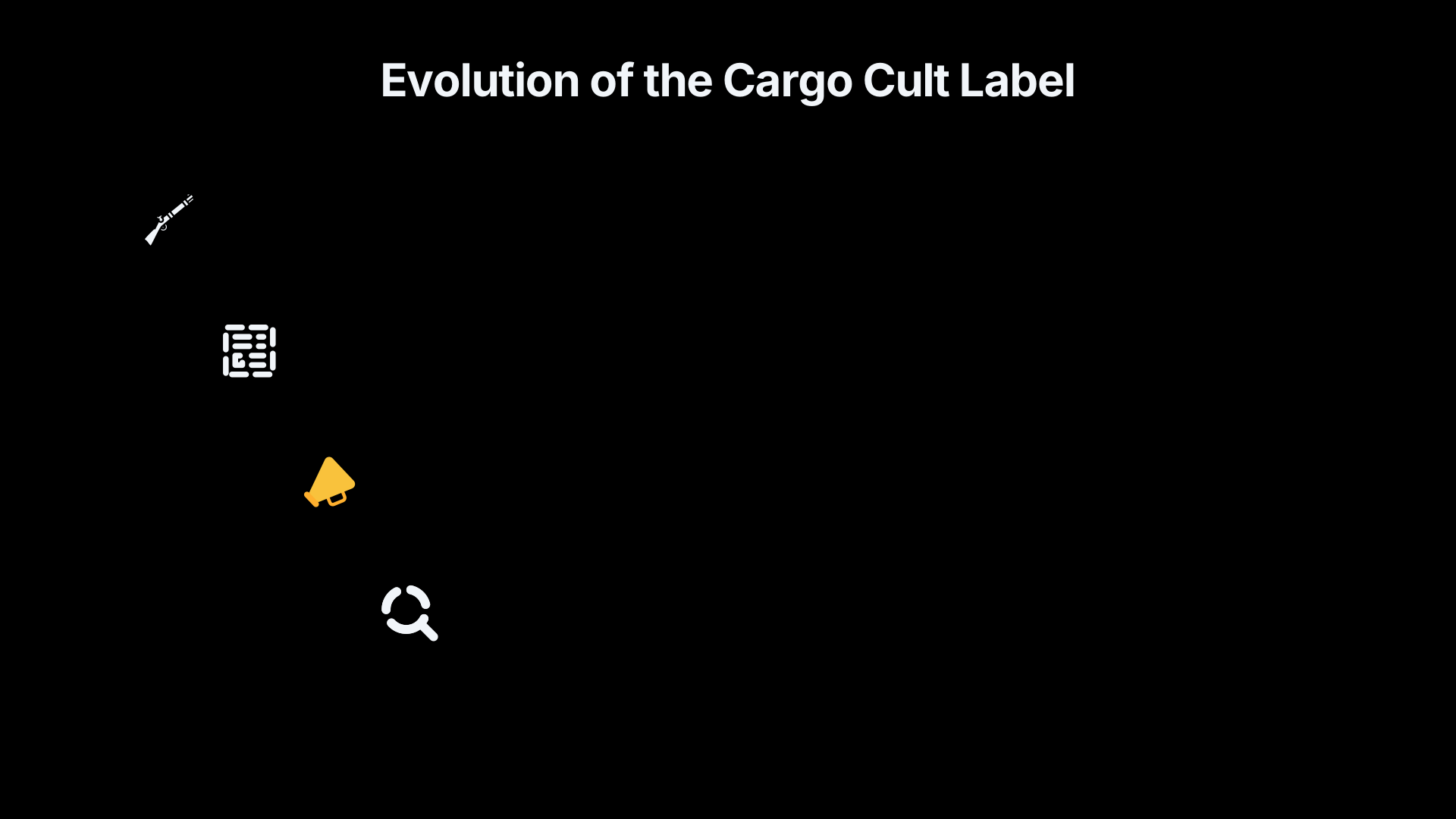
The phrase did not originate with the people whose movements it described. It first appeared in print in 1945 in the colonial magazine Pacific Islands Monthly, where former colonial resident Norris Mervyn Bird used it to warn that missionary teaching, wartime disruption and political reform might encourage supposedly irrational religious movements in New Guinea. Bird presented these movements as evidence that Indigenous people were vulnerable to dangerous fantasies rather than responding to real social conditions.[Open Encyclopedia of Anthropology]anthroencyclopedia.comOpen Encyclopedia of AnthropologyCargo cults | Open Encyclopedia of AnthropologyMarch 29, 2018…
The new expression quickly replaced earlier labels such as “Vailala Madness”, itself a colonial description of the Vailala movement in the Papuan Gulf during the early 1920s. By using the word cult, colonial writers implied religious irrationality, while cargo suggested that the movements were motivated primarily by greed for imported goods. The combination proved memorable, and it spread rapidly through anthropology, journalism and popular culture.[Open Encyclopedia of Anthropology]anthroencyclopedia.comOpen Encyclopedia of AnthropologyCargo cults | Open Encyclopedia of AnthropologyMarch 29, 2018…
Yet the convenience of the phrase came at a cost. It grouped together dozens of unrelated movements across Papua New Guinea, the Solomon Islands and Vanuatu despite their different leaders, beliefs, political goals and historical settings. A label originally created as criticism became treated as though it described a single social phenomenon.[Open Encyclopedia of Anthropology]anthroencyclopedia.comOpen Encyclopedia of AnthropologyCargo cults | Open Encyclopedia of AnthropologyMarch 29, 2018…
Were followers really waiting for free goods?
The popular stereotype imagines people building imitation airstrips or marching with wooden rifles because they believed these actions would magically attract Western supplies. While some movements did include symbolic rituals involving ships, aircraft or military drill, these practices were only one part of much broader religious and political programmes.[Open Encyclopedia of Anthropology]anthroencyclopedia.comOpen Encyclopedia of AnthropologyCargo cults | Open Encyclopedia of AnthropologyMarch 29, 2018…
Many followers were trying to answer difficult questions created by colonialism:
- Why did Europeans possess enormous wealth while local communities remained poor?
- Why did missionaries preach equality before God while colonial governments enforced unequal political power?
- Why did imported goods appear to arrive without local people seeing how they were produced?
- Could moral reform, religious renewal or ancestral intervention restore justice?
In this context, “cargo” often symbolised much more than manufactured products. It represented prosperity, dignity, rightful authority and participation in a rapidly changing world. Expectations that ancestors or divine forces would bring abundance resembled millenarian movements found in many parts of the world, rather than uniquely Melanesian misunderstandings of technology.[anthroencyclopedia.com]anthroencyclopedia.comOpen Encyclopedia of AnthropologyCargo cults | Open Encyclopedia of AnthropologyMarch 29, 2018…
What followers believed and wanted
Although no single description fits every movement, several recurring themes appear across the historical record.
Religious renewal. Many movements encouraged moral reform, rejection of wrongdoing and preparation for a transformed future. Christian ideas blended with existing beliefs about ancestors and spiritual power rather than replacing them outright.[Open Encyclopedia of Anthropology]anthroencyclopedia.comOpen Encyclopedia of AnthropologyCargo cults | Open Encyclopedia of AnthropologyMarch 29, 2018…
Justice and equality. Followers often interpreted colonial inequality through a religious framework. They questioned why foreigners controlled trade, government and education despite Christian teachings about universal humanity. Hopes for future abundance frequently expressed a desire for fairness rather than simple material acquisition.[Open Encyclopedia of Anthropology]anthroencyclopedia.comOpen Encyclopedia of AnthropologyCargo cults | Open Encyclopedia of AnthropologyMarch 29, 2018…
Political autonomy. Some movements sought greater local authority, challenged colonial taxation or imagined new forms of Indigenous leadership. Colonial officials sometimes viewed these ambitions as politically threatening even when expressed in religious language.[Open Encyclopedia of Anthropology]anthroencyclopedia.comOpen Encyclopedia of AnthropologyCargo cults | Open Encyclopedia of AnthropologyMarch 29, 2018…
Community solidarity. Shared rituals, meetings and prophecy helped communities cope with rapid social disruption caused by labour migration, missionisation, warfare and new economic systems. These movements offered explanations during periods when older social structures were under intense pressure.[Open Encyclopedia of Anthropology]anthroencyclopedia.comOpen Encyclopedia of AnthropologyCargo cults | Open Encyclopedia of AnthropologyMarch 29, 2018…
How colonial accounts distorted the movements
Colonial administrators, missionaries and journalists often interpreted unfamiliar rituals literally while overlooking their symbolic or political meanings.
One recurring misunderstanding involved imitation. Marching, flag ceremonies or military drill were frequently described as naïve attempts to copy Europeans in order to obtain cargo. Modern researchers note that such performances could instead express discipline, unity, new political identities or participation in a transformed moral order. Similar ceremonial borrowing occurs in many religious traditions without implying confusion about how technology works.[Wiley Online Library]onlinelibrary.wiley.comOnline Library Cargo Cults and Discursive MadnessWiley Online LibraryCargo Cults and Discursive Madness - Dalton - 2000 - Oceania - Wiley Online Library…
Another distortion came from treating all reports equally. Outsiders often highlighted the most unusual stories because they made compelling colonial anecdotes, while everyday concerns about land, labour, authority and development received far less attention. As a result, spectacular claims became representative of entire movements that were actually diverse and locally specific.[Wiley Online Library]onlinelibrary.wiley.comOnline Library Cargo Cults and Discursive MadnessWiley Online LibraryCargo Cults and Discursive Madness - Dalton - 2000 - Oceania - Wiley Online Library…
Colonial descriptions also tended to portray Indigenous people as misunderstanding modern production. Yet many participants had worked on plantations, travelled widely or served alongside Allied forces during the Second World War. They were well aware that factories, transport systems and governments existed. Their questions were often about why wealth was distributed so unequally, not about how machinery physically operated.[Open Encyclopedia of Anthropology]anthroencyclopedia.comOpen Encyclopedia of AnthropologyCargo cults | Open Encyclopedia of AnthropologyMarch 29, 2018…
Why many anthropologists now use the term cautiously
Beginning in the 1970s, increasing numbers of anthropologists argued that “cargo cult” obscured more than it explained. As Papua New Guinea and neighbouring territories gained independence, scholars increasingly examined these movements as revitalisation movements, millenarian movements or new religious movements shaped by colonial history rather than as examples of irrational belief.[Open Encyclopedia of Anthropology]anthroencyclopedia.comOpen Encyclopedia of AnthropologyCargo cults | Open Encyclopedia of AnthropologyMarch 29, 2018…
Today, several positions exist:
- Many scholars avoid the term entirely, arguing that its colonial origins and popular stereotypes make it analytically misleading.
- Some retain it cautiously as a historical label while carefully explaining its limitations.
- Others argue it remains useful for comparing related movements, provided readers understand that it covers highly varied historical experiences rather than one uniform phenomenon.[edu.au]eprints.jcu.edu.auWhat happened to cargo cults? Material religions in Melanesia and the WestWhat happened to cargo cults? Material religions in Melanesia and the West
The debate itself has become important because it illustrates how language can shape public understanding of another society.

Why the misunderstanding still matters
The image of the “cargo cult” continues to appear far beyond Melanesia. In popular speech it has become shorthand for people who imitate outward appearances without understanding underlying causes, particularly in computing, management and politics. Ironically, this metaphor often reinforces the same colonial assumptions that modern scholarship has questioned.[Wiley Online Library]onlinelibrary.wiley.comOnline Library Cargo CultsWiley Online LibraryCargo Cults - Otto - Major Reference Works - Wiley Online Library…
For Papua New Guinea, the legacy is significant because it affects how historical movements are remembered. Seeing them simply as irrational quests for free goods obscures their roles as responses to colonial inequality, religious change and struggles over authority. Understanding the history behind the label reveals less about supposed Indigenous irrationality than about the ways colonial observers interpreted unfamiliar beliefs through their own assumptions.
Rather than asking whether “cargo cults” were really about cargo, historians increasingly ask a different question: what did imported wealth, Christian prophecy and ancestral promises mean to communities trying to make sense of a profoundly unequal colonial world? Framed that way, these movements become not historical curiosities but serious attempts to explain injustice and imagine a different future.[anthroencyclopedia.com]anthroencyclopedia.comOpen Encyclopedia of AnthropologyCargo cults | Open Encyclopedia of AnthropologyMarch 29, 2018…


Endnotes
1.
Source: onlinelibrary.wiley.com
Title: Online Library Cargo Cults
Link:https://onlinelibrary.wiley.com/doi/10.1002/9781118430873.est0042
Source snippet
Wiley Online LibraryCargo Cults - Otto - Major Reference Works - Wiley Online Library...
2.
Source: eprints.jcu.edu.au
Title: What happened to cargo cults? Material religions in Melanesia and the West
Link:https://eprints.jcu.edu.au/9273/
3.
Source: onlinelibrary.wiley.com
Title: Online Library Cargo Cults and Discursive Madness
Link:https://onlinelibrary.wiley.com/doi/abs/10.1002/j.1834-4461.2000.tb03071.x
Source snippet
Wiley Online LibraryCargo Cults and Discursive Madness - Dalton - 2000 - Oceania - Wiley Online Library...
4.
Source: onlinelibrary.wiley.com
Link:https://onlinelibrary.wiley.com/doi/abs/10.1002/ocea.5414
Source snippet
wiley.comCritique, Vision and Cosmology: Millenarian Ideas in Melanesia - Hirsch - 2024 - Oceania - Wiley Online LibraryNovember 18, 2024...
Published: November 18, 2024
5.
Source: encyclopedia.com
Title: Cargo Cult | Encyclopedia.com
Link:https://www.encyclopedia.com/social-sciences-and-law/anthropology-and-archaeology/anthropology-terms-and-concepts/cargo-cult
Source snippet
May 14, 2018 — CARGO CULTS views 2,486,683 updated May 14 2018 CARGO CULTS Various forms of modern mythologies among the native peoples o...
Published: May 14, 2018
6.
Source: onlinelibrary.wiley.com
Link:https://onlinelibrary.wiley.com/doi/abs/10.1002/9781118430873.est0042
7.
Source: encyclopedia.com
Link:https://www.encyclopedia.com/environment/encyclopedias-almanacs-transcripts-and-maps/lawrence-peter
8.
Source: everything.explained.today
Link:https://everything.explained.today/Cargo_cult/
9.
Source: anthroencyclopedia.com
Link:https://www.anthroencyclopedia.com/entry/cargo-cults
Source snippet
Open Encyclopedia of AnthropologyCargo cults | Open Encyclopedia of AnthropologyMarch 29, 2018...
Published: March 29, 2018
10.
Source: Wikipedia
Title: Cargo cult
Link:https://en.wikipedia.org/wiki/Cargo_cult
11.
Source: kureansiklopedi.com
Title: Cargo Cults | KÜRE Encyclopedia
Link:https://kureansiklopedi.com/en/detay/cargo-cults-b1541
Source snippet
November 30, 2025 — CARGO CULTS Anthropology More Quote Cargo Cults (English: Cargo Cults) is a general term for religious and social mov...
Published: November 30, 2025
12.
Source: books.openedition.org
Link:https://books.openedition.org/pacific/168?format=embed
13.
Source: books.openedition.org
Link:https://books.openedition.org/pacific/1935
14.
Source: doi.org
Title: Sage Reference
Link:https://doi.org/10.4135/9781529714401.n71
Additional References
15.
Source: academic.oup.com
Link:https://academic.oup.com/book/6453/chapter-abstract/150293580
Source snippet
OUP AcademicCommodity Millennialism: Papuan Cargo Cults (Twentieth Century) | Heaven on Earth: The Varieties of the Millennial Experience...
16.
Source: youtube.com
Title: Geography of Vanuatu: The Most Fascinating Religions on Earth?
Link:https://www.youtube.com/watch?v=dna8j4vPjVU
Source snippet
The Man Who Convinced a Tribe to WORSHIP America...
17.
Source: newworldencyclopedia.org
Title: New World Encyclopedia Cargo cult
Link:https://www.newworldencyclopedia.org/entry/Cargo_cult
Source snippet
New World EncyclopediaCargo cult - New World Encyclopedia...
18.
Source: youtube.com
Title: How WWII Created a NEW Religion In The Jungle
Link:https://www.youtube.com/watch?v=b0a9mOtf0UU
Source snippet
Geography of Vanuatu: The Most Fascinating Religions on Earth?...
19.
Source: degruyterbrill.com
Link:https://www.degruyterbrill.com/document/doi/10.1515/9780824840440/html?lang=en
20.
Source: scribd.com
Link:https://www.scribd.com/document/727288141/Cargo-Cult-1
21.
Source: natlib.govt.nz
Link:https://natlib.govt.nz/records/20970814?search%5Bi%5D%5Bsubject%5D=Social+change&search%5Bi%5D%5Bsubject_text%5D=Papua+New+Guineans&search%5Bpath%5D=items
22.
Source: youtube.com
Title: Cargo Cults: When WWII Supplies Became a Religion
Link:https://www.youtube.com/watch?v=2cPKc-lH4No
Source snippet
How WWII Created a NEW Religion In The Jungle...
23.
Source: researchgate.net
Title: 291348641 Bell JA 2015 Cargo Kago and Culture Parkett 97 106 117
Link:https://www.researchgate.net/publication/291348641_Bell_JA_2015_Cargo_Kago_and_Culture_Parkett
24.
Source: scientificamerican.com
Title: 50 Years Ago: Cargo Cults of Melanesia | Scientific American
Link:https://www.scientificamerican.com/article/1959-cargo-cults-melanesia/
Topic Tree