Within Moldova Belief Panics
How the Soviet State Manufactured a Sect Scare
The 1951 deportation of Jehovah's Witnesses shows how Soviet officials turned religious independence into evidence of political conspiracy.
On this page
- Why Jehovah's Witnesses were treated as subversive
- Deportation from Soviet Moldavia
- How official labels made persecution appear protective
Page outline Jump by section
Introduction
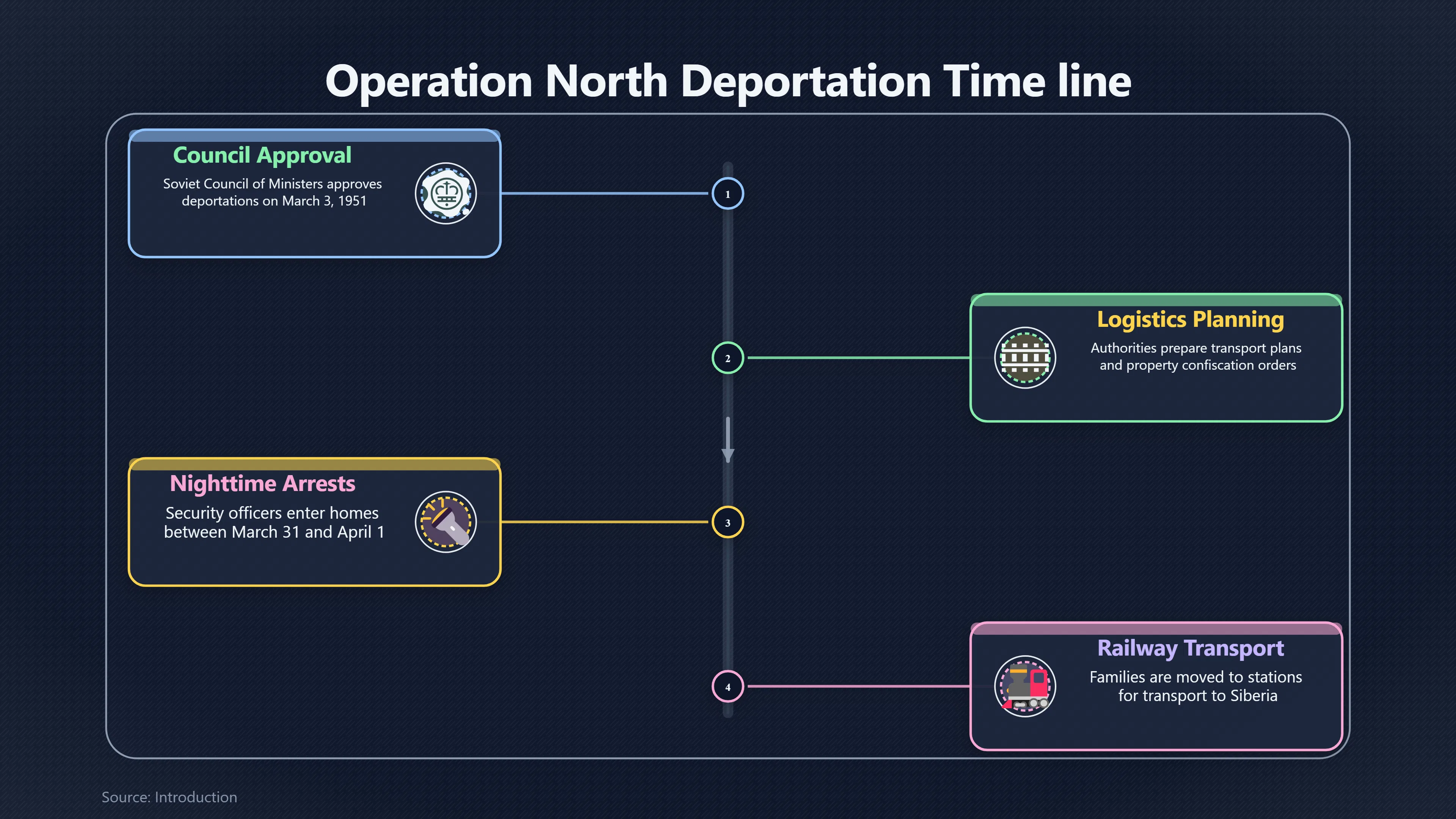
Operation North was the Soviet Union’s coordinated deportation of Jehovah’s Witnesses from six western Soviet republics on 1–2 April 1951. In Soviet Moldavia, today’s Republic of Moldova, more than 2,600 people from over 700 families were forced onto trains bound for Siberia. Unlike earlier deportations that targeted broad social categories such as landowners or alleged collaborators, this operation focused almost entirely on one religious community. The campaign illustrates how the Soviet state transformed religious independence into evidence of political conspiracy. By portraying Jehovah’s Witnesses as an “anti-Soviet sect” rather than a peaceful religious minority, officials presented mass repression as a measure of public protection rather than persecution.[1951deport.org]1951deport.orgMoldova – 70th Anniversary of Operation NorthFebruary 19, 1951…
Operation North therefore occupies an important place in Moldova’s history of state-sponsored religious scares. It was not a spontaneous public panic but a manufactured one, created through official language, secret-police reports and propaganda that framed ordinary religious practices as signs of hidden subversion.
Why Jehovah’s Witnesses were treated as subversive
The Soviet authorities did not primarily fear spectacular supernatural claims or charismatic leadership. Instead, they regarded Jehovah’s Witnesses as politically unreliable because their beliefs conflicted with the demands of a one-party state.
Several features of the movement alarmed Soviet officials:
- Members refused military service because of religious conscience.
- They declined to participate in elections or political organisations, insisting on political neutrality.
- They maintained contacts with fellow believers outside the Soviet Union, something the security services interpreted as evidence of foreign influence.
- They continued religious activity despite repeated attempts to suppress it.
Within a democratic society these practices represent questions of religious liberty. Under Stalin’s government, however, neutrality itself became suspicious. The Ministry of State Security (MGB) repeatedly described Jehovah’s Witnesses as an “anti-Soviet illegal Jehovist sect”, arguing that the movement undermined loyalty to the socialist state. Official memoranda presented deportation as a necessary security measure rather than punishment for religious belief.[1951deport.org]1951deport.orgMoldova – 70th Anniversary of Operation NorthFebruary 19, 1951…
This distinction mattered politically. Soviet documents generally avoided admitting that people were being deported because of their faith. Instead, religious commitment was reinterpreted as evidence of organised political hostility.
Deportation from Soviet Moldavia
Operation North followed months of planning. On 3 March 1951, the Soviet Council of Ministers approved the deportation of Jehovah’s Witnesses from the Moldavian, Ukrainian, Belarusian, Latvian, Lithuanian and Estonian Soviet republics. Moldavian authorities then prepared detailed transport plans, property confiscation orders and local operational instructions before the arrests began.[1951deport.org]1951deport.orgMoldova – 70th Anniversary of Operation NorthFebruary 19, 1951…
During the night of 31 March to 1 April 1951, security officers entered homes across Soviet Moldavia, giving families little time to collect belongings before transporting them to railway stations. Entire households—including elderly relatives and children—were deported together because the Soviet leadership regarded family members as inseparable from the supposed threat posed by active believers. Their homes and possessions were confiscated by the state.[1951deport.org]1951deport.orgMoldova – 70th Anniversary of Operation NorthFebruary 19, 1951…
Official figures indicate that:
- Around 723 families were deported from the Moldavian SSR.
- Approximately 2,617 people were removed from the republic.
- Across all six republics, nearly 9,800 Jehovah’s Witnesses and relatives were deported during Operation North.[wikipedia.org]WikipediaOperation NorthOperation North
Most deportees were sent to special settlements in Siberia, particularly Tomsk and Irkutsk regions, where they lived under restrictions similar to internal exile. Although conditions varied, deportees faced harsh climates, compulsory labour, surveillance and separation from their former communities.[1951deport.org]1951deport.orgOperation North, The Whys and Wherefores – 70th Anniversary of Operation NorthOperation North, The Whys and Wherefores – 70th Anniversary of Operation North
How official labels made persecution appear protective
[Operation North]WikipediaOperation North demonstrates how language can reshape public understanding of repression.
Rather than presenting Jehovah’s Witnesses as citizens exercising religious belief, Soviet documents consistently described them as members of an illegal underground sect engaged in anti-state activity. This terminology carried several political advantages.
First, it implied that the state was confronting conspiracy rather than belief. Second, it associated an unfamiliar minority religion with espionage, sabotage and foreign influence despite limited evidence of such activities. Third, it encouraged officials and the wider public to see deportation as preventative action rather than religious persecution.
The label “sect” itself was particularly powerful within Soviet political culture. It suggested secrecy, manipulation and social danger, making extraordinary police measures appear reasonable. Historians have argued that this was part of a broader Soviet strategy in which independent religious organisations were portrayed as threats to public order whenever they escaped state control.[1951deport.org]1951deport.orgMoldova – 70th Anniversary of Operation NorthFebruary 19, 1951…
In this sense, Operation North was less a response to demonstrable criminal activity than an example of a state constructing a security narrative around a religious minority.
Was there evidence of a genuine conspiracy?
Modern historical research has found little evidence supporting the central implication of the Soviet campaign—that Jehovah’s Witnesses posed a serious political or security threat to the USSR.
The movement certainly rejected military service, political participation and ideological conformity. Those positions conflicted sharply with Stalin’s expectations of citizenship. However, historians generally distinguish these forms of religious non-cooperation from organised attempts to overthrow the Soviet government.
Recently published archival documents show that the MGB built its case largely around the continued existence of an underground religious network rather than evidence of violent or revolutionary activity. The fact that believers continued meeting after previous bans became, in official reasoning, proof that harsher measures were required.[1951deport.org]1951deport.orgMoldova – 70th Anniversary of Operation NorthFebruary 19, 1951…
This illustrates an important difference between a documented security threat and a state-created sect scare. The authorities did not invent Jehovah’s Witnesses, but they reframed ordinary religious behaviour as political extremism.

Why Operation North matters in Moldova’s history
For Moldova, Operation North represents the final major Stalin-era deportation carried out on the republic’s territory. Earlier campaigns had targeted broad social or economic categories; this operation singled out a religious minority almost exclusively because of its beliefs. The National Museum of History of Moldova presents the deportation alongside the wider history of Soviet repression, displaying documents, confiscation records and personal belongings that illustrate its human consequences.[nationalmuseum.md]nationalmuseum.mdOpen source on nationalmuseum.md.
The episode also shows how moral and political panics can be manufactured from above. Unlike rumours spreading through villages or sensational stories amplified by newspapers, the Soviet sect scare originated within the state itself. Secret-police memoranda, administrative language and ideological propaganda transformed religious difference into evidence of political danger.
Today, historians generally interpret Operation North as an example of systematic religious persecution rather than a justified security operation. It remains a reminder that governments can use emotionally charged labels such as “sect”, “anti-state” or “subversive” to redefine peaceful minorities as public threats, making extraordinary coercive measures appear both necessary and protective.[1951deport.org| Communist Crimes]1951deport.orgMoldova – 70th Anniversary of Operation NorthFebruary 19, 1951…
Amazon book picks
Further Reading
Books and field guides related to How the Soviet State Manufactured a Sect Scare. Use these as the next step if you want deeper reading beyond the article.

The Soviet century
Provides context for campaigns against independent religious groups.
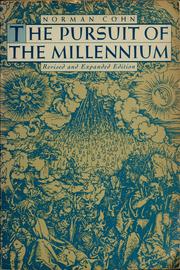
The pursuit of the millennium
Adds broader context about perceived threats from religious movements.
Religion and the Soviet State
Directly explains state repression of religious minorities.
Endnotes
1.
Source: 1951deport.org
Title: Moldova – 70th Anniversary of Operation North
Link:https://1951deport.org/en/archive/moldova/
Source snippet
February 19, 1951...
Published: February 19, 1951
2.
Source: Wikipedia
Title: Operation North
Link:https://en.wikipedia.org/wiki/Operation_North
3.
Source: jw.org
Link:https://www.jw.org/en/news/region/russia/International-Memorial-Society-Hosts-an-Academic-Conference-Dedicated-to-the-70th-Anniversary-of-the-Soviet-Deportation-of-Jehovahs-Witnesses-to-Siberia/
Source snippet
esses to Siberia...
4.
Source: nationalmuseum.md
Link:https://www.nationalmuseum.md/en/exhibitions/the_compartment_of_world_war_ii_and_stalinist_repression/
5.
Source: 1951deport.org
Title: Operation North, What was it like? – 70th Anniversary of Operation North
Link:https://1951deport.org/en/how/
6.
Source: 1951deport.org
Title: Operation North, The Whys and Wherefores – 70th Anniversary of Operation North
Link:https://1951deport.org/en/why/
7.
Source: jw.org
Link:https://www.jw.org/en/news/region/global/SUMMARY-Series-of-Conferences-in-Moldova-Russia-and-Ukraine-Dedicated-to-the-70th-Anniversary-of-the-Soviet-Deportation-of-Jehovahs-Witnesses-to-Siberia/
8.
Source: jw.org
Link:https://www.jw.org/no/nyheter/region/global/SAMMENDRAG-Konferanser-i-Moldova-Russland-og-Ukraina-for-%C3%A5-markere-at-det-er-70-%C3%A5r-siden-Jehovas-vitner-ble-deportert-til-Sibir/
9.
Source: jw.org
Link:https://www.jw.org/sv/nyheter/omr%C3%A5de/internationella/SAMMANFATTNING-Konferenser-i-Moldavien-Ryssland-och-Ukraina-uppm%C3%A4rksammar-att-det-g%C3%A5tt-70-%C3%A5r-sedan-Jehovas-vittnen-deporterades-till-Sibirien/
10.
Source: jw.org
Title: Moscow Press Conference on 70th Anniversary of Operation North
Link:https://www.jw.org/en/news/region/russia/Moscow-Press-Conference-on-70th-Anniversary-of-Operation-North/
11.
Source: moldova.org
Title: 60th anniversary of the 2nd wave of deportation marked in Moldova
Link:https://www.moldova.org/en/60th-anniversary-of-the-2nd-wave-of-deportation-marked-in-moldova-202336-eng/
12.
Source: jw.org
Link:https://www.jw.org/en/library/books/2004-Yearbook-of-Jehovahs-Witnesses/Moldova/
13.
Source: 1951deport.org
Link:https://1951deport.org/en/
14.
Source: communistcrimes.org
Title: ussrs 1951 deportation jehovahs witnesses
Link:https://communistcrimes.org/en/ussrs-1951-deportation-jehovahs-witnesses
Source snippet
Communist CrimesThe USSR’s 1951 Deportation of Jehovah’s Witnesses | Communist Crimes...
15.
Source: osce.org
Link:https://www.osce.org/country/moldova
Additional References
16.
Source: researchgate.net
Link:https://www.researchgate.net/publication/354911027_Secret_Operations_of_the_Soviet_Security_Services_against_the_Jehovah%27s_Witnesses_in_Ukraine
Source snippet
(PDF) Secret Operations of the Soviet Security Services against the Jehovah’s Witnesses in Ukraine (1949—1955)September 13, 2021 — Articl...
Published: September 13, 2021
17.
Source: jw-russia.org
Link:https://jw-russia.org/en/news/2026/04/011559.html
Source snippet
News - Jehovah's WitnessesApril 1, 2026 — Video was prepared for the 70th anniversary of Operation North, but eyewitness testimonies are...
Published: April 1, 2026
18.
Source: journals.us.edu.pl
Link:https://journals.us.edu.pl/index.php/WSN/article/view/14621
Source snippet
19 No. 24 (2024): Wieki Stare i Nowe | Wieki Stare i NoweDecember 31, 2024 —...
Published: December 31, 2024
19.
Source: docs.historyrussia.org
Link:https://docs.historyrussia.org/ru/nodes/517314-zapiska-po-locale-nil-vch-locale-nil-o-zayavke-na-podvizhnoy-sostav-31-marta-1951-g
20.
Source: msuir.usm.md
Link:https://msuir.usm.md/items/5317b477-4f94-41a5-8c79-f67bdecbf36e
21.
Source: jw-russia.org
Title: 70 years of Operation North
Link:https://jw-russia.org/en/news/2021/04/9.html
22.
Source: youtube.com
Link:https://www.youtube.com/watch?v=152qdVHTqSU
23.
Source: youtube.com
Link:https://www.youtube.com/watch?v=odqY3Dp48fY
24.
Source: youtube.com
Link:https://www.youtube.com/watch?v=pC70FbNGzLM
25.
Source: youtube.com
Link:https://www.youtube.com/watch?v=tphnqvJfLoc
Topic Tree