Within Myanmar
How a Minority Became a National Threat
Nationalist campaigns turned unsupported fears about marriage, conversion and population growth into boycotts, laws and political power.
On this page
- Colonial roots of anti Muslim fear
- The rise of 969 and Ma Ba Tha
- From moral panic to race and religion laws
Page outline Jump by section
Introduction
Modern Buddhist nationalist campaigns in Myanmar transformed long-standing anxieties about identity into a powerful moral panic that portrayed the country’s Muslim minorities as an organised existential threat to Buddhism, women and the nation. Although Muslims make up only a small share of Myanmar’s population, nationalist movements claimed they were pursuing a coordinated strategy of rapid population growth, forced religious conversion, intermarriage and economic domination. These claims were not supported by credible demographic or historical evidence, yet they became politically influential. They helped justify consumer boycotts, discriminatory legislation, organised hate campaigns and, in some areas, deadly communal violence. Rather than emerging spontaneously, the panic drew on older colonial-era grievances, was promoted by influential monks and nationalist organisations, and was amplified through modern social media and political patronage.[ecoi.net]ecoi.netInternational Crisis Group (Author): “Buddhism and State Power in Myanmar”, Document #1406588 - ecoi.netSeptember 5, 2017…
Colonial roots of anti-Muslim fear
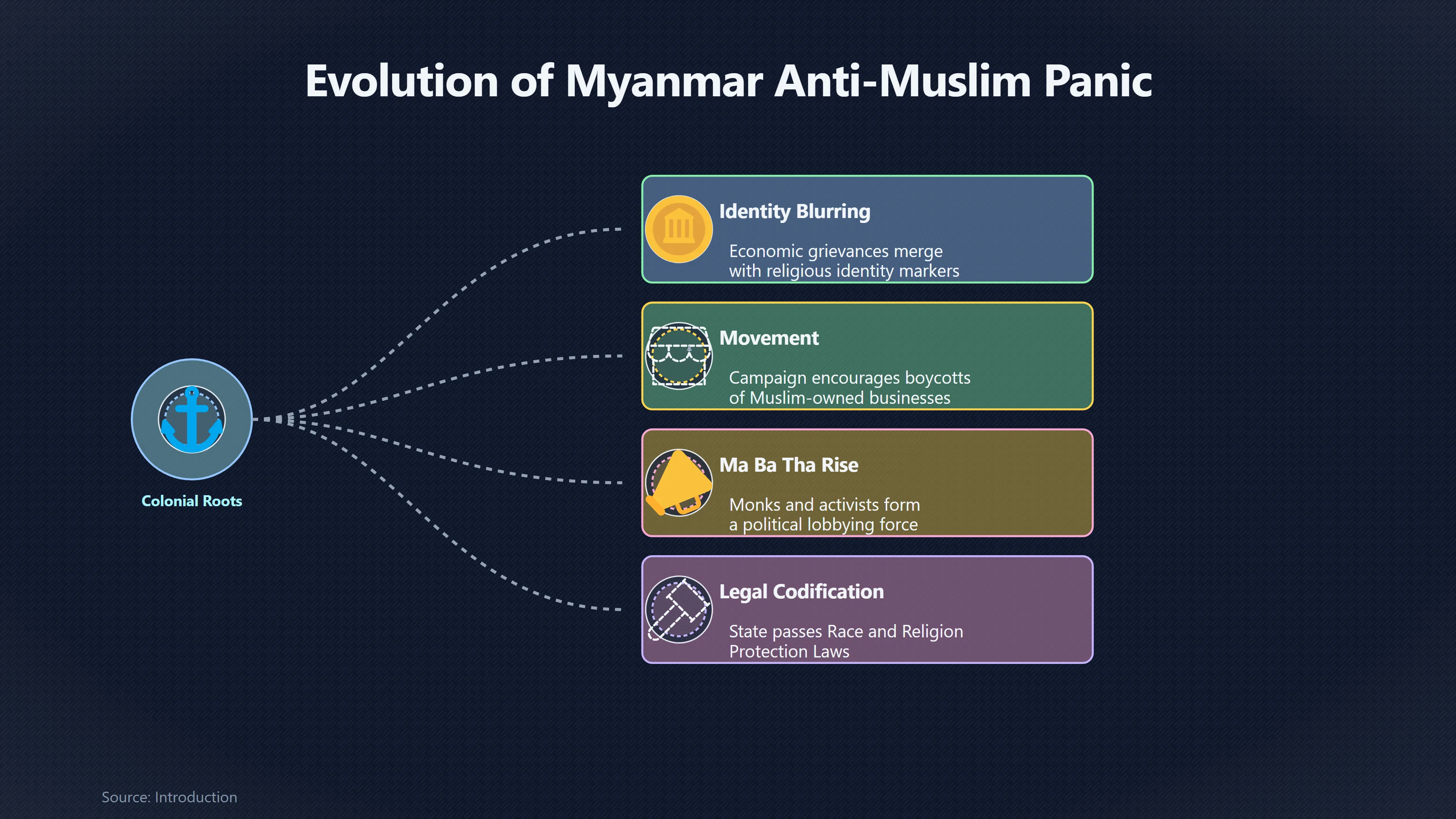
The fear of Muslims as a national danger did not originate in the twenty-first century. Its foundations stretch back to British colonial rule, when large numbers of migrants from British India moved into Burma for work in administration, commerce and agriculture. Because migration occurred under colonial authority, many Burmese Buddhists associated Indian migrants with foreign domination and economic competition rather than simply with immigration.
Over time these economic grievances became entangled with religious identity. Anti-Indian riots erupted in the 1930s, and distinctions between Indian ethnicity and Islam increasingly blurred in popular nationalist discourse. Later generations inherited simplified stories that presented Muslims not as diverse communities with different histories, but as outsiders whose presence threatened Burmese culture. Historians argue that contemporary Buddhist nationalist rhetoric recycled these colonial narratives rather than inventing entirely new ones.[oup.com]academic.oup.comOUP AcademicIslamophobia in Buddhist Myanmar: The 969 Movement and Anti-Muslim Violence | Islam and the State in Myanmar: Muslim-Buddhist…
One recurring theme proved especially durable: the belief that Buddhist women required protection from Muslim men. Rumours of planned marriages, religious conversion and demographic replacement appeared repeatedly from the colonial period onwards. Although evidence for organised campaigns of this kind was lacking, such stories became emotionally persuasive because they linked family life, religion and national survival into a single narrative of danger.[Taylor & Francis]taylorfrancis.comOpen source on taylorfrancis.com.
The rise of 969 and Ma Ba Tha
Following Myanmar’s political opening after 2011, these older fears gained unprecedented visibility through organised nationalist movements.
The first major campaign was the 969 Movement, whose name referred to Buddhist symbolism but whose public activity centred on encouraging Buddhists to buy only from Buddhist-owned businesses and to avoid Muslim traders. The movement’s sermons, pamphlets and DVDs argued that Muslims were using wealth, marriage and higher birth rates to undermine Buddhism from within. While supporters described the campaign as defensive, researchers found that its messaging consistently framed Muslims as a collective enemy rather than as individual citizens.[oup.com]academic.oup.comOUP AcademicIslamophobia in Buddhist Myanmar: The 969 Movement and Anti-Muslim Violence | Islam and the State in Myanmar: Muslim-Buddhist…
The movement evolved into the Association for the Protection of Race and Religion, widely known as Ma Ba Tha. This organisation brought together influential monks, lay activists and supporters across much of the country. Rather than operating only as a religious network, it became a significant political force capable of lobbying legislators, organising public demonstrations and influencing national debates over identity and citizenship. The International Crisis Group notes that Ma Ba Tha combined genuine religious concerns among supporters with organised political campaigning, making it one of the most influential nationalist organisations in Myanmar during the mid-2010s.[ecoi.net]ecoi.netInternational Crisis Group (Author): “Buddhism and State Power in Myanmar”, Document #1406588 - ecoi.netSeptember 5, 2017…
It is important not to treat Buddhist nationalism as representative of all Buddhists in Myanmar. Many monks, Buddhist scholars and civil society organisations criticised both 969 and Ma Ba Tha, arguing that hatred and discrimination contradicted core Buddhist ethical teachings. Opposition existed within the Buddhist community itself, even if nationalist voices often dominated public discussion.[ecoi.net]ecoi.netInternational Crisis Group (Author): “Buddhism and State Power in Myanmar”, Document #1406588 - ecoi.netSeptember 5, 2017…
How ordinary differences became a national emergency
The panic succeeded because it presented scattered social changes as evidence of a single hidden conspiracy.
Several recurring claims appeared in nationalist speeches, pamphlets and online campaigns:
- Muslims were secretly planning to outnumber Buddhists through higher birth rates.
- Muslim men were deliberately marrying Buddhist women to convert families.
- Muslim-owned businesses were financing a coordinated takeover.
- Buddhist tolerance would eventually lead to the disappearance of Buddhism in Myanmar.
These narratives relied heavily on anecdote, rumour and isolated incidents rather than systematic evidence. Myanmar’s Muslim communities are internally diverse, including long-established Burmese Muslims, Indian-origin Muslims, Rohingya and several smaller groups with different histories and identities. Nationalist rhetoric nevertheless portrayed them as a unified movement pursuing identical political goals.[oup.com]academic.oup.comOUP AcademicIslamophobia in Buddhist Myanmar: The 969 Movement and Anti-Muslim Violence | Islam and the State in Myanmar: Muslim-Buddhist…
Social psychologists often describe this kind of process as a moral panic: ordinary social anxieties become concentrated around a symbolic enemy that is portrayed as posing an existential threat out of proportion to the available evidence. In Myanmar, demographic fears, concerns about women’s safety and uncertainty during rapid political change reinforced one another until many people viewed discrimination as a form of national self-defence rather than prejudice.[Taylor & Francis Online]tandfonline.comOpen source on tandfonline.com.
From moral panic to race and religion laws
The most significant political success of these campaigns came with the passage of the 2015 Race and Religion Protection Laws.
The package included legislation covering religious conversion, monogamy, population control measures and interfaith marriage. Supporters argued that the laws protected Buddhism and vulnerable women. Critics, including international human rights organisations and many legal scholars, argued that the legislation disproportionately targeted Muslims and institutionalised assumptions promoted by nationalist movements rather than responding to documented social problems.[ecoi.net]ecoi.netInternational Crisis Group (Author): “Buddhism and State Power in Myanmar”, Document #1406588 - ecoi.netSeptember 5, 2017…
The laws demonstrated how a moral panic can reshape governance. Claims that began as rumours and campaign speeches became the basis for state regulation of family life and religious practice. Once translated into legislation, the underlying assumptions gained an appearance of official legitimacy even though the alleged coordinated Muslim threat remained unsubstantiated.[ecoi.net]ecoi.netInternational Crisis Group (Author): “Buddhism and State Power in Myanmar”, Document #1406588 - ecoi.netSeptember 5, 2017…
Rumours, Facebook and the acceleration of fear
Social media dramatically increased both the speed and reach of nationalist narratives.
During the 2010s, Facebook effectively functioned as the internet for many people in Myanmar. False stories alleging rapes, forced conversions, mosque conspiracies or impending Muslim attacks spread rapidly through networks where users often had little experience distinguishing verified reporting from fabricated content.
Investigations by the United Nations, Amnesty International and independent researchers concluded that anti-Muslim disinformation circulated widely on Facebook and that military-linked accounts, nationalist activists and organised networks played a major role in amplifying hatred. The platform’s limited Burmese-language moderation allowed inflammatory content to spread for years before substantial reforms were introduced.[amnesty.org.uk]amnesty.org.ukeport | Amnesty International UKSeptember 28, 2022…
Researchers stress that Facebook did not create anti-Muslim prejudice. Instead, it accelerated existing narratives, allowing rumours that previously might have remained local to spread nationwide within hours and making coordinated campaigns far easier to organise.[Amnesty International UK]amnesty.org.ukeport | Amnesty International UKSeptember 28, 2022…
Why the panic proved so persuasive
Several factors combined to make the nationalist message convincing for many supporters.
Rapid political liberalisation after decades of military rule created uncertainty about Myanmar’s future. Economic change produced new inequalities, while ethnic conflicts and debates over citizenship heightened fears about national identity. Against this backdrop, nationalist movements offered a simple explanation: social problems resulted from insufficient protection of Buddhism and excessive tolerance towards Muslims.
Scholars also point to what some describe as a narrative of collective victimhood. Nationalist leaders argued that although Buddhists formed the majority, they were spiritually vulnerable because history showed that Buddhist societies elsewhere had supposedly declined after failing to resist external religious influences. This transformed majority status into a perceived condition of permanent insecurity.[taylorfrancis.com]taylorfrancis.comOpen source on taylorfrancis.com.
Lasting significance
The Muslim threat panic became one of the defining examples of how organised fear can reshape modern politics. Unsupported claims about demographic replacement, religious conversion and cultural extinction moved from sermons and rumours into electoral politics, legislation and, in some places, mass violence. The episode also illustrates that moral panics rarely emerge from misinformation alone. They are most powerful when old historical grievances, political incentives, religious symbolism and new communication technologies reinforce one another.
Although organisations such as Ma Ba Tha lost some formal influence after government restrictions and internal disputes, the broader nationalist ideas they popularised have not disappeared. Scholars continue to argue that understanding the colonial roots, political uses and emotional appeal of these narratives is essential for explaining why a small and diverse religious minority could be widely portrayed as an existential national danger despite the absence of evidence for the conspiracy that nationalist movements claimed to expose.

Amazon book picks
Further Reading
Books and field guides related to How a Minority Became a National Threat. Use these as the next step if you want deeper reading beyond the article.
Rohingyas
Documents the persecution of the Rohingya and discusses the role of Buddhist clergy, state discrimination and nationalist narratives in l...
Islam and the State in Myanmar
Traces Muslim-Buddhist relations and state policy, helping explain the historical grievances and legal structures that enabled Muslims to...
Buddhism, Politics and Political Thought in Myanmar
Provides the intellectual and historical background needed to understand how Buddhist concepts became intertwined with nationalism, polit...

Myanmar's Enemy Within
First published 2017. Subjects: Islam and state, Buddhism and state, Burma, politics and government, Burma, religion, Rohingya (Burmese p...
Endnotes
1.
Source: ecoi.net
Link:https://www.ecoi.net/en/document/1406588.html
Source snippet
International Crisis Group (Author): “Buddhism and State Power in Myanmar”, Document #1406588 - ecoi.netSeptember 5, 2017...
Published: September 5, 2017
2.
Source: academic.oup.com
Link:https://academic.oup.com/book/11127/chapter-abstract/159566236
Source snippet
OUP AcademicIslamophobia in Buddhist Myanmar: The 969 Movement and Anti-Muslim Violence | Islam and the State in Myanmar: Muslim-Buddhist...
3.
Source: jstage.jst.go.jp
Title: J-STAGEWhither Buddhist Nationalism in Myanmar?
Link:https://www.jstage.jst.go.jp/article/tak/62/1/62_10/_article/-char/en
4.
Source: amnesty.org.uk
Link:https://www.amnesty.org.uk/latest/myanmar-facebooks-business-model-profits-echo-chamber-hatred-which-fuelled-rohingya/
Source snippet
eport | Amnesty International UKSeptember 28, 2022...
Published: September 28, 2022
5.
Source: time.com
Link:https://time.com/5230474/facebook-myanmar-hate-speech-rohingya/
Source snippet
U.N. investigators claim Facebook played a "determining role" in the violence through hate speech that rapidly spread on its platform. De...
6.
Source: time.com
Link:https://time.com/6217730/myanmar-meta-rohingya-facebook/
Source snippet
The report indicates that Facebook ignored warnings from civilians and activists to curb hate speech while benefiting from increased enga...
7.
Source: ecoi.net
Link:https://www.ecoi.net/en/document/2131614.html
8.
Source: ecoi.net
Link:https://www.ecoi.net/de/dokument/1406588.html
9.
Source: tandfonline.com
Link:https://www.tandfonline.com/doi/full/10.1080/0048721X.2019.1610810
10.
Source: taylorfrancis.com
Link:https://www.taylorfrancis.com/chapters/edit/10.4324/9781003111450-33/buddhist-nationalism-burma-myanmar-niklas-foxeus
11.
Source: jstage.jst.go.jp
Link:https://www.jstage.jst.go.jp/article/tak/62/1/62_10/_article/-char/ja
12.
Source: tandfonline.com
Link:https://www.tandfonline.com/doi/full/10.1080/00472336.2022.2032801
13.
Source: tandfonline.com
Link:https://www.tandfonline.com/doi/abs/10.1080/00472336.2022.2032801
Additional References
14.
Source: youtube.com
Title: The Venerable W. | Trailer | NYFF55
Link:https://www.youtube.com/watch?v=rzBZFN-QZwY
Source snippet
An Unholy Alliance: Monks and the Military in Myanmar is highly relevant as it documents how nationalist Buddhist organizations like Ma B...
15.
Source: youtube.com
Title: Myanmar’s Buddhist Nationalists Rally Support Ahead of Poll
Link:https://www.youtube.com/watch?v=og2VjHGYgFM
Source snippet
An Unholy Alliance: Monks and the Military in Myanmar | Featured Documentary...
16.
Source: youtube.com
Title: An Unholy Alliance: Monks and the Military in Myanmar | Featured Documentary
Link:https://www.youtube.com/watch?v=mF1GZ0O94qk
Source snippet
Myanmar monks campaign for religious segregation...
17.
Source: arxiv.org
Title: arXiv Tackling Hate Speech in Low-resource Languages with Context Experts
Link:https://arxiv.org/abs/2303.16828
18.
Source: researchgate.net
Link:https://www.researchgate.net/publication/273514173_Anti-Muslim_Buddhist_Nationalism_in_Burma_and_Sri_Lanka_Religious_Violence_and_Globalized_Imaginaries_of_Endangered_Identities
19.
Source: researchgate.net
Link:https://www.researchgate.net/publication/400767245_Decolonizing_Buddhist_Authority_Religious_Nationalism_and_State-Sanctioned_Violence_in_Myanmar
20.
Source: researchgate.net
Link:https://www.researchgate.net/publication/333222612_The_Buddha_was_a_devoted_nationalist_Buddhist_nationalism_ressentiment_and_defending_Buddhism_in_Myanmar
21.
Source: bhrn.org.uk
Link:https://bhrn.org.uk/en/press-release/1330-hate-speech-against-muslims-rohingya-and-women-surged-in-2025-as-military-backed-nationalists-escalated-online-campaigns.html
22.
Source: the-independent.com
Link:https://www.the-independent.com/news/world/asia/myanmar-un-blames-facebook-spreading-hatred-rohingya-muslims-a8256596.html
23.
Source: cambridge.org
Link:https://www.cambridge.org/core/services/aop-cambridge-core/content/view/9691384DFB8459061F429EE85FF4D819/S0026749X20000323a.pdf/buddhism-has-been-insulted-take-immediate-steps-burmese-fascism-and-the-origins-of-burmese-islamophobia-193638.pdf
Topic Tree