How Fear Became Violence in Sao Tome
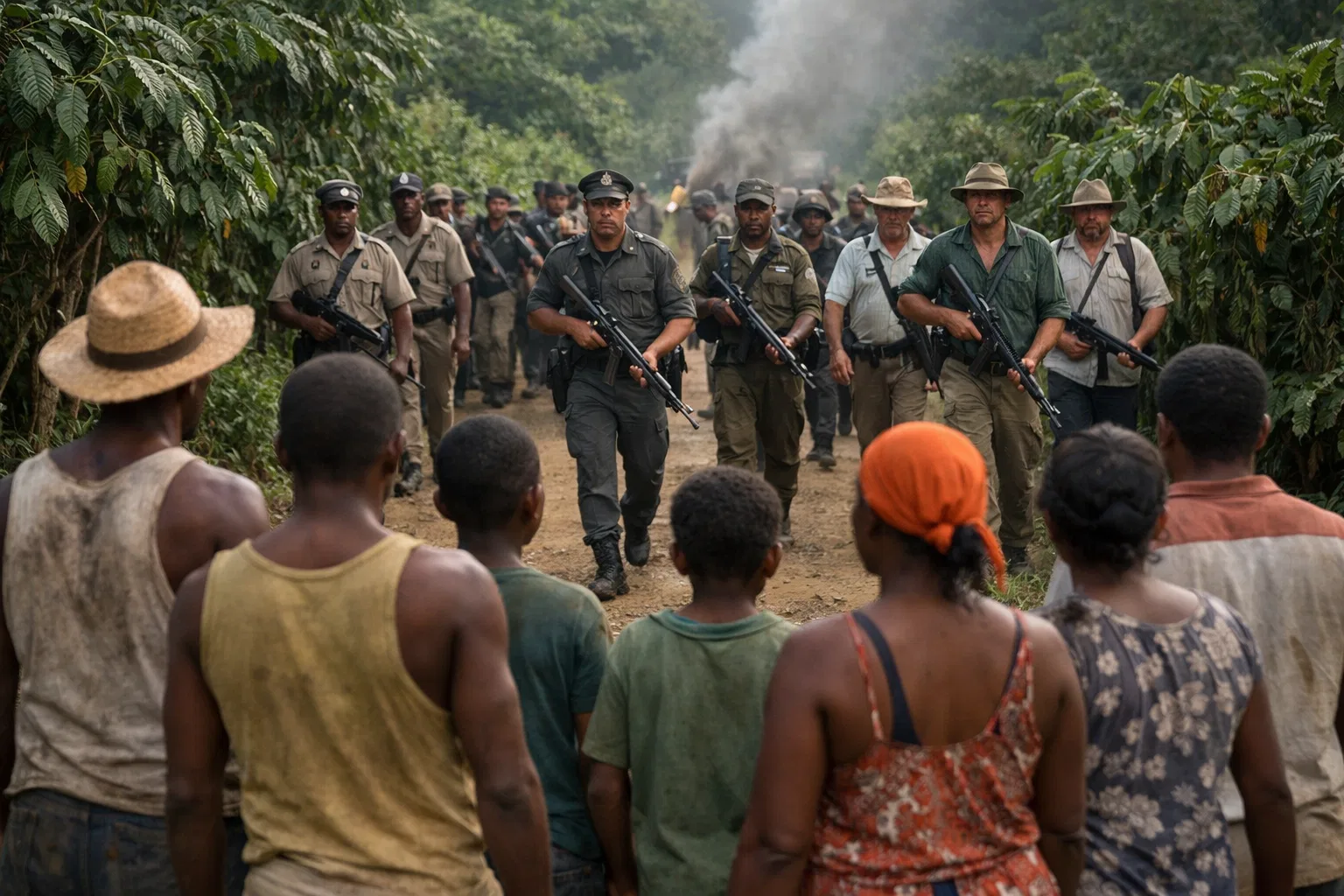
São Tomé and Príncipe has no well-documented equivalent of the Salem witch trials, a dancing plague or a nationwide outbreak of mass psychogenic illness. The country’s clearest case of collective fear becoming historically destructive is instead the Batepá massacre of February 1953.
Page outline Jump by section
Introduction
Batepá is therefore best understood not as “mass hysteria” in the clinical sense, but as a colonial rumour panic. Genuine grievances and justified fears were transformed by state propaganda into an imaginary security emergency. The episode shows how collective belief becomes lethal when authorities possess the means to turn suspicion into arrests, torture and organised violence.
Why São Toméans feared forced labour
The panic grew from the plantation society created under Portuguese rule. Large estates dominated São Tomé’s cocoa economy and depended heavily on workers brought from Angola, Mozambique and Cape Verde. Although slavery had formally ended, plantation labour remained associated with coercion, harsh discipline and systems that many observers regarded as slavery in all but name.[cambridge.org]cambridge.org“Early Limits of Local Decolonization in São Tomé and Príncipe: From Colonial Abuses to Postcolonial Disappointment, 1945–1976…Read more…
A locally born Creole population, commonly described in historical sources as Forros, occupied a different social position. Many were descendants of freed people and regarded their freedom from plantation field labour as central to their status. They might farm, trade or perform other work, but generally resisted recruitment as plantation labourers because it threatened to reduce them to the condition imposed on imported contract workers.[ResearchGate]researchgate.netResearchGate(PDF) The February 1953 Massacre in São ToméJanuary 1, 2003 — The article analyses the causes of the massacre, reconstructs t…
Governor Carlos Gorgulho, who took office in 1945, wanted more labour for plantations, construction and public works. Historian Alexander Keese argues that Gorgulho’s rule combined development schemes with coercive practices, including raids and forced recruitment for government projects. Restrictions affecting local livelihoods and increased taxation added to the sense that the administration intended to make economic independence impossible.[cambridge.org]cambridge.org“Early Limits of Local Decolonization in São Tomé and Príncipe: From Colonial Abuses to Postcolonial Disappointment, 1945–1976…Read more…
This history matters because the central rumour of 1953 was not absurd. São Toméans were not imagining coercion in a peaceful labour market. They were interpreting new threats through long experience of racial hierarchy, police intimidation and plantation abuse.

How the rumours became a crisis
By late 1952, labour shortages had sharpened conflict between the government, plantation owners and the Forros. Plans involving the possible arrival of thousands of Cape Verdeans fed rumours that local land would be taken and that São Toméans would be compelled to sign plantation contracts. Handwritten notices and threatening messages appeared in early February 1953, warning against attempts to recruit Forros for estate work.[wikipedia.org]WikipediaBatepá massacreBatepá massacre
The colonial government answered the rumours publicly, but its response did not calm the situation. It claimed that hostile people identified as communists were spreading false stories about forced labour and urged residents to report them to the police. This was a crucial escalation. A dispute over labour policy was reframed as organised political subversion.[Wikipedia]WikipediaBatepá massacreBatepá massacre
The two sides were not simply sharing mirror-image fantasies. The Forros’ fear of coercion had a strong basis in colonial practice. By contrast, later investigation failed to substantiate the administration’s claim that a communist organisation was preparing an uprising. The supposed conspiracy supplied the government with an enemy category broad enough to include protesters, critics and almost anyone resisting its authority.[researchgate.net]researchgate.netResearchGate(PDF) The February 1953 Massacre in São ToméJanuary 1, 2003 — The article analyses the causes of the massacre, reconstructs t…
On 3 February, confrontations between local people and the authorities turned deadly. The police killing of Manuel da Conceição Soares intensified resistance, and disturbances spread around Trindade, Batepá and neighbouring settlements. Governor Gorgulho warned settlers that a rebellion threatened them and encouraged the formation of armed groups. White colonists, police officers and some imported African workers were drawn into the repression.[wikipedia.org]WikipediaBatepá massacreBatepá massacre
The panic now became self-reinforcing:
- resistance to arrest was treated as proof of conspiracy;
- flight was interpreted as suspicious behaviour;
- rumours of attacks encouraged pre-emptive violence;
- arrests and killings provoked further resistance;
- each new confrontation was presented as confirmation that rebellion had begun.
This is a familiar mechanism in political panics. Once authorities assume that an invisible organisation is operating, the absence of clear evidence may itself be explained as evidence of secrecy.
When fear became organised violence
The repression was not a spontaneous crowd disturbance alone. Colonial police, officials and armed civilians conducted arrests, raids and punitive operations over several days. Prisoners were beaten, tortured and forced to work. Accounts describe detainees dying from suffocation in overcrowded cells, from physical abuse and during forced labour. Bodies were buried in unmarked graves or disposed of at sea.[wikipedia.org]WikipediaBatepá massacreBatepá massacre
The death toll is uncertain. Published estimates range from a few dozen to more than a thousand, while São Toméan educational and commemorative accounts sometimes use figures at the higher end. The destruction or absence of records, secret disposal of bodies and the colonial administration’s interest in minimising responsibility make a precise count impossible. “Hundreds” is a cautious description, but it should not be mistaken for a settled total.[me.gov.st]repositoriodigital.me.gov.stOpen source on me.gov.st.
The violence also exploited divisions created by colonial labour policy. Settlers were encouraged to fear the Forros, while workers from elsewhere in Portuguese Africa could be mobilised against them. The resulting conflict was racialised, but it was also structured by differences in legal status, occupation and access to land. The administration turned those divisions into instruments of control.[ResearchGate]researchgate.netResearchGate(PDF) The February 1953 Massacre in São ToméJanuary 1, 2003 — The article analyses the causes of the massacre, reconstructs t…
Calling Batepá simply a riot obscures this imbalance. There was local resistance, and two police officers were reportedly killed, but the state possessed the weapons, prisons and administrative machinery that transformed unrest into a campaign of collective punishment.[Wikipedia]WikipediaBatepá massacreBatepá massacre
Was it mass hysteria, conspiracy theory or moral panic?
No single label captures the whole episode. Each common term describes only part of what happened.
Mass psychogenic illness does not fit. There was no documented epidemic of fainting, paralysis or physical symptoms spreading without an identifiable medical cause.
Mass hysteria is also too vague and can wrongly imply that the population behaved irrationally for no reason. The fear of coerced labour arose from real conditions, even where particular rumours could not be verified.
Conspiracy theory applies more clearly to the colonial claim that communist organisers had secretly engineered an uprising. Investigators sent from Portugal reportedly found no evidence of the alleged communist conspiracy. Yet the allegation had already performed its political function by turning opposition into treason.[Wikipedia]WikipediaBatepá massacreBatepá massacre
Moral panic is useful because officials portrayed an entire section of society as a dangerous internal enemy threatening public order and settler safety. The response was disproportionate, and the alleged menace was never demonstrated. Even so, the term must not flatten the episode into a media scare. Batepá involved direct state violence under colonial rule, not merely exaggerated newspaper coverage or public anxiety.
The most accurate description is therefore a state-driven colonial panic built around an unproven conspiracy, interacting with a popular rumour rooted in genuine fears of forced labour.
Religious belief without a documented witch panic
São Tomé and Príncipe’s cultural history includes Catholicism, Protestant churches and healing traditions shaped by African and European influences. Sources describe ritual specialists, spiritual healing and beliefs involving harmful supernatural forces. Such practices may coexist with formal Christian affiliation rather than forming a separate, clearly bounded religion.[Department of Justice]justice.govDepartment of Justice Sao Tome and PrincipeDepartment of Justice Sao Tome and Principe
That does not make them evidence of collective delusion. Spirit possession ceremonies, divination and traditional healing can function as systems for explaining illness, misfortune, family tension or social obligations. Describing them automatically as hysteria or as “cults” would reproduce older colonial habits of treating unfamiliar religion as irrational or dangerous.
Available sources do not establish a major São Toméan witch-hunt, organised satanic scare or possession epidemic comparable with better-documented cases elsewhere. This absence should be stated rather than filled with stories borrowed from neighbouring countries. The historical record is uneven, and local oral histories may preserve incidents that have not entered internationally accessible scholarship, but no national panic of that type can presently be described with confidence.
Modern law presents a different picture from the coercive religious and political hierarchies of the colonial period. São Tomé and Príncipe is a secular state whose constitution and legislation protect freedom of conscience and worship. Recent religious-freedom reporting describes a predominantly Christian society with several denominations and no comparable state campaign against a religious minority.[State Department]state.gov547499 SAO TOME AND PRINCIPE 2023 INTERNATIONAL RELIGIOUS FREEDOM REPORT547499 SAO TOME AND PRINCIPE 2023 INTERNATIONAL RELIGIOUS FREEDOM REPORT

How Batepá was remembered
The massacre did not immediately produce an organised independence struggle, but it became a foundational event in São Toméan nationalism. It exposed the violence beneath Portugal’s claim that its empire was a harmonious, multiracial community and demonstrated that legal status or cultural assimilation offered local elites little protection when colonial authority felt threatened.[researchgate.net]researchgate.netResearchGate(PDF) The February 1953 Massacre in São ToméJanuary 1, 2003 — The article analyses the causes of the massacre, reconstructs t…
After independence in 1975, the dead were incorporated into a national story of resistance. The victims became known as martyrs, and 3 February is observed as a public holiday commemorating the massacre. Memorials, ceremonies and school accounts have helped make Batepá one of the country’s central historical reference points.[rtp.pt]rtp.ptEnsina O Massacre de BatepáAssinala o episódio que é tido como estando na origem do nacionalismo são-tomense. As vítimas da brutalidade cRTP EnsinaO Massacre de BatepáAssinala o episódio que é tido como estando na origem do nacionalismo são-tomense. As vítimas da brutalidad…
Commemoration has also simplified some aspects of the past. Scholar Inês Nascimento Rodrigues describes Batepá as a field of memories, silences and competing narratives rather than a perfectly settled national story. The continuing uncertainty over victim numbers, individual responsibility and the roles of different social groups illustrates how traumatic events acquire symbolic clarity even when their documentary details remain incomplete.[OpenEdition Journals]journals.openedition.orgOpen source on openedition.org.
This does not make the massacre a myth. The violence is firmly documented. What remains contested is its exact scale, the sequence of particular incidents and how later governments have shaped its meaning.
Why the episode still matters
Batepá shows that a destructive collective belief need not centre on magic, prophecy or supernatural possession. Political authorities can create an equally powerful panic by naming an invisible enemy, presenting ordinary resistance as conspiracy and persuading one group that violence against another is preventive self-defence.
The episode also warns against treating every rumour as equally false. São Toméan fears of forced labour were grounded in an exploitative plantation order. The colonial story of a communist insurrection, by contrast, lacked supporting evidence and was promoted by people able to imprison or kill those they accused. Understanding the difference requires asking not only whether a belief was verified, but also who circulated it, what experiences made it credible and what power followed from accepting it.[researchgate.net]researchgate.netResearchGate(PDF) The February 1953 Massacre in São ToméJanuary 1, 2003 — The article analyses the causes of the massacre, reconstructs t…
For the social history of panics and contagious fear, São Tomé and Príncipe’s most important lesson is therefore not that an entire society suddenly lost its reason. It is that prolonged inequality created fertile ground for rumour, while colonial authority converted uncertainty into a fabricated emergency. The lasting tragedy of Batepá lies in that combination: an understandable popular fear, an invented state conspiracy and a machinery of repression ready to act on it.
Amazon book picks
Further Reading
Books and field guides related to How Fear Became Violence in Sao Tome. Use these as the next step if you want deeper reading beyond the article.
King Leopold's ghost
First published 1998. Subjects: Politics and government, Race relations, Forced labor, Human rights movements, Indigenous peoples.
The fate of Africa
First published 2004. Subjects: Politics and government, Social conditions, Economic conditions, Politique et gouvernement, Conditions so...

Born in Blackness
First published 2021. Subjects: Africa, history, Slave trade, History, African diaspora, Modern History.

Chocolate islands
First published 2012. Subjects: Moral and ethical aspects, Cacao growers, Cadbury Brothers, Travel, Administration.
Endnotes
1.
Source: researchgate.net
Link:https://www.researchgate.net/publication/351091344_The_February_1953_Massacre_in_Sao_Tome_Crack_in_the_Salazarist_Image_of_Multiracial_Harmony_and_Impetus_for_Nationalist_Demands_for_Independence
Source snippet
ResearchGate(PDF) The February 1953 Massacre in São ToméJanuary 1, 2003 — The article analyses the causes of the massacre, reconstructs t...
Published: February 1953
2.
Source: cambridge.org
Link:https://www.cambridge.org/core/journals/itinerario/article/forced-labour-in-the-gorgulho-years-understanding-reform-and-repression-in-rural-sao-tome-e-principe-19451953/B628B49145E08B04021177B3DAC465BE
Source snippet
“Early Limits of Local Decolonization in São Tomé and Príncipe: From Colonial Abuses to Postcolonial Disappointment, 1945–1976...Read more...
3.
Source: ensina.rtp.pt
Link:https://ensina.rtp.pt/artigo/o-massacre-de-[batepa
Source snippet
RTP EnsinaO Massacre de BatepáAssinala o episódio que é tido como estando na origem do nacionalismo são-tomense. As vítimas da brutalidad...
4.
Source: Wikipedia
Title: History of São Tomé and Príncipe
Link:https://en.wikipedia.org/wiki/History_of_S%C3%A3o_Tom%C3%A9_and_Pr%C3%ADncipe
5.
Source: Wikipedia
Title: São Tomé and Príncipe
Link:https://en.wikipedia.org/wiki/S%C3%A3o_Tom%C3%A9_and_Pr%C3%ADncipe
6.
Source: Wikipedia
Title: Batepá massacre
Link:https://en.wikipedia.org/wiki/Batep%C3%A1_massacre
7.
Source: d-nb.info
Link:https://d-nb.info/120767284X/34
Source snippet
1976*. By Alexander... 1953 Massacre in São Tomé: Crack in the Salazarist Image of Mul- tiracial...Read more...
8.
Source: academia.edu
Link:https://www.academia.edu/47728783/The_February_1953_Massacre_in_S%C3%A3o_Tom%C3%A9_Crack_in_the_Salazarist_Image_of_Multiracial_Harmony_and_Impetus_for_Nationalist_Demands_for_Independence
Source snippet
Academia(PDF) The February 1953 Massacre in São ToméThe February 1953 massacre in São Tomé was a violent response to Creole resistance ag...
Published: February 1953
9.
Source: justice.gov
Title: Department of Justice Sao Tome and Principe
Link:https://www.justice.gov/file/283746/dl?inline=
10.
Source: state.gov
Title: 547499 SAO TOME AND PRINCIPE 2023 INTERNATIONAL RELIGIOUS FREEDOM REPORT
Link:https://www.state.gov/wp-content/uploads/2024/04/547499-SAO-TOME-AND-PRINCIPE-2023-INTERNATIONAL-RELIGIOUS-FREEDOM-REPORT.pdf
11.
Source: state.gov
Title: Department Sao Tome and Principe
Link:https://www.state.gov/reports/2019-report-on-international-religious-freedom/sao-tome-and-principe
12.
Source: state.gov
Title: Department Sao Tome and Principe
Link:https://www.state.gov/reports/2024-country-reports-on-human-rights-practices/sao-tome-and-principe
13.
Source: africabib.org
Link:https://www.africabib.org/rec.php?RID=P00051124
14.
Source: journals.openedition.org
Link:https://journals.openedition.org/rccs/6954
15.
Source: cambridge.org
Link:https://www.cambridge.org/core/books/black-saints-in-early-modern-global-catholicism/bibliography/C7D538A81EA7E8B066942BE8EDD222ED
16.
Source: cambridge.org
Link:https://www.cambridge.org/core/elements/power-and-conviction/B2A08965A5847D3E6F071A0E72688F52
17.
Source: resolve.cambridge.org
Link:https://resolve.cambridge.org/core/services/aop-cambridge-core/content/view/8122FEF6EE5F9229EFD10D7817AEB359/9781782049760ind_p298-308_CBO.pdf/index.pdf
18.
Source: cambridge.org
Link:https://www.cambridge.org/core/journals/journal-of-african-history/article/to-satisfy-my-savage-appetite-slavery-belief-and-sexual-violence-on-the-mina-gold-coast-14711571/A64854383344E4A92B2E131B12FAA366
19.
Source: cambridge.org
Link:https://www.cambridge.org/core/books/population-politics-in-the-tropics/tropical-medicine-and-sleeping-sickness-control-before-1918/425A05BEA75F1DDD131FB53DFABFFD60
20.
Source: assets.cambridge.org
Title: 9780521594349 index
Link:https://assets.cambridge.org/97805215/94349/index/9780521594349_index.htm
21.
Source: cambridge.org
Link:https://www.cambridge.org/core/books/new-world-in-early-modern-italy-14921750/new-world-and-italian-religious-culture/FD9A65526125676FF66E69E9873B0D36
22.
Source: cambridge.org
Link:https://www.cambridge.org/core/journals/comparative-studies-in-society-and-history/article/mimetic-governmentality-and-the-administration-of-colonial-justice-in-east-timor-ca-18601910/EDA956054D3796C18657BE3C36A317C0
23.
Source: cambridge.org
Link:https://www.cambridge.org/core/journals/international-review-of-social-history/article/figure-of-the-gypsy-cigano-as-a-signpost-for-crises-of-the-social-hierarchy-bahia-1590s1900s/2B1DFA8D624ED622E7B8A3DCE4B1B221
24.
Source: cambridge.org
Title: Devotion (Part I)
Link:https://www.cambridge.org/core/books/black-saints-in-early-modern-global-catholicism/devotion/629E50C860CC37015D79136803C69F9A
25.
Source: cambridge.org
Link:https://www.cambridge.org/core/books/cambridge-world-history-of-genocide/nationstate-system-during-the-cold-war/C72CFF7D66D59A61FDD726219AACC7CB
26.
Source: state.gov
Title: 441219 SAO TOME AND PRINCIPE 2022 INTERNATIONAL RELIGIOUS FREEDOM REPORT
Link:https://www.state.gov/wp-content/uploads/2023/05/441219-SAO-TOME-AND-PRINCIPE-2022-INTERNATIONAL-RELIGIOUS-FREEDOM-REPORT.pdf
27.
Source: state.gov
Title: SAO TOME AND PRINCIPE 2021 INTERNATIONAL RELIGIOUS FREEDOM REPORT
Link:https://www.state.gov/wp-content/uploads/2022/05/SAO-TOME-AND-PRINCIPE-2021-INTERNATIONAL-RELIGIOUS-FREEDOM-REPORT.pdf
28.
Source: 2021-2025.state.gov
Title: sao tome and principe
Link:https://2021-2025.state.gov/reports/2020-report-on-international-religious-freedom/sao-tome-and-principe/
29.
Source: state.gov
Title: Sao Tome and Principe
Link:https://www.state.gov/reports/2018-report-on-international-religious-freedom/sao-tome-and-principe
30.
Source: 2021-2025.state.gov
Title: sao tome and principe 2021 international religious freedom report 2
Link:https://2021-2025.state.gov/reports/2021-report-on-international-religious-freedom/sao-tome-and-principe/sao-tome-and-principe-2021-international-religious-freedom-report-2/
31.
Source: state.gov
Title: SAO TOME AND PRINCIPE 2018 INTERNATIONAL RELIGIOUS FREEDOM REPORT
Link:https://www.state.gov/wp-content/uploads/2019/05/SAO-TOME-AND-PRINCIPE-2018-INTERNATIONAL-RELIGIOUS-FREEDOM-REPORT.pdf
32.
Source: 2021-2025.state.gov
Title: sao tome and principe
Link:https://2021-2025.state.gov/reports/2017-report-on-international-religious-freedom/sao-tome-and-principe/
33.
Source: researchgate.net
Link:https://www.researchgate.net/publication/271759288_Mass_hysteria_among_South_African_primary_school_learners_in_Kwa-Dukuza_KwaZulu-Natal
34.
Source: researchgate.net
Link:https://www.researchgate.net/publication/288481608_Early_Limits_of_Local_Decolonization_in_Sao_Tome_and_Principe_From_Colonial_Abuses_to_Postcolonial_Disappointment
35.
Source: researchgate.net
Link:https://www.researchgate.net/publication/334552877_As_multiplas_vidas_de_Batepa_memorias_de_um_massacre_colonial_em_Sao_Tome_e_Principe
36.
Source: researchgate.net
Link:https://www.researchgate.net/publication/325616062_Rethinking_the_1961_Baixa_de_Kassanje_Revolt_Towards_a_Relational_Geo-History_of_Angola
37.
Source: researchgate.net
Link:https://www.researchgate.net/publication/317449743_Rethinking_religion_magic_and_witchcraft_in_South_Africa_From_colonial_coherence_to_postcolonial_conundrum
38.
Source: researchgate.net
Link:https://www.researchgate.net/publication/49607130_Healing_and_Spirit_Possession_in_the_Caribbean
39.
Source: m.africabib.org
Link:https://m.africabib.org/rec.php?RID=A00004188
40.
Source: africabib.org
Link:https://www.africabib.org/query_p.php?su=%21294938974%21
41.
Source: Wikipedia
Title: List of mass panic cases
Link:https://en.wikipedia.org/wiki/List_of_mass_panic_cases
42.
Source: Wikipedia
Title: Batepá Massaker
Link:https://de.wikipedia.org/wiki/Batep%C3%A1-Massaker
43.
Source: academia.edu
Link:https://www.academia.edu/83619086/Health_and_the_holy_in_African_and_Afro_American_spirit_possession
44.
Source: academia.edu
Link:https://www.academia.edu/122795027/Introduction_Witchcraft_Magic_Divination_and_the_Twenty_First_Century
45.
Source: journals.openedition.org
Link:https://journals.openedition.org/mulemba/1807?lang=en
46.
Source: museudoaljube.pt
Title: batepa massacre
Link:https://www.museudoaljube.pt/en/2023/02/03/batepa-massacre/
47.
Source: repositoriodigital.me.gov.st
Link:https://repositoriodigital.me.gov.st/public/storage/files/May2023/fvCtBxvjf0d7Qa59IB1x.pdf
48.
Source: repositoriodigital.me.gov.st
Title: ueiq86B0zrq Qul XWc9Rx
Link:https://repositoriodigital.me.gov.st/storage/files/September2022/ueiq86B0zrqQulXWc9Rx.pdf
49.
Source: timeanddate.com
Title: commemoration of the batepo massacre
Link:https://www.timeanddate.com/holidays/sao-tome-and-principe/commemoration-of-the-batepo-massacre
50.
Source: jstor.org
Link:https://www.jstor.org/stable/pdf/20638859.pdf
51.
Source: repositoriodigital.me.gov.st
Title: tf Fm Ck JVd K6qlc K0u HFy
Link:https://repositoriodigital.me.gov.st/storage/files/September2022/tfFmCkJVdK6qlcK0uHFy.pdf
52.
Source: x.com
Link:https://x.com/wrkclasshistory/status/1489267567323754497?lang=en
Additional References
53.
Source: youtube.com
Title: The crumbling colonial plantations of Sao Tome and Principe
Link:https://www.youtube.com/watch?v=rTNktpu9iSo
Source snippet
Sao Tome and Principe | The most mysterious island in the world...
54.
Source: youtube.com
Title: Sao Tome and Principe | The most mysterious island in the world
Link:https://www.youtube.com/watch?v=dVjRH4PeQ2k
Source snippet
A Brief History of Sao Tome and Principe...
55.
Source: oikoumene.org
Link:https://www.oikoumene.org/resources/documents/massacres-committed-in-africa-during-colonial-times
56.
Source: calendarific.com
Link:https://calendarific.com/holiday/sao-tome-and-principe/commemoration-of-the-batepo-massacre
57.
Source: webplus.info
Link:https://webplus.info/index.php?event=184248&page=340
58.
Source: facebook.com
Link:https://www.facebook.com/arfsBlog/posts/happy-51st-regained-independence-day-celebration-to-the-republic-of-s%C3%A3o-tom%C3%A9-e-p/1585937516229822/
59.
Source: ncheteach.org
Link:https://ncheteach.org/resource/hysteria-on-trial-investigating-the-salem-witch-trials/
60.
Source: edicoesafrontamento.pt
Link:https://www.edicoesafrontamento.pt/collections/ines-nascimento-rodrigues
61.
Source: reddit.com
Link:https://www.reddit.com/r/NoStupidQuestions/comments/1uk9tdb/other_than_the_salem_witch_trials_what_are_some/
62.
Source: scribd.com
Link:https://www.scribd.com/document/298941624/Nicolau-Pares-The-Phenomenology-of-Spirit-Possession
Topic Tree
Follow this branch
Related pages 192
- Antigua and Barbuda
- Argentina Belief Scares
- Azerbaijan Belief
- Bahrain Beliefs
- North Korea
- +187 more in sidebar