Within Iranian Panics
Why Bahais Were Cast as Iran's Hidden Enemy
Foreign-agent myths turned a religious minority into a permanent internal enemy and helped justify systematic repression.
On this page
- How foreign agent accusations changed over time
- State discrimination after the 1979 revolution
- Inherited guilt from the Babi conflicts
Page outline Jump by section
Introduction
For more than a century, Iran’s Bahá’í community has been portrayed by opponents as a hidden internal enemy rather than simply a religious minority. The specific accusations have changed with political circumstances—from serving imperial Russia, to Britain, to the United States, Israel or foreign intelligence agencies—but the underlying narrative has remained remarkably consistent: that Bahá’ís are not loyal Iranian citizens but agents of hostile outside powers. These conspiracy claims have played a central role in legitimising discrimination, imprisonment, property confiscation and exclusion from public life. Human rights organisations, historians and United Nations experts have found no credible evidence supporting the broad allegations of organised espionage or foreign subversion that have repeatedly been used against the community. Instead, they identify the accusations as part of a long-standing pattern of religious persecution backed by state institutions.[Human Rights Watch]hrw.orgiranian authorities crime persecution against bahais iranHuman Rights Watch“The Boot on My Neck”: Iranian Authorities’ Crime of Persecution Against Baha’is in Iran | HRWApril 1, 2024…
Why Bahá’ís were cast as Iran’s hidden enemy
The Bahá’í faith emerged in nineteenth-century Iran from the earlier Bábí movement, whose violent confrontations with the Qajar state left a lasting political memory. Although the Bahá’í religion later rejected armed struggle and emphasised peaceful coexistence, many critics continued to treat Bahá’ís as inheritors of the earlier conflict. This created a form of inherited collective guilt in which later generations were blamed for events in which they had played no part.
Religious disagreements also mattered. Mainstream Twelver Shia Islam teaches that Muhammad was the final prophet, while the Bahá’í faith recognises later divine messengers. For many influential clerics this was not simply theological disagreement but apostasy. Over time, theological objections became intertwined with political conspiracy theories. Rather than describing Bahá’ís only as religious dissidents, critics increasingly portrayed them as a covert organisation working for foreign interests. Historians note that these narratives made repression appear to be a matter of national security rather than religious intolerance.[Human Rights Watch]hrw.orgiranian authorities crime persecution against bahais iranHuman Rights Watch“The Boot on My Neck”: Iranian Authorities’ Crime of Persecution Against Baha’is in Iran | HRWApril 1, 2024…
How foreign-agent accusations changed over time
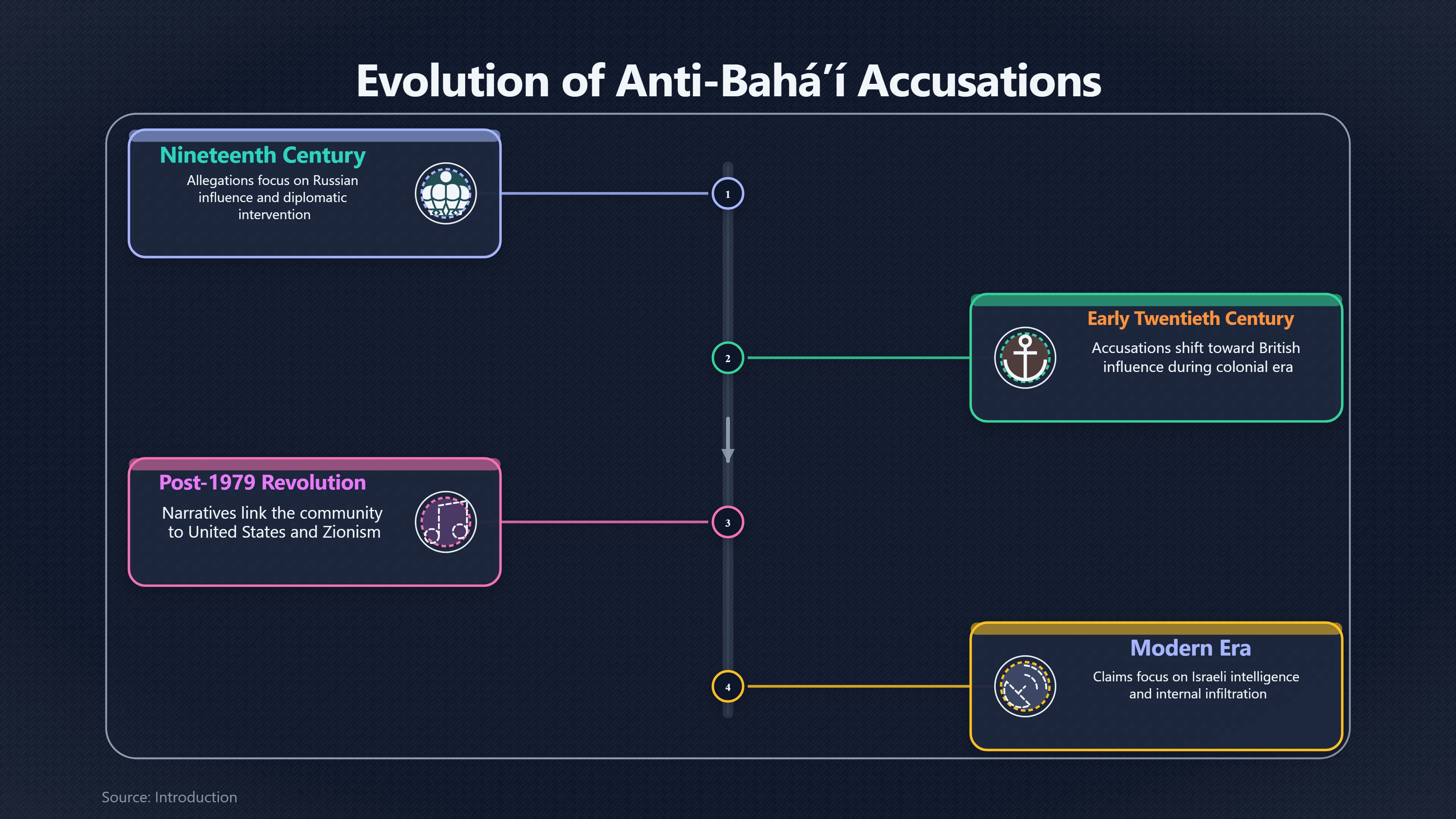
One striking feature of anti-Bahá’í conspiracy narratives is their adaptability. The alleged foreign sponsor shifted as Iran’s geopolitical enemies changed.
During the late nineteenth and early twentieth centuries, opponents sometimes alleged Russian influence because Russian diplomats occasionally intervened to protect persecuted Bahá’ís. Later, especially during the era of British influence in Iran, accusations shifted towards Britain. After the 1979 Islamic Revolution, claims increasingly linked Bahá’ís to the United States, Zionism or Israeli intelligence.
The Israel allegation has a particular historical basis that is often presented without its historical context. The Bahá’í World Centre is located in present-day Israel because the faith’s founder, Bahá’u’lláh, was exiled by the Ottoman Empire to Acre decades before the creation of the modern Israeli state. Historians and the Bahá’í community regard the location as the consequence of nineteenth-century exile rather than evidence of political allegiance. Nevertheless, Iranian officials have repeatedly used the existence of the World Centre in Israel to reinforce espionage allegations.[hrw.org]hrw.orgiranian authorities crime persecution against bahais iranHuman Rights Watch“The Boot on My Neck”: Iranian Authorities’ Crime of Persecution Against Baha’is in Iran | HRWApril 1, 2024…
Another recurring claim has been that Bahá’ís secretly infiltrate government institutions, education or business. Individual Bahá’ís did hold public positions under previous governments, just as members of other religious communities did. However, historians have found no evidence of a coordinated conspiracy to control the Iranian state. The pattern instead reflects a common feature of conspiracy thinking: isolated examples become proof of an imagined hidden network.[Human Rights Watch]hrw.orgiranian authorities crime persecution against bahais iranHuman Rights Watch“The Boot on My Neck”: Iranian Authorities’ Crime of Persecution Against Baha’is in Iran | HRWApril 1, 2024…
State discrimination after the 1979 revolution
Following the Islamic Revolution, anti-Bahá’í rhetoric became embedded in state institutions. Because the Iranian Constitution recognises only Islam, Christianity, Judaism and Zoroastrianism as protected religions, Bahá’ís receive no constitutional recognition.
Human Rights Watch concludes that discrimination has affected almost every area of life, including:
- arbitrary arrest and imprisonment;
- confiscation of homes, businesses and farmland;
- exclusion from many forms of public employment;
- denial or restriction of higher education;
- closure of businesses;
- destruction or confiscation of cemeteries and burial sites;
- restrictions on religious gatherings and community organisation.[Human Rights Watch]hrw.orgiranian authorities crime persecution against bahais iranHuman Rights Watch“The Boot on My Neck”: Iranian Authorities’ Crime of Persecution Against Baha’is in Iran | HRWApril 1, 2024…
Iranian authorities commonly frame prosecutions in terms of national security rather than religion, charging Bahá’ís with offences such as propaganda against the state, membership of an illegal organisation or cooperation with hostile governments. Human rights researchers who have reviewed court documents argue that the evidence frequently centres on ordinary religious activities—holding prayer meetings, teaching their faith or participating in community administration—rather than genuine espionage or violent activity.[Human Rights Watch]hrw.orgiranian authorities crime persecution against bahais iranHuman Rights Watch“The Boot on My Neck”: Iranian Authorities’ Crime of Persecution Against Baha’is in Iran | HRWApril 1, 2024…
A document widely discussed by international human rights bodies, attributed to senior Iranian authorities and first publicised through the United Nations in the 1990s, recommended that Bahá’ís should not be eliminated physically but should be prevented from social and economic advancement. Human rights organisations regard subsequent policies towards education, employment and property as broadly consistent with that objective.[Human Rights Watch]hrw.orgiranian authorities crime persecution against bahais iranHuman Rights Watch“The Boot on My Neck”: Iranian Authorities’ Crime of Persecution Against Baha’is in Iran | HRWApril 1, 2024…

How conspiracy claims reinforce persecution
Conspiracy narratives have served several practical purposes beyond explaining theological disagreement.
First, they transform a religious minority into a security threat. If Bahá’ís are portrayed as foreign agents rather than fellow citizens, restrictions on education, employment or property can be presented as defensive measures rather than discrimination.
Second, the accusations are highly adaptable. During periods of tension with Britain, the United States or Israel, the same community can be linked to whichever external enemy dominates political discourse. The changing identities of the alleged foreign sponsor illustrate that the structure of the conspiracy theory has often mattered more than its factual consistency.
Third, conspiracy claims encourage collective rather than individual suspicion. Instead of requiring evidence against particular people, membership of the Bahá’í faith itself becomes treated as evidence of disloyalty. This blurring of religious identity with presumed political intent has been repeatedly criticised by United Nations experts and international human rights organisations.[Human Rights Watch]hrw.orgiranian authorities crime persecution against bahais iranHuman Rights Watch“The Boot on My Neck”: Iranian Authorities’ Crime of Persecution Against Baha’is in Iran | HRWApril 1, 2024…
Why the accusations remain influential
The persistence of anti-Bahá’í conspiracy claims cannot be explained solely by state policy. Historians point to a combination of factors:
- memories of nineteenth-century Bábí conflicts;
- longstanding clerical hostility towards a religion viewed as superseding Islam;
- repeated official propaganda presenting Bahá’ís as agents of foreign powers;
- restrictions on independent media and public debate;
- political incentives to identify internal enemies during periods of crisis.
These influences reinforce one another. Older religious polemics become blended with modern security rhetoric, while political tensions with foreign states create new opportunities to recycle older allegations in updated forms.[Human Rights Watch]hrw.orgiranian authorities crime persecution against bahais iranHuman Rights Watch“The Boot on My Neck”: Iranian Authorities’ Crime of Persecution Against Baha’is in Iran | HRWApril 1, 2024…

How historians and human rights researchers interpret the case
Scholars generally distinguish between genuine historical conflict and later conspiracy narratives. The nineteenth-century Bábí movement did include episodes of armed resistance, but historians emphasise that the Bahá’í religion which emerged afterwards developed different teachings centred on non-violence and obedience to civil government. Treating all later Bahá’ís as responsible for earlier conflicts is therefore viewed as an example of inherited collective blame rather than historical continuity.
Human rights organisations go further, arguing that conspiracy allegations have become an institutional mechanism for sustaining persecution. Human Rights Watch concluded in 2024 that the Iranian state’s long-running and systematic deprivation of Bahá’ís’ fundamental rights amounts to persecution under international criminal law. Amnesty International and successive United Nations human rights mechanisms have likewise documented repeated use of national security rhetoric to justify actions that primarily target individuals because of their religious identity rather than any demonstrated criminal conduct.[Human Rights Watch]hrw.orgiranian authorities crime persecution against bahais iranHuman Rights Watch“The Boot on My Neck”: Iranian Authorities’ Crime of Persecution Against Baha’is in Iran | HRWApril 1, 2024…
Within the wider history of collective fears in Iran, anti-Bahá’í conspiracy claims stand out as an example of how adaptable narratives about hidden enemies can outlast the political circumstances that created them. The alleged conspirators change, but the underlying story remains remarkably stable: a vulnerable religious minority is portrayed as secretly serving foreign powers, making extraordinary restrictions appear necessary even when independent investigations have repeatedly failed to substantiate the central allegations.


Endnotes
1.
Source: hrw.org
Title: iranian authorities crime persecution against bahais iran
Link:https://www.hrw.org/report/2024/04/01/boot-my-neck/iranian-authorities-crime-persecution-against-bahais-iran
Source snippet
Human Rights Watch“The Boot on My Neck”: Iranian Authorities’ Crime of Persecution Against Baha’is in Iran | HRWApril 1, 2024...
Published: April 1, 2024
2.
Source: hrw.org
Title: Human Rights Watch Iran: Persecution of Baha’is | Human Rights Watch
Link:https://www.hrw.org/news/2024/04/01/iran-persecution-bahais
Source snippet
Iran: Persecution of Baha’is | Human Rights WatchApril 1, 2024 — April 1, 2024 12:00AM EDT | News Release Available In * English * العربي...
Published: April 1, 2024
3.
Source: bic.org
Link:https://www.bic.org/Bahai-Question-Revisited
4.
Source: amnesty.org
Link:https://www.amnesty.org/en/latest/news/2022/08/iran-stop-ruthless-attacks-on-persecuted-bahai-religious-minority/
Source snippet
Amnesty InternationalIran: Stop ruthless attacks on persecuted Baha’i religious minority - Amnesty International...
5.
Source: hrw.org
Title: Iran: Weaponizing Justice System to Persecute Baha’is | Human Rights Watch
Link:https://www.hrw.org/news/2025/12/10/iran-weaponizing-justice-system-to-persecute-bahais
Source snippet
December 10, 2025 — IRAN: WEAPONIZING JUSTICE SYSTEM TO PERSECUTE BAHA’IS Print Donate Now December 10, 2025 12:00AM EST | News Release A...
Published: December 10, 2025
6.
Source: hrw.org
Title: Iran: Persécution des bahaïs | Human Rights Watch
Link:https://www.hrw.org/fr/news/2024/04/01/iran-persecution-des-bahais
Source snippet
April 1, 2024 — 1 avril 2024 4:10PM EDT | Communiqué de presse Disponible en * English * العربية * Français * Deutsch * فارسی * Português...
Published: April 1, 2024
7.
Source: hrw.org
Title: Iran: End Persecution of Baha’is | Human Rights Watch
Link:https://www.hrw.org/news/2010/02/23/iran-end-persecution-bahais
8.
Source: hrw.org
Link:https://www.hrw.org/reports/1997/iran/Iran-05.htm
Additional References
9.
Source: apnews.com
Link:https://apnews.com/article/19919530f264fff033fd1e2f26e651f6
Source snippet
Originating in 19th-century Persia, Baha'is are often viewed as apostates by Shiite Muslim clerics, leading to systemic persecution in na...
10.
Source: bic.org
Link:https://www.bic.org/news/major-new-report-exposes-decades-violence-against-irans-bahais-adds-unprecedented-series-statements-and-findings
Source snippet
International CommunityNovember 11, 2024 — MAJOR NEW REPORT EXPOSES DECADES OF VIOLENCE AGAINST IRAN’S BAHA’IS: ADDS TO AN UNPRECEDENTED...
Published: November 11, 2024
11.
Source: youtube.com
Title: The Baháʼí Question Revisited: Persecution and Resilience in Iran
Link:https://www.youtube.com/watch?v=vUWuJ4tNNHo
Source snippet
Understanding the Persecution of Baha'i People...
12.
Source: youtube.com
Title: Understanding the Persecution of Baha’i People
Link:https://www.youtube.com/watch?v=EzVArk4ssTA
Source snippet
Iran's Persecution of Religious Minorities Discussed in Geneva...
13.
Source: youtube.com
Title: What’s Happening to Baha’is in Iran?
Link:https://www.youtube.com/watch?v=C9kcsPNyxi4
Source snippet
The Intersection of Oppression: Women's Rights and Religious Freedom in Iran...
14.
Source: bic.org
Link:https://www.bic.org/focus-areas/situation-iranian-bahais/united-nations-documents-referencing-bahai-community
15.
Source: youtube.com
Title: Iran’s Persecution of Religious Minorities Discussed in Geneva
Link:https://www.youtube.com/watch?v=6i_fPV1deWs
Source snippet
What's Happening to Baha'is in Iran?...
16.
Source: youtube.com
Title: The Intersection of Oppression: Women’s Rights and Religious Freedom in Iran
Link:https://www.youtube.com/watch?v=shQZGEXmkeg
17.
Source: iranicaonline.org
Title: BAHAIS M vii. Bahai Persecutions
Link:https://www.iranicaonline.org/articles/bahaism-index/bahaism-vii/
18.
Source: news.bahai.org
Title: un statements
Link:https://news.bahai.org/human-rights/iran/yaran-special-report/un-statements/
Topic Tree