Within Albania
How Pyramid Schemes Unravelled Albania
Fraudulent investment schemes spread through trust and imitation before their collapse helped trigger armed disorder in 1997.
On this page
- Why the schemes looked credible
- How confidence turned into nationwide panic
- Why financial collapse became state collapse
Page outline Jump by section
Introduction
The collapse of Albania’s pyramid schemes in 1996–97 was not simply a financial scandal. It was a crisis of collective confidence that drew in much of the population, destroyed household savings, and helped trigger the breakdown of state authority. At their peak, the schemes held liabilities equivalent to almost half of Albania’s annual economic output, while roughly two-thirds of Albanians are estimated to have invested in one or more of them. When confidence vanished, protests escalated into armed disorder, the government fell, and the country descended into months of chaos.[IMF]imf.orgFinance & Development, March 2000 - The Rise and Fall of Albania's Pyramid Schemes…
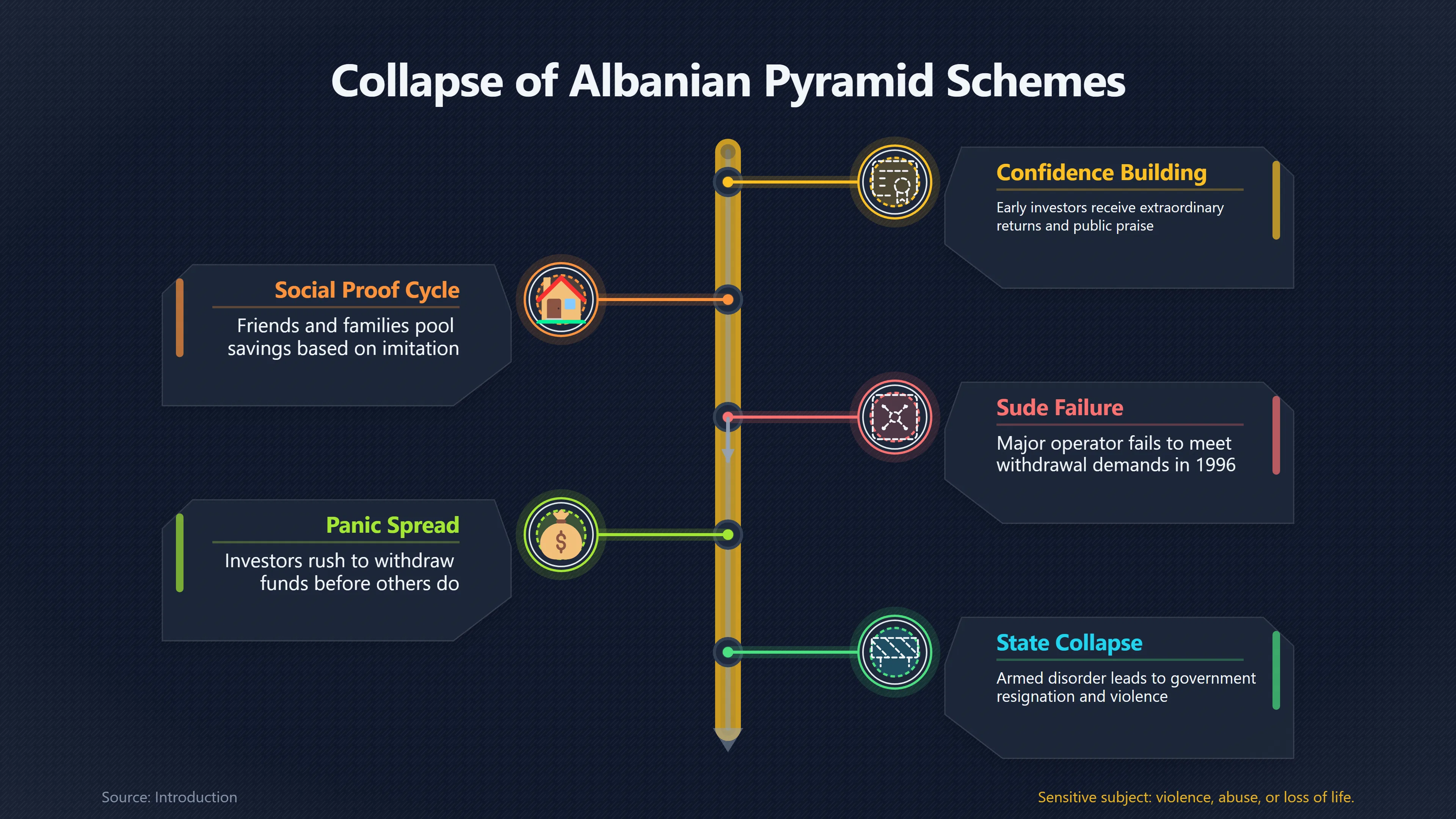
For historians of collective belief, the Albanian pyramid crisis is especially significant because it demonstrates how fraud can spread through trust, imitation and social proof rather than simple deception. The schemes succeeded because they appeared to work, early investors genuinely received extraordinary returns, and many people interpreted the absence of decisive government action as evidence that the companies were legitimate.
Why the schemes looked credible
The schemes emerged during Albania’s difficult transition from one of Europe’s most isolated communist states to a market economy. Financial institutions were weak, private banking was underdeveloped, and many Albanians had little experience with investment or modern financial markets. Large remittances from Albanians working abroad created substantial pools of savings with few legitimate investment opportunities.[IMF]imf.orgThe Rise and Fall of the Pyramid Schemes in AlbaniaThe Rise and Fall of the Pyramid Schemes in Albania…
Many of the companies did not initially resemble obvious frauds. Some operated shops, factories, transport businesses or construction projects alongside their deposit-taking activities. Firms such as VEFA became highly visible commercial empires, employing thousands of people and sponsoring public events. This mixture of genuine commercial activity and unsustainable financial promises blurred the distinction between legitimate business and classic Ponzi-style financing.[IMF]imf.orgThe Rise and Fall of the Pyramid Schemes in AlbaniaThe Rise and Fall of the Pyramid Schemes in Albania…
The promised returns steadily became more extravagant. Monthly interest rates that began in single digits eventually climbed into double figures, with some operators promising to double or even triple investments within a few months. Such returns were economically impossible, but the fact that earlier investors continued receiving payments made the promises appear credible.
Official behaviour reinforced confidence. International organisations, including the International Monetary Fund and the World Bank, warned Albanian authorities that the schemes posed a serious danger. However, the government was slow to intervene. Some politicians publicly associated themselves with successful companies, and reports of political donations or close relationships between scheme operators and government figures further encouraged the belief that the businesses enjoyed official approval.[IMF]imf.orgFinance & Development, March 2000 - The Rise and Fall of Albania's Pyramid Schemes…
How confidence turned into nationwide panic
The Albanian pyramid schemes illustrate the same social dynamics seen in many financial bubbles. Success attracted more participants, whose investments generated the cash needed to pay existing investors. Every successful withdrawal seemed to prove that the system worked.
This created a powerful cycle of imitation.
- Friends persuaded friends to invest.
- Families pooled savings.
- Entire villages discussed which company offered the highest returns.
- People sold homes, livestock and businesses to increase their investments.
- Scepticism became socially costly because non-investors appeared to be missing extraordinary opportunities.
Unlike many investment manias, however, the Albanian schemes reached an unprecedented proportion of the population. Their scale meant that confidence itself became a national resource. As long as people believed, payments continued.
The turning point came late in 1996 when one of the major operators, Sude, failed. Once depositors realised that one company could not meet withdrawals, confidence rapidly spread in the opposite direction. Investors rushed to recover their money before others did, depriving the schemes of the continuous inflow of new deposits on which they depended.[IMF eLibrary]elibrary.imf.orgarticle A001 en.xmlIMF eLibraryThe Rise and Fall of the Pyramid Schemes in Albania in: IMF Working Papers Volume 1999 Issue 098 (1999)July 1, 1999…
Attempts by larger companies to reassure investors—including reducing their promised monthly returns to appear more sustainable—failed to restore confidence. Bankruptcy declarations by Sude and Gjallica accelerated the panic, and the remaining firms soon stopped making payments altogether.[IMF eLibrary]elibrary.imf.orgarticle A001 en.xmlIMF eLibraryThe Rise and Fall of the Pyramid Schemes in Albania in: IMF Working Papers Volume 1999 Issue 098 (1999)July 1, 1999…

Why financial collapse became state collapse
The extraordinary feature of the Albanian crisis is that the collapse of fraudulent investments became a collapse of government authority.
Several mechanisms combined to produce this outcome.
First, the losses were exceptionally widespread. Instead of affecting a narrow class of investors, they affected ordinary households across the country. Many families had invested their life savings, believing the companies represented the country’s new capitalist future.
Second, many Albanians believed the government had either encouraged the schemes or deliberately ignored repeated warnings. As demonstrations spread, financial anger quickly became political anger. Protesters demanded compensation, prosecutions and the resignation of officials they believed had failed to protect them.[IMF]imf.orgFinance & Development, March 2000 - The Rise and Fall of Albania's Pyramid Schemes…
Third, the state’s coercive institutions themselves began to weaken. Soldiers and police officers had also invested in the schemes or had family members who had lost money. As discipline deteriorated, large numbers abandoned their posts.
The most dramatic consequence followed the looting of military armouries. Approximately one million weapons entered civilian hands, transforming protests into an armed national crisis. Government control collapsed across much of southern Albania, criminal groups expanded their influence, and widespread violence forced the resignation of the government before new elections were held later in 1997. Around 2,000 people died during the unrest.[IMF]imf.orgFinance & Development, March 2000 - The Rise and Fall of Albania's Pyramid Schemes…
Was this really mass hysteria?
Although the Albanian crisis is often discussed alongside episodes of mass panic or collective delusion, the comparison has limits.
Participants were responding to real financial incentives rather than imaginary threats. Many investors genuinely received substantial returns for months or even years before the schemes failed. Their belief was therefore continually reinforced by observable evidence.
Historians and economists generally describe the episode as a confidence bubble rather than a case of irrational mass hysteria. The central psychological mechanism was social proof: each successful investor became evidence that encouraged additional investment.
Other factors strengthened that process:
- weak financial regulation;
- limited experience of private investment after decades of communism;
- visible displays of wealth by early investors;
- political signals that appeared to legitimise the companies;
- optimism generated by rapid economic transition.
The schemes therefore spread through an interaction between fraud, institutional weakness and contagious social belief rather than through delusion alone.[IMF]imf.orgThe Rise and Fall of the Pyramid Schemes in AlbaniaThe Rise and Fall of the Pyramid Schemes in Albania…

What happened afterwards?
The Albanian authorities eventually froze some company assets, prosecuted several operators and introduced legislation banning pyramid schemes. Importantly, despite enormous public pressure, the government did not reimburse investors from the state budget, a decision economists generally argue prevented an even larger fiscal collapse, though it remained deeply unpopular among those who had lost their savings.[IMF eLibrary]elibrary.imf.orgarticle A012 en.xmlIMF eLibraryThe Rise and Fall of Albania’s Pyramid Schemes in: Finance & Development Volume 37 Issue 001 (2000)…
International assistance focused on restoring order, rebuilding public institutions and stabilising the economy. Economic growth resumed after the immediate crisis, but the social damage proved far longer lasting. Trust in public institutions, political parties and financial markets remained badly weakened for years.
Why the crisis still matters
The Albanian pyramid collapse remains one of the clearest historical demonstrations of how financial confidence can become a form of collective belief powerful enough to reshape an entire society.
The episode is regularly studied because it shows that investment bubbles are rarely driven by greed alone. They also depend on trust, imitation, optimism and assumptions about institutional legitimacy. When governments appear to endorse risky behaviour—or fail to act decisively against it—the public may reasonably interpret silence as reassurance.
For Albania, the events of 1997 became a defining national trauma, remembered simply as “1997” by many citizens. For scholars of social psychology, economic history and collective behaviour, the crisis remains an exceptional example of how a nationwide confidence scheme can evolve from financial fraud into political collapse.[ft.com]ft.comAs the schemes collapsed—triggered notably by the downfall of a small operator named Maksude Kademi—economic destabilization erupted into…
Amazon book picks
Further Reading
Books and field guides related to How Pyramid Schemes Unravelled Albania. Use these as the next step if you want deeper reading beyond the article.
Extraordinary Popular Delusions and the Madness of Crowds
Rating: 4.0/5 from 5 Google Books ratings
Explores speculative manias and collective financial belief.



Endnotes
1.
Source: imf.org
Link:https://www.imf.org/external/pubs/ft/fandd/2000/03/jarvis.htm
Source snippet
Finance & Development, March 2000 - The Rise and Fall of Albania's Pyramid Schemes...
Published: March 2000
2.
Source: imf.org
Title: The Rise and Fall of the Pyramid Schemes in Albania
Link:https://www.imf.org/en/publications/wp/issues/2016/12/30/the-rise-and-fall-of-the-pyramid-schemes-in-albania-3161
Source snippet
The Rise and Fall of the Pyramid Schemes in Albania...
3.
Source: imf.org
Title: Press Release: IMF Approves Emergency Post Conflict Assistance for Albania
Link:https://www.imf.org/en/news/articles/2015/09/14/01/49/pr9751
Source snippet
Press Release: IMF Approves Emergency Post Conflict Assistance for Albania...
4.
Source: elibrary.imf.org
Title: article A001 en.xml
Link:https://www.elibrary.imf.org/view/journals/001/1999/098/article-A001-en.xml
Source snippet
IMF eLibraryThe Rise and Fall of the Pyramid Schemes in Albania in: IMF Working Papers Volume 1999 Issue 098 (1999)July 1, 1999...
Published: July 1, 1999
5.
Source: elibrary.imf.org
Title: article A012 en.xml
Link:https://www.elibrary.imf.org/view/journals/022/0037/001/article-A012-en.xml
Source snippet
IMF eLibraryThe Rise and Fall of Albania’s Pyramid Schemes in: Finance & Development Volume 37 Issue 001 (2000)...
6.
Source: imf.org
Title: Press Release: IMF Approves Three-Year ESAF Loan for Albania
Link:https://www.imf.org/en/news/articles/2015/09/14/01/49/pr9818
Source snippet
Press Release: IMF Approves Three-Year ESAF Loan for Albania...
7.
Source: ft.com
Link:https://www.ft.com/content/199b6c9f-fe1a-402f-9ea1-c77ea8cba334
Source snippet
As the schemes collapsed—triggered notably by the downfall of a small operator named Maksude Kademi—economic destabilization erupted into...
8.
Source: elibrary.imf.org
Title: article A001 en.xml
Link:https://www.elibrary.imf.org/view/journals/024/2000/002/article-A001-en.xml
Source snippet
Christopher J. Jarvis Mr. Christopher J. Jarvis Search for other papers by Mr. Christopher J. Jarvis in Current site Google Scholar...
9.
Source: elibrary.imf.org
Title: 001.1999.issue 098 en.xml
Link:https://www.elibrary.imf.org/view/journals/001/1999/098/001.1999.issue-098-en.xml
Source snippet
Christopher J. Jarvis Mr. Christopher J. Jarvis Search for other papers by Mr. Christopher J. Jarvis in Current site Google Scholar...
10.
Source: elibrary.imf.org
Title: 001.1999.issue 098 en.xml
Link:https://www.elibrary.imf.org/abstract/journals/001/1999/098/001.1999.issue-098-en.xml
11.
Source: elibrary.imf.org
Title: article A014 en.xml
Link:https://www.elibrary.imf.org/view/journals/023/0028/021/article-A014-en.xml
12.
Source: imf.org
Title: IM F Staff Papers
Link:https://www.imf.org/external/pubs/ft/staffp/2000/00-01/jarvis.htm
Additional References
13.
Source: youtube.com
Link:https://www.youtube.com/watch?v=7PU8yOn_S3w
Source snippet
Election info changes quickly. Verify responses with official sources...
14.
Source: youtube.com
Link:https://www.youtube.com/watch?v=_Gpf7lhUKiQ
Source snippet
Real Life SHTF: Albania Civil Unrest of 1997...
15.
Source: youtube.com
Title: Albania: State of Emergency Follows Pyramid Scheme Collapse
Link:https://www.youtube.com/watch?v=VrdVOsy7DVw
Source snippet
Financial Mania and Social Collapse: The 1997 Albanian Crisis...
16.
Source: youtube.com
Title: Albania: Protesters Angry at Collapse of Saving Schemes
Link:https://www.youtube.com/watch?v=COqLYnZMuEk
Source snippet
Albania: State of Emergency Follows Pyramid Scheme Collapse...
17.
Source: osce.org
Link:https://www.osce.org/albania/52514
18.
Source: youtube.com
Link:https://www.youtube.com/watch?v=s96KoL2lL04
Source snippet
Albania: Protesters Angry at Collapse of Saving Schemes...
19.
Source: ifes.org
Link:https://www.ifes.org/publications/ifes-observer-coordination-osce-albanian-election-observation-mission-june-july-1997
20.
Source: ifes.org
Title: Technical Assistance Mission to the OSCE/ODHIR, Republic of Albania, May
Link:https://www.ifes.org/publications/technical-assistance-mission-osceodhir-republic-albania-may-july-1997
21.
Source: rferl.org
Title: Albania: Pyramid Schemes Common Across Eastern Europe
Link:https://www.rferl.org/amp/1083065.html
22.
Source: rferl.org
Title: Albania: World Bank Anti-Pyramid-Scheme Plan Delayed
Link:https://www.rferl.org/a/1086661.html
Topic Tree