Within Finland's Strange Fears
What Really Happened in the Korpela Movement?
The Korpela movement mixed apocalyptic prophecy, failed expectations and criminal scandal across the Finnish-Swedish border.
On this page
- Toivo Korpela and the Tornio Valley following
- The ark prophecy and changing end times beliefs
- Trials, scandal and the problem of embellished stories
Page outline Jump by section
Introduction
The Korpela movement was one of the most unusual religious movements to emerge from the Finnish–Swedish borderlands during the 1930s. Although it began with the preaching of the Finnish lay preacher Toivo Korpela, its most dramatic and controversial phase unfolded among Finnish-speaking communities in Sweden’s Tornio Valley. What started as a strict revivalist movement influenced by Laestadian Christianity evolved into an apocalyptic community expecting the imminent end of the world. After those prophecies failed, parts of the movement descended into behaviour that attracted criminal investigations, sensational newspaper coverage and lasting folklore. Historians now distinguish carefully between documented events and later embellishments, arguing that the movement reveals as much about poverty, isolation and religious culture in the border region as it does about failed prophecy or scandal.[umu.se]journals.ub.umu.seUmeå University JournalsMillenarianism and the Narration of the Nation: Narratives about the Korpela Movement | Journal of Northern Studi…
Toivo Korpela and the Tornio Valley following
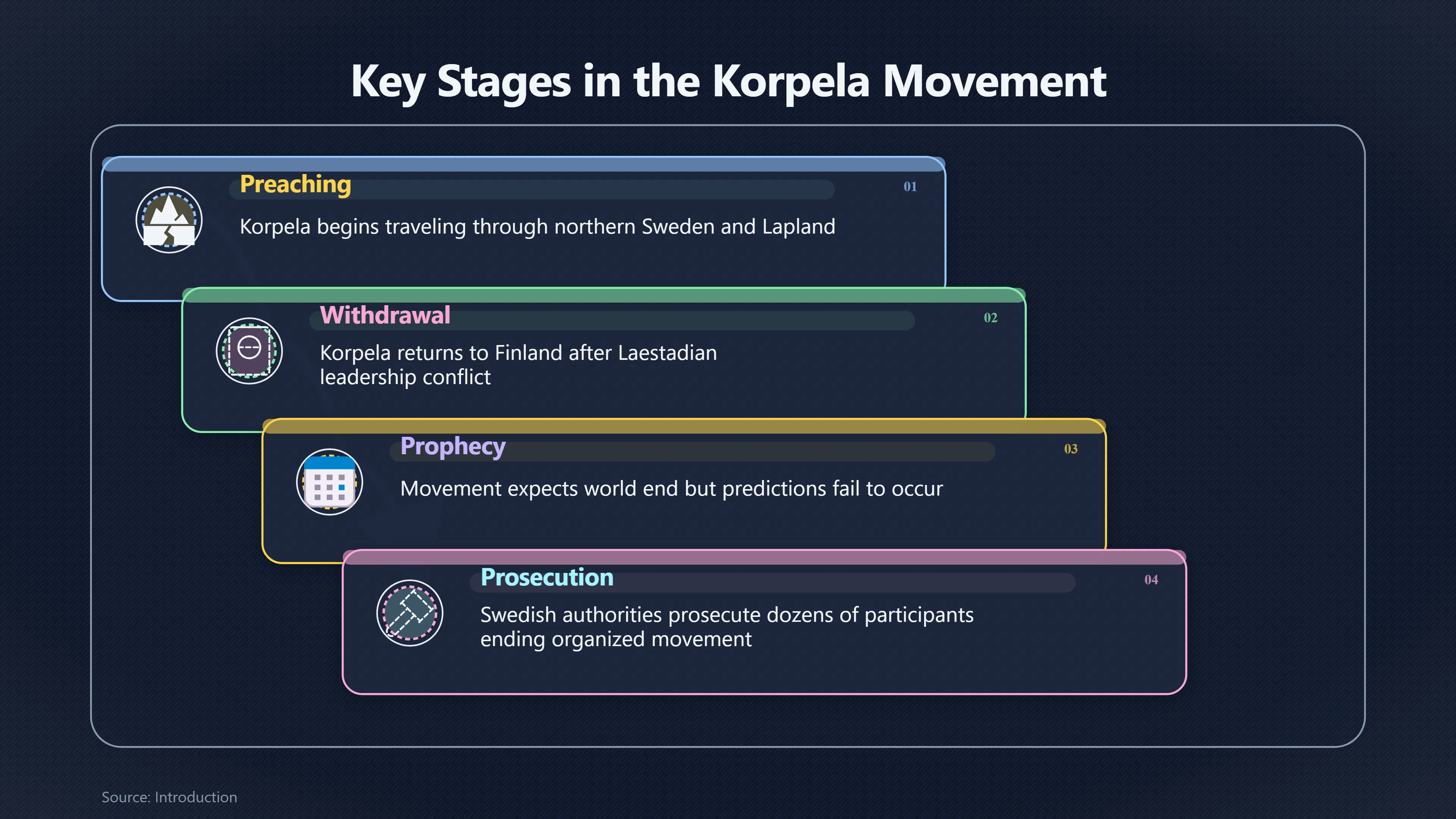
Toivo Korpela was a Finnish revivalist preacher who had been influenced by the conservative Laestadian movement, a Lutheran revival tradition that remained especially strong among Finnish-speaking communities on both sides of the Finnish–Swedish border. After disagreements with established Laestadian leaders in Finland, he began travelling through northern Sweden from 1928, preaching in isolated settlements across the Tornio Valley and Lapland. His sermons attracted followers who believed mainstream churches had become spiritually complacent.[NE]ne.seNE - korpelarörelsen…
The movement illustrates how porous the border remained despite Finland and Sweden being separate states. Families, language and religious networks crossed the frontier far more easily than political maps suggested. Finnish-speaking communities in northern Sweden shared preachers, publications and traditions with neighbouring Finland, allowing Korpela’s message to spread without becoming a nationwide Finnish movement. Instead, its centre of gravity shifted into Sweden even though its founder was Finnish.[Umeå University Journals]journals.ub.umu.seUmeå University JournalsMillenarianism and the Narration of the Nation: Narratives about the Korpela Movement | Journal of Northern Studi…
Korpela himself never established a tightly organised church. His preaching stressed repentance, moral purity and preparation for Christ’s return. Conflict with established Laestadian leaders eventually forced him to withdraw, and by 1934 he had returned to Finland. Ironically, the movement that carried his name became more radical after he ceased directing it.[Wikipedia]WikipediaKorpela movementKorpela movement
The ark prophecy and changing end-times beliefs
Following Korpela’s departure, leadership passed to figures including Sigurd Siikavaara and Arthur Niemi. Under their influence, the movement became increasingly millenarian, meaning it expected an imminent transformation of the world through divine intervention rather than gradual religious renewal.[Wikipedia]WikipediaKorpela movementKorpela movement
The best-known belief concerned a miraculous “ark” that would rescue the faithful before the end of the present age. Contemporary newspapers often described followers expecting a flying or heavenly ark that would transport believers to safety or Palestine. Prophecies fixed specific dates for the world’s end, including expectations surrounding March 1935. When these predictions failed, interpretations changed rather than disappearing altogether. Some leaders argued that the ark should be understood spiritually rather than literally, while others announced new revelations.[Wikipedia]WikipediaKorpela movementKorpela movement
This pattern is familiar to historians of millenarian movements. Failed prophecies do not always destroy a movement immediately. Instead, believers may reinterpret predictions, postpone dates or claim that invisible spiritual events have already occurred. The Korpela movement followed this broader historical pattern rather than representing a unique psychological phenomenon.[Fri Tanke]fritanke.seFri Tanke Korpelarörelsen – från fröjd till förfallFri TankeKorpelarörelsen – från fröjd till förfall - Fri Tanke…
The movement’s appeal also reflected local circumstances. Northern border communities experienced economic hardship during the Depression, geographical isolation and rapid social change. Traditional religious authority remained strong, yet many people also felt disconnected from both state institutions and established churches. Apocalyptic preaching offered certainty and meaning during an unsettled period.[Umeå University Journals]journals.ub.umu.seUmeå University JournalsMillenarianism and the Narration of the Nation: Narratives about the Korpela Movement | Journal of Northern Studi…

Trials, scandal and the problem of embellished stories
After the expected apocalypse failed to occur, parts of the movement underwent a striking transformation. Some leaders proclaimed themselves specially inspired by God and claimed authority to forgive sins directly. Accounts from police investigations and court proceedings describe heavy drinking, gambling and sexual relationships that were presented as spiritually permissible because ordinary moral rules no longer applied to the chosen believers. Swedish authorities eventually prosecuted dozens of participants in 1939, effectively ending the organised movement.[Wikipedia]WikipediaKorpela movementKorpela movement
Yet this is also where historical interpretation becomes more complicated. The movement quickly acquired an extraordinary reputation in popular culture, with stories of bizarre rituals, supernatural practices and extreme sexual licence circulating for decades. Historians who have examined police files and court records argue that many later anecdotes cannot be verified and were amplified through repeated retelling. The Korpela movement became a regional legend as much as a documented historical event.[fritanke.se]fritanke.seFri Tanke Korpelarörelsen – från fröjd till förfallFri TankeKorpelarörelsen – från fröjd till förfall - Fri Tanke…
Some disputed claims concern alleged ritualised sexual ceremonies. While court records document criminal prosecutions and abusive behaviour by certain leaders, relatives of participants and later researchers have questioned whether every sensational allegation reflected actual events rather than hostile rumours spread by opponents or embellished through decades of storytelling. This distinction matters because the movement has often been remembered through folklore rather than careful historical reconstruction.[wikipedia.org]WikipediaKorpela movementKorpela movement
Why the movement crossed the Finnish–Swedish border
Unlike many religious movements associated with a single nation, the Korpela movement belonged to a cross-border cultural region. The Tornio Valley contained Finnish-speaking communities divided by a political boundary but connected through family ties, language and revivalist religion.
Several factors helped the movement spread across this landscape:
- Finnish-speaking revivalist networks already linked congregations on both sides of the border.
- Lay preachers could travel relatively freely between communities.
- Laestadian revivalism had created expectations of personal revelation and intense religious experience, even though mainstream Laestadian leaders rejected Korpela’s teachings.
- Economic uncertainty and social isolation made prophetic explanations attractive to some believers.[ne.se]ne.seNE - korpelarörelsen…
The result was not a Finnish national religious movement exported into Sweden, but a borderland phenomenon rooted in a shared regional culture.
Why historians still study it
The Korpela movement remains important because it illustrates several recurring themes in the history of collective belief without fitting neatly into any single category.
It was an apocalyptic movement built around failed prophecy, but it was not simply an episode of “mass hysteria”. It involved genuine religious conviction, charismatic leadership, internal conflict and criminal conduct, alongside exaggerated rumours that later became part of regional folklore. Modern scholarship therefore treats it as a case study in millenarianism, social change and memory rather than merely as an example of irrational behaviour.[Umeå University Journals]journals.ub.umu.seUmeå University JournalsMillenarianism and the Narration of the Nation: Narratives about the Korpela Movement | Journal of Northern Studi…
The movement also demonstrates how reputations can become detached from historical evidence. Popular books, films and local storytelling have often emphasised lurid episodes, whereas historians increasingly return to court records, newspapers and archival documents to separate documented actions from myths that accumulated over subsequent decades. Recent cultural interest, including new dramatic portrayals in Sweden, has renewed discussion about where the historical record ends and legend begins.[sverigesradio.se]sverigesradio.seOpen source on sverigesradio.se.
Within Finland’s wider history of collective belief, the Korpela movement occupies a distinctive place because it shows how a Finnish preacher inspired a movement whose defining events occurred largely among Finnish-speaking communities in Sweden. It stands at the intersection of revivalist religion, borderland identity, failed prophecy and the enduring power of local legend.[ne.se]ne.seNE - korpelarörelsen…
Amazon book picks
Further Reading
Books and field guides related to What Really Happened in the Korpela Movement?. Use these as the next step if you want deeper reading beyond the article.
Extraordinary Popular Delusions and the Madness of Crowds
Rating: 4.0/5 from 5 Google Books ratings
Broad context for episodes of collective belief.

Endnotes
1.
Source: journals.ub.umu.se
Link:https://journals.ub.umu.se/index.php/jns/article/view/591
Source snippet
Umeå University JournalsMillenarianism and the Narration of the Nation: Narratives about the Korpela Movement | Journal of Northern Studi...
2.
Source: ne.se
Link:https://www.ne.se/uppslagsverk/encyklopedi/l%C3%A5ng/korpelar%C3%B6relsen
Source snippet
NE - korpelarörelsen...
3.
Source: fritanke.se
Title: Fri Tanke Korpelarörelsen – från fröjd till förfall
Link:https://fritanke.se/sans/2016-nr-2/korpelarorelsen-fran-frojd-till-forfall
Source snippet
Fri TankeKorpelarörelsen – från fröjd till förfall - Fri Tanke...
4.
Source: Wikipedia
Title: Korpela movement
Link:https://en.wikipedia.org/wiki/Korpela_movement
5.
Source: sverigesradio.se
Title: Sveriges Radio Författaren Bengt Pohjanen om Korpelarörelsen | Sveriges Radio
Link:https://www.sverigesradio.se/artikel/5606570
6.
Source: sverigesradio.se
Link:https://www.sverigesradio.se/artikel/nu-kommer-filmen-om-korpelarorelsen-sa-sann-ar-den
7.
Source: sverigesradio.se
Link:https://www.sverigesradio.se/artikel/6143092
8.
Source: ne.se
Link:https://www.ne.se/uppslagsverk/encyklopedi/article/korpelar%C3%B6relsen
Additional References
9.
Source: yle.fi
Link:https://yle.fi/a/74-20111471
Source snippet
September 28, 2024 — SUOMALAINEN LESTADIOLAISPUHUJA SAI ALULLE NIIN HURJAN USKONNOLLISEN LIIKKEEN, ETTÄ LOPPUTULOSTA KÄSITELTIIN KÄRÄJILL...
Published: September 28, 2024
10.
Source: youtube.com
Link:https://www.youtube.com/watch?v=V3HAhgM1dx0
Source snippet
"I tro under himmelens skyar" ("With faith under the clouds of heaven") Swedish Lutheran song...
11.
Source: yle.fi
Title: Nu är den aktuel
Link:https://yle.fi/a/7-10074369
Source snippet
Filmen Rörelser skildrar en väckelserörelse på 1930-talet i Tornedalen som urartar till en sekt | Kultur | Svenska YleMarch 18, 2025 — FI...
Published: March 18, 2025
12.
Source: academic.oup.com
Link:https://academic.oup.com/edited-volume/34744/chapter/296572652?searchresult=1
Source snippet
The First Century of the Town of Tornio: Urbanization on the Northern Edge of Europe * 1 Introduction * 2 Urbanization * 3 The Developmen...
13.
Source: researchgate.net
Link:https://www.researchgate.net/publication/277787387_Millenarianism_and_the_Narration_of_the_Nation_Narratives_about_the_Korpela_Movement
14.
Source: en-academic.com
Link:https://en-academic.com/dic.nsf/enwiki/4245594
15.
Source: europeana.eu
Link:https://www.europeana.eu/en/item/9200111/BibliographicResource_1000085999571
16.
Source: kansalliskirjasto.finna.fi
Link:https://kansalliskirjasto.finna.fi/Record/arto.014029017
17.
Source: kansalliskirjasto.finna.fi
Link:https://kansalliskirjasto.finna.fi/Record/fikka.3286148
18.
Source: hanken.elib.se
Link:https://hanken.elib.se/Books/Details/1035731
Topic Tree