Within Namibia
Why Did Illness Spread Through Namibia's Schools?
Namibian schools have repeatedly faced sudden clusters of real but unexplained symptoms that spread through frightened pupil groups.
On this page
- The recurring pattern across schools
- What pupils and witnesses reported
- How doctors and officials interpreted the episodes
Page outline Jump by section
Introduction
Namibia’s best-documented episodes of collective unexplained illness have occurred in schools rather than factories, military bases or villages. Over several decades, pupils—most often adolescent girls—have suddenly fainted, screamed, shaken, entered trance-like states, spoken strangely, reported seeing frightening figures, or behaved in ways that terrified classmates. These episodes were genuine emergencies for the schools involved, disrupting lessons and examinations, but medical investigations repeatedly failed to identify a common infectious disease or environmental poison. Instead, officials, doctors and psychologists increasingly interpreted many of the outbreaks as examples of mass psychogenic illness (sometimes called collective psychogenic illness), while many parents and local communities attributed them to witchcraft, demons or spiritual attack.[com.na]namibian.com.naThe Namibian Ignore mass hysteria, experts sayThe NamibianIgnore mass hysteria, experts say - The NamibianOctober 26, 2017…
Rather than representing a single incident, Namibia’s school outbreaks form a recurring pattern. They illustrate how stress, fear, cultural beliefs and close-knit social groups can interact to produce real physical symptoms without evidence of a shared organic illness. At the same time, each episode required health authorities first to consider and exclude ordinary medical explanations before concluding that a psychogenic process was the most likely explanation.[nih.gov]pmc.ncbi.nlm.nih.govPMCEpisodes of mass hysteria in African schools: A study of literaturePMCEpisodes of mass hysteria in African schools: A study of literature
The recurring pattern across schools
Although individual incidents differed, reports from schools across northern Namibia and Windhoek show striking similarities.
The outbreaks typically began with one or a handful of pupils complaining of headaches, dizziness or an overwhelming feeling of fear before collapsing, screaming or entering a trance-like state. Other pupils who witnessed the event then developed similar symptoms, sometimes within minutes or hours. In many schools, the episodes spread through classrooms or dormitories but rarely affected teachers or the wider community to the same extent.[nih.gov]pmc.ncbi.nlm.nih.govPMCEpisodes of mass hysteria in African schools: A study of literaturePMCEpisodes of mass hysteria in African schools: A study of literature
Several common features recur in contemporary reporting:
- Most affected pupils were adolescent girls.
- Symptoms included fainting, crying, screaming, shaking, rolling on the ground, uncontrollable running, unusual speech or apparent seizures.
- Medical examinations frequently found no infectious disease or neurological explanation.
- Episodes often occurred close to examinations or periods of heightened school stress.
- Rumours about demons, ghosts or witchcraft commonly spread alongside the symptoms themselves.[The Namibian]namibian.com.naThe Namibian Ignore mass hysteria, experts sayThe NamibianIgnore mass hysteria, experts say - The NamibianOctober 26, 2017…
The broad geographical distribution is also notable. Similar incidents were reported in the Oshikoto, Ohangwena, Oshana, Omusati and Kunene regions as well as in Windhoek, suggesting that no single school, ethnic community or local environmental factor explains all cases.[The Namibian]namibian.com.naThe Namibian Ignore mass hysteria, experts sayThe NamibianIgnore mass hysteria, experts say - The NamibianOctober 26, 2017…
What pupils and witnesses reported
One of the most striking aspects of the Namibian outbreaks is the consistency of eyewitness descriptions despite their occurring in different schools over many years.
Teachers and pupils described children who suddenly:
- screamed or wailed uncontrollably;
- fainted or lost consciousness;
- shook or experienced seizure-like movements;
- nodded repeatedly without being able to stop;
- spoke in unusually deep voices or unfamiliar-sounding speech;
- claimed to see black figures, ghosts or demons;
- ran around classrooms or school grounds in apparent panic.[The Namibian]namibian.com.naThe Namibian The case of mass hysteriaThe NamibianThe case of mass hysteria - The Namibian…
Some pupils reported that the attacks began with severe headaches or a sensation that everything “went blank” before they lost awareness of their surroundings. Others believed they had encountered supernatural beings immediately before symptoms appeared. Such reports were sincere accounts of frightening experiences, regardless of how those experiences were later interpreted by doctors or religious leaders.[The Namibian]namibian.com.naThe Namibian Ignore mass hysteria, experts sayThe NamibianIgnore mass hysteria, experts say - The NamibianOctober 26, 2017…
Because these experiences closely resembled popular ideas of spirit possession, they often reinforced fear among classmates, making additional episodes more likely.
Case studies that shaped public understanding
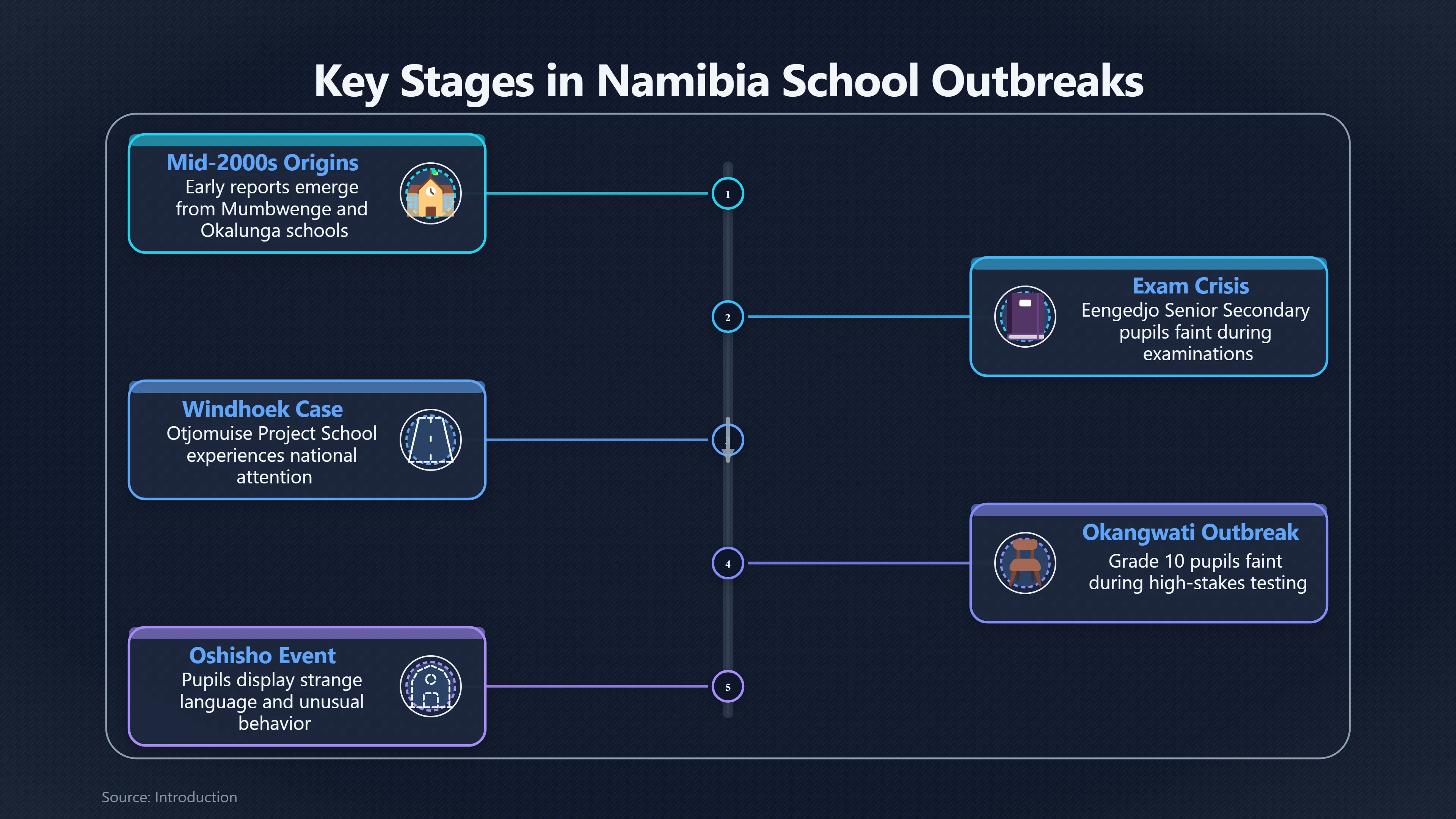
Northern schools in the mid-2000s
Some of Namibia’s earliest well-publicised school outbreaks occurred in northern regions between 2005 and 2007.
Schools including Mumbwenge Combined School, Okalunga Primary School and Ondukuta Combined School reported pupils screaming, fainting and claiming to see demons. At another school, pupils developed persistent involuntary nodding that puzzled teachers. Health workers examined affected children, yet doctors reportedly found no obvious physical illness. Regional education officials increasingly suggested that hysteria, rather than supernatural forces, best explained the pattern.[The Namibian]namibian.com.naThe Namibian Nodding children puzzle teachersThe NamibianNodding children puzzle teachers - The Namibian…
These incidents established the pattern that later reports would repeatedly follow: alarming symptoms, medical investigations, competing supernatural and medical explanations, and significant disruption to teaching.
Examination-related outbreaks
Several highly publicised outbreaks coincided with examination periods.
At Eengedjo Senior Secondary School in 2009, pupils fainted while reporting encounters with mysterious “black things”. Around 26 pupils were taken to hospital, but doctors reportedly found nothing physically wrong. Contemporary reporting noted that similar incidents had become familiar during examination seasons at other northern schools.[The Namibian]namibian.com.naThe Namibian Exam 'demons' on the looseThe NamibianExam 'demons' on the loose - The NamibianAugust 11, 2009…
In 2016, Grade 10 pupils at Okangwati Combined School fainted during examinations, prompting allegations of witchcraft. Education officials investigated while also noting that comparable incidents had occurred elsewhere in Namibia. Officials pointed out that earlier outbreaks had likewise been associated with examinations and had previously been interpreted by education authorities as mass psychogenic illness requiring counselling rather than exorcism.[The Namibian]namibian.com.naThe Namibian'Witchcraft' allegations hit Okangwati Combined SchoolThe NamibianApril 17, 2016…
The repeated association with examinations does not prove that exams caused every incident, but it supports the broader psychological literature identifying periods of intense stress as common triggers for collective psychogenic episodes among adolescents.[PMC]pmc.ncbi.nlm.nih.govPMCEpisodes of mass hysteria in African schools: A study of literaturePMCEpisodes of mass hysteria in African schools: A study of literature
Otjomuise Project School, 2015
The Otjomuise Project School incident in Windhoek attracted national attention because it demonstrated that such episodes were not confined to rural northern schools.
Pupils reportedly screamed, fainted and spoke in unusually deep voices after one learner claimed to have encountered a ghost. Clinical psychologist Shaun Whittaker later argued that public discussion should focus less on spirits or witchcraft and more on recognised psychological conditions now classified as Functional Neurological Symptom Disorder (FNSD), formerly known as conversion disorder.[The Namibian]namibian.com.naThe Namibian The case of mass hysteriaThe NamibianThe case of mass hysteria - The Namibian…
Oshisho Combined School, 2017
At Oshisho Combined School near Okongo, pupils—again mostly girls—displayed unusual behaviour including speaking in what witnesses described as a strange language. Psychiatrist Mnubi Farahani rejected claims of witchcraft, suggesting instead that pupils sharing similar social pressures could develop collective psychogenic symptoms and recommending counselling rather than supernatural explanations.[The Namibian]namibian.com.naThe Namibian Mass hysteria hits Okongo schoolThe NamibianMass hysteria hits Okongo school - The Namibian…
How doctors and officials interpreted the episodes
Health and education authorities consistently stressed that frightening behaviour should not automatically be attributed to supernatural causes.
Psychiatrists and psychologists interviewed during several outbreaks described the incidents as examples of mass psychogenic illness or Functional Neurological Symptom Disorder. These conditions involve genuine neurological or physical symptoms that arise through psychological mechanisms rather than detectable structural disease. The symptoms are involuntary and should not be dismissed as pretending or deliberate misbehaviour.[com.na]namibian.com.naThe Namibian The case of mass hysteriaThe NamibianThe case of mass hysteria - The Namibian…
Officials also emphasised practical management.
Counselling, temporarily separating affected pupils, reducing public attention and reassuring students were repeatedly recommended. Some education officials argued that intense media coverage and large gatherings of anxious parents could unintentionally prolong outbreaks by reinforcing fear. One regional education director even described a case in which pupils remained calm until television crews and worried parents arrived, after which symptoms reportedly resumed.[The Namibian]namibian.com.naThe Namibian Ignore mass hysteria, experts sayThe NamibianIgnore mass hysteria, experts say - The NamibianOctober 26, 2017…
This approach broadly reflects international public-health guidance on collective psychogenic illness, which recommends first excluding environmental hazards before using reassurance, communication and psychological support to prevent further spread.[New England Journal of Medicine]nejm.orgOpen source on nejm.org.

Why supernatural explanations remained influential
Medical explanations did not replace local beliefs overnight.
Many parents interpreted the attacks through existing beliefs about witchcraft, ancestral forces or demonic possession. Prayer meetings were organised at some schools, while others requested help from traditional healers or church leaders. In several reported cases, multiple pastors attempted prayers and exorcism-like interventions after hospitals failed to identify a physical illness.[The Namibian]namibian.com.naThe Namibian'Demons' wreak havoc in NorthThe Namibian…
These differing interpretations reflected contrasting ways of explaining the same observable events. Doctors focused on psychological and neurological mechanisms, whereas many communities viewed the episodes within established religious or spiritual traditions. The coexistence of these explanations helps explain why outbreaks often generated intense public debate rather than a single agreed interpretation.
What these outbreaks reveal about Namibia
Taken together, Namibia’s school outbreaks demonstrate how collective illness can emerge where psychological stress, close social networks and culturally meaningful beliefs intersect.
The symptoms were real and often deeply distressing, regardless of whether they were ultimately attributed to psychogenic illness, spiritual forces or another explanation. Because many outbreaks occurred among pupils who spent long periods together under academic pressure, schools provided the social conditions in which fear and expectation could spread rapidly once an initial case appeared.[nih.gov]pmc.ncbi.nlm.nih.govPMCEpisodes of mass hysteria in African schools: A study of literaturePMCEpisodes of mass hysteria in African schools: A study of literature
These episodes also illustrate the importance of careful investigation. Public-health practice requires ruling out poisoning, infectious disease, neurological illness and other medical conditions before concluding that an outbreak is psychogenic. Namibia’s school cases therefore remain important not because they provide evidence for supernatural causes, but because they show how communities interpret unexplained illness differently, and how education, medicine, religion and local belief all shape responses to frightening collective events.[nejm.org]nejm.orgOpen source on nejm.org.
Amazon book picks
Further Reading
Books and field guides related to Why Did Illness Spread Through Namibia's Schools?. Use these as the next step if you want deeper reading beyond the article.

The Sleeping Beauties
Investigates collective and culture-linked psychogenic illnesses in communities, closely matching the unexplained symptoms, social contag...

It's All in Your Head
Explains how psychological distress can produce genuine neurological and physical symptoms even when conventional medical tests find no o...
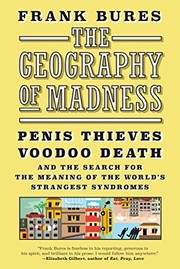
The geography of madness
Provides useful context for understanding how cultural beliefs, community narratives and fear can shape outbreaks of unusual symptoms and...

Mass psychogenic illness
Examines the mechanisms, outbreak patterns, stressors and group dynamics of mass psychogenic illness in schools, workplaces and other clo...
Endnotes
1.
Source: namibian.com.na
Title: The Namibian Ignore mass hysteria, experts say
Link:https://www.namibian.com.na/ignore-mass-hysteria-experts-say/
Source snippet
The NamibianIgnore mass hysteria, experts say - The NamibianOctober 26, 2017...
Published: October 26, 2017
2.
Source: pmc.ncbi.nlm.nih.gov
Title: PMCEpisodes of mass hysteria in African schools: A study of literature
Link:https://pmc.ncbi.nlm.nih.gov/articles/PMC3588562/
3.
Source: nejm.org
Link:https://www.nejm.org/doi/full/10.1056/NEJM200001133420206
4.
Source: namibian.com.na
Title: The Namibian Nodding children puzzle teachers
Link:https://www.namibian.com.na/nodding-children-puzzle-teachers/
Source snippet
The NamibianNodding children puzzle teachers - The Namibian...
5.
Source: namibian.com.na
Title: The Namibian The case of mass hysteria
Link:https://www.namibian.com.na/the-case-of-mass-hysteria/
Source snippet
The NamibianThe case of mass hysteria - The Namibian...
6.
Source: namibian.com.na
Title: The Namibian Mass hysteria hits Okongo school
Link:https://www.namibian.com.na/mass-hysteria-hits-okongo-school/
Source snippet
The NamibianMass hysteria hits Okongo school - The Namibian...
7.
Source: namibian.com.na
Title: The Namibian’Demons’ wreak havoc in North
Link:https://www.namibian.com.na/demons-wreak-havoc-in-north/
Source snippet
The Namibian...
8.
Source: namibian.com.na
Title: The Namibian Exam ‘demons’ on the loose
Link:https://www.namibian.com.na/exam-demons-on-the-loose/
Source snippet
The NamibianExam 'demons' on the loose - The NamibianAugust 11, 2009...
Published: August 11, 2009
9.
Source: namibian.com.na
Title: The Namibian’Witchcraft’ allegations hit Okangwati Combined School
Link:https://www.namibian.com.na/witchcraft-allegations-hit-okangwati-combined-school/
Source snippet
The NamibianApril 17, 2016...
Published: April 17, 2016
10.
Source: pmc.ncbi.nlm.nih.gov
Link:https://pmc.ncbi.nlm.nih.gov/articles/PMC12710187/
11.
Source: pmc.ncbi.nlm.nih.gov
Link:https://pmc.ncbi.nlm.nih.gov/articles/PMC7704439/
12.
Source: pmc.ncbi.nlm.nih.gov
Link:https://pmc.ncbi.nlm.nih.gov/articles/PMC7368451/
13.
Source: pubmed.ncbi.nlm.nih.gov
Link:https://pubmed.ncbi.nlm.nih.gov/28618331/
14.
Source: namibian.com.na
Title: ‘Exam demons’ strike again
Link:https://www.namibian.com.na/exam-demons-strike-again/
Additional References
15.
Source: sciencedirect.com
Link:https://www.sciencedirect.com/science/article/pii/S1059131117302935
Source snippet
Psychogenic nonepileptic seizures: Namibian healthcare providers’ perceptions and frustrations - ScienceDirect...
16.
Source: news24.com
Title: Witchcraft allegations as pupils faint at Namibian school | News24
Link:https://www.news24.com/witchcraft-allegations-as-pupils-faint-at-namibian-school-20160418
Source snippet
Witchcraft allegations as pupils faint at Namibian school | News24...
17.
Source: youtube.com
Title: The Razor-Thin Line Between Contagion and Connection | Dan Taberski | TED
Link:https://www.youtube.com/watch?v=u0fFIJapsRY
Source snippet
Can Laughter Kill You? - The Mysterious Tanganyika Laughter Epidemic of 1962...
18.
Source: youtube.com
Title: Can Laughter Kill You?
Link:https://www.youtube.com/watch?v=qpJKn8qdq4M
Source snippet
East African Laughing Epidemic – History Documentary...
19.
Source: youtube.com
Title: East African Laughing Epidemic – History Documentary
Link:https://www.youtube.com/watch?v=pGVvD7hlYzI
Source snippet
Episode 71. Frenzy – The Turmoil of Mass Psychogenic Illness...
20.
Source: youtube.com
Title: Episode 71. Frenzy – The Turmoil of Mass Psychogenic Illness
Link:https://www.youtube.com/watch?v=e2AdorYLDF8
Source snippet
Girls cured in NY 'medical mystery'?...
21.
Source: namibiansun.com
Title: Mass hysteria strikes another school
Link:https://www.namibiansun.com/news/mass-hysteria-strikes-another-school
22.
Source: namibiansun.com
Title: Mvula learners return to school
Link:https://www.namibiansun.com/news/mvula-learners-return-to-school
23.
Source: youtube.com
Title: Girls cured in NY ‘medical mystery’?
Link:https://www.youtube.com/watch?v=FazyFtW1UvA
Topic Tree