Within Djibouti
Why Djibouti's Scares Are So Hard to Trace
Colonial bias, regional overlap and tight media control make dramatic claims about Djiboutian scares unusually difficult to confirm.
On this page
- How colonial observers shaped the archive
- Why regional traditions blur national boundaries
- How media controls hide local rumours and scares
Page outline Jump by section
Introduction
Djibouti has no well-documented national equivalent of a famous witch panic, school fainting epidemic or moral scare that historians can reconstruct in detail. That does not necessarily mean such episodes never occurred. Instead, the country’s historical record makes dramatic claims unusually difficult to verify. Much of what survives was written by French colonial administrators or outside researchers, many beliefs were shared across borders with neighbouring societies rather than confined to modern Djibouti, and contemporary reporting is constrained by one of the most tightly controlled media environments in Africa. Together, these factors mean that historians must distinguish carefully between documented events, regional traditions, rumours and later retellings rather than assuming that every striking story reflects a verifiable Djiboutian episode.[ARTICLE 19]article19.orgARTICLE 19Djibouti: Media and the lawARTICLE 19October 16, 2015…

How colonial observers shaped the archive
The oldest written accounts of religion, healing and unusual beliefs in Djibouti were rarely produced by local people themselves. Instead, they came largely from French colonial officials, military doctors, missionaries and ethnographers working in what was then French Somaliland.
This matters because colonial writers often had their own priorities. They recorded customs they regarded as unusual, linked practices to public order or labour discipline, and frequently interpreted unfamiliar ceremonies through the language of “superstition”, “primitive religion” or “native psychology”. Such descriptions remain valuable historical sources, but they cannot simply be accepted at face value because they reflect both what local communities did and what colonial observers considered worth recording.
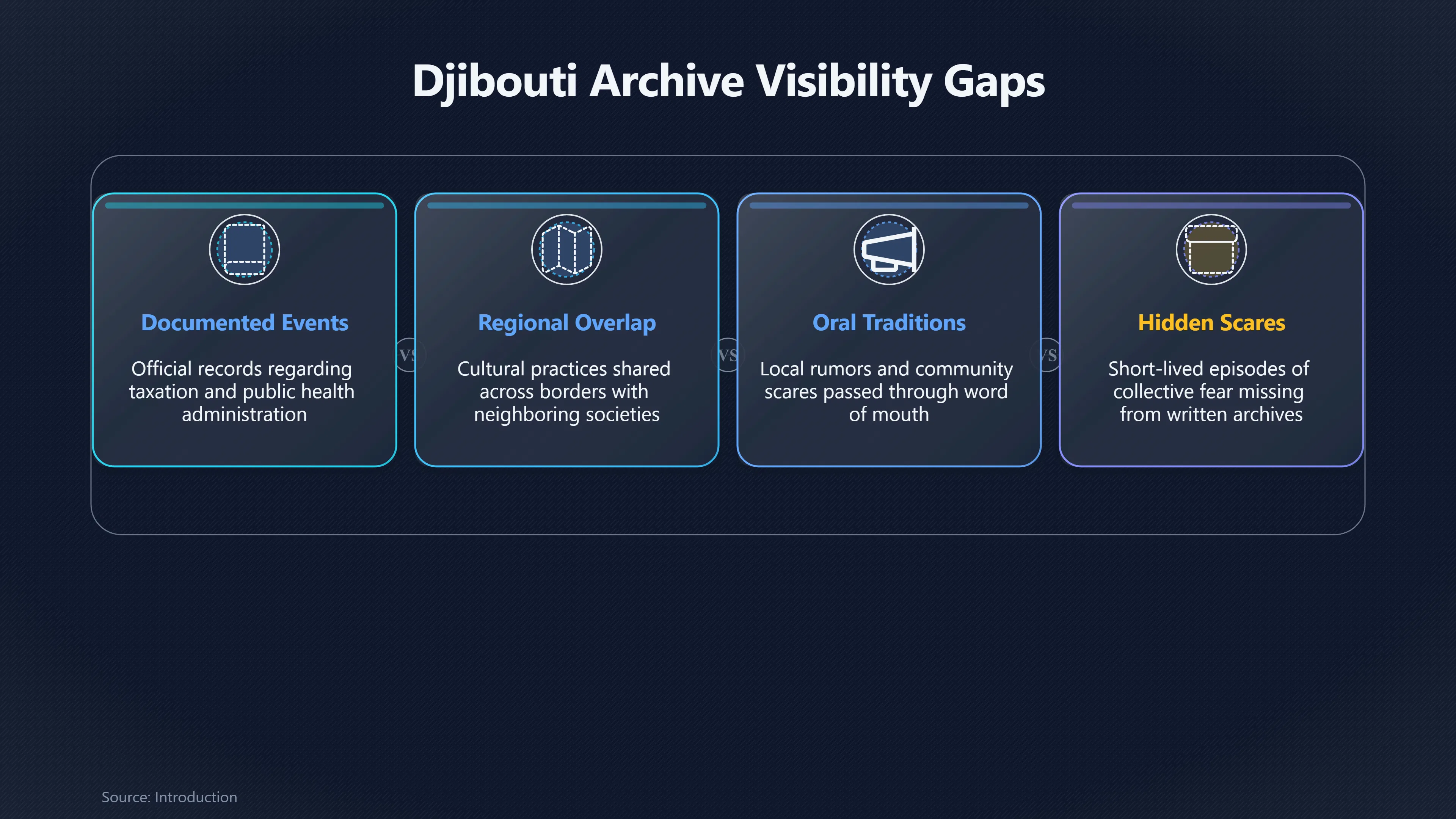
The archive is also uneven. Officials were more likely to document events that affected administration, taxation, policing or health than everyday local rumours or short-lived episodes of collective fear. A village scare that never reached colonial authorities may have disappeared entirely from the written record.
For that reason, modern historians compare colonial reports with anthropology, oral traditions and later scholarship instead of relying on a single source. Apparent silences in the archive are not automatically evidence that no rumours, scares or episodes of collective belief occurred.
Why regional traditions blur national boundaries
Djibouti sits at the meeting point of the Horn of Africa and the Red Sea. For centuries, Afar and Somali communities have maintained family, trade and religious links extending into Ethiopia, Eritrea, Somalia and Yemen. Cultural traditions therefore spread across the region rather than stopping at modern political frontiers.
This creates a problem for anyone trying to identify uniquely “Djiboutian” panics or collective-belief episodes. Spirit-possession traditions, healing rituals and stories about supernatural forces are documented throughout the wider region. Researchers regularly describe these practices as regional phenomena whose local forms differ from one community to another, making it difficult to assign a particular account confidently to Djibouti alone.
The result is frequent overlap:
- A ceremony described in Ethiopia may also have been familiar in Djibouti, but the source may never mention Djiboutian participants.
- A traveller’s account may describe customs observed among Somali or Afar communities without specifying which side of a later international border they lived on.
- Modern summaries sometimes repeat regional examples while accidentally presenting them as specifically Djiboutian.
Careful scholarship therefore separates evidence that is directly documented inside Djibouti from evidence that simply demonstrates wider regional traditions.
How media controls hide local rumours and scares
The difficulties do not end with the colonial period. Modern documentation is also limited because independent reporting inside Djibouti remains heavily restricted.
International press-freedom organisations describe a media landscape dominated by state-owned outlets, with no independent domestic news organisation operating freely inside the country. Journalists report widespread self-censorship, while independent reporting has often been carried out from exile. Authorities have also been criticised for restricting access to information and limiting critical coverage.[rsf.org]rsf.orgReporters Without Borders Djibouti | RSFReporters Without Borders Djibouti | RSF
For historians of rumours or moral panics, this has important consequences.
A local scare may:
- remain confined to word of mouth;
- appear only briefly on social media before disappearing;
- never receive detailed independent reporting;
- survive only in personal memory rather than searchable archives.
This makes verification much harder than in countries with extensive local newspaper archives or multiple competing media organisations documenting unusual events from different perspectives.
Why the absence of evidence is not evidence of absence
One of the biggest mistakes is assuming that a lack of documentation proves nothing happened.
In Djibouti, several structural factors reduce the chance that local scares will leave permanent records:
- relatively small population and limited historical publishing;
- dependence on outside observers during much of the colonial period;
- cross-border cultural traditions that are often documented elsewhere instead of locally;
- limited press pluralism after independence;
- fewer digitised historical collections than in many larger countries.
These gaps mean historians often cannot reconstruct the exact development of rumours, possession scares or community anxieties with the precision possible for better-documented societies.
At the same time, these limitations make caution especially important. Sparse documentation also means unsupported claims should not be repeated simply because they are dramatic. A story circulating online may ultimately trace back to a single travel account, an unsourced blog or a misunderstanding of a regional tradition.
What this means for interpreting Djibouti’s panic history
The strongest conclusion is not that Djibouti lacked collective fears or unusual beliefs. Every society experiences rumours, religious tensions, health scares and periods of uncertainty. Rather, the challenge is that the surviving evidence is fragmented and filtered through historical circumstances.
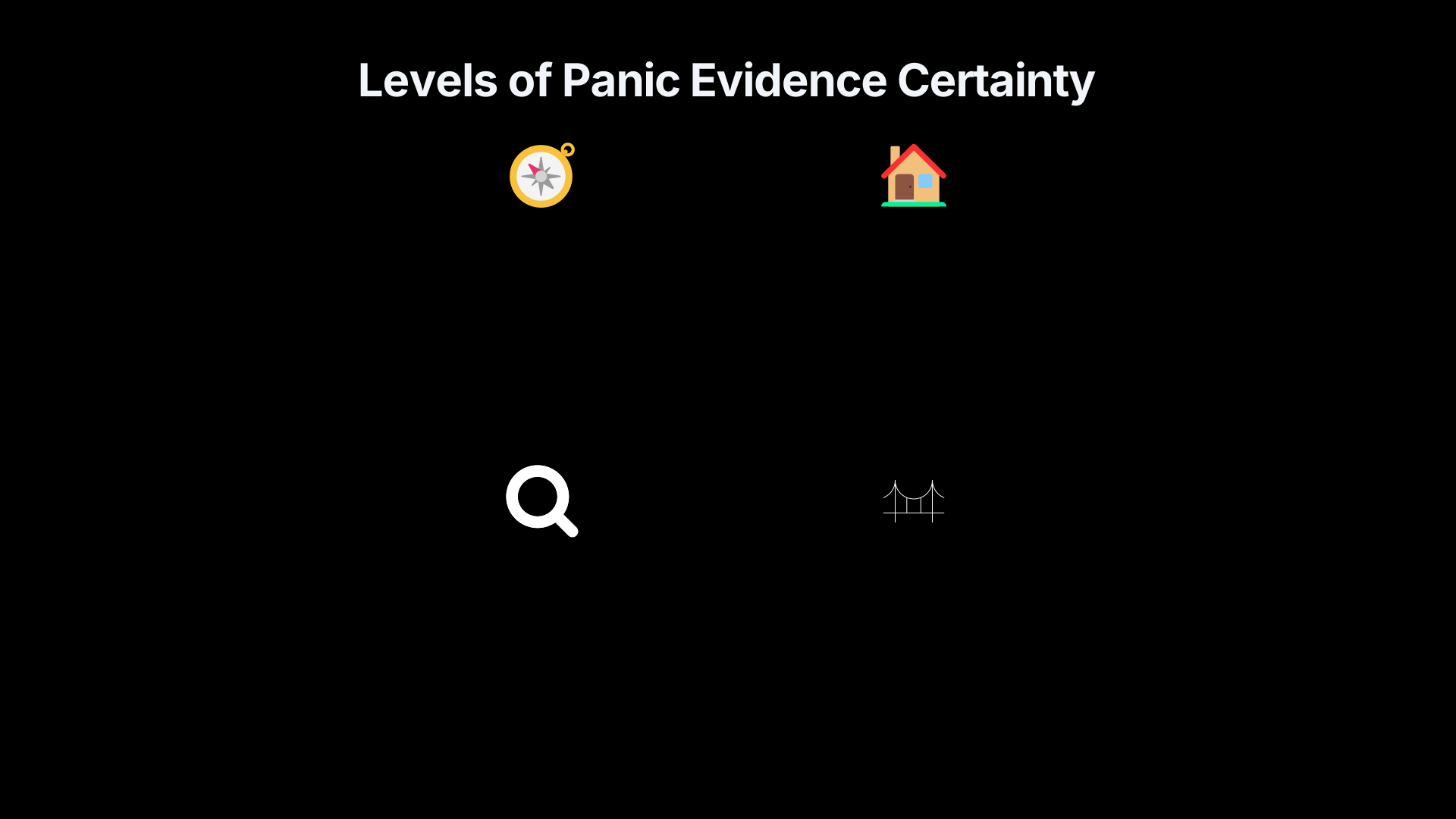
For readers interested in collective belief, the safest approach is to distinguish between three different levels of certainty:
- Well supported: broad regional traditions such as spirit-possession practices that are documented across the Horn of Africa and include Djibouti within their geographical range.
- Plausible but difficult to reconstruct: local rumours, community scares or temporary episodes that may have occurred but left little independent documentation.
- Poorly supported: sensational stories presented as uniquely Djiboutian despite lacking reliable contemporary evidence.
Seen this way, the most important feature of Djibouti’s panic history is not a single famous episode but the unusually incomplete archive itself. Understanding how colonial record-keeping, regional cultural overlap and modern information controls shape that archive helps explain why historians write about Djibouti with greater caution than they do about countries whose collective scares are documented through abundant newspapers, court records and eyewitness accounts.
Amazon book picks
Further Reading
Books and field guides related to Why Djibouti's Scares Are So Hard to Trace. Use these as the next step if you want deeper reading beyond the article.

The fortunes of Africa
Helps readers understand colonial documentation and historical context.

Decolonizing Methodologies
Explores limits and biases in colonial knowledge production.

Endnotes
1.
Source: article19.org
Title: ARTICLE 19Djibouti: Media and the law
Link:https://www.article19.org/resources/djibouti-media-and-the-law/
Source snippet
ARTICLE 19October 16, 2015...
Published: October 16, 2015
2.
Source: 2021-2025.state.gov
Title: U.S. Department of State Djibouti
Link:https://2021-2025.state.gov/reports/2019-country-reports-on-human-rights-practices/djibouti/
Source snippet
U.S. Department of StateDjibouti - United States Department of State...
3.
Source: rsf.org
Title: Reporters Without Borders Djibouti | RSF
Link:https://rsf.org/en/country/djibouti
4.
Source: refworld.org
Link:https://www.refworld.org/reference/annualreport/rsf/2003/en/27667
Source snippet
Reporters Without Borders Annual Report 2003 - Djibouti | RefworldREPORTERS WITHOUT BORDERS ANNUAL REPORT 2003 - DJIBOUTI 2003 Reporters...
5.
Source: refworld.org
Link:https://www.refworld.org/reference/annualreport/rsf/2004/en/26222
Source snippet
Reporters Without Borders Annual Report 2004 - Djibouti | RefworldREPORTERS WITHOUT BORDERS ANNUAL REPORT 2004 - DJIBOUTI [Button: Hide D...
6.
Source: rsf.org
Title: analyse regionale
Link:https://rsf.org/en/analyse_regionale/846
Source snippet
Djibouti 2023 - EN | RSFDjibouti 2023 - EN Djibouti MEDIA LANDSCAPE Djibouti’s media landscape is completely locked down and is almost ex...
7.
Source: rsf.org
Title: analyse regionale
Link:https://rsf.org/en/analyse_regionale/611
Source snippet
Djibouti 2022 - EN | RSFDjibouti 2022 - EN Djibouti MEDIA LANDSCAPE Djibouti’s media landscape is under permanent lockdown and is limited...
Additional References
8.
Source: researchgate.net
Title: (PDF) Djibouti: Media and the law
Link:https://www.researchgate.net/publication/373391549_Djibouti_Media_and_the_law
Source snippet
August 25, 2023 — Book PDF Available DJIBOUTI: MEDIA AND THE LAW * August 2023 DOI:10.13140/RG.2.2.35975.78246 * Publisher: ARTICLE 19 Au...
Published: August 25, 2023
9.
Source: youtube.com
Link:https://www.youtube.com/watch?v=MtCRmCsvx58
Source snippet
RR7727A DJIBOUTI PROBLEMS OF INDEPENDENCE...
10.
Source: youtube.com
Title: Djibouti A Strategic History of the Horn of Africa
Link:https://www.youtube.com/watch?v=tlxVuU8XD8c
Source snippet
Djibouti's Quiet Break | How the Last French African Colony Gained Independence (1977)...
11.
Source: ecoi.net
Link:https://www.ecoi.net/en/document/1397258.html
Source snippet
Freedom House (Author): “Freedom of the Press 2016 - Djibouti”, Document #1397258 - ecoi.netApril 27, 2016 — FREEDOM OF THE PRESS 2016...
Published: April 27, 2016
12.
Source: reporter-ohne-grenzen.de
Link:https://www.reporter-ohne-grenzen.de/dschibuti
13.
Source: reporter-ohne-grenzen.de
Link:https://www.reporter-ohne-grenzen.de/rangliste/laender/11/dschibuti
14.
Source: youtube.com
Title: Episode 54: the History of Djibouti
Link:https://www.youtube.com/watch?v=Qf1t1zcaI1M
Source snippet
Djibouti: A Window to Africa's Strategic and Cultural Riches...
15.
Source: youtube.com
Link:https://www.youtube.com/watch?v=BkEq7miPYUc
Source snippet
Episode 54: the History of Djibouti...
16.
Source: youtube.com
Title: Djibouti: A Window to Africa’s Strategic and Cultural Riches
Link:https://www.youtube.com/watch?v=HEKenTz7YZE
17.
Source: freedomhouse.org
Title: freedom world
Link:https://freedomhouse.org/country/djibouti/freedom-world/2024
Topic Tree