Within Marshall Islands
Were Marshallese Fears Ever Really a Cult Panic?
Marshallese spirit traditions and Christian prophecy shaped interpretations of misfortune, but evidence does not support a classic cult or witch-panic story.
On this page
- Traditional spirits, divination and Christian continuity
- Why witch hunt and cargo cult labels fit poorly
- How colonial language turned unfamiliar belief into irrationality
Page outline Jump by section
Introduction
Were Marshallese fears ever really a cult panic? The available historical evidence suggests the answer is no. Traditional Marshallese religion included belief in ancestral spirits, sacred places, divination and supernatural forces, but these beliefs did not produce a documented nationwide witch-hunt, organised cult scare or mass persecution comparable to better-known episodes elsewhere. Instead, the islands experienced a gradual blending of older religious traditions with Christianity, creating a form of religious continuity rather than a cycle of collective panic.[micsem.org]micsem.orgReligion in the Marshall Islands – Micronesian SeminarReligion in the Marshall Islands – Micronesian Seminar
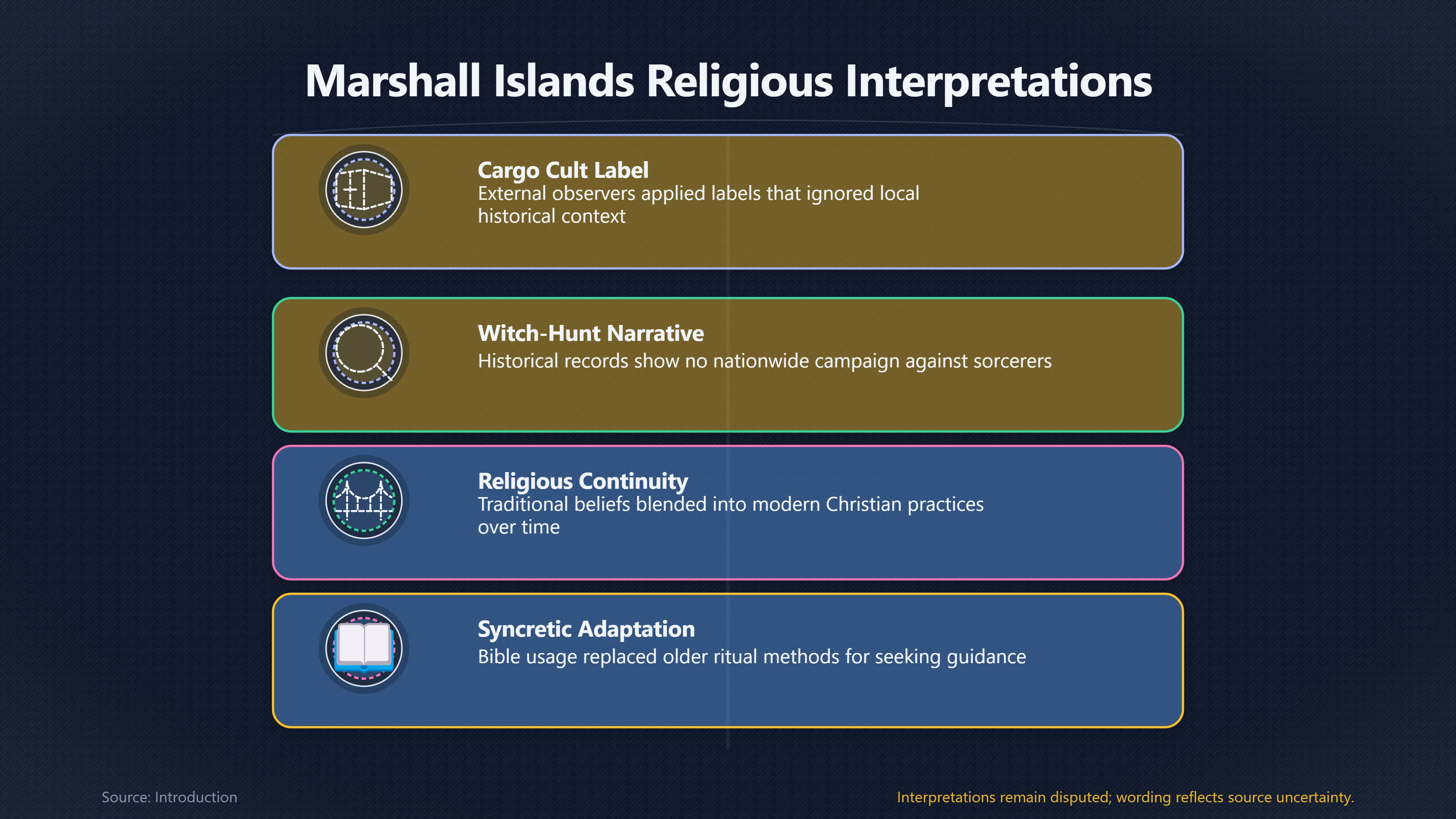
The more misleading story comes from outside observers. Colonial officials, missionaries and later popular writers sometimes interpreted unfamiliar Pacific religious practices through labels such as “cargo cult” or “primitive superstition”. Those labels fit the Marshall Islands poorly. While Marshallese communities adapted to profound social change brought by missionaries, colonial rule and military occupation, historians have found little evidence for a classic millenarian movement or a society driven by irrational cult fears.[micsem.org]micsem.orgReligion in the Marshall Islands – Micronesian SeminarReligion in the Marshall Islands – Micronesian Seminar
Traditional spirits, divination and Christian continuity
Before Christianity became dominant in the nineteenth century, Marshallese religion described a world inhabited by numerous spiritual beings rather than a simple division between good and evil. Ancestral spirits were believed to remain connected to living families, sometimes communicating through possession or trance. Certain reefs, trees and other locations were thought to house powerful spirits, while illness, misfortune and difficult decisions could be interpreted through interactions with the spirit world.[micsem.org]micsem.orgReligion in the Marshall Islands – Micronesian SeminarReligion in the Marshall Islands – Micronesian Seminar
Divination formed part of this religious landscape. Historical accounts describe specialists using pebbles, knotted plant fibres and other techniques to seek guidance about sickness, voyages or disputes. These practices were not signs of social breakdown but ordinary ways of making sense of uncertainty within the traditional worldview.[micsem.org]micsem.orgReligion in the Marshall Islands – Micronesian SeminarReligion in the Marshall Islands – Micronesian Seminar
Christian missionaries did not erase these beliefs overnight. Instead, many practices were reshaped. Francis X. Hezel notes that some Marshallese Christians continued to believe ancestral spirits could influence daily life, while forms of divination sometimes survived in altered form, such as opening the Bible at random to seek guidance instead of using older ritual methods. This illustrates religious adaptation rather than a sharp divide between “traditional” and “Christian” belief.[micsem.org]micsem.orgReligion in the Marshall Islands – Micronesian SeminarReligion in the Marshall Islands – Micronesian Seminar
Importantly, surviving belief in spirits did not automatically produce accusations that neighbours were secretly responsible for illness or disaster. Unlike parts of Europe, Africa or Melanesia where witchcraft accusations occasionally escalated into organised violence, the historical record for the Marshall Islands contains no well-documented national campaign against supposed witches.
Why witch-hunt and cargo-cult labels fit poorly
Readers sometimes expect every Pacific society to have experienced either witch panics or so-called cargo cults. The Marshall Islands demonstrates why those assumptions are misleading.
There is little evidence for:
- organised witch trials or sustained witch persecutions;
- nationwide possession panics;
- violent campaigns against alleged sorcerers;
- a documented Marshallese equivalent of famous Melanesian millenarian movements.
Instead, religious change was largely driven by missionary activity, conversion, education and long-term coexistence between Christian teaching and older cultural traditions.[micsem.org]micsem.orgReligion in the Marshall Islands – Micronesian SeminarReligion in the Marshall Islands – Micronesian Seminar
The “cargo cult” label is especially problematic. Anthropologists increasingly emphasise that the phrase itself can oversimplify complex Indigenous religious and political movements, many of which were responses to colonial domination rather than naïve attempts to summon material goods. Those movements are principally associated with parts of Melanesia, especially Papua New Guinea and Vanuatu. Applying the same label to the Marshall Islands merely because Marshallese communities encountered foreign militaries or imported technology ignores important historical differences.[Reddit]reddit.comAre Cargo Cults a real thing?Are Cargo Cults a real thing?April 12, 2021…
The Marshall Islands certainly experienced dramatic encounters with outside powers, including Japanese rule, American military occupation and nuclear testing. Yet those experiences produced political protest, demands for justice and enduring distrust of official assurances far more clearly than they produced any documented cargo-cult movement.

How colonial language encouraged misleading interpretations
European missionaries and colonial administrators often described Indigenous religions using terms such as “heathen”, “superstition” or “primitive”. Such language reflected colonial attitudes as much as it described Marshallese beliefs.
Missionary accounts record that some supporters of traditional religion resisted early Christian converts, occasionally threatening or intimidating them before Christianity became firmly established. However, these episodes are better understood as conflicts accompanying rapid religious change than as evidence of a society consumed by irrational panic. Over time, Christianity became deeply rooted while aspects of traditional belief survived alongside it.[micsem.org]micsem.orgReligion in the Marshall Islands – Micronesian SeminarReligion in the Marshall Islands – Micronesian Seminar
Modern scholarship instead emphasises continuity. Rather than disappearing, elements of older belief systems were incorporated into Christian life, family traditions and local understandings of illness, ancestors and sacred places. This kind of religious blending, often called syncretism, is common across the Pacific and should not be confused with the emergence of dangerous cults.[micsem.org]micsem.orgReligion in the Marshall Islands – Micronesian SeminarReligion in the Marshall Islands – Micronesian Seminar
What modern religious life tells us
Today’s Marshall Islands is overwhelmingly Christian, with the largest communities including the United Church of Christ–Congregational, Assemblies of God, the Roman Catholic Church and several other Protestant denominations. The constitution protects freedom of religion, although smaller religious minorities have reported occasional social discrimination.[State Department]2021-2025.state.govDepartment Marshall IslandsState DepartmentMarshall Islands - United States Department of State…
This religious diversity illustrates another reason why cult language is misleading. The country’s religious landscape consists primarily of established churches with long local histories rather than isolated, coercive or apocalyptic movements. Traditional beliefs have not disappeared entirely, but where they persist they usually exist as cultural or family practices within a broader Christian framework.[micsem.org]micsem.orgReligion in the Marshall Islands – Micronesian SeminarReligion in the Marshall Islands – Micronesian Seminar
What the evidence actually supports
The strongest historical conclusion is that the Marshall Islands does not provide a classic example of either a witch panic or a cult scare.
Instead, the evidence points to a different pattern:
- Indigenous spirit beliefs formed a normal part of traditional Marshallese religion.
- Christianity spread rapidly but absorbed some earlier religious practices instead of eliminating them completely.
- No well-supported evidence exists for a nationwide witch-hunt or comparable persecution.
- Applying the label “cargo cult” to the Marshall Islands imports assumptions from different Pacific societies and obscures the islands’ own distinctive religious history.
- Colonial descriptions often portrayed unfamiliar beliefs as irrational, whereas modern historians and anthropologists emphasise cultural continuity, adaptation and historical context.[micsem.org]micsem.orgReligion in the Marshall Islands – Micronesian SeminarReligion in the Marshall Islands – Micronesian Seminar
Amazon book picks
Further Reading
Books and field guides related to Were Marshallese Fears Ever Really a Cult Panic?. Use these as the next step if you want deeper reading beyond the article.
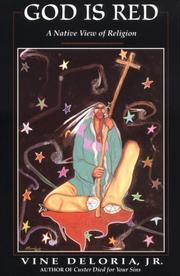
God is red
Helps readers understand non-Western religious traditions without sensationalism.


The Penguin book of witches
Offers comparative material on supernatural belief and accusation.
Endnotes
1.
Source: micsem.org
Title: Religion in the Marshall Islands – Micronesian Seminar
Link:https://micsem.org/article/religion-in-the-marshall-islands/
2.
Source: academic.oup.com
Link:https://academic.oup.com/hawaii-scholarship-online/book/18329/chapter/176366314
Source snippet
OUP AcademicThe Religion of the Marshall Islands | Summoning the Powers Beyond: Traditional Religions in Micronesia | Hawai'i Scholarship...
3.
Source: 2021-2025.state.gov
Title: Department Marshall Islands
Link:https://2021-2025.state.gov/reports/2022-report-on-international-religious-freedom/marshall-islands/
Source snippet
State DepartmentMarshall Islands - United States Department of State...
4.
Source: reddit.com
Title: Are Cargo Cults a real thing?
Link:https://www.reddit.com/r/AskAnthropology/comments/mpones
Source snippet
Are Cargo Cults a real thing?April 12, 2021...
Published: April 12, 2021
5.
Source: academic.oup.com
Link:https://academic.oup.com/book/58134/chapter-abstract/480190450
Source snippet
and Postcolonial Spirits: States of Possession and Culture History in Polynesia and Micronesia | Ideas of Possession: Interdisciplinary a...
6.
Source: academic.oup.com
Title: reference article
Link:https://academic.oup.com/reference/62334/reference-article-abstract/554061984?login=false
7.
Source: academic.oup.com
Link:https://academic.oup.com/hawaii-scholarship-online/book/18329
8.
Source: micsem.org
Link:https://micsem.org/articles-categories/religion/
9.
Source: micsem.org
Link:https://micsem.org/article/distribution-of-spirit-possession-and-trance-in-micronesia/
10.
Source: encyclopedia.com
Title: Marshall Islands | Encyclopedia.com
Link:https://www.encyclopedia.com/places/australia-and-oceania/pacific-islands-political-geography/marshall-islands
Source snippet
Nearly all Marshall Islanders now anchor part of their identity in one of several forms of Christian belief, but indigenous interpretatio...
11.
Source: anthroencyclopedia.com
Title: Cargo cults | Open Encyclopedia of Anthropology
Link:https://www.anthroencyclopedia.com/entry/cargo-cults
Additional References
12.
Source: cambridge.org
Title: Violence and Religious Change in the Pacific Islands
Link:https://www.cambridge.org/core/books/violence-and-religious-change-in-the-pacific-islands/0EE88A9739EC58F3CCA0C37A8EDBE714
Source snippet
THIS LIST IS GENERATED BASED ON DATA PROVIDED BY CROSSREF. * * * Trompf, Garry 2023. Violence and Religious Change in the Pacific Islands...
13.
Source: worldatlas.com
Title: Religious Beliefs In The Marshall Islands
Link:https://www.worldatlas.com/articles/religious-beliefs-in-the-marshall-islands.html
Source snippet
The Kwajalein Atoll in the Marshall Islands. The island nation of the Marshall Islands is an associated...
14.
Source: youtube.com
Title: The Sound of Crickets at Night (Ainikien Jidjid ilo Boñ)
Link:https://www.youtube.com/watch?v=pmgAy_FrmTM
Source snippet
Our Micronesian Churches in Hawai'i: History, Who they are, What are their issues?...
15.
Source: youtube.com
Link:https://www.youtube.com/watch?v=F8LyXLsmYg4
Source snippet
The Sound of Crickets at Night (Ainikien Jidjid ilo Boñ)...
16.
Source: atomicatolls.org
Link:https://www.atomicatolls.org/anthropology-of-the-marshall-island
17.
Source: youtube.com
Title: A Walk Through The Past: Part 2
Link:https://www.youtube.com/watch?v=FMT5MDUrbmo
Source snippet
Jilel - The Calling of the Shell - GIFF 2015 Official Selection...
18.
Source: researchgate.net
Title: The Religion of the Marshall Islands: Traditional Religions in Micronesia
Link:https://www.researchgate.net/publication/310497147_The_Religion_of_the_Marshall_Islands_Traditional_Religions_in_Micronesia
19.
Source: youtube.com
Link:https://www.youtube.com/watch?v=5NL6RG9oUN8
20.
Source: cambridge.org
Title: The interpretation of cargo cults (Chapter 8)
Link:https://www.cambridge.org/core/books/abs/melanesian-religion/interpretation-of-cargo-cults/F2621B49CA14C1E3B2670322F95761F9
21.
Source: Wikipedia
Title: Religion in the Marshall Islands
Link:https://en.wikipedia.org/wiki/Religion_in_the_Marshall_Islands
Topic Tree