Within Monaco
Was Monaco's Earthquake Panic Really Hysteria?
The 1887 earthquake caused genuine fear in Monaco, showing why real disaster panic must not be mistaken for psychogenic illness.
On this page
- What struck Monaco and the western Riviera
- Flight, rumours and fear of aftershocks
- Panic versus mass psychogenic illness
Page outline Jump by section
Introduction
The panic that swept Monaco during the 1887 Riviera earthquake was a response to a genuine natural disaster, not an episode of mass psychogenic illness or collective delusion. On the morning of 23 February 1887, one of the strongest earthquakes ever recorded on the French–Italian Riviera struck the region, killing hundreds of people, destroying towns to the east and west of Monaco, and triggering months of anxiety as repeated aftershocks kept residents uncertain whether an even larger shock was about to follow. Contemporary reports describe frightened crowds fleeing buildings, spending nights outdoors and reacting to persistent rumours, but these responses reflected an objectively dangerous situation rather than irrational contagion. For Monaco, the earthquake remains the clearest historical example of widespread public fear rooted in a real physical threat.
What struck Monaco and the western Riviera?
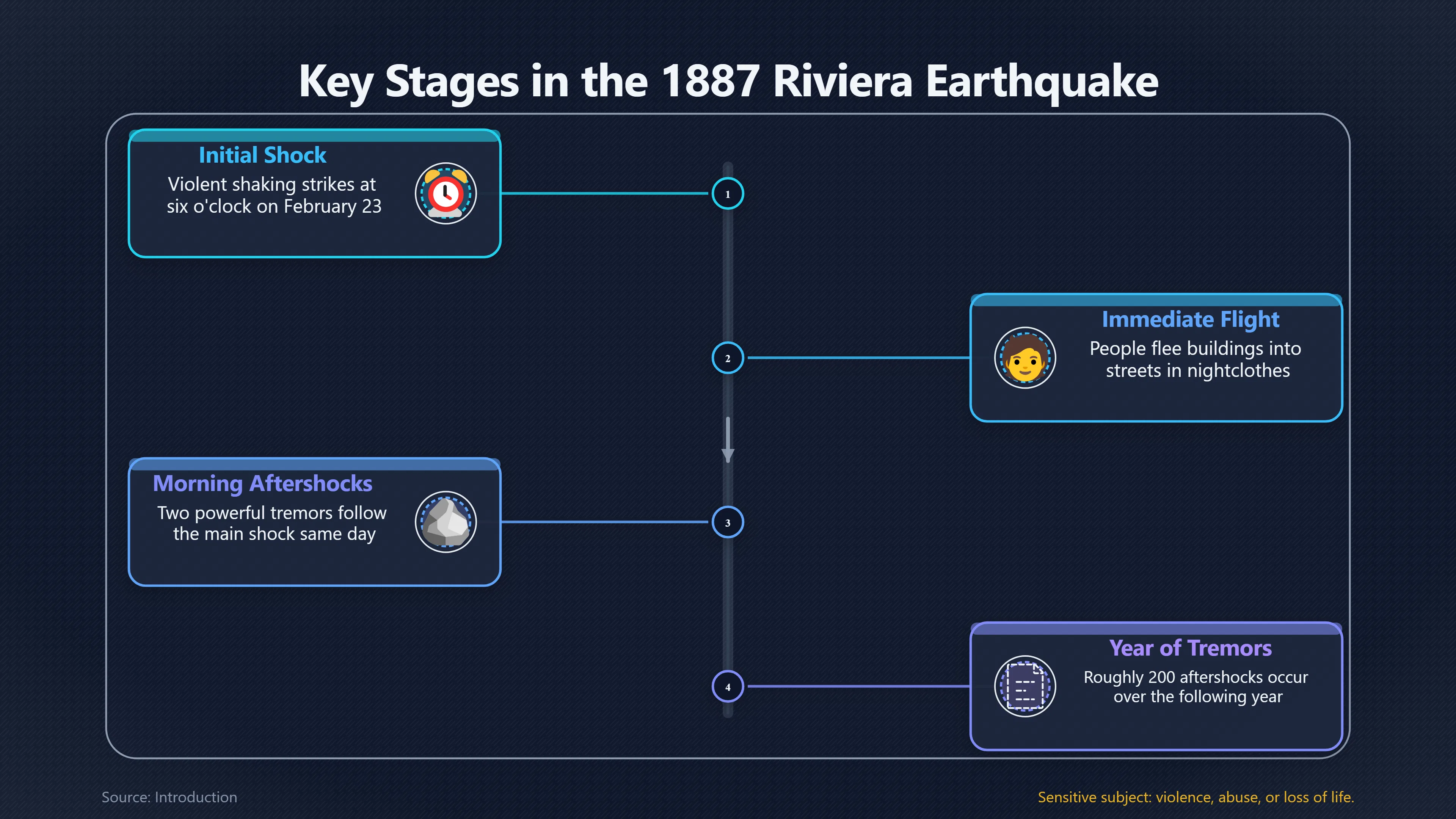
The earthquake occurred shortly after six o’clock in the morning on 23 February 1887. Modern seismological research places it among the largest earthquakes known from the Ligurian and western Mediterranean region, with an estimated intensity of IX on the MSK scale in the worst-hit areas. Damage stretched for roughly 100 kilometres along the coast between present-day France and Italy, while the shaking was felt across much of northern Italy, southern France, Switzerland and beyond.[Nature]nature.comStrong earthquakes on the French-Italian Mediterranean Riviera | Communications Earth & EnvironmentMarch 20, 2026…
Monaco lay close enough to the epicentral region to experience severe shaking. Although the principality escaped the catastrophic destruction seen in places such as Diano Marina and Bussana, buildings were damaged, rockfalls occurred on the steep coastal slopes, and the population experienced the same violent ground motion that affected neighbouring Menton and Nice. Contemporary scientific reports collected observations from across the Riviera, including Monaco, as researchers attempted to understand the sequence of shocks and their unusually wide effects.[Nature]nature.comThe Earthquake | NatureThe Earthquake | NatureMarch 3, 1887…
The earthquake did not consist of a single isolated event. Two powerful aftershocks followed the main shock on the same morning, and seismic activity continued for many months afterwards. Modern reconstructions identify roughly 200 aftershocks during the following year, explaining why fear remained high long after the initial disaster.[OUP Academic]academic.oup.comOUP AcademicReappraisal of the 1887 Ligurian earthquake (western Mediterranean) from macroseismicity, active tectonics and tsunami modell…

Flight, rumours and fear of aftershocks
The first reaction throughout the Riviera was immediate flight. People rushed from homes, hotels and public buildings into open streets or squares, often wearing only nightclothes after being awakened by the violent shaking. Newspapers from across Europe described terrified crowds, churches filling with worshippers and widespread uncertainty about whether buildings would remain standing.[paperspast.natlib.govt.nz]paperspast.natlib.govt.nzPapers Past | Newspapers | Northern Advocate | 26 February 1887 | TERRIBLE EARTHQUAKE IN EUROPE.February 26, 1887…
In Monaco and neighbouring Monte Carlo, the earthquake produced intense public alarm despite comparatively lighter structural damage than in some nearby Italian towns. Contemporary reports describe residents and visitors abandoning buildings and gathering outside because nobody knew whether further shocks would follow. The region’s famous hotels and casinos attracted many foreign visitors, meaning that fear spread rapidly through an unusually international population.[paperspast.natlib.govt.nz]paperspast.natlib.govt.nzPapers Past | Newspapers | Northern Advocate | 26 February 1887 | TERRIBLE EARTHQUAKE IN EUROPE.February 26, 1887…
The continuing aftershocks created an ideal environment for rumours. Every tremor revived fears that the disaster was beginning again. Reports circulated of fresh collapses elsewhere on the Riviera, while news from devastated Italian communities arrived slowly and often incompletely. Without modern seismological monitoring or instant communication, people could not distinguish harmless minor tremors from signs of another major earthquake.
Scientists investigating the event also noted unusual observations, including reports of dead deep-sea fish washing ashore after the earthquake. Although such phenomena attracted public attention, they were treated by researchers as natural observations requiring explanation rather than evidence of supernatural causes.[Nature]nature.comEarthquake in the Western Riviera | NatureEarthquake in the Western Riviera | NatureMay 5, 1887…
Was this really “mass hysteria”?
It is tempting to describe scenes of frightened crowds as “mass hysteria”, but that label is misleading.
Mass psychogenic illness usually refers to groups developing symptoms that cannot be explained by an underlying physical cause. Moral panics similarly involve exaggerated fears about social threats whose scale is unsupported by evidence. Neither description fits Monaco in February 1887.
Instead, several factors justified the population’s behaviour:
- A powerful earthquake had genuinely struck the region.
- Hundreds of people had already been killed elsewhere on the Riviera.
- Buildings had collapsed in neighbouring towns.
- Strong aftershocks continued throughout the day and for months afterwards.
- People had no reliable way of knowing when further dangerous shocks might occur.
Modern earthquake science recognises that damaging aftershocks commonly follow major earthquakes, meaning that remaining outdoors immediately after a destructive event can be a rational precaution rather than a panic response. The continued seismic sequence during 1887 confirms that residents’ fears were grounded in an ongoing physical hazard.[OUP Academic]academic.oup.comOUP AcademicReappraisal of the 1887 Ligurian earthquake (western Mediterranean) from macroseismicity, active tectonics and tsunami modell…
This distinction matters because historical writing sometimes uses older expressions such as “panic” or “hysteria” loosely to describe emotional reactions. In Monaco’s case, the fear itself was real, but so was the danger.

Why Monaco’s experience matters in the history of collective fear
Within a wider study of panics and collective belief, the 1887 earthquake provides an important contrast with episodes driven mainly by rumour, superstition or imagined conspiracies.
The Monegasque population responded to:
- direct physical danger rather than imagined persecution;
- observable destruction rather than unsupported rumours alone;
- continuing aftershocks that reinforced legitimate concern;
- incomplete information, which naturally increased uncertainty.
This illustrates an important principle for historians and psychologists: not every episode of widespread fear should be interpreted as collective irrationality. Human beings often display similar outward behaviours—crowding into streets, abandoning homes, repeating rumours or seeking reassurance—whether the underlying threat is genuine or imagined. Understanding the difference requires examining the evidence for the hazard itself.
In Monaco, that evidence is overwhelming. The earthquake was one of the defining natural disasters in the history of the western Mediterranean, prompting scientific investigations, government relief efforts in the affected regions and decades of geological research into Riviera seismic hazards.[search.acs.beniculturali.it]search.acs.beniculturali.itArchivio Centrale dello StatoDirezione generale amministrazione civile. Commissione reale per i danneggiati del terremoto in Liguria, 23 febbraio 1887 1887 - 1894…
A lasting reminder of real disaster panic
The 1887 Riviera earthquake remains Monaco’s clearest documented episode of sudden collective fear. Unlike stories built around legends, miracle claims or later myths, this event is supported by abundant contemporary scientific reports, newspaper accounts and modern seismological research.
Its historical importance lies not in demonstrating mass hysteria, but in showing how ordinary people react when confronted with an immediate, life-threatening natural disaster. The fear that spread through Monaco was proportionate to the evidence available at the time: violent shaking, visible damage, reports of widespread deaths nearby and an exhausting sequence of aftershocks that kept uncertainty alive for months. The episode therefore serves as a useful reminder that collective fear is not inherently irrational; sometimes it is the expected human response to a very real danger.
Amazon book picks
Further Reading
Books and field guides related to Was Monaco's Earthquake Panic Really Hysteria?. Use these as the next step if you want deeper reading beyond the article.
The Unthinkable
Examines how people behave during genuine emergencies rather than imagined panics.
Extraordinary Popular Delusions and the Madness of Crowds
Rating: 4.0/5 from 5 Google Books ratings
Useful comparison for distinguishing real danger from collective delusion.

The great quake
Provides context for understanding historic earthquake events and public reaction.
Endnotes
1.
Source: nature.com
Link:https://www.nature.com/articles/s43247-026-03407-0
Source snippet
Strong earthquakes on the French-Italian Mediterranean Riviera | Communications Earth & EnvironmentMarch 20, 2026...
Published: March 20, 2026
2.
Source: academic.oup.com
Link:https://academic.oup.com/gji/article/190/1/87/601785
Source snippet
OUP AcademicReappraisal of the 1887 Ligurian earthquake (western Mediterranean) from macroseismicity, active tectonics and tsunami modell...
3.
Source: nature.com
Title: The Earthquake | Nature
Link:https://www.nature.com/articles/035419b0
Source snippet
The Earthquake | NatureMarch 3, 1887...
Published: March 3, 1887
4.
Source: paperspast.natlib.govt.nz
Link:https://paperspast.natlib.govt.nz/newspapers/NA18870226.2.17.12
Source snippet
Papers Past | Newspapers | Northern Advocate | 26 February 1887 | TERRIBLE EARTHQUAKE IN EUROPE.February 26, 1887...
Published: February 26, 1887
5.
Source: nature.com
Title: Earthquake in the Western Riviera | Nature
Link:https://www.nature.com/articles/036004c0
Source snippet
Earthquake in the Western Riviera | NatureMay 5, 1887...
Published: May 5, 1887
6.
Source: search.acs.beniculturali.it
Title: Archivio Centrale dello Stato
Link:https://search.acs.beniculturali.it/OpacACS/inventario/IT-ACS-GEAST0263-0000000001
Source snippet
Direzione generale amministrazione civile. Commissione reale per i danneggiati del terremoto in Liguria, 23 febbraio 1887 1887 - 1894...
7.
Source: search.acs.beniculturali.it
Title: Archivio Centrale dello Stato
Link:https://search.acs.beniculturali.it/OpacACS/guida/IT-ACS-AS0001-0001539
Source snippet
Guida ai Fondi - Commissione reale per i danneggiati del terremoto in Liguria 1887 - 1894...
8.
Source: nature.com
Title: The Late Earthquake on the Riviera,
Link:https://www.nature.com/articles/036151c0
9.
Source: nature.com
Title: The Earthquake in the Riviera | Nature
Link:https://www.nature.com/articles/035534c0
10.
Source: nature.com
Title: The Earthquake in Switzerland | Nature
Link:https://www.nature.com/articles/035442a0
11.
Source: paperspast.natlib.govt.nz
Link:https://paperspast.natlib.govt.nz/newspapers/CL18870304.2.23
Additional References
12.
Source: cambridge.org
Title: E. Kendell Show author details * * * R. E. Kendell* Affiliation: Departme
Link:https://www.cambridge.org/core/journals/the-british-journal-of-psychiatry/article/distinction-between-mental-and-physical-illness/5FA9AC9A9A8F7D6395BF41B3CD004305
Source snippet
The distinction between mental and physical illness | The British Journal of Psychiatry | Cambridge CoreJanuary 2, 2018 — THE DISTINCTION...
Published: January 2, 2018
13.
Source: youtube.com
Link:https://www.youtube.com/watch?v=KYp2UU-pbU4
Source snippet
Ghost Towns: The Scars of Italy's Disasters...
14.
Source: youtube.com
Title: Places to see in (Sanremo
Link:https://www.youtube.com/watch?v=j17givgkqDs
Source snippet
This town was abandoned after the 1887 earthquake - I'll tell you the story of Bussana Vecchia...
15.
Source: cambridge.org
Link:https://www.cambridge.org/core/journals/the-british-journal-of-psychiatry/article/protean-nature-of-mass-sociogenic-illness/2BDC2262E104B8A33F3DD49773DA0D8B
Source snippet
Protean nature of mass sociogenic illness | The British Journal of Psychiatry | Cambridge CoreJanuary 2, 2018 — PROTEAN NATURE OF MASS SO...
Published: January 2, 2018
16.
Source: youtube.com
Title: Ghost Towns: The Scars of Italy’s Disasters
Link:https://www.youtube.com/watch?v=KXNPcvS_Zgk
Source snippet
Bajardo (Imperia), the village that belonged to the Celts and the Druids...
17.
Source: researchgate.net
Link:https://www.researchgate.net/publication/404805398_communications_earth_environment_Article_A_Nature_Portfolio_journal
18.
Source: sciencedirect.com
Link:https://www.sciencedirect.com/science/article/abs/pii/S0022399905005076
19.
Source: arxiv.org
Title: arXiv Aftershocks as a time independant phenomenon
Link:https://arxiv.org/abs/2403.18672
20.
Source: youtube.com
Title: Bussana Vecchia BBC World report
Link:https://www.youtube.com/watch?v=PLTRLgbz9Qk
Source snippet
Places to see in (Sanremo - Italy) Bussana Vecchia...
21.
Source: sciencedirect.com
Title: A simple method for distinguishing between expected and unexpected panics
Link:https://www.sciencedirect.com/science/article/pii/0005796787900866
Topic Tree