When Belief and Fear Reshaped Mongolia
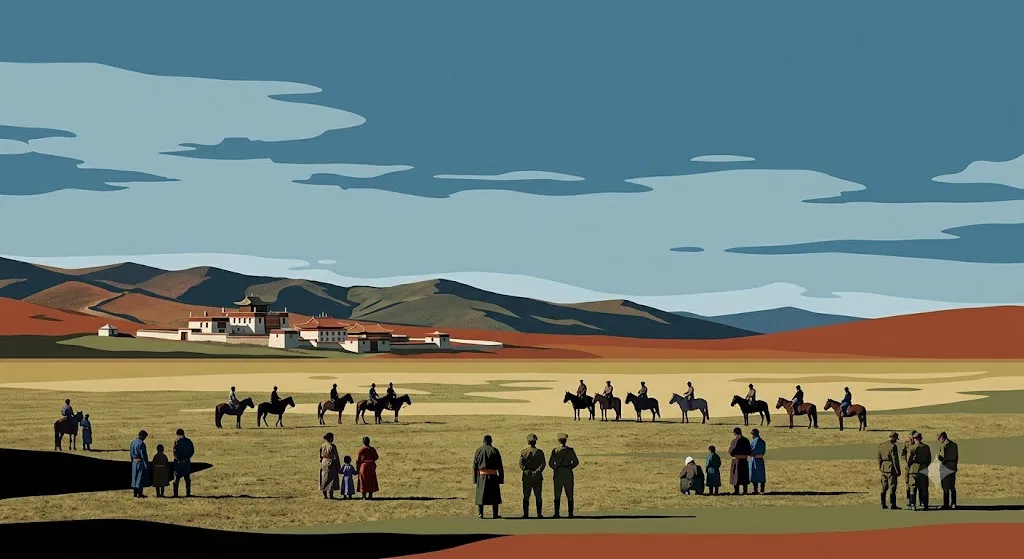
Mongolia’s history of collective belief and social fear does not offer a neat equivalent to the Salem witch trials or a famous school outbreak of mass psychogenic illness.
Page outline Jump by section
Introduction
These episodes matter because belief was rarely acting alone. Mongolia passed through imperial collapse, revolution, forced collectivisation, religious destruction, Soviet domination and a sudden transition to democracy and markets. In such unstable conditions, prophecies and rumours could give suffering a meaningful pattern, while governments could turn uncertainty into stories about conspirators and enemies. The result was sometimes genuine mobilisation, sometimes exaggerated fear and, in the late 1930s, catastrophic persecution.[University of Cambridge]cam.ac.ukOpen source on cam.ac.uk.
Why Mongolia’s cases resist easy labels
Terms such as “cult”, “mass hysteria” and “superstition” can obscure more than they reveal in Mongolia. A prophecy repeated by rebels may have expressed sincere religious expectation, political strategy and desperation at the same time. A shamanic movement may be a community’s attempt to recover suppressed family history rather than a closed or coercive sect. Conversely, accusations of conspiracy or spiritual danger can themselves become contagious beliefs, especially when promoted by officials or mass media.
The historical record is also uneven. Revolutionary governments destroyed monasteries, persecuted religious specialists and controlled public accounts of opposition. Later memories were shaped by trauma, family silence and political efforts to place responsibility entirely on Soviet dictator Joseph Stalin. Anthropologist Christopher Kaplonski argues that Mongolia’s repression must be understood as a struggle involving both Soviet direction and Mongolian institutions, rather than as a simple foreign order passively obeyed by everyone inside the country.[University of Cambridge]cam.ac.ukOpen source on cam.ac.uk.
The useful distinctions are therefore:
- Charismatic or millenarian mobilisation: a leader or movement promises national, spiritual or world transformation.
- Rumour panic: unverified reports of invasion, betrayal or supernatural intervention change behaviour.
- Political moral panic: authorities magnify a supposed internal threat until exceptional punishment appears necessary.
- Religious revival: suppressed practices return rapidly, producing uncertainty and competition but not necessarily collective delusion.
- Mass psychogenic illness: groups develop real physical symptoms without an identified organic cause. No comparably well-documented Mongolian episode dominates the available English-language historical literature.
Ja Lama and the power of returned heroes
One of Mongolia’s clearest charismatic cases centred on the adventurer commonly known as Ja Lama. Active around western Mongolia from the late nineteenth century until his death in 1922, he presented himself not merely as a political fighter but as the returning embodiment of Amursana, an eighteenth-century Oirat leader who had resisted Qing rule.
This claim drew upon a wider prophetic tradition in the Altai region. Stories predicted that Amursana, or a related liberating figure, would return to restore the fortunes of oppressed peoples. Such beliefs were not simply private folklore. They offered a language through which communities experiencing foreign rule, economic disruption and loss of political power could imagine rescue. Scholar Andrei Znamenski describes how versions of the Amursana prophecy were repeatedly adapted by activists, nationalists and later revolutionary organisers.[OpenEdition Journals]journals.openedition.orgOpenEdition JournalsPower for the Powerless: Oirot/Amursana Prophecy in Altai…by AA Znamenski · 2014 · Cited by 14 — Last but not lea…
Ja Lama’s appeal also rested on concrete political action. He participated in the struggle that removed Qing control from the western city of Khovd in 1912. His religious image, military reputation and uncertain personal history reinforced one another: mystery made his claims harder to disprove, while battlefield success made them appear more credible.
Yet describing his followers as a “cult” would be misleading without qualification. Ja Lama operated as a warlord, nationalist symbol, supposed reincarnation and religious authority in a region where those roles could overlap. Accounts also portray his later rule as violent and coercive. The important point is not that an irrational population was deceived by a magician. His authority grew because a familiar prophecy was attached to a man who appeared during imperial breakdown and seemed, for a time, capable of delivering political liberation.
His story also demonstrates how later mythmaking can overtake evidence. Reports of supernatural cruelty, invulnerability and miraculous reappearances became attached to him, while the bizarre preservation and display of his severed head helped turn a historical actor into a figure of dark legend. Separating documented violence from embellished travel writing and oral tradition remains difficult.
The 1932 rebellion and the promise of sacred war
The uprising that spread through northern and western Mongolia in 1932 was rooted in severe material and political pressures. The revolutionary government’s “left course” included rapid collectivisation, attacks on private trade, confiscation of property and mounting pressure on monasteries. Herders resisted the loss of animals and autonomy, while Buddhist clergy faced the destruction of their economic and social position.
Religious expectation helped organise this anger. Rebel propaganda reportedly announced that the Panchen Lama, a major Tibetan Buddhist leader, was coming with troops, that outside assistance was imminent and that the fighting formed part of a prophesied sacred conflict associated with Shambhala. In Buddhist tradition, Shambhala is an ideal realm linked in some teachings to a future struggle against forces hostile to religion. In the political conditions of 1932, the image could be converted into an assurance that a seemingly weak rebellion was participating in an inevitable cosmic victory.[biblio.uz]biblio.uzTHE KHUBSUGUL UPRISING OF 1932 IN MONGOLIA29 Nov 2024 — more than 40 people were killed here on April 12 during a successful rebel raid. the uprising is a Shambhala war that is pr…
Rumour was especially powerful because reliable information was scarce. Isolated communities could not easily verify claims about foreign armies, religious leaders or events elsewhere in Mongolia. Stories of approaching rescue encouraged participation and reduced the apparent hopelessness of confronting a Soviet-backed state.
However, the uprising should not be reduced to an outbreak of religious frenzy. Herders, monks, former officials and even some party members took part for differing reasons. Government policies had produced genuine economic damage and political resentment. Archival research has not confirmed claims that either the Panchen Lama or Japan actually directed the rebellion, even though rumours of their support circulated among insurgents and officials.[Wikipedia]Wikipedia1932 armed uprising in Mongolia1932 armed uprising in Mongolia
The violence was extensive and was committed by both sides. Rebels attacked government offices, cooperatives and perceived supporters of the regime; government forces used military units, summary proceedings and executions to suppress them. Casualty totals remain disputed, but the fighting and subsequent punishments killed large numbers of people. Moscow then forced Mongolian leaders to moderate the most aggressive collectivisation programme, showing that the revolt was not merely a delusion but a political crisis serious enough to alter policy.[Wikipedia]Wikipedia1932 armed uprising in Mongolia1932 armed uprising in Mongolia
The episode is best understood as an uprising in which millenarian language gave direction and confidence to resistance created by real social upheaval. The prophecy did not manufacture the crisis, but it helped people interpret it, recruit others and imagine victory.
When the state created the greater panic
The most destructive collective fear in modern Mongolian history was generated not by an isolated religious group but by the revolutionary state. From the 1920s onward, officials framed the Buddhist establishment as the “lama question”: a vast obstacle to socialist modernisation and a possible network of counter-revolutionaries, foreign agents and class enemies.
Before the revolution, monasteries were central to education, ritual, economic exchange and political life. Cambridge’s account of Kaplonski’s archival research estimates that Mongolia had more than 700 monasteries and around 80,000 lamas. To socialist leaders, this was not simply a religion but a rival structure of authority with deep local loyalty.[University of Cambridge]cam.ac.ukOpen source on cam.ac.uk.
The government initially used taxation, propaganda, confiscation and restrictions to weaken it. Officials depicted monasteries as parasitic, backward and politically treacherous. Some criticism had a basis in real conflicts over wealth, privilege and institutional power, and Buddhist reformers had themselves criticised parts of the monastic establishment. The panic developed when such criticism expanded into the assumption that clergy as a category formed a dangerous internal conspiracy.
The 1932 rebellion strengthened this perception. Because lamas had played prominent roles in the revolt, later officials could present almost any religious network as a security threat. Fear of Japanese expansion and alleged foreign espionage intensified the atmosphere. Accusations did not need to be supported by evidence specific to each defendant; religious identity, social status, family connections or coerced testimony could become proof of disloyalty.
During the peak purges of 1937–39, Mongolia’s security machinery destroyed most of the remaining monastic system. Kaplonski estimates that approximately 18,000 Buddhist priests were executed. Other victims included officials, intellectuals, aristocrats, ethnic minorities and people accused of nationalism or espionage.[University of Cambridge]cam.ac.ukOpen source on cam.ac.uk.
This was more than an anti-religious policy. It displayed the central features of a political moral panic:
- a large and varied population was compressed into the category of “enemy”;
- isolated acts of resistance were treated as evidence of a coordinated national plot;
- propaganda made extraordinary danger seem immediate;
- secret accusations and confessions created apparently self-confirming evidence;
- emergency institutions removed normal protections;
- punishment expanded far beyond people involved in actual rebellion.
The fear had material origins: Mongolia was a small state caught between powerful neighbours, and Japan was advancing across East Asia. Yet the scale of persecution cannot be explained by genuine security concerns alone. The imagined conspiracy became far larger than any demonstrated organisation. Once the state accepted that hidden enemies were everywhere, each arrest produced names for further arrests.
The destruction had effects far beyond the immediate death toll. Monasteries disappeared, texts and artworks were lost, religious education was broken and families concealed clerical ancestry. Public silence continued for decades. Modern remembrance therefore involves not only mourning victims but asking how institutions, neighbours and local officials participated in persecution.[University of Cambridge]cam.ac.ukOpen source on cam.ac.uk.
Shamanism after socialism: belief, scepticism and insecurity
When state socialism ended around 1990, religious life returned with remarkable speed. Buddhist monasteries reopened, foreign religious organisations arrived and shamanic practitioners became visible again. The transition also brought unemployment, inequality and the collapse of institutions that had previously organised work and social welfare.
Anthropologist Manduhai Buyandelger found that the revival of shamanism was closely connected to this instability. People sought help not only with illness or fortune but with histories that socialist repression had erased. Among some Buryat communities, spirits provided narratives about ancestors whose records, graves or family stories had been lost. Shamanic ritual could function as a form of historical reconstruction and emotional repair.[MIT News]news.mit.eduMIT NewsThe surprising story of Mongolian shamanism | MIT News | Massachusetts Institute of Technology…
This was not a simple return to an unchanged ancient tradition. Practitioners multiplied quickly, methods varied and clients often visited several shamans while deciding whom to trust. Buyandelger notes the apparent paradox that scepticism itself encouraged expansion: people tested competing practitioners rather than either accepting or rejecting the entire field.[MIT News]news.mit.eduMIT NewsThe surprising story of Mongolian shamanism | MIT News | Massachusetts Institute of Technology…
The resulting environment could generate accusations of fraud, commercial exploitation or invented tradition. Some practitioners undoubtedly treated spiritual services as a source of income, but commercialisation alone does not establish that the revival was a “cult boom”. It was also a response to broken historical continuity and a precarious market economy. The popularity of shamans reflected uncertainty about the future and the past at once.
The post-socialist religious landscape was similarly eclectic rather than neatly divided into exclusive camps. Studies of lay Buddhism in Ulaanbaatar describe people combining Buddhist rites with shamanic, healing and other practices. This flexibility makes Western-style classifications of fixed membership or conversion less useful.[JSTOR]jstor.orgOpen source on jstor.org.
Foreign religions and modern “cult” scares
Mongolia’s democratic constitution protects freedom of conscience and religion, but religious organisations must register, and much of the process has historically been left to local authorities. The law also contains broad restrictions on activities judged inhumane or dangerous to Mongolian tradition and culture, without always defining those categories precisely.[refworld.org]refworld.orgOpen source on refworld.org.
These rules reflect a genuine dilemma. After decades of compulsory atheism, Mongolia reopened to international missionaries and religious movements at the same moment that poverty made food, education and welfare assistance especially valuable. Critics worried that foreign organisations might use material aid to obtain converts or weaken national culture. Earlier religious-freedom reporting recorded friction over humanitarian assistance combined with proselytising and public concern about incentives offered to young people.[Department of Justice]justice.govOpen source on justice.gov.
At times, however, suspicion has moved beyond scrutiny of particular conduct into hostility towards religious minorities as such. A 2016 religious-freedom report recorded social-media harassment involving Christians and controversy surrounding videos about the Unification Church. The movement has attracted serious criticism internationally, but the Mongolian case illustrates why allegations should still be tested individually rather than allowing the label “cult” to serve as proof of criminality.[State.gov]2021-2025.state.govmongolia trashedmongolia trashed
Foreignness is an important amplifier. Buddhism is commonly treated as part of Mongolian national heritage, while newer Christian or international movements can be portrayed as imported threats. Yet even the boundary between native and foreign religion is historically unstable: Mongolian Buddhism has long been connected to Tibet, and modern Buddhist practice has absorbed international reform, science and healing movements.[Taylor & Francis Online]tandfonline.comOpen source on tandfonline.com.
The danger of a moral panic appears when several separate questions are collapsed into one. A group may deserve investigation for financial abuse, coercion or harm to children. That does not mean every unfamiliar doctrine is dangerous, every convert has been manipulated or every charitable activity is a disguised recruitment scheme. Mongolia’s registration system and cultural-protection language can provide oversight, but their vagueness also risks unequal treatment.
Rumours of China and the fear of national disappearance
One of Mongolia’s most persistent modern social scares is not strictly religious, but it resembles a moral panic and often overlaps with ideas about cultural purity. Mongolia’s position between Russia and China, combined with its small population and economic dependence on Chinese trade, has encouraged fears of absorption by its southern neighbour.
Anthropologist Franck Billé has documented rumours that Chinese men are deliberately fathering children with Mongolian women to dilute the population, that Chinese vegetables are poisoned and that China is waiting to seize the country. Such claims circulate alongside real concerns about economic influence, mining, migration and historical domination.[University of Cambridge]cam.ac.ukOpen source on cam.ac.uk.
The distinction between legitimate geopolitical anxiety and contagious rumour is crucial. China is Mongolia’s dominant trading partner and has used economic pressure in disputes, including after the Dalai Lama’s 2016 visit. That gives stories of vulnerability a credible foundation. But rumours about poisoned food or organised reproductive infiltration transform structural dependence into a hidden biological conspiracy.[Le Monde.fr]lemonde.frOpen source on lemonde.fr.
Nationalist groups have sometimes enforced these fears through humiliation and violence, particularly against Mongolian women associated with Chinese men. Billé’s research describes a 2009 video in which a woman’s hair was cut as punishment for such a relationship. Although extreme nationalist organisations lacked broad support, their actions drew power from a wider atmosphere in which public hostility towards China could be treated as proof of patriotism.[University of Cambridge]cam.ac.ukOpen source on cam.ac.uk.
This is a classic mechanism of moral panic: a complicated economic and political relationship is embodied in supposedly disloyal individuals. Women, migrants, traders or minority believers become visible targets for anxieties that cannot easily be resolved at the level of international power.
What these episodes have in common
Mongolia’s cases differ greatly, but several recurring pressures connect them.
Rapid loss of control. Prophetic movements and rumours flourished when old institutions collapsed or new policies overturned everyday life. Ja Lama emerged during the fall of Qing authority; the 1932 sacred-war stories spread during forced collectivisation; shamans returned amid the insecurities of market transition.
Missing or distrusted information. Sparse communications helped rumours about foreign armies and religious rescuers circulate in 1932. Socialist secrecy later concealed the purges. In the democratic period, social media has made accusations travel faster than legal or journalistic verification.
Threats to national continuity. Amursana prophecies promised the restoration of a people’s power. Shamanic ancestors restored suppressed memory. Fears of missionaries or Chinese influence presented Mongolia’s language, bloodline or spiritual inheritance as vulnerable to disappearance.
Institutions that benefit from fear. Charismatic leaders can gain followers by presenting themselves as saviours. Nationalists can turn suspicion into political legitimacy. Most consequentially, the socialist security state used the supposed ubiquity of counter-revolutionaries to justify exceptional power.
A mixture of fact and amplification. Mongolian monasteries really did possess political and economic authority; the 1932 rebellion really was violent; foreign governments really do exert pressure; some religious organisations may behave abusively. Panics arise not because every underlying concern is imaginary, but because complexity is replaced by an expanding story of concealed, unified and existential danger.

Why the history still matters
Mongolia’s experience warns against treating collective belief as a defect belonging only to the religious or poorly educated. The Shambhala expectations of some rebels were powerful, but the state’s belief in an enormous clerical conspiracy killed far more people. Modern rumours may seem implausible, yet they draw strength from real memories of foreign domination and from present economic dependence.
The history also explains why religious revival remains emotionally charged. Buddhism and shamanism are not merely private faiths; for many people they are means of recovering family histories and cultural practices almost erased by state violence. At the same time, the memory of religious authority before socialism, and concern about commercial or foreign exploitation after it, make unrestricted celebration of every spiritual movement equally inadequate.
The clearest lesson is to ask what evidence exists for specific harm. Charisma, unusual doctrine, prophecy or foreign origin should not automatically define a dangerous “cult”. Nor should the language of national security turn broad classes of people into conspirators. Mongolia’s most devastating panic began when political leaders stopped distinguishing between opposition, religious identity, rumour and treason.
Amazon book picks
Further Reading
Books and field guides related to When Belief and Fear Reshaped Mongolia. Use these as the next step if you want deeper reading beyond the article.
The Secret History of the Mongol Queens
Introduces Mongolian culture, leadership and historical traditions.

The history of Mongolia
Covers the political and religious background behind the featured episodes.

Mongolia
First published 2019. Subjects: Mongolia, history, Asia, politics and government, History, Politics and government.
Genghis Khan and the Making of the Modern World
Provides broad historical context for later Mongolian developments.
Endnotes
1.
Source: news.mit.edu
Link:https://news.mit.edu/2013/the-surprising-story-of-mongolian-shamanism-1216
Source snippet
MIT NewsThe surprising story of Mongolian shamanism | MIT News | Massachusetts Institute of Technology...
2.
Source: journals.openedition.org
Link:https://journals.openedition.org/emscat/2444
Source snippet
OpenEdition JournalsPower for the Powerless: Oirot/Amursana Prophecy in Altai...by AA Znamenski · 2014 · Cited by 14 — Last but not lea...
3.
Source: journals.openedition.org
Link:https://journals.openedition.org/emscat/2444?lang=en
Source snippet
OpenEdition JournalsOirot/Amursana Prophecy in Altai and Western Mongolia...Seven years later, in Western Mongolia, the assertive and ru...
4.
Source: biblio.uz
Title: THE KHUBSUGUL UPRISING OF 1932 IN MONGOLIA
Link:https://biblio.uz/m/articles/view/THE-KHUBSUGUL-UPRISING-OF-1932-IN-MONGOLIA
Source snippet
29 Nov 2024 — more than 40 people were killed here on April 12 during a successful rebel raid. the uprising is a Shambhala war that is pr...
5.
Source: Wikipedia
Title: 1932 armed uprising in Mongolia
Link:https://en.wikipedia.org/wiki/1932_armed_uprising_in_Mongolia
6.
Source: Wikipedia
Title: Stalinist repressions in Mongolia
Link:https://en.wikipedia.org/wiki/Stalinist_repressions_in_Mongolia
7.
Source: jstor.org
Link:https://www.jstor.org/stable/24572065
8.
Source: refworld.org
Link:https://www.refworld.org/reference/annualreport/usdos/2017/118333
9.
Source: 2021-2025.state.gov
Title: mongolia trashed
Link:https://2021-2025.state.gov/reports/2019-report-on-international-religious-freedom/mongolia__trashed/
10.
Source: justice.gov
Link:https://www.justice.gov/file/288806/dl?inline=
11.
Source: justice.gov
Link:https://www.justice.gov/file/288376/dl?inline=
12.
Source: 2021-2025.state.gov
Title: mongolia trashed
Link:https://2021-2025.state.gov/reports/2016-report-on-international-religious-freedom/mongolia__trashed/
13.
Source: refworld.org
Link:https://www.refworld.org/reference/annualreport/usdos/2017/en/118333
14.
Source: Wikipedia
Title: Moral panic
Link:https://en.wikipedia.org/wiki/Moral_panic
15.
Source: Wikipedia
Title: Mass psychogenic illness
Link:https://en.wikipedia.org/wiki/Mass_psychogenic_illness
16.
Source: Wikipedia
Title: Satanic panic
Link:https://en.wikipedia.org/wiki/Satanic_panic
17.
Source: Wikipedia
Title: List of mass panic cases
Link:https://en.wikipedia.org/wiki/List_of_mass_panic_cases
18.
Source: Wikipedia
Title: Ja Lama
Link:https://en.wikipedia.org/wiki/Ja_Lama
19.
Source: Wikipedia
Title: Mongolian shamanism
Link:https://en.wikipedia.org/wiki/Mongolian_shamanism
20.
Source: cambridge.org
Link:https://www.cambridge.org/core/journals/pmla/article/land-of-gods-the-myth-of-shambhala-as-a-dream-of-american-exceptionalism/D4CB92220D4707134E0394A7DC1F4563
21.
Source: cambridge.org
Link:https://www.cambridge.org/core/journals/journal-of-asian-studies/article/reimagining-the-buddhist-universe-pilgrimage-and-cosmography-in-the-court-of-the-thirteenth-dalai-lama-18761933/C7E5E3F876CFCE85F182EF2936D0322D
22.
Source: cambridge.org
Title: Buddhism and Comparative Constitutional Law
Link:https://www.cambridge.org/core/services/aop-cambridge-core/content/view/36B349A13BAFF639EC6E737A9C9FB186/9781009286046AR.pdf/Buddhism_and_Comparative_Constitutional_Law.pdf?event-type=FTLA
23.
Source: cambridge.org
Link:https://www.cambridge.org/core/books/sacred-mountains-of-the-world/sacred-mountains-around-the-world/008DFDBEA7DBF45127D8E8EAB36B9E3C
24.
Source: cambridge.org
Link:https://www.cambridge.org/core/books/an-anthropology-of-ethics/references/96794E790DF5B8178FF55F0D18C23528
25.
Source: cambridge.org
Link:https://www.cambridge.org/core/books/an-anthropology-of-ethics/54534DDA69F010C456418AB3C9A51E8A
26.
Source: jstor.org
Link:https://www.jstor.org/stable/26858307
27.
Source: jstor.org
Link:https://www.jstor.org/stable/43830029
28.
Source: jstor.org
Link:https://www.jstor.org/stable/40463273
29.
Source: jstor.org
Link:https://www.jstor.org/stable/2709338
30.
Source: jstor.org
Link:https://www.jstor.org/content/pdf/oa_book_monograph/j.ctvbtzmg6
31.
Source: jstor.org
Link:https://www.jstor.org/stable/1523254
32.
Source: jstor.org
Link:https://www.jstor.org/stable/pdf/2649344.pdf
33.
Source: jstor.org
Link:https://www.jstor.org/stable/pdf/40270568.pdf
34.
Source: jstor.org
Link:https://www.jstor.org/stable/pdf/1845062.pdf
35.
Source: jstor.org
Link:https://www.jstor.org/content/pdf/oa_book_monograph/10.1163/j.ctv2gjwp1p.pdf
36.
Source: jstor.org
Link:https://www.jstor.org/stable/2645157
37.
Source: 2009-2017.state.gov
Link:https://2009-2017.state.gov/j/drl/rls/irf/2014/eap/238316.htm
38.
Source: 2009-2017.state.gov
Link:https://2009-2017.state.gov/j/drl/rls/irf/2009/127280.htm
39.
Source: 2009-2017.state.gov
Link:https://2009-2017.state.gov/documents/organization/171660.pdf
40.
Source: refworld.org
Link:https://www.refworld.org/reference/annualreport/usdos/2012/88126
41.
Source: shambhala.com
Title: the revival of mongolian buddhism a brief report by david urubshurow
Link:https://www.shambhala.com/snowlion_articles/the-revival-of-mongolian-buddhism-a-brief-report-by-david-urubshurow/?srsltid=AfmBOopWPpuRKkKg__n9fH82Dgf86KlJsIEO7sDfsLRMKtrO9D8I2sdA
42.
Source: cam.ac.uk
Link:https://www.cam.ac.uk/research/features/mongolia-unravelling-the-troubled-narratives-of-a-nation
43.
Source: tandfonline.com
Link:https://www.tandfonline.com/doi/full/10.1080/02634937.2021.1994920
44.
Source: lemonde.fr
Link:https://www.lemonde.fr/en/international/article/2024/06/21/mongolia-s-sacred-child-the-heavy-geopolitical-responsibility-weighing-on-a-9-year-old-boy_6675308_4.html
45.
Source: ebsco.com
Link:https://www.ebsco.com/research-starters/social-sciences-and-humanities/mass-hysteria
46.
Source: frontiersin.org
Link:https://www.frontiersin.org/journals/psychiatry/articles/10.3389/fpsyt.2020.493094/full
47.
Source: sajp.org.za
Link:https://sajp.org.za/index.php/sajp/article/view/1671/2648
48.
Source: haenfler.sites.grinnell.edu
Title: moral panic
Link:https://haenfler.sites.grinnell.edu/moral-panic/
49.
Source: library.tj
Title: THE KHUBSUGUL UPRISING OF 1932 IN MONGOLIA
Link:https://library.tj/blogs/entry/THE-KHUBSUGUL-UPRISING-OF-1932-IN-MONGOLIA?lang=en
50.
Source: history-maps.com
Title: 1932 armed uprising in Mongolia
Link:https://history-maps.com/story/History-of-Mongolia/event/1932-armed-uprising-in-Mongolia
51.
Source: lemonde.fr
Link:https://www.lemonde.fr/en/religions/article/2023/08/30/religious-freedom-is-real-in-mongolia-despite-an-alliance-between-buddhism-and-the-government_6116239_63.html?srsltid=AfmBOor069TCDaln3Y2hb-_emo8_a63HRBfcZMdwviYPBa3fTrMzEpOH
52.
Source: ejournal.um.edu.my
Link:https://ejournal.um.edu.my/index.php/IJCS/article/download/62683/18660/174590
Additional References
53.
Source: studybuddhism.com
Link:https://studybuddhism.com/en/advanced-studies/history-culture/shambhala/use-of-the-shambhala-legend-for-control-of-mongolia
Source snippet
Use of the Shambhala Legend for Control of MongoliaThe legend of Shambhala was used by Mongol rebels against the Soviets in the “Shambhal...
54.
Source: academia.edu
Link:https://www.academia.edu/36314621/Ja_Lama_with_his_Legends_by_Vello_Vaartnou
55.
Source: researchgate.net
Link:https://www.researchgate.net/publication/392838044_Factors_related_to_the_occurrence_of_mass_psychogenic_illness_in_schools_a_systematic_review
56.
Source: facebook.com
Link:https://www.facebook.com/USEmbMongolia/posts/as-democracies-the-united-states-and-mongolia-share-a-commitment-to-protecting-r/6228763847149187/
57.
Source: mongolianstore.com
Link:https://mongolianstore.com/civil-war-in-mongolia/?srsltid=AfmBOoqPhu-iFrbjsBLoz9IDq0VtESrpn9ugLbRZ7U8TfF9qkbluASMT
58.
Source: medium.com
Link:https://medium.com/%40kwchang/day-13-shamanism-in-mongolia-c8bc838b713
59.
Source: researchgate.net
Link:https://www.researchgate.net/publication/259732121_Decline_of_a_Moral_Panic_A_Social_Psychological_and_Socio-Legal_Examination_of_the_Current_Status_of_Satanism
60.
Source: study.com
Link:https://study.com/learn/lesson/mass-hysteria-moral-panic.html
61.
Source: philarchive.org
Link:https://philarchive.org/archive/DOMMHA
62.
Source: apothecaries.org
Link:https://www.apothecaries.org/wp-content/uploads/2019/06/Mass-psychogenic-illness-and-how-to-respond.pdf
Topic Tree
Follow this branch
Related pages 192
- Antigua and Barbuda
- Argentina Belief Scares
- Azerbaijan Belief
- Bahrain Beliefs
- North Korea
- +187 more in sidebar