When Fear and Belief Gripped Slovakia
Slovakia has no single defining episode of “mass hysteria”.
Page outline Jump by section
Introduction
These cases should not be collapsed into one diagnosis. Witch trials were legal persecutions built from supernatural assumptions and neighbourhood conflict. Blood libels were antisemitic conspiracy accusations that led to collective punishment. Apparition sites are contested religious movements, not automatically delusions or “cults”. Modern conspiracy waves are political and media phenomena rather than clinical illness. Evidence for a major Slovak outbreak of mass psychogenic illness—physical symptoms spreading through a group without an identified organic cause—is notably thin. The larger Slovak story is therefore about how uncertain claims gain authority: through courts, churches, politicians, media networks and communities seeking clear explanations during periods of upheaval.
When witchcraft accusations became court cases
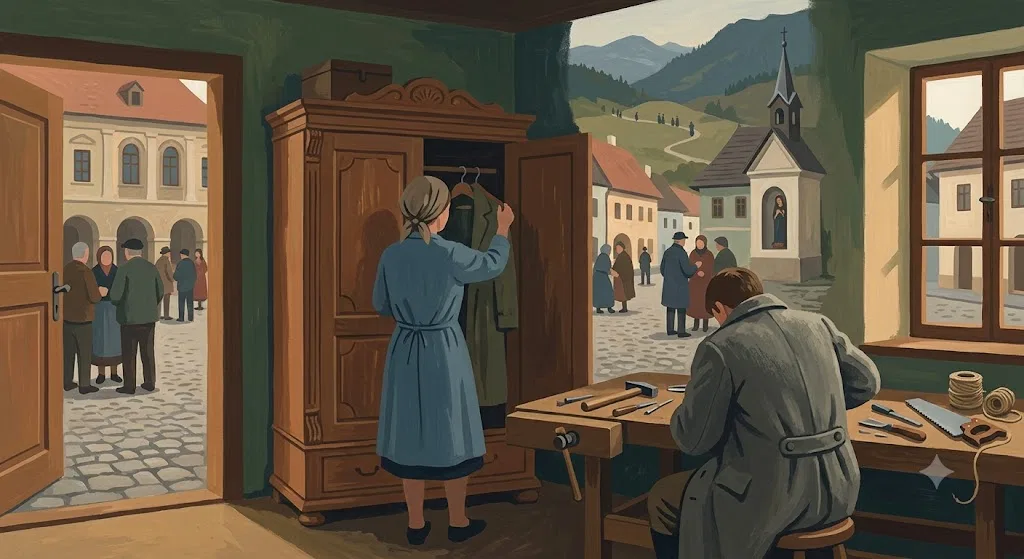
The witch trials associated with present-day Slovakia occurred before the creation of the modern Slovak state. The territory formed the northern part of the Kingdom of Hungary, often called Upper Hungary, and its towns operated within Hungarian and Habsburg legal systems. Surviving records document prosecutions in places including Bratislava, Bardejov, Košice, Komárno, Krupina, Šamorín, Trenčín and Kežmarok. Estimates sometimes speak of roughly 400 trials in Upper Hungary, but totals vary because researchers count accusations, proceedings and executions differently, while many records have been lost.[Lia Paugsch Art]liapaugsch.comwas the kezmarok witch trial really the last in central europeLia Paugsch ArtWas the Kežmarok witch trial really the last in Central…31 Oct 2023 — Around 400 witch trials are documented in Upper H…
Most cases did not begin with a whole town suddenly gripped by panic. They usually grew from smaller disputes. A healer failed to cure someone; livestock died after an argument; a neighbour made an angry threat shortly before an illness; or a person already regarded as troublesome was blamed for repeated misfortune. Across the Kingdom of Hungary, witchcraft cases commonly arose from conflicts between individuals and families, involving peasants, townspeople and occasionally members of the nobility.[Wikipedia]WikipediaWitch trials in HungaryWitch trials in Hungary
What made these accusations lethal was institutional acceptance. Town courts and feudal courts could treat harmful magic as a real crime, use torture to obtain confessions, and ask defendants to identify accomplices. Once a court assumed that a hidden magical conspiracy existed, denial became difficult to distinguish from deceit. Testimony about dreams, curses, strange behaviour or damaged animals could be reorganised into a coherent story of demonic wrongdoing.
Women were especially vulnerable because domestic healing, childbirth, food preparation and care for the sick placed them near events that early modern communities struggled to explain. Older women, widows and healers could accumulate dangerous reputations over many years. Men were also accused, however, particularly when associated with divination, folk healing or unusual spiritual powers. The trials reflected gender inequality, but they also reflected competition, resentment and a legal culture that converted social suspicion into criminal proof.
The Kežmarok execution of 1777
The execution of a woman for witchcraft at Kežmarok in 1777 is often presented as the last witchcraft execution in the Kingdom of Hungary, and sometimes as the last in Central Europe. That description requires care. It was an illegal and unusually late proceeding, carried out after Habsburg authorities had already restricted witchcraft prosecutions and abolished the death penalty for the offence.[Lia Paugsch Art]liapaugsch.comwas the kezmarok witch trial really the last in central europeLia Paugsch ArtWas the Kežmarok witch trial really the last in Central…31 Oct 2023 — Around 400 witch trials are documented in Upper H…
The case is important because it shows that legal reform and popular belief did not change at the same speed. The Habsburg court had increasingly required central review of convictions from the 1750s, influenced by sceptical officials and physicians including Gerard van Swieten. In 1768, capital punishment for witchcraft was prohibited in the Hungarian lands. Yet local authorities could still act on older assumptions, while accusations of sorcery survived outside the courtroom.[Wikipedia]WikipediaWitch trials in HungaryWitch trials in Hungary
The decline of witch trials therefore did not mean that everyone stopped believing in magic. It meant that the state became less willing to let such beliefs determine guilt and punishment. That distinction matters in the history of panics: private suspicion becomes persecution when an institution gives it coercive force.
Blood libel made an entire minority suspect
The blood-libel cases at Trnava in 1494 and Pezinok in 1529 were among the most destructive collective accusations recorded on the territory of present-day Slovakia. Blood libel was the false claim that Jews murdered Christians, usually children, and used their blood for ritual or medicinal purposes. It had no basis in Jewish teaching or practice, but it circulated widely in medieval Christian Europe and repeatedly served as a justification for violence.
In Trnava, then known as Nagyszombat, suspicion fell on the Jewish community after a Christian child disappeared. A scholarly account based on the historical literature states that some Jewish men, interrogated under torture, confessed to an imagined international programme of ritual murder. Fourteen Jews were burned and others fined. The bizarre content of the confessions is evidence of coercive questioning and the expectations of interrogators, not of an actual Jewish ritual.[Cambridge University Press & Assessment]cambridge.orgCambridge University Press & AssessmentCultivating an Orderly Society: Physical and Mental…by T Olin · 2017 · Cited by 6 — The earlies…
The episode is also identified in the Cambridge History of Judaism as an important late medieval blood libel that led to multiple executions.[Cambridge University Press & Assessment]cambridge.orgCambridge University Press & AssessmentNortheastern Europe (Chapter 10)Trnava, Slovakia), In 1494, a blood libel against the Jews of Nagy… What made the accusation powerful was its circular logic. Jewish defendants were presumed to belong to a secretive criminal community; denials could therefore be treated as further proof of concealment, while statements obtained under torture were accepted as confirmation.
At Pezinok in 1529, another ritual-murder accusation resulted in the burning of 30 members of the Jewish community, according to the JewishGen encyclopaedia of Slovak Jewish communities. The surviving Jews fled, and the community was destroyed.[JewishGen]jewishgen.orgJewish Gen Encyclopaedia of Jewish communitiesSlovakia. - JewishGenIn 1529 a blood libel was lodged against the Jews of Pezinok. Thirty members of the community were burned at the sta…
These cases resemble witch trials because both turned unexplained misfortune into a claim of hidden, intentional evil. Yet blood libel was more explicitly collective. A witch accusation might spread through a chain of named neighbours, but ritual-murder stories marked Jewish identity itself as evidence of danger. They could justify execution, expulsion and confiscation while presenting persecution as the defence of Christian society.
Later retellings sometimes reduce these events to grim curiosities. Their greater significance lies in the mechanism they expose: a prejudiced society starts with the assumed guilt of a minority, forces reality to fit the accusation, and then treats the resulting punishment as proof that the fear was justified.
Apparitions, pilgrimage and managed uncertainty
Modern Marian apparition movements offer a different form of contagious belief. They can attract crowds, healing stories, conversion testimonies and apocalyptic interpretations, but they should not automatically be treated as panics or collective delusions. For believers, pilgrimage may be an ordinary expression of faith. For historians and sociologists, the central question is how an initially private claim becomes a lasting public institution.
Litmanová and Mount Zvir
The best-known recent Slovak case began near Litmanová in 1990. Three children reported encounters with the Virgin Mary on Mount Zvir, and alleged apparitions continued until 1995. The reports emerged just after the collapse of communist rule, when previously restricted public religious life was expanding and Slovakia was undergoing rapid political and social change. According to the Vatican’s account, the site continued to attract pilgrims for decades after the reported apparitions ended.[Vatican News]vaticannews.vaddf vatican nihil obstat marian devotion slovakia mount zvirVatican NewsVatican grants 'Nihil obstat' for Marian devotion on Mount…9 Jul 2025 — The alleged apparitions began on August 5, 1990, t…
That historical setting helps explain why the movement grew, but it does not settle whether the original experiences were supernatural, psychological or misunderstood. Post-communist uncertainty created a receptive environment for religious renewal, testimony and pilgrimage. Mount Zvir offered a sacred place, a story of divine communication and a moral vocabulary for interpreting a rapidly changing society.
In July 2025, the Vatican’s Dicastery for the Doctrine of the Faith approved a nihil obstat for the devotion associated with Mount Zvir. This permits and pastorally supports the religious practice because church authorities judged that it had produced positive spiritual effects, including confessions and conversions. It does not certify that the Virgin Mary appeared, nor does it declare every attributed message authentic.[Vatican]vatican.varc ddf doc 20250704 lettera esperienza litmanova enrc ddf doc 20250704 lettera esperienza litmanova en
The Vatican’s letter also drew boundaries around the movement. It endorsed themes such as conversion, peace and freedom while warning against interpretations that could foster fear, confusion or unhealthy dependence on alleged revelations. This is a form of institutional management: the church permits pilgrimage but refuses to make supernatural certainty a condition of faith.
That distinction is often lost in popular reporting. “Approved devotion” and “confirmed apparition” are not the same. The first is a judgement about whether a religious practice may safely continue; the second would be a much stronger claim about what objectively happened.
Mount Živčák and the growth of a shrine
An earlier Slovak apparition tradition centres on Mount Živčák near Turzovka. In 1958, forest worker Matúš Lašut reported seeing the Virgin Mary. The claim appeared during communist rule, when organised religion faced surveillance and restrictions. Pilgrimage nevertheless developed around the site, which later became more formally integrated into Catholic devotional life.[europepilgrime.eu]europepilgrime.euOpen source on europepilgrime.eu.
Such integration changes a visionary movement. Buildings, scheduled services, clergy and approved prayers can replace the unpredictability of private messages. Church oversight may limit financial exploitation, uncontrolled prophecy or the claim that a visionary possesses authority superior to priests and bishops. At the same time, official management can soften or marginalise the original visionary’s role.
Neither Litmanová nor Turzovka is accurately described simply as a “cult”. They are contested Marian pilgrimage movements involving ordinary worshippers, committed apparition believers, clerical authorities and sceptics. The relevant question is not whether crowds prove a miracle, but how repeated testimony, ritual practice and institutional recognition make a disputed event socially durable.
Why the “cult” label can mislead
The end of communist rule opened Slovakia to missionaries, alternative spiritualities, imported evangelical churches and other new religious movements. Public debate frequently used language equivalent to “sect” or “cult” for unfamiliar groups. Such labels can draw attention to genuine abuse, but they can also turn theological difference into presumed danger.
Religious-studies scholars generally prefer the neutral term “new religious movement” unless there is evidence of specific harmful conduct. The modern idea of a dangerous “cult” was shaped partly by the Western anti-cult scares of the 1970s and 1980s, when diverse groups were often described through sweeping claims about brainwashing and total psychological control.[Religion Media Centre]religionmediacentre.org.ukReligion Media Centre Factsheet: New Religious MovementsReligion Media Centre Factsheet: New Religious Movements
A minority religion may be demanding, unconventional or led by a charismatic figure without necessarily being abusive. Conversely, an established or legally recognised organisation can still conceal coercion. Useful assessment depends on conduct rather than strangeness:
- Can members leave without threats, stalking or punishment?
- Are leaders subject to meaningful oversight?
- Are finances and fundraising practices transparent?
- Are members pressured to cut off relatives or independent sources of information?
- Is medical treatment discouraged or replaced by unverifiable spiritual claims?
- Are children and vulnerable adults protected?
- Are claims of divine authority used to obtain sex, money or unquestioning obedience?
A cult scare begins when concern about demonstrable behaviour expands into the claim that all unfamiliar religious organisations form a hidden threat. There is no strong evidence that Slovakia experienced a national satanic-ritual-abuse panic on the scale seen in the United States or Britain during the late twentieth century. Stories about organised Satanist networks should therefore be separated from documented criminal cases, individual occult interests, music subcultures and ordinary religious polemic.
The absence of a large documented panic is itself informative. It cautions against building a dramatic national narrative from scattered newspaper stories, hostile church commentary or rumours repeated without court evidence.
Conspiracy belief became the modern contagion
Slovakia’s most important contemporary form of contagious belief is probably its conspiracy and disinformation environment. This is not a single organised movement. It is a loose ecosystem of websites, social-media channels, politicians, influencers and audiences that circulate overlapping stories about hidden foreign control, manipulated elections, public-health plots, war and cultural betrayal.
GLOBSEC polling has repeatedly found high receptiveness to conspiracy claims in Slovakia. Earlier Slovak survey analysis reported that belief was not confined to intensive internet users: similar levels appeared among daily users and people who did not use the internet, suggesting that online networks amplify attitudes also carried through television, personal relationships and political rhetoric.[Globsec]globsec.orgOpen source on globsec.org. The organisation’s regional research has also described Slovakia as particularly conspiracy-prone within Central Europe, though such rankings depend on the statements selected and should not be treated as permanent national character traits.[Globsec]globsec.orgOpen source on globsec.org.
A 2021 study of Slovak untrustworthy websites found links among some sites through shared advertising and tracking infrastructure, but it did not uncover one unified command centre. Most investigated sites appeared to have separate administrators. The ecosystem is therefore better understood as a fragmented marketplace whose actors borrow, adapt and reinforce one another’s narratives.[arXiv]arxiv.orgOpen source on arxiv.org.
This structure helps rumours appear more widely confirmed than they are. A claim may move from one small site to several social-media accounts, then to a politician or television discussion. Readers encounter the same allegation from apparently independent sources, although the underlying evidence may still trace back to one unsupported post.
Fear as an election strategy
The 2023 parliamentary election demonstrated how conspiracy language could merge with conventional campaigning. Political opponents were accused of serving foreign interests, plotting coups or preparing electoral manipulation. Fears surrounding migration, the war in Ukraine and LGBTQ+ rights were used to mobilise voters in an intensely polarised environment.[The Guardian]theguardian.comOpen source on theguardian.com.
These narratives worked because they connected international conspiracy themes to real Slovak experiences: disappointment with post-1989 economic change, distrust created by corruption scandals, political instability, the disruption of the COVID-19 pandemic and anxiety over war in neighbouring Ukraine. A conspiracy story can feel persuasive not because every detail is believed, but because its emotional structure matches an existing sense that institutions are remote and ordinary people have been deceived.
The attempted assassination of Prime Minister Robert Fico in May 2024 produced a particularly rapid rumour cycle. Unsupported claims blamed Ukraine, Western governments, Jews, Muslims, the CIA and anti-vaccine conspirators before reliable evidence about motive had emerged. A documented Russian-language campaign attempted to frame the attack as punishment for Fico’s stance on Ukraine, although researchers noted that much of this particular activity targeted international rather than Slovak audiences.[WIRED]wired.comOpen source on wired.com.
The episode illustrates a key feature of digital panic: interpretation begins before verification. The first hours after a shocking event create an information vacuum in which highly motivated actors compete to establish a story. Later corrections rarely travel through exactly the same communities or carry the same emotional force.
Deepfakes and exaggerated technological panic
Slovakia also became a prominent case in debate over artificial intelligence and electoral manipulation after fabricated audio circulated shortly before the 2023 election. The recording appeared to depict a leading opposition politician discussing electoral fraud. Its timing, during a pre-election media blackout, made rapid rebuttal difficult.
Researchers caution, however, against attributing the election result to a single deepfake. The Slovak case demonstrated a real vulnerability—cheap synthetic media inserted into an already distrustful information environment—but evidence for a decisive change in voting behaviour is limited. Treating every synthetic recording as an all-powerful weapon risks creating a secondary moral panic about artificial intelligence, distracting from older mechanisms such as partisan media, selective editing, ordinary falsehoods and repeated political insinuation.[Misinformation Review]misinforeview.hks.harvard.eduMisinformation Review Beyond the deepfake hype: AI, democracy, and “the SlovakMisinformation Review Beyond the deepfake hype: AI, democracy, and “the Slovak
The deeper problem is the “liar’s dividend”: once realistic fakes are known to exist, genuine recordings can also be dismissed as artificial. Public uncertainty becomes useful in its own right. The aim need not be to make everyone believe one story; it may be enough to make shared judgement feel impossible.
What is missing from the Slovak record
Searches for dramatic Slovak dance plagues, school fainting epidemics or large outbreaks of mass psychogenic illness produce little strong evidence. Mass psychogenic illness is a recognised phenomenon in which real symptoms—such as dizziness, fainting, nausea, trembling or weakness—spread through a group without an identified infectious or toxic cause. Diagnosis normally requires careful medical and environmental investigation, not merely the observation that several people became ill at once.[PMC]pmc.ncbi.nlm.nih.govOpen source on nih.gov.
Slovakia does not currently have a widely documented national case comparable to the school outbreaks reported elsewhere. That does not prove that no local episode ever occurred. It means the available evidence is too sparse to place such an event at the centre of the country’s history. Unverified anecdotes about pupils fainting, possessed teenagers or mysterious workplace illnesses should not be upgraded into “mass hysteria” without clinical records, a reliable chronology and evidence that toxins, infection and environmental causes were properly investigated.
The same caution applies to supposed Slovak UFO religions and apocalyptic sects. Individual contactee claims, occult circles or millenarian predictions may have circulated, but the evidence does not support presenting them as nationally significant movements without clearer documentation of membership, organisation, social impact and contemporary response.
This thinness is useful rather than disappointing. It prevents Slovakia from being forced into a ready-made catalogue of sensational cases and shifts attention towards the forms of collective belief that genuinely left records: judicial persecution, minority scapegoating, pilgrimage, political rumour and digital conspiracy culture.
What connects the cases—and what does not
Slovakia’s witch trials, blood libels, apparition movements and online conspiracies share certain mechanisms, but they are not morally or psychologically equivalent.
They simplify uncertainty. Illness becomes a neighbour’s curse; a missing child becomes evidence of ritual murder; political instability becomes a secret foreign plan. A complicated problem is reduced to a hidden agent with a clear intention.
They rely on trusted intermediaries. Courts authenticated witchcraft testimony. Clergy and civic authorities repeated blood-libel claims. Pilgrimage leaders and church officials shape apparition narratives. Politicians and media personalities lend visibility to digital rumours.
They reward repetition. A claim heard from several neighbours, witnesses or websites begins to feel independently confirmed, even when every version derives from the same original allegation.
They identify moral outsiders. The feared figure may be a witch, a Jewish community, an unfamiliar religious group, a liberal elite, a foreign power or a vaguely defined global network. The category creates unity among believers by giving them someone to blame.
The differences are equally important. Witch trials and blood libels involved coercive state violence against accused people. Marian pilgrimage usually involves voluntary religious participation and institutional negotiation. Digital conspiracies spread through decentralised networks and may influence politics without creating a formal organisation. “Mass hysteria” is therefore too broad a label to explain all of them.
The most useful dividing line is between belief and power. Many people hold unusual, intense or unverifiable beliefs without harming anyone. Danger increases when those beliefs authorise punishment, silence criticism, strip minorities of legal protection or make public institutions treat suspicion as proof.
Why this history still matters
Slovakia’s cases reveal that collective fear is rarely just an eruption of irrationality. It grows through institutions, existing prejudices and moments of uncertainty. Early modern courts did not merely observe witch panics; they organised and legitimised them. Blood libels did not spread only because individuals accepted a grotesque rumour; they spread because authorities treated Jewish people as a category of suspects. Apparition movements endure because testimony is repeated through pilgrimage and carefully negotiated by religious institutions. Online conspiracies become politically powerful when public figures turn them into explanations for everyday insecurity.
The history also shows how panics end. Witch prosecutions declined when central authorities changed evidential and legal standards, not when every supernatural belief disappeared. Apparition movements can be contained through a distinction between permitted devotion and verified supernatural fact. Conspiracy claims are harder to restrain because digital networks are decentralised, but transparent investigation, independent journalism and institutions willing to correct mistakes without contempt remain essential.
Slovakia’s record is therefore less a collection of bizarre beliefs than a history of contested evidence. Again and again, the decisive question has been not simply what people feared or hoped, but who possessed the authority to declare that fear or hope true—and what they were then permitted to do to others.
Amazon book picks
Further Reading
Books and field guides related to When Fear and Belief Gripped Slovakia. Use these as the next step if you want deeper reading beyond the article.
Extraordinary Popular Delusions and the Madness of Crowds
Rating: 4.0/5 from 5 Google Books ratings
Broad framework for contagious belief.



Endnotes
1.
Source: Wikipedia
Title: Witch trials in Hungary
Link:https://en.wikipedia.org/wiki/Witch_trials_in_Hungary
2.
Source: cambridge.org
Link:https://www.cambridge.org/core/journals/austrian-history-yearbook/article/cultivating-an-orderly-society-physical-and-mental-landscapes-on-the-habsburgs-southern-frontiers/03C1ACD0C0175298038D896450A736A8
Source snippet
Cambridge University Press & AssessmentCultivating an Orderly Society: Physical and Mental...by T Olin · 2017 · Cited by 6 — The earlies...
3.
Source: cambridge.org
Link:https://www.cambridge.org/core/books/cambridge-history-of-judaism/northeastern-europe/BC995D131DA530451DDC2E9052328215
Source snippet
Cambridge University Press & AssessmentNortheastern Europe (Chapter 10)Trnava, Slovakia), In 1494, a blood libel against the Jews of Nagy...
4.
Source: cambridge.org
Link:https://www.cambridge.org/core/books/cambridge-history-of-judaism/jews-in-the-medieval-christian-world/293BCA06AD831884CBF326385B4B2730
Source snippet
In 1494, a blood libel against the Jews of Nagyszombat led to the execution of many. In 1496, the Jewish street in...
5.
Source: jewishgen.org
Title: Jewish Gen Encyclopaedia of Jewish communities
Link:https://www.jewishgen.org/yizkor/pinkas_slovakia/Slo0XI.html
Source snippet
Slovakia. - JewishGenIn 1529 a blood libel was lodged against the Jews of Pezinok. Thirty members of the community were burned at the sta...
6.
Source: vatican.va
Title: rc ddf doc 20250704 lettera esperienza litmanova en
Link:https://www.vatican.va/roman_curia/congregations/cfaith/documents/rc_ddf_doc_20250704_lettera-esperienza-litmanova_en.html
7.
Source: europepilgrime.eu
Link:https://europepilgrime.eu/en/place/turzovka-vrch-zivcakova-2/
8.
Source: globsec.org
Link:https://www.globsec.org/what-we-do/commentaries/majority-slovaks-believe-conspiracy-theories
9.
Source: globsec.org
Link:https://www.globsec.org/what-we-do/commentaries/which-slovaks-believe-conspiracy-theories
10.
Source: arxiv.org
Link:https://arxiv.org/abs/2109.01527
11.
Source: wired.com
Link:https://www.wired.com/story/russia-blaming-ukraine-slovakia-prime-minister-robert-fico-shooting
12.
Source: pmc.ncbi.nlm.nih.gov
Link:https://pmc.ncbi.nlm.nih.gov/articles/PMC7396040/
13.
Source: Wikipedia
Title: European witchcraft
Link:https://en.wikipedia.org/wiki/European_witchcraft
14.
Source: Wikipedia
Title: Between the Living and the Dead
Link:https://en.wikipedia.org/wiki/Between_the_Living_and_the_Dead
15.
Source: Wikipedia
Title: Zaubererjackl witch trials
Link:https://en.wikipedia.org/wiki/Zaubererjackl_witch_trials
16.
Source: Wikipedia
Title: Blood libel
Link:https://en.wikipedia.org/wiki/Blood_libel
17.
Source: Wikipedia
Title: Mass psychogenic illness
Link:https://en.wikipedia.org/wiki/Mass_psychogenic_illness
18.
Source: Wikipedia
Title: Satanic panic
Link:https://en.wikipedia.org/wiki/Satanic_panic
19.
Source: Wikipedia
Title: New religious movement
Link:https://en.wikipedia.org/wiki/New_religious_movement
20.
Source: globsec.org
Title: GLOBSEC Trends 2025 1
Link:https://www.globsec.org/sites/default/files/2025-05/GLOBSEC%20Trends%202025_1.pdf
21.
Source: globsec.org
Title: globsec trends 2025 ready new era
Link:https://www.globsec.org/what-we-do/publications/globsec-trends-2025-ready-new-era
22.
Source: globsec.org
Link:https://www.globsec.org/what-we-do/publications
23.
Source: globsec.org
Link:https://www.globsec.org/sites/default/files/2025-06/Globsec_brozura_20rokov_210x210_EN_nahlad_1.pdf
24.
Source: cambridge.org
Link:https://www.cambridge.org/core/services/aop-cambridge-core/content/view/01A5EB7E30F19708242998E18B0E1A79/S0067237800003350a.pdf/list_of_publications_and_dissertations_in_austrian_history_in_1988_and_1989.pdf
25.
Source: cambridge.org
Title: list of publications and dissertations in austrian history in 1990
Link:https://www.cambridge.org/core/services/aop-cambridge-core/content/view/F925CD68DE8CEF534D6A51E6E4DA43A6/S0067237800005749a.pdf/list_of_publications_and_dissertations_in_austrian_history_in_1990.pdf
26.
Source: state.gov
Link:https://www.state.gov/report/custom/a329948607
27.
Source: history.com
Title: what was satanic panic 1980s
Link:https://www.history.com/articles/what-was-satanic-panic-1980s
28.
Source: liapaugsch.com
Title: was the kezmarok witch trial really the last in central europe
Link:https://www.liapaugsch.com/journal/was-the-kezmarok-witch-trial-really-the-last-in-central-europe
Source snippet
Lia Paugsch ArtWas the Kežmarok witch trial really the last in Central...31 Oct 2023 — Around 400 witch trials are documented in Upper H...
29.
Source: vaticannews.va
Title: ddf vatican nihil obstat marian devotion slovakia mount zvir
Link:https://www.vaticannews.va/en/vatican-city/news/2025-07/ddf-vatican-nihil-obstat-marian-devotion-slovakia-mount-zvir.html
Source snippet
Vatican NewsVatican grants 'Nihil obstat' for Marian devotion on Mount...9 Jul 2025 — The alleged apparitions began on August 5, 1990, t...
Published: August 5, 1990
30.
Source: religionmediacentre.org.uk
Title: Religion Media Centre Factsheet: New Religious Movements
Link:https://religionmediacentre.org.uk/factsheets/factsheet-new-religious-movements/
31.
Source: theguardian.com
Link:https://www.theguardian.com/world/2023/sep/27/slovakia-knife-edge-elections
32.
Source: misinforeview.hks.harvard.edu
Title: Misinformation Review Beyond the deepfake hype: AI, democracy, and “the Slovak
Link:https://misinforeview.hks.harvard.edu/article/beyond-the-deepfake-hype-ai-democracy-and-the-slovak-case/
33.
Source: encyclopedia.ushmm.org
Title: blood libel
Link:https://encyclopedia.ushmm.org/content/en/article/blood-libel
34.
Source: jewishvirtuallibrary.org
Link:https://jewishvirtuallibrary.org/pezinok
35.
Source: ewtnnews.com
Title: vatican approves marian devotion in slovakia but doesn t recognize apparitions
Link:https://www.ewtnnews.com/vatican/vatican-approves-marian-devotion-in-slovakia-but-doesn-t-recognize-apparitions
36.
Source: dbs.anumuseum.org.il
Link:https://dbs.anumuseum.org.il/skn/en/c6/e210534/Place/Trnava
37.
Source: theguardian.com
Title: carol morley the falling mass hysteria is a powerful group activity
Link:https://www.theguardian.com/film/2015/mar/29/carol-morley-the-falling-mass-hysteria-is-a-powerful-group-activity
38.
Source: pmc.ncbi.nlm.nih.gov
Link:https://pmc.ncbi.nlm.nih.gov/articles/PMC13116957/
39.
Source: pmc.ncbi.nlm.nih.gov
Link:https://pmc.ncbi.nlm.nih.gov/articles/PMC3536509/
40.
Source: senecalearning.com
Title: New Religious Movements
Link:https://senecalearning.com/en-GB/revision-notes/a-level/sociology/aqa/7-2-2-new-religious-movements
41.
Source: nationalarchives.gov.uk
Link:https://www.nationalarchives.gov.uk/education/resources/early-modern-witch-trials/
Additional References
42.
Source: youtube.com
Title: How political polarization has become deadly in Slovakia
Link:https://www.youtube.com/watch?v=euc8cl2NXis
Source snippet
Marian Apparitions in Slovakia This video is highly relevant because it details the Marian apparitions of Litmanová, a key example of mod...
43.
Source: youtube.com
Title: Pro-Russian deepfakes: Slovakia fears election interference
Link:https://www.youtube.com/watch?v=EPbOCcJ_S9s
Source snippet
Populists and propaganda: Electoral thriller in Slovakia...
44.
Source: youtube.com
Title: Populists and propaganda: Electoral thriller in Slovakia
Link:https://www.youtube.com/watch?v=oEMuUEC4KKk
Source snippet
How political polarization has become deadly in Slovakia...
45.
Source: researchgate.net
Link:https://www.researchgate.net/publication/321364330_Ildiko_Sz_Kristof_The_Social_Background_of_Witchcraft_Accusations_in_Early_Modern_Debrecen_and_Bihar_County
46.
Source: researchgate.net
Link:https://www.researchgate.net/publication/348390712River_Ordeal-Trial_by_Water-Swimming_of_Witches_Procedures_of_Ordeal_in_Witch_Trials_In_Gabor_KLANICZAY-_Eva_POCS_Demons_Spirits_Witches_Vol_III_Witchcraft_Mythologies_and_Persecutions_Central_Europe
47.
Source: academia.edu
Link:https://www.academia.edu/3572760/A_Witch_Hunt_in_Szeged_in_the_Early_Eighteenth_Century_In_Blanka_Szeghyov%C3%A1_ed_The_Role_of_Magic_in_the_Past_Learned_and_Popular_Magic_Popular_Beliefs_and_Diversity_of_Attitudes_Pro_Historia_Bratislava_2005_pp
48.
Source: byzcath.org
Link:https://www.byzcath.org/forums/ubbthreads.php/topics/306346/re-decree-on-marian-apparition-in-litmanova
49.
Source: fieldepidemiology.org
Link:https://fieldepidemiology.org/index.php/ajfe/article/download/7807/6435/21437
50.
Source: apothecaries.org
Link:https://www.apothecaries.org/wp-content/uploads/2019/06/Mass-psychogenic-illness-and-how-to-respond.pdf
51.
Source: kamnavylet.sk
Link:https://www.kamnavylet.sk/en/attraction/pilgrimage-place-zivcakova
Topic Tree
Follow this branch
Related pages 192
- Antigua and Barbuda
- Argentina Belief Scares
- Azerbaijan Belief
- Bahrain Beliefs
- North Korea
- +187 more in sidebar