Within Azerbaijan Belief
Who Gets to Count as a Legitimate Believer?
Minority churches and Jehovah's Witnesses faced raids, fines and hostile labels as the state defined acceptable religion.
On this page
- Traditional and Non Traditional Religion
- Raids, Registration and Literature Controls
- When Security Claims Outrun Evidence
Page outline Jump by section
Introduction
In post-Soviet Azerbaijan, debates about religion have centred less on spectacular new religious movements than on the state’s distinction between “traditional” and “non-traditional” faiths. The authorities recognise freedom of religion in law, but they also operate one of the region’s most tightly regulated systems for registering religious communities, approving religious literature and supervising public worship. In practice, unfamiliar Christian denominations, Jehovah’s Witnesses and other minority groups have often found themselves treated as administratively suspect even when there has been no evidence that they promoted violence or public disorder. At the same time, the government argues that strict oversight is necessary to prevent religious extremism, foreign interference and sectarian conflict. The result is a long-running dispute over where legitimate security policy ends and unnecessary restriction on peaceful religious life begins.
Who Gets to Count as a Legitimate Believer?
Azerbaijan presents itself as a country of religious tolerance, pointing to the peaceful coexistence of Muslims, Jews, Orthodox Christians and other historic communities. Official policy also stresses the importance of protecting society from radicalisation and politically motivated religious movements.
The distinction becomes more controversial when applied to minority faiths that fall outside established religious traditions. Government statements have frequently contrasted “traditional” religions with imported or unfamiliar movements, especially evangelical Protestant churches, Jehovah’s Witnesses and other newer Christian groups. Although these organisations generally reject violence and operate openly elsewhere, they have often been described by officials or state-aligned media as socially disruptive, foreign influenced or potentially destabilising. This language does not necessarily accuse every member of criminal behaviour, but it places such communities under greater official suspicion than longer-established religious organisations.[USCIRF]uscirf.govReligious Freedom Conditions in Azerbaijan | USCIRFReligious Freedom Conditions in Azerbaijan | USCIRF…
International observers have repeatedly argued that this distinction is problematic because international human rights standards protect freedom of religion regardless of whether a belief system is old or new, popular or unpopular. In other words, legal protection should depend on conduct rather than familiarity.
Traditional and Non-Traditional Religion
Rather than banning minority religions outright, Azerbaijan has developed an administrative system that determines which religious organisations may function legally and under what conditions.
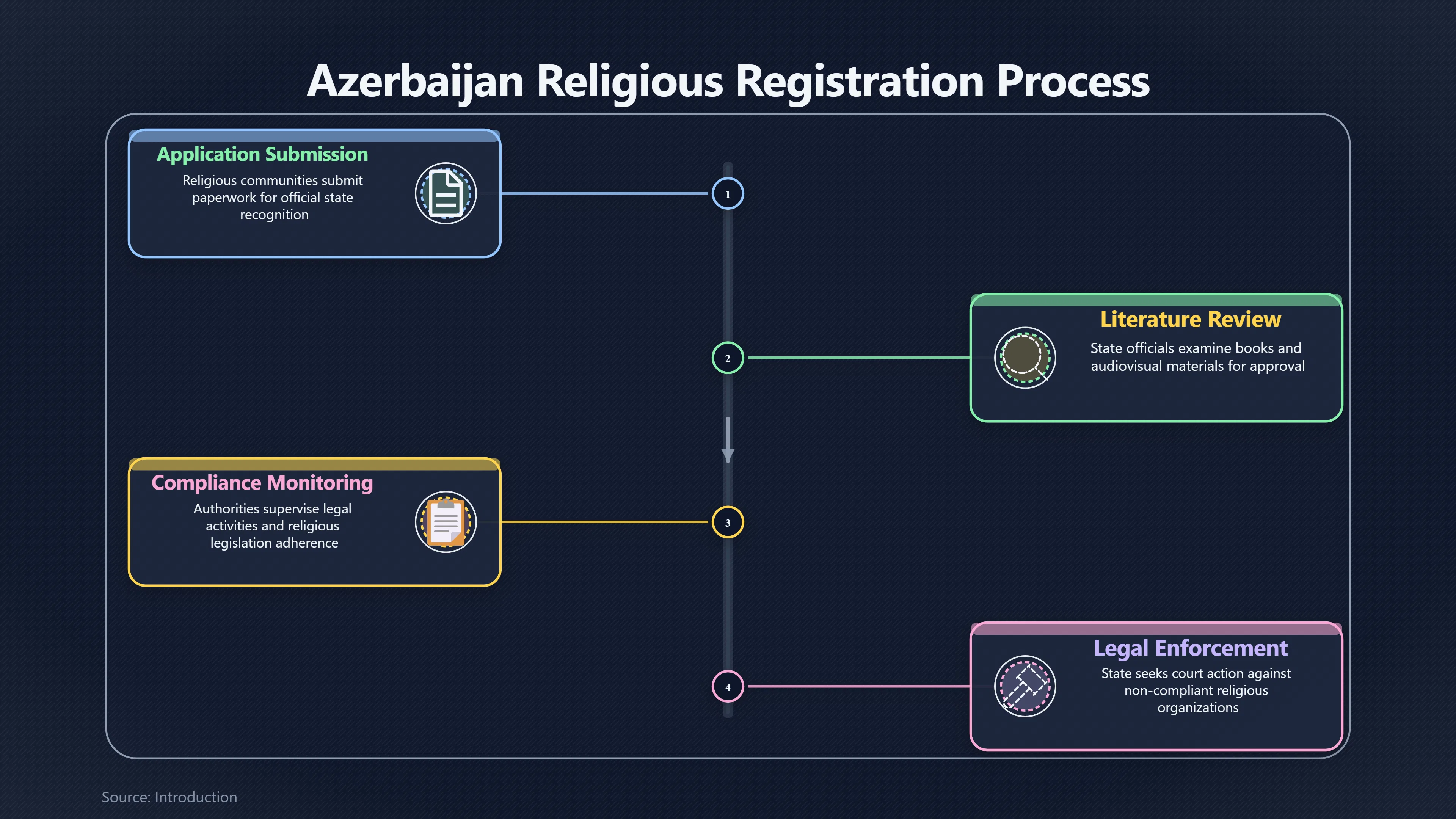
The central institution is the State Committee for Work with Religious Organisations (now the State Committee for Work with Religious Institutions). Its responsibilities include:
- registering religious communities;
- reviewing and approving religious literature before distribution;
- supervising the legal activities of religious organisations;
- monitoring compliance with religious legislation;
- seeking court action against organisations where legal grounds exist.[State Religious Committee]scara.gov.azOpen source on scara.gov.az.
From the government’s perspective, these powers help prevent extremist recruitment, foreign political influence and religious violence. Officials argue that oversight protects both public security and interfaith harmony.
Critics accept that governments may regulate organisations that incite violence or terrorism but argue that Azerbaijan’s system extends well beyond genuine security threats. They contend that routine religious activities—including meeting for worship, importing books or sharing religious literature—have sometimes been treated as regulatory offences simply because a community lacked registration or official approval.[USCIRF]uscirf.govReligious Freedom Conditions in Azerbaijan | USCIRFReligious Freedom Conditions in Azerbaijan | USCIRF…
Raids, Registration and Literature Controls
Registration has become one of the defining issues affecting minority religious communities.
Following amendments to the religion law in 2009, religious organisations were required to undergo a new registration process. Many communities reported years of delays, repeated requests to amend paperwork or applications rejected for technical reasons. Some groups that had previously operated legally found themselves in administrative uncertainty despite continuing to practise peacefully.[state.gov]state.govDepartment AzerbaijanState DepartmentAzerbaijan - United States Department of State…
The consequences were practical rather than merely bureaucratic. Religious groups without recognised registration reported:
- police interruptions of meetings;
- fines for holding religious gatherings;
- confiscation of religious literature;[modern.az]modern.azAzerbaijan 49 titles of religious literature banned | Modern.azJanuary 13, 2026 — AZERBAIJAN 49 TITLES OF RELIGIOUS LITERATURE BANNED Image: Azerbaijan 49 titles of religious literature banned CURRENT…
- difficulty renting premises or openly advertising worship services.
International monitoring bodies, including the European Commission against Racism and Intolerance (ECRI), expressed concern that communities awaiting registration remained vulnerable to police intervention and recommended completing registration procedures while preventing unlawful raids and discrimination.[HUDOC-ECRI]hudoc.ecri.coe.intHUDOC-ECRIFourth report on AzerbaijanHUDOC-ECRIFourth report on Azerbaijan
Another distinctive feature of Azerbaijani policy is prior state examination of religious publications. Religious books, electronic materials and audiovisual resources may require official approval before importation or distribution. The State Committee identifies this as a safeguard against extremist propaganda, while critics argue that it gives the government unusually broad power to control peaceful religious expression.[State Religious Committee]scara.gov.azOpen source on scara.gov.az.

Jehovah’s Witnesses as a Case Study
Jehovah’s Witnesses provide perhaps the clearest example of how administrative regulation became an international religious freedom issue.
The community obtained legal recognition in Baku before the 2009 legal changes but later encountered difficulties during the re-registration process. Police raids on private worship meetings, confiscation of literature and prosecutions relating to religious activity became recurring complaints. Several cases eventually reached international human rights bodies, including the European Court of Human Rights.[JW.ORG]jw.orgLegal & Human Rights Facts: Jehovah’s Witnesses in Azerbaijan | JW.OR GLegal & Human Rights Facts: Jehovah’s Witnesses in Azerbaijan | JW.OR G
Some developments later moved in a more positive direction. Restrictions on importing Witness publications eased after 2015, larger religious assemblies resumed, and the Baku congregation obtained full legal registration in 2018. Nevertheless, disputes have continued over issues such as conscientious objection to compulsory military service, an area where international observers note that Azerbaijan has yet to establish a comprehensive civilian alternative despite constitutional provisions referring to alternative service.[JW.ORG]jw.orgLegal & Human Rights Facts: Jehovah’s Witnesses in Azerbaijan | JW.OR GLegal & Human Rights Facts: Jehovah’s Witnesses in Azerbaijan | JW.OR G
This mixed picture illustrates an important point. Relations between the Azerbaijani state and minority religions have not followed a simple path of either continuous repression or steady liberalisation. Administrative improvements have occurred alongside continuing disagreements over broader questions of religious freedom.
When Security Claims Outrun Evidence
Azerbaijan faces genuine security challenges. Officials point to militant organisations operating elsewhere in the region, concerns about foreign-sponsored extremism and the risk that religious movements could become vehicles for political mobilisation.
Most international criticism does not dispute the legitimacy of addressing violent extremism. Instead, it questions whether policies designed for security have sometimes been extended to peaceful minority communities that show no evidence of advocating violence.
This distinction matters because once unfamiliar religious groups are routinely described as dangerous, foreign or socially harmful, public suspicion can become self-reinforcing. Administrative controls that were originally justified by counter-terrorism concerns may then affect ordinary worshippers whose only distinguishing characteristic is belonging to a small or unfamiliar denomination. Human rights organisations and religious freedom monitors have repeatedly argued that many prosecutions involving minority Christian communities concern registration, literature distribution or unauthorised meetings rather than incitement or violent activity.[uscirf.gov]uscirf.govReligious Freedom Conditions in Azerbaijan | USCIRFReligious Freedom Conditions in Azerbaijan | USCIRF…
Why This Matters in Azerbaijan’s History of Moral Panic
Within Azerbaijan’s wider history of collective fears, the story is not primarily about a dramatic “cult scare” comparable to the Satanic Panic in parts of North America or Europe. Instead, it concerns how official definitions of legitimate religion shape public perceptions of minority believers.
The language of “non-traditional religion” has often functioned as a warning label rather than a precise description. Once attached to a community, it can encourage assumptions that unfamiliar beliefs are inherently foreign, socially disruptive or politically suspect even where evidence for those claims is limited.
For historians of moral panic and religious policy, Azerbaijan therefore offers a revealing example of how suspicion can emerge through administrative classification rather than mass public hysteria. The central question has not usually been whether minority believers posed an immediate threat, but who possesses the authority to decide which forms of belief deserve full legal recognition and which remain permanently subject to exceptional state scrutiny.




Endnotes
1.
Source: uscirf.gov
Title: Religious Freedom Conditions in Azerbaijan | USCIRF
Link:https://www.uscirf.gov/countries/azerbaijan
Source snippet
Religious Freedom Conditions in Azerbaijan | USCIRF...
2.
Source: state.gov
Title: Department Azerbaijan
Link:https://www.state.gov/reports/2016-report-on-international-religious-freedom/azerbaijan
Source snippet
State DepartmentAzerbaijan - United States Department of State...
3.
Source: jw.org
Title: Religious Freedom—Jehovah’s Witnesses in Azerbaijan Appeal to ECHR
Link:https://www.jw.org/en/news/region/azerbaijan/religious-freedom-echr-appeal/
4.
Source: hudoc.ecri.coe.int
Title: HUDOC-ECRIFourth report on Azerbaijan
Link:https://hudoc.ecri.coe.int/eng?i=AZE-CbC-V-2016-017-ENG
5.
Source: jw.org
Title: Legal & Human Rights Facts: Jehovah’s Witnesses in Azerbaijan | JW.OR G
Link:https://www.jw.org/en/news/region/azerbaijan/jehovah-witness-facts/
6.
Source: uscirf.gov
Title: releases report religious freedom azerbaijan 0
Link:https://www.uscirf.gov/news-room/releases-statements/uscirf-releases-report-religious-freedom-azerbaijan-0
Source snippet
USCIRF Releases Report on Religious Freedom in Azerbaijan | USCIRFAugust 29, 2025 — USCIRF RELEASES REPORT ON RELIGIOUS FREEDOM IN AZERBA...
Published: August 29, 2025
7.
Source: uscirf.gov
Title: religious freedom conditions azerbaijan
Link:https://www.uscirf.gov/events/hearings/religious-freedom-conditions-azerbaijan
Source snippet
Commission on International Religious Freedom Hearing Religious Freedom Conditions in Azerbaij...
8.
Source: jw.org
Title: Recent ECHR Decisions Bolster Freedom of Worship in Azerbaijan
Link:https://www.jw.org/en/news/region/azerbaijan/Recent-ECHR-Decisions-Bolster-Freedom-of-Worship-in-Azerbaijan/
9.
Source: uscirf.gov
Link:https://www.uscirf.gov/publication/country-update-azerbaijan
10.
Source: uscirf.gov
Link:https://www.uscirf.gov/publications/azerbaijan-country-update
11.
Source: scara.gov.az
Link:https://scara.gov.az/en/details/haqqimizda/komite-haqqinda/komitenin-vezifeleri
12.
Source: scara.gov.az
Link:https://scara.gov.az/en/details/haqqimizda/komite-haqqinda/komitenin-tarixi
13.
Source: modern.az
Title: Azerbaijan 49 titles of religious literature banned | Modern.az
Link:https://modern.az/en/aktual/557058/azerbaijan-49-titles-of-religious-literature-banned/
Source snippet
January 13, 2026 — AZERBAIJAN 49 TITLES OF RELIGIOUS LITERATURE BANNED Image: Azerbaijan 49 titles of religious literature banned CURRENT...
Published: January 13, 2026
14.
Source: scara.gov.az
Link:https://scara.gov.az/en/details/haqqimizda/komite-haqqinda/komitenin-huquqlari
Additional References
15.
Source: en.apa.az
Link:https://en.apa.az/religion/-47533
16.
Source: forum18.org
Link:https://www.forum18.org/archive.php?article_id=2605
17.
Source: csce.gov
Title: Re-Registration Campaign Denying Religious Freedom in Azerbaijan
Link:https://www.csce.gov/statements/re-registration-campaign-denying-religious-freedom/
18.
Source: forum18.org
Title: Forum 18: AZERBAIJAN: Censorship case to join 56 other ECt HR cases?
Link:https://www.forum18.org/archive.php?article_id=2490
19.
Source: azerbaijans.com
Title: The State Committee for Work with Religious Associations
Link:https://www.azerbaijans.com/content_555_en.html
20.
Source: youtube.com
Link:https://www.youtube.com/watch?v=1Xkng7busA4
21.
Source: youtube.com
Link:https://www.youtube.com/watch?v=EZpyHbZaz2s
22.
Source: youtube.com
Link:https://www.youtube.com/watch?v=HJl1ttRCTZg
23.
Source: youtube.com
Link:https://www.youtube.com/watch?v=Z45CjL2WVLU
24.
Source: youtube.com
Link:https://www.youtube.com/watch?v=novbq5ujzdo
Topic Tree