Within Jamaica
Why Did Tacky's Revolt Make Obeah Illegal?
After the 1760 revolt, colonial rulers treated obeah as both spiritual power and a threat to plantation control.
On this page
- Spiritual authority during the 1760 rebellion
- How colonial accounts shaped the surviving story
- Why rebellion laws targeted African derived power
Page outline Jump by section
Introduction
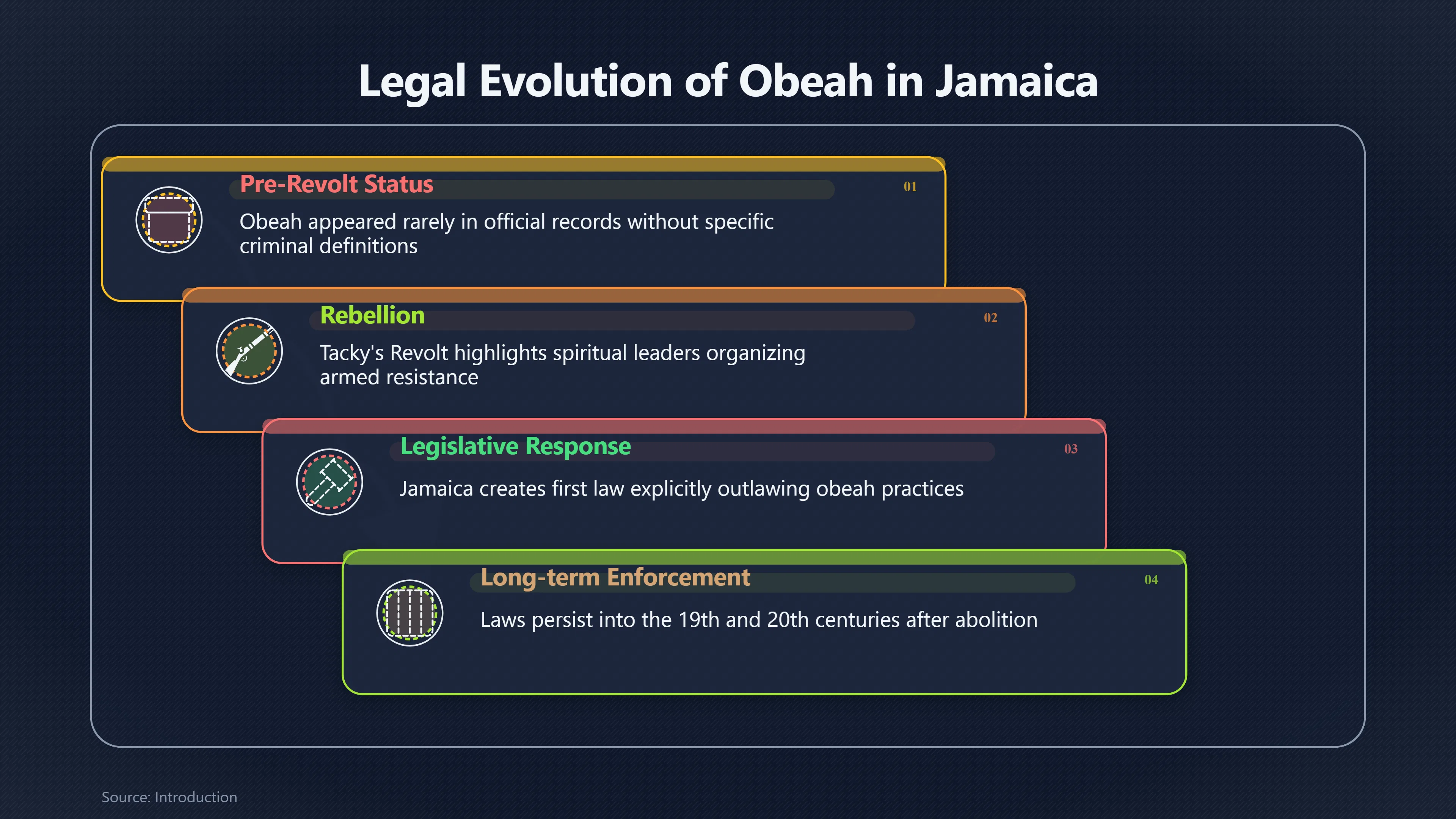
Tacky’s Revolt in 1760 did more than trigger one of the largest slave uprisings in eighteenth-century Jamaica. It also transformed how colonial authorities viewed African-derived spiritual practices. Before the rebellion, the word obeah appeared only rarely in official records and was not defined as a specific criminal offence. After the revolt, however, Jamaica’s legislature created the British Caribbean’s first law explicitly outlawing obeah, treating African spiritual authority as a direct threat to plantation security rather than simply as a religious or cultural practice.[Edinburgh Research]research.ed.ac.ukEdinburgh Research Witchcraft, poison, law and Atlantic slaveryinburgh ResearchWitchcraft, poison, law and Atlantic slavery - University of Edinburgh Research Explorer…
For historians, this legal change marks a crucial turning point in the relationship between belief, fear and political power. Colonial officials came to argue that obeah practitioners could inspire courage, organise resistance and undermine slavery itself. The surviving evidence must be read carefully because it comes overwhelmingly from enslavers, military officers and government officials. Even so, those records clearly show that the fear of African spiritual authority became embedded in Jamaican law for generations.
Why did Tacky’s Revolt make obeah illegal?
The rebellion began during Easter 1760 when enslaved Africans led by Tacky seized weapons from Fort Haldane in St Mary before attacks spread to plantations across the island. Although the revolt had military objectives, colonial observers repeatedly emphasised the presence of spiritual leaders alongside military commanders. These figures were described as administering oaths, preparing ritual substances and assuring participants that they would be protected from enemy weapons.[Obeah Histories]obeahhistories.org1760 jamaica lawObeah HistoriesAn Act to Remedy the Evils arising from Irregular Assemblies of Slaves, Jamaica 1760 | Obeah Histories…
Modern historians caution against accepting every detail of these reports literally. White planters often exaggerated unfamiliar African religious practices or interpreted them through European ideas about witchcraft and the devil. Yet the consistency of the reports suggests that ritual authority genuinely played an important organisational role. Shared ceremonies helped create trust among rebels drawn from different plantations, reinforced commitment to the uprising and strengthened morale in the face of overwhelming military odds.[Edinburgh Research]research.ed.ac.ukEdinburgh Research Witchcraft, poison, law and Atlantic slaveryinburgh ResearchWitchcraft, poison, law and Atlantic slavery - University of Edinburgh Research Explorer…
Rather than treating this as simply a religious issue, colonial legislators concluded that spiritual specialists had become political organisers. Their response therefore targeted both armed rebellion and the authority figures who helped sustain it.
Spiritual authority during the 1760 rebellion
Colonial descriptions frequently refer to an “obeah man” associated with Tacky who allegedly promised supernatural protection to rebel fighters. According to these accounts, recruits participated in oath-taking ceremonies using ritual objects and symbolic substances intended to bind participants together and convince them they could survive combat.[Edinburgh Research]research.ed.ac.ukEdinburgh Research Witchcraft, poison, law and Atlantic slaveryinburgh ResearchWitchcraft, poison, law and Atlantic slavery - University of Edinburgh Research Explorer…
Whether these ceremonies literally promised invulnerability or whether colonial writers misunderstood more complex African religious practices remains debated. Historians such as Diana Paton argue that the surviving evidence reflects a collision between African understandings of spiritually powerful medicine and European assumptions about sorcery. Colonial officials interpreted practices they scarcely understood through the language of witchcraft and deception.[Edinburgh Research]research.ed.ac.ukEdinburgh Research Witchcraft, poison, law and Atlantic slaveryinburgh ResearchWitchcraft, poison, law and Atlantic slavery - University of Edinburgh Research Explorer…
What mattered politically was not whether supernatural protection actually existed, but that officials believed these practices could encourage resistance. If enslaved people believed they were spiritually protected, authorities feared they would become more willing to fight and less likely to betray conspirators.
How colonial accounts shaped the surviving story
Almost every detailed description of obeah during Tacky’s Revolt comes from hostile witnesses. Plantation owners, military officers and later historians such as Edward Long wrote from the perspective of a colonial society determined to justify slavery and suppress future rebellions. Their accounts therefore served political as well as historical purposes.[Obeah Histories]obeahhistories.org1760 jamaica lawObeah HistoriesAn Act to Remedy the Evils arising from Irregular Assemblies of Slaves, Jamaica 1760 | Obeah Histories…
This creates several problems for modern interpretation.
- African voices are largely absent. Enslaved participants left few written accounts of their own beliefs or intentions.
- European categories shaped the language. Officials frequently described obeah as communication with the devil or as fraudulent witchcraft rather than attempting to understand African systems of healing, protection or spiritual authority.
- Military defeat influenced the narrative. Public executions of alleged spiritual leaders were presented as proof that colonial power had defeated both rebellion and the beliefs that sustained it.[Obeah Histories]obeahhistories.org1760 jamaica lawObeah HistoriesAn Act to Remedy the Evils arising from Irregular Assemblies of Slaves, Jamaica 1760 | Obeah Histories…
For these reasons, historians distinguish between what colonial officials claimed about obeah and what can be established with greater confidence. Most agree that spiritual specialists were important community figures whose knowledge extended beyond religion into healing, mediation and political leadership. Exactly how their rituals worked or what participants believed remains much harder to reconstruct.[OUP Academic]academic.oup.comOUP AcademicDiana Paton. The Cultural Politics of Obeah: Religion, Colonialism, and Modernity in the Caribbean World. | The American Hist…
Why rebellion laws targeted African-derived power
The legislation passed after the revolt reveals what colonial authorities feared most. The 1760 Act was formally designed to prevent further slave rebellions by restricting movement, weapons and assemblies. Within that wider security law appeared the first explicit criminal offence relating to obeah.[Obeah Histories]obeahhistories.org1760 jamaica lawObeah HistoriesAn Act to Remedy the Evils arising from Irregular Assemblies of Slaves, Jamaica 1760 | Obeah Histories…
The Act described “obeah men and women” as people pretending to possess supernatural powers who deceived others into believing they could provide protection from harm. It authorised severe punishments, including death or transportation, for enslaved people convicted of practising obeah.[Obeah Histories]obeahhistories.org1760 jamaica lawObeah HistoriesAn Act to Remedy the Evils arising from Irregular Assemblies of Slaves, Jamaica 1760 | Obeah Histories…
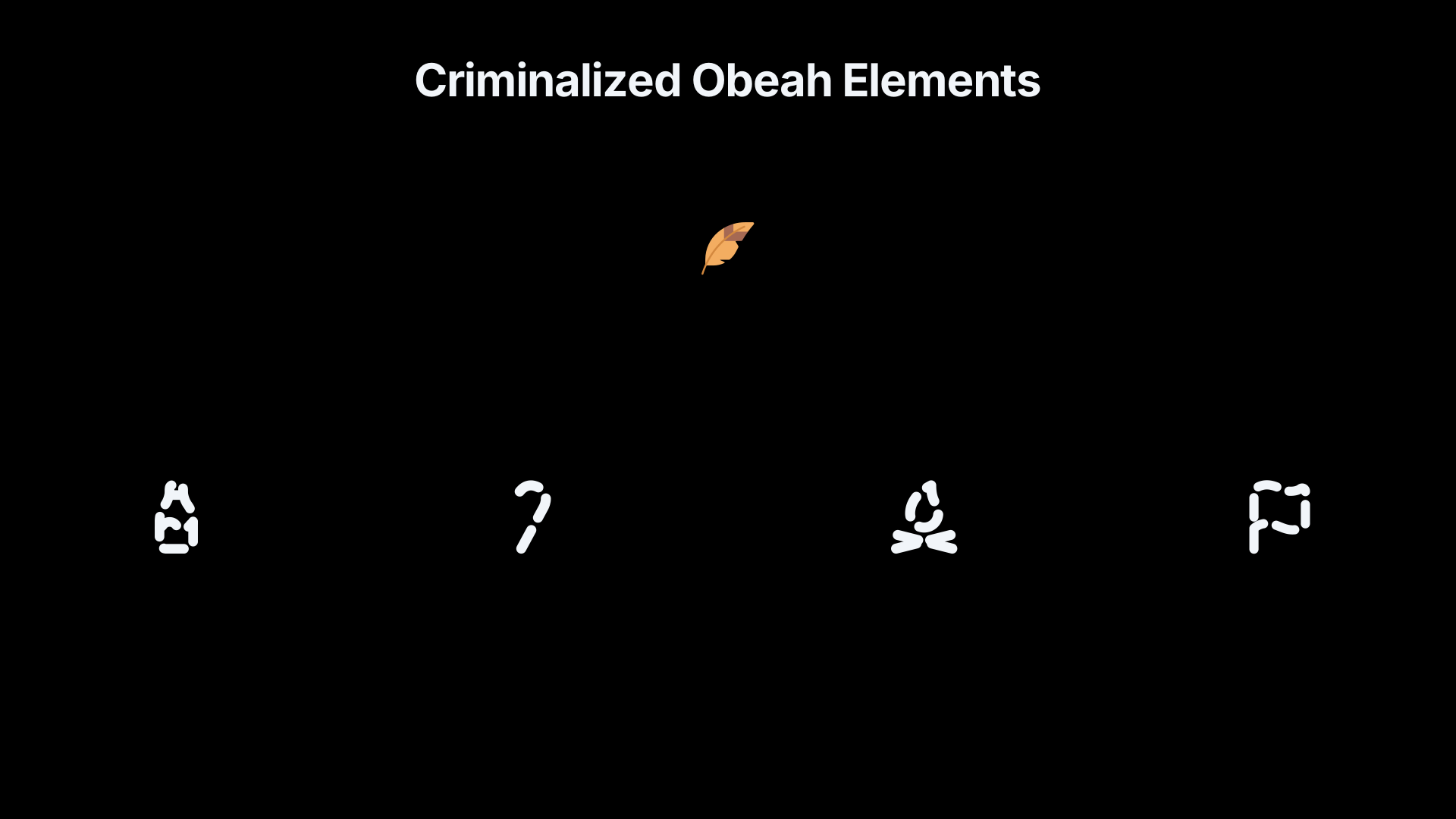
The wording of the legislation is revealing. Rather than banning a recognised religion, lawmakers criminalised particular forms of spiritual authority that they believed encouraged collective resistance. The law identified ritual objects—including feathers, grave dirt, animal teeth and bottles—not because these items were inherently dangerous, but because officials associated them with networks of influence they wanted to dismantle.[Obeah Histories]obeahhistories.org1760 jamaica lawObeah HistoriesAn Act to Remedy the Evils arising from Irregular Assemblies of Slaves, Jamaica 1760 | Obeah Histories…
Modern scholarship therefore interprets the Act as an instrument of counter-insurgency. It sought to weaken the social bonds that could unite enslaved communities by making respected spiritual practitioners vulnerable to prosecution.[Edinburgh Research]research.ed.ac.ukEdinburgh Research Witchcraft, poison, law and Atlantic slaveryinburgh ResearchWitchcraft, poison, law and Atlantic slavery - University of Edinburgh Research Explorer…
From emergency measure to lasting legal system
Although the immediate crisis eventually ended, the legal treatment of obeah did not. The 1760 legislation established a precedent that shaped colonial law throughout the British Caribbean.
Over time:
- Jamaica repeatedly renewed or strengthened laws against obeah.[dukeupress.edu]dukeupress.eduSource details in endnotes.
- Other British Caribbean colonies adopted similar legislation.
- The offence survived the abolition of slavery, remaining part of colonial criminal law well into the nineteenth and twentieth centuries.[obeahhistories.org]obeahhistories.orgObeah Histories Legislation | Obeah HistoriesObeah Histories Legislation | Obeah Histories
This continuity demonstrates that colonial governments viewed obeah as more than an emergency wartime concern. It became a permanent category through which African-derived religious authority, healing traditions and independent leadership could be monitored or suppressed.
Historians Jerome Handler and Kenneth Bilby argue that the criminalisation of obeah helped create the very concept it claimed merely to regulate. Diverse African spiritual traditions were increasingly grouped together under a single legal label, allowing colonial administrations to police them as one supposedly dangerous practice.[Obeah Histories]obeahhistories.orgObeah Histories Legislation | Obeah HistoriesObeah Histories Legislation | Obeah Histories
Why the episode remains important
Tacky’s Revolt illustrates how collective fear can reshape law. Colonial officials certainly faced a genuine military uprising, but their response extended beyond suppressing armed resistance. They concluded that African spiritual authority itself represented a continuing threat to the plantation system.
The result was a long-lasting legal tradition in which religious practice, healing, political organisation and rebellion became intertwined in official thinking. That legacy influenced later campaigns against obeah long after slavery ended and helped shape wider colonial attitudes towards African-derived religions across the Caribbean.[ed.ac.uk]research.ed.ac.ukEdinburgh Research Witchcraft, poison, law and Atlantic slaveryinburgh ResearchWitchcraft, poison, law and Atlantic slavery - University of Edinburgh Research Explorer…
Today, historians see the criminalisation of obeah less as evidence that colonial authorities discovered a dangerous secret society than as evidence of how governments respond when unfamiliar belief systems appear capable of creating solidarity among oppressed populations. In that sense, the laws enacted after Tacky’s Revolt reveal as much about colonial fears as they do about the spiritual practices they sought to eliminate.[OUP Academic]academic.oup.comOUP AcademicDiana Paton. The Cultural Politics of Obeah: Religion, Colonialism, and Modernity in the Caribbean World. | The American Hist…
Amazon book picks
Further Reading
Books and field guides related to Why Did Tacky's Revolt Make Obeah Illegal?. Use these as the next step if you want deeper reading beyond the article.

Testing the Chains: Resistance to Slavery in the British West...
Covers rebellions including Jamaica in depth.

Endnotes
1.
Source: academic.oup.com
Link:https://academic.oup.com/ahr/article-pdf/121/5/1714/10298787/zah1714.pdf
Source snippet
OUP AcademicDiana Paton. The Cultural Politics of Obeah: Religion, Colonialism, and Modernity in the Caribbean World. | The American Hist...
2.
Source: scholarship.miami.edu
Link:https://scholarship.miami.edu/esploro/outputs/doctoral/Witchcraft-Witchdoctors-and-Empire-The-Proscription/991031447808402976
Source snippet
Miami ScholarshipWitchcraft, Witchdoctors and Empire: The Proscription and Prosecution of African Spiritual Practices in British Atlantic...
3.
Source: research.ed.ac.uk
Title: Edinburgh Research Witchcraft, poison, law and Atlantic slavery
Link:https://www.research.ed.ac.uk/en/publications/witchcraft-poison-law-and-atlantic-slavery/
Source snippet
inburgh ResearchWitchcraft, poison, law and Atlantic slavery - University of Edinburgh Research Explorer...
4.
Source: obeahhistories.org
Title: 1760 jamaica law
Link:https://obeahhistories.org/1760-jamaica-law/
Source snippet
Obeah HistoriesAn Act to Remedy the Evils arising from Irregular Assemblies of Slaves, Jamaica 1760 | Obeah Histories...
5.
Source: historyworkshop.org.uk
Title: History Workshop The Racist History of Jamaica’s [Obeah Laws]({{ ‘obeah-laws-49f63d/’ | relative_url }}) | History Workshop
Link:https://www.historyworkshop.org.uk/empire-decolonisation/the-racist-history-of-jamaicas-obeah-laws/
6.
Source: obeahhistories.org
Title: Obeah Histories Legislation | Obeah Histories
Link:https://obeahhistories.org/law/
7.
Source: research.ed.ac.uk
Link:https://www.research.ed.ac.uk/en/publications/obeah-acts-producing-and-policing-the-boundaries-of-religion-in-t/
Additional References
8.
Source: uplopen.com
Title: Archival Irruptions | University Press Library Open
Link:https://uplopen.com/en/books/m/10.1515/9781478094364
Source snippet
August 22, 2025 — ARCHIVAL IRRUPTIONS CONSTRUCTING RELIGION AND CRIMINALIZING OBEAH IN EIGHTEENTH-CENTURY JAMAICA Published by Duke Unive...
Published: August 22, 2025
9.
Source: slaveryandfreedomlaws.lib.unb.ca
Title: Laws of Enslavement and Freedom
Link:https://slaveryandfreedomlaws.lib.unb.ca/laws/jamaica-1760
Source snippet
Slavery and Freedom LawsAn Act to remedy the Evils arising from irregular Assemblies of Slaves, and to prevent their possessing Arms and...
10.
Source: youtube.com
Title: Tacky’s Revolt: The Story of an Atlantic Slave War
Link:https://www.youtube.com/watch?v=Mp4PaBfWmoE
Source snippet
"Vincent Brown, 'Tacky's Revolt: The Story of an Atlantic Slave War' (02-02-22)[https://www.youtube.com/watch?v=2nUmFK0XSk4..."](https://www.youtube.com/watch?v=2nUmFK0XSk4...")...
11.
Source: youtube.com
Title: Archival Irruptions: Moravians, Obeah, and Hidden Caribbean Histories
Link:https://www.youtube.com/watch?v=crP-n_zfkZc
Source snippet
Takyi's Rebellion Pt 1 The Easter Rebellion of Port Maria...
12.
Source: youtube.com
Title: Takyi’s Rebellion Pt 1 The Easter Rebellion of Port Maria
Link:https://www.youtube.com/watch?v=vq3kIaWP_BY
Source snippet
The Obeah Man Who Terrified the British Empire Before Tacky's War...
13.
Source: jamaicaobserver.com
Title: Obeah battle
Link:https://www.jamaicaobserver.com/2026/06/09/obeah-battle/
Source snippet
Jamaica ObserverJune 9, 2026 — BY ALICIA DUNKLEY WILLIS Senior reporter dunkleywillisa@jamaicaobserver.com June 9, 2026 OBEAH BATTLE SCHO...
Published: June 9, 2026
14.
Source: catalog.folger.edu
Title: Shakespeare Library Catalog Enacting power
Link:https://catalog.folger.edu/record/1154369
Source snippet
Folger Shakespeare Library CatalogEnacting power...
15.
Source: dukeupress.edu
Link:https://www.dukeupress.edu/Archival-Irruptions
16.
Source: cambridge.org
Title: The emergence of Caribbean spiritual politics (Chapter 1)
Link:https://www.cambridge.org/core/books/cultural-politics-of-obeah/emergence-of-caribbean-spiritual-politics/FC51D36577DC37AC641288F0AC718D28
17.
Source: researchgate.net
Title: 261731943 Witchcraft Poison Law and Atlantic Slavery
Link:https://www.researchgate.net/publication/261731943_Witchcraft_Poison_Law_and_Atlantic_Slavery
Topic Tree