When Fear and Faith Swept Through Belgium
Belgium’s history of collective fear and contagious belief is not one single story of “mass hysteria”. It ranges from lethal witch prosecutions in the early modern Southern Netherlands to twentieth-century Marian apparitions, anxiety about unconventional religions, and the extraordinary Coca-Cola health scare of 1999.
Page outline Jump by section
Introduction
The most useful lesson is therefore not that Belgians were unusually credulous. It is that belief spreads through institutions as well as crowds. Courts converted village gossip into witchcraft convictions. Pilgrims, newspapers and church investigators turned children’s visions into national religious events. Parliament and the media made “sects” a public-security category. During the Coca-Cola scare, schools, news reports, government action and memories of a recent food scandal helped transform ambiguous symptoms into a nationwide crisis.[kuleuven.be]lirias.kuleuven.be8 WITCH HUNTS IN THE LOW COUNTRIES (1450–1685)October 26, 2019 — by D Vanysacker · Cited by 4 — The most striking characteristic of…
When witchcraft accusations became state violence
The territories that now form Belgium experienced substantial witch persecution between the fifteenth and late seventeenth centuries. It is misleading to describe these events simply as spontaneous village hysteria. Accusations often began with quarrels, illness, crop failure, unexplained death or a reputation for harmful magic, but prosecution depended on magistrates, legal procedure, interrogation and, in many cases, torture.
The political map was very different from modern Belgium. Most of the region belonged to the Southern Netherlands, while areas including Liège had separate rulers and courts. Prosecution also varied sharply between districts. Research on the Low Countries indicates that the French- and German-speaking southern territories suffered proportionally heavier persecution than many Dutch-speaking areas, although Flanders continued executing people for witchcraft unusually late. Historians warn against any single explanation: local law, religious conflict, poverty, war, harvest conditions, demonological ideas and the behaviour of particular judges could all alter the course of a panic.[Lirias]lirias.kuleuven.be8 WITCH HUNTS IN THE LOW COUNTRIES (1450–1685)October 26, 2019 — by D Vanysacker · Cited by 4 — The most striking characteristic of…
The scale remains uncertain because records have been lost, jurisdictions changed and historical estimates do not always cover the same territory. The strongest scholarship nevertheless places the number executed across the Southern Netherlands far above that of the Dutch Republic to the north. In the County of Flanders alone, surviving evidence indicates that at least 200 accused witches died between roughly 1450 and 1680. Women formed the majority of victims, but men and children were also accused.[Lirias]lirias.kuleuven.be8 WITCH HUNTS IN THE LOW COUNTRIES (1450–1685)October 26, 2019 — by D Vanysacker · Cited by 4 — The most striking characteristic of…
Cathelyne Van den Bulcke and the power of reputation
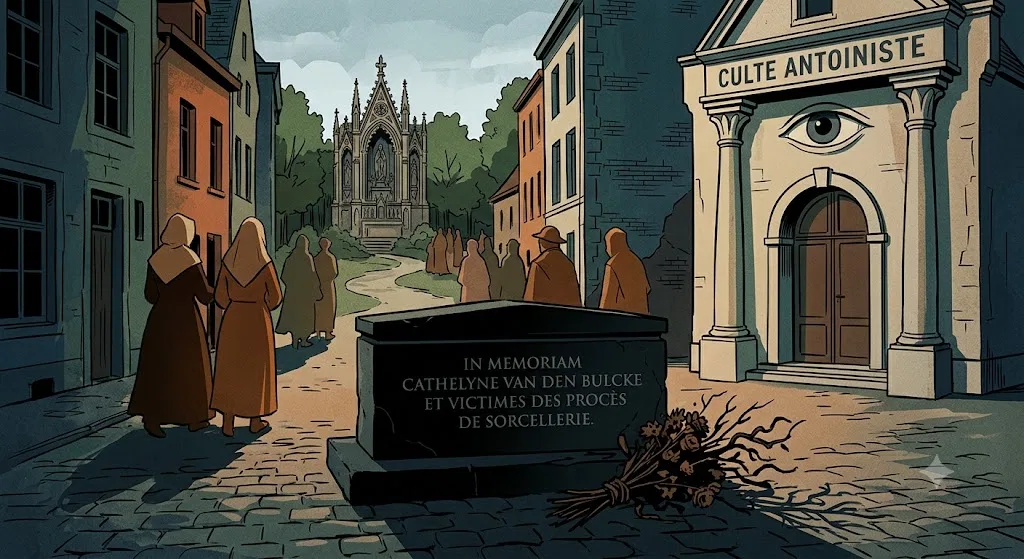
Cathelyne Van den Bulcke, executed at Lier in 1590, has become one of Belgium’s best-known witch-trial victims. Her case is memorable not because she led an occult group—there is no good evidence that she did—but because it shows how an established reputation could harden into legal “proof”. Stories about harmful magic, family associations and previous suspicion made an accused person vulnerable long before a formal charge was brought.
A stone in Lier’s market square now recalls the site associated with witch executions. Such memorials shift attention away from the old question of whether accused people possessed supernatural powers and towards the documented actions of neighbours, interrogators and courts. They also correct a common misconception: Belgium’s major witch persecutions belonged mainly to the early modern period, not to a vaguely imagined “Dark Ages”.[The Brussels Times]brusselstimes.combelgiums bloody witch hunting historyThe Brussels TimesBelgium's bloody witch-hunting history31 Oct 2024 — Today the heksensteen (witch's stone) in the city's Grote Markt rem…
Ghent has undertaken a broader act of remembrance. Municipal historical institutions report that 44 women, 15 men and one boy were accused there between 1364 and 1713. Gossip and rumour could lead to arrest and torture, although outcomes ranged from release or banishment to execution. The city’s rehabilitation initiative explicitly treats those accused as victims of persecution rather than participants in a hidden satanic conspiracy.[Historic Houses]historischehuizen.stad.gentNo fewer than 44 women, 15 men and 1 boy were accused of witchcraft in Ghent between 1364 and 1713. The…Read more…

Why prosecutions spread—and why they stopped
Witch panics could become self-reinforcing. Under coercive questioning, suspects named alleged accomplices. Each new name appeared to confirm the existence of a wider conspiracy, while the use of torture produced narratives that matched what interrogators already expected to hear. Religious and secular authorities then treated the accumulation of similar confessions as corroboration, even though the investigative process itself had helped create the similarity.
Yet there was no uniform Belgian witch craze. Antwerp, despite its size, recorded remarkably few executions compared with some rural districts. Elsewhere, a zealous magistrate or a cluster of accusations could produce a local wave. This unevenness is important because it suggests that fear alone was insufficient: institutional choices determined whether suspicion ended in gossip, banishment, acquittal or death.[Lirias]lirias.kuleuven.be8 WITCH HUNTS IN THE LOW COUNTRIES (1450–1685)October 26, 2019 — by D Vanysacker · Cited by 4 — The most striking characteristic of…
Prosecutions declined as central authorities and higher courts became more sceptical of local evidence, torture and extravagant claims about organised witches’ gatherings. The change was gradual rather than a sudden triumph of science. Flanders still saw executions after 1650, with a final burning recorded in 1684.[Lirias]lirias.kuleuven.be8 WITCH HUNTS IN THE LOW COUNTRIES (1450–1685)October 26, 2019 — by D Vanysacker · Cited by 4 — The most striking characteristic of…
The visions that drew crowds to Beauraing and Banneux
In the winter of 1932–33, Belgium became the setting for two major series of reported Marian apparitions. Five children in Beauraing said they repeatedly saw the Virgin Mary between 29 November 1932 and 3 January 1933. Soon afterwards, Mariette Beco, a girl in Banneux, reported a further series of visions between January and March 1933. Crowds gathered, claims of cures circulated and both villages eventually became pilgrimage centres.[theotokos.org.uk]theotokos.org.ukarticle beauraing apparitionsarticle beauraing apparitions
These events should not automatically be called mass hysteria. The children were the principal reported visionaries; the crowds did not all claim to see the same figure. A better description is contagious religious expectation: reports of extraordinary events attracted observers, and the presence of observers increased publicity, emotional intensity and the possibility of further claims.
The timing mattered. Belgium was experiencing economic hardship, political division and deep uncertainty between the world wars. Catholic practice remained culturally powerful, especially in many rural communities, while stories of the apparitions at Lourdes and Fátima had provided a familiar pattern: humble witnesses, a female sacred figure, calls to prayer and the possibility of miraculous healing. Beauraing and Banneux therefore entered a religious culture already equipped to interpret children’s testimony as potentially supernatural.
Church authorities did not immediately accept every claim. Investigations examined the witnesses and the associated reports of cures, while critics challenged inconsistencies and questioned the influence of suggestion. This long process complicates the idea that the institutional Church simply encouraged popular excitement. Local devotion grew before final episcopal recognition, which came in 1949 for both Beauraing and Banneux.[banneux-nd.be]banneux-nd.berecognition of apparitionsBanneux Notre-DameRecognition of apparitionsIn 1949, Mgr Louis-Joseph Kerkhofs, Bishop of Liège, definitively recognized the reality of t…
From a social-history perspective, the apparitions show how collective belief can spread without obvious coercion or panic. Pilgrims travelled because they hoped, doubted, sought healing or wished to witness history. Their actions created durable shrines and identities for two small Belgian communities. Whether the visions are understood as miracles, personal religious experiences or culturally shaped perceptions depends on the observer’s assumptions; the historical evidence establishes the claims, crowds, investigations and institutional recognition, not a scientifically demonstrable supernatural cause.
Antoinism: a Belgian movement without the usual “cult” story
Belgium also produced one of Western Europe’s most distinctive healing religions. Antoinism emerged around Louis Antoine, a former industrial worker from the Liège region who became known as a spiritual healer. By the early twentieth century, his teachings had developed into an organised movement combining Christian language, spiritual healing, reincarnation and an emphasis on moral transformation. It spread through Belgian and French working-class communities and constructed a network of temples.[arXiv]arxiv.orgarXiv Econophysics of a religious cult: the Antoinists in BelgiumarXiv Econophysics of a religious cult: the Antoinists in Belgium
Antoinism is relevant because it demonstrates the problem with using “cult” as though it were a neutral diagnosis. Scholars and public bodies have variously described the movement as a sect, a healing religion or a new religious movement. Yet it became known for quiet services, free healing practices, anonymous donations and limited proselytising rather than for violence, isolation or apocalyptic coercion. Studies of its temple building and finances suggest rapid early expansion followed by long-term decline, not a catastrophic collapse.[arXiv]arxiv.orgOpen source on arxiv.org.
Its success is easier to understand in the industrial landscape around Liège. Miners and steelworkers lived with dangerous labour, ill health and limited medical security. A healer who spoke in familiar religious terms but stood outside both conventional medicine and Catholic authority could offer hope, dignity and community. That does not establish that faith healing cured disease, but it helps explain why the movement appealed to people whose needs were not fully met by established institutions.
Antoinism therefore belongs in Belgium’s history of unconventional belief, but not as evidence that every minority religion hides abuse. Its quieter history is a useful counterweight to later anti-sect narratives that tended to place very different organisations under the same alarming label.
How “sects” became a national security concern
Belgian concern about minority religious and esoteric organisations intensified during the 1990s. The deaths associated with the Order of the Solar Temple in Switzerland, Canada and France were especially influential. The movement had Belgian connections, including members from Belgium, and its mixture of esoteric teaching, authoritarian leadership, murder and suicide gave the public a genuine example of extreme harm. Between 1994 and 1997, 74 members or associates died in a series of incidents, some of whom had been killed rather than voluntarily taking their own lives.[U.S. Department of State]2009-2017.state.govU.S. Department of State BelgiumU.S. Department of State Belgium
Belgium’s Parliament subsequently investigated “sects”, producing a controversial report in 1997. A table attached to the inquiry named a large number of organisations that had been examined, but its status was easily misunderstood. Appearance in the material did not by itself prove illegality or harmful conduct. Some named religious groups argued that the list functioned in practice as a blacklist and exposed them to discrimination.[digitalcommons.law.byu.edu]digitalcommons.law.byu.edu1. to study the phenomenon of harmful sectarian organizations in Belgium as well as their international connections…Read more…
In 1998, Belgium created the Centre for Information and Advice on Harmful Sectarian Organisations. The wording matters: its formal concern is not unconventional belief as such, but organisations whose activities are illegal, damaging to individuals or society, or contrary to human dignity. Belgium’s security service was also assigned responsibilities relating to harmful sectarian organisations.[fecris.org]fecris.orgCentre for Information and Advice on Harmful SectarianCentre for Information and Advice on Harmful Sectarian
The policy represented an attempt to distinguish freedom of religion from conduct involving fraud, coercion, abuse or exploitation. Critics nevertheless argued that the state’s approach could stigmatise peaceful minorities and that the word “sect” carried a pejorative meaning before any wrongdoing had been established. The controversy is not merely semantic. When a public authority groups a therapeutic association, an esoteric school, a recognised religion and a violent apocalyptic organisation within the same investigative frame, ordinary readers may assume a level of equivalence that the evidence does not support.[springer.com]link.springer.comBelgium's Anti-Sect Policy*Belgium's Anti-Sect Policy*
A Belgian court dispute demonstrated that parliamentary labelling could have consequences. An association named in the inquiry brought proceedings against the state, and an appeal court accepted a liability claim and ordered publication of the judgment as well as compensation. The episode underlined the tension between warning the public and preserving due process and reputational rights.[La Chambre]lachambre.beECPRD UKECPRD UK
Belgium’s anti-sect system is therefore best understood as a response to both real and imagined dangers. Solar Temple deaths showed that closed, authoritarian movements could cause grave harm. But the wider panic risked turning unusual theology, alternative therapy or social nonconformity into evidence of dangerousness. The central question is not whether a group seems strange; it is whether reliable evidence shows deception, coercive control, violence, abuse or other unlawful harm.
The Coca-Cola scare: contamination, anxiety or both?
Belgium’s clearest modern episode of possible mass psychogenic illness began in June 1999. Pupils at a school in Bornem reported nausea, headaches, dizziness and other symptoms after drinking Coca-Cola. Similar complaints appeared at other schools and among members of the public. Coca-Cola products were withdrawn on a huge scale, and hundreds of people sought advice or medical attention.[nih.gov]pubmed.ncbi.nlm.nih.govA qualitative investigation described the scenario.Read moreBelgian coca-cola-related outbreak: intoxication, mass…by A Gallay · 2002 · Cited by 43 — An epidemic of health complaints occur…
The alarm did not arise in a calm environment. Belgium had just been shaken by the dioxin crisis, in which contaminated animal feed entered the food chain. The scandal damaged confidence in regulators, disrupted food exports and contributed to the fall of the government. Against that background, reports that children were becoming ill after consuming a globally recognised drink appeared entirely credible. People had recently learned that official reassurance about food safety might be wrong.[ScienceDirect]sciencedirect.comOpen source on sciencedirect.com.
Investigators found genuine production problems. Some bottles were associated with an unusual smell linked to contamination around wooden transport pallets, while cans from another plant were investigated for chemical residues. These findings meant that the incident could not simply be dismissed as imaginary. However, toxicological assessments struggled to explain the number, geographical spread and variety of reported symptoms by contamination alone.
A later epidemiological study of cases in five Belgian schools concluded that a bad odour may have triggered symptoms in the first cluster, after which anxiety, expectation and social transmission contributed to further illness. In other words, the most plausible interpretation was not necessarily “poisoning” versus “hysteria”. A limited sensory or chemical problem may have acted as the spark, while publicity and fear greatly enlarged the outbreak.[PubMed]pubmed.ncbi.nlm.nih.govA qualitative investigation described the scenario.Read moreBelgian coca-cola-related outbreak: intoxication, mass…by A Gallay · 2002 · Cited by 43 — An epidemic of health complaints occur…
This distinction matters because psychogenic symptoms are real symptoms. Calling the pupils hysterical can sound as though they were pretending, but mass sociogenic illness does not require conscious fabrication. Headache, nausea, dizziness, breathing difficulties and faintness can emerge through stress, hyperventilation, expectation and close observation of other affected people. Such episodes often spread efficiently through schools because pupils share the same environment, talk to one another and are rapidly exposed to the same warnings.[PMC]pmc.ncbi.nlm.nih.govPMCMass psychogenic illness and the social networkPMCMass psychogenic illness and the social network
The response itself amplified the signal. Ambulances, school closures, television coverage, product recalls and government warnings showed that authorities regarded the threat as serious. Those measures were understandable while contamination remained possible, but each also gave worried consumers another reason to monitor their bodies. Ordinary sensations acquired a possible explanation: perhaps the drink had made them ill.
The Coca-Cola episode remains culturally important because it resists a tidy answer. The company did have quality-control failures. Public suspicion was rational after the dioxin scandal. Some early complaints may have had a physical trigger. Yet the eventual scale of illness appears to have depended heavily on social contagion. It is an unusually clear demonstration that environmental events and collective anxiety can interact rather than exclude one another.[nih.gov]pubmed.ncbi.nlm.nih.govA qualitative investigation described the scenario.Read moreBelgian coca-cola-related outbreak: intoxication, mass…by A Gallay · 2002 · Cited by 43 — An epidemic of health complaints occur…
What Belgium’s cases have in common
Belgium’s witch trials, apparitions, sect controversies and product scare differ too greatly to be collapsed into one psychological diagnosis. Witch persecution involved judicial violence against imagined conspirators. Beauraing and Banneux produced devotional communities rather than widespread social breakdown. Antoinism was an unconventional healing movement whose public reputation was often shaped by outside labels. The 1990s sect debate combined reasonable concern about coercive organisations with the risk of indiscriminate suspicion. The Coca-Cola event involved genuine product defects as well as probable symptom contagion.
Several recurring mechanisms nevertheless connect them.
Ambiguous events acquired familiar explanations. A sick animal or failed harvest could be blamed on witchcraft. A child’s vision could be understood through existing Marian traditions. Headaches after a strange-smelling drink could be interpreted as evidence of poisoning.
Trusted institutions made beliefs more consequential. Courts converted rumours into convictions. Church investigations transformed local apparition claims into recognised pilgrimage traditions. Parliament and security bodies formalised “harmful sectarian organisations” as an official field of concern. Public-health decisions confirmed that the Coca-Cola reports demanded national action.
Recent shocks lowered the threshold for belief. Religious war and economic hardship formed part of the setting for witch persecution. Interwar uncertainty surrounded the Belgian apparitions. Solar Temple deaths made fears of dangerous sects concrete. The dioxin scandal made a second food-safety failure seem not merely possible but likely.
Stories spread through social networks. In early modern villages, reputation circulated through neighbours and kin. Apparition reports travelled through pilgrims and the press. Anti-sect allegations crossed borders through media and activist networks. In 1999, information moved among pupils, parents, schools, doctors, broadcasters and government departments.
The label chosen shaped the response. “Witch” made persecution appear defensive. “Miracle” encouraged pilgrimage. “Sect” could invite surveillance. “Mass hysteria” could minimise suffering, while “poisoning” could intensify alarm. More precise language—persecution, devotion, coercive organisation, moral panic or mass psychogenic illness—usually produces a clearer account.

Why these histories still matter
Belgium’s cases show that collective belief is rarely a matter of foolish crowds suddenly losing reason. It is usually built from understandable fears, available cultural stories and signals from people or institutions believed to possess authority. The resulting belief may be false, partly true or impossible to verify, but its consequences can be concrete: executions, damaged reputations, pilgrimages, new state agencies, school disruption and costly product recalls.
They also show why scepticism must work in both directions. Authorities should not dismiss clusters of illness before excluding environmental hazards, nor should they assume that every unconventional religion is harmless. Equally, a suspicious smell does not explain every later symptom, and unusual beliefs do not prove coercion or criminality. Responsible investigation separates evidence of harm from discomfort with difference.
The deepest continuity in Belgium’s history is therefore not hysteria but amplification. A rumour, vision, accusation or bodily sensation becomes socially powerful when it passes through courts, churches, newspapers, schools, medical systems or government. Understanding that process does not require contempt for believers or sufferers. It requires attention to how uncertainty travels—and to who gains the power to name it.
Amazon book picks
Further Reading
Books and field guides related to When Fear and Faith Swept Through Belgium. Use these as the next step if you want deeper reading beyond the article.
Extraordinary Popular Delusions and the Madness of Crowds
Rating: 4.0/5 from 5 Google Books ratings
Explores collective belief and social contagion.


The Penguin book of witches
Supports understanding of European witch beliefs and prosecutions.
Endnotes
1.
Source: digitalcommons.law.byu.edu
Link:https://digitalcommons.law.byu.edu/cgi/viewcontent.cgi?article=2110&context=lawreview
Source snippet
1. to study the phenomenon of harmful sectarian organizations in Belgium as well as their international connections...Read more...
2.
Source: theotokos.org.uk
Title: article beauraing apparitions 1932 33
Link:https://theotokos.org.uk/article-beauraing-apparitions-1932-33/
3.
Source: hozana.org
Link:https://hozana.org/en/miracles-and-apparitions/marian-apparitions/beauraing
4.
Source: arxiv.org
Title: arXiv Econophysics of a religious cult: the Antoinists in Belgium [
Link:https://arxiv.org/pdf/1201.4841
5.
Source: arxiv.org
Title: arXiv Logistic Modeling of a Religious Sect Features
Link:https://arxiv.org/abs/1309.1964
6.
Source: arxiv.org
Link:https://arxiv.org/abs/1201.4841
7.
Source: 2009-2017.state.gov
Title: U.S. Department of State Belgium
Link:https://2009-2017.state.gov/j/drl/rls/irf/2001/5563.htm
8.
Source: fecris.org
Title: Centre for Information and Advice on Harmful Sectarian
Link:https://www.fecris.org/conferences/marseille2023/Marseille_2023_CIAOSN_SLIDES.pdf
9.
Source: 2009-2017.state.gov
Title: U.S. Department of State Belgium
Link:https://2009-2017.state.gov/j/drl/rls/irf/2005/51543.htm
10.
Source: 2009-2017.state.gov
Title: U.S. Department of State Belgium
Link:https://2009-2017.state.gov/j/drl/rls/irf/2006/71371.htm
11.
Source: link.springer.com
Title: Belgium’s Anti-Sect Policy*
Link:https://link.springer.com/content/pdf/10.1007/978
12.
Source: cdn.osce.org
Link:https://cdn.osce.org/sites/default/files/f/documents/8/b/34243.pdf
13.
Source: cdn.osce.org
Link:https://cdn.osce.org/sites/default/files/f/documents/4/1/34018.pdf
14.
Source: bmj.com
Link:https://www.bmj.com/content/319/7203/146.2
15.
Source: sciencedirect.com
Link:https://www.sciencedirect.com/science/article/abs/pii/S0278691502001357
16.
Source: pmc.ncbi.nlm.nih.gov
Title: PMCCoca-Cola health scare may be mass sociogenic illness
Link:https://pmc.ncbi.nlm.nih.gov/articles/PMC1174603/
17.
Source: pmc.ncbi.nlm.nih.gov
Title: PMCMass psychogenic illness and the social network
Link:https://pmc.ncbi.nlm.nih.gov/articles/PMC3536509/
18.
Source: 2009-2017.state.gov
Link:https://2009-2017.state.gov/j/drl/rls/irf/2004/35444.htm
19.
Source: history.com
Title: what was satanic panic 1980s
Link:https://www.history.com/articles/what-was-satanic-panic-1980s
20.
Source: sciencedirect.com
Link:https://www.sciencedirect.com/science/article/abs/pii/S0378437112000088
21.
Source: lirias.kuleuven.be
Link:https://lirias.kuleuven.be/retrieve/562021
Source snippet
8 WITCH HUNTS IN THE LOW COUNTRIES (1450–1685)October 26, 2019 — by D Vanysacker · Cited by 4 — The most striking characteristic of...
Published: October 26, 2019
22.
Source: banneux-nd.be
Title: recognition of apparitions
Link:https://banneux-nd.be/en/recognition-of-apparitions/
Source snippet
Banneux Notre-DameRecognition of apparitionsIn 1949, Mgr Louis-Joseph Kerkhofs, Bishop of Liège, definitively recognized the reality of t...
23.
Source: pubmed.ncbi.nlm.nih.gov
Title: A qualitative investigation described the scenario.Read more
Link:https://pubmed.ncbi.nlm.nih.gov/11790677/
Source snippet
Belgian coca-cola-related outbreak: intoxication, mass...by A Gallay · 2002 · Cited by 43 — An epidemic of health complaints occur...
24.
Source: brusselstimes.com
Title: belgiums bloody witch hunting history
Link:https://www.brusselstimes.com/1289066/belgiums-bloody-witch-hunting-history
Source snippet
The Brussels TimesBelgium's bloody witch-hunting history31 Oct 2024 — Today the heksensteen (witch's stone) in the city's Grote Markt rem...
25.
Source: historischehuizen.stad.gent
Link:https://historischehuizen.stad.gent/en/rehabilitation-ghent-victims-witch-hunting
Source snippet
No fewer than 44 women, 15 men and 1 boy were accused of witchcraft in Ghent between 1364 and 1713. The...Read more...
26.
Source: lachambre.be
Title: ECPRD UK
Link:https://www.lachambre.be/kvvcr/pdf_sections/jurid/ECPRD_UK.pdf
27.
Source: Wikipedia
Title: Mass psychogenic illness
Link:https://en.wikipedia.org/wiki/Mass_psychogenic_illness
28.
Source: Wikipedia
Title: Order of the Solar Temple
Link:https://en.wikipedia.org/wiki/Order_of_the_Solar_Temple
29.
Source: Wikipedia
Link:https://en.wikipedia.org/wiki/Antoinism
30.
Source: childrenaustralia.org.au
Link:https://childrenaustralia.org.au/journal/download/pdf/1519/
31.
Source: parliament.vic.gov.au
Link:https://www.parliament.vic.gov.au/4968d1/contentassets/7190d7b91ce64c528873842567f2d367/submission-documents/002a_25.06.24_sue-winter.pdf
32.
Source: onlinecaveman.com
Title: Mass Psychogenic Illness
Link:https://onlinecaveman.com/science/mass-psychogenic-illness-how-to-survive-a-panic-epidemic/
33.
Source: wakefieldinstitute.org
Link:https://wakefieldinstitute.org/wiki/Antoinism
Additional References
34.
Source: canonvanvlaanderen.be
Link:https://www.canonvanvlaanderen.be/en/events/cathelyne-van-den-bulcke/
Source snippet
Canon van VlaanderenCathelyne Van den BulckeMany witch trials took place in the southern part of the Low Countries between the 15th and 1...
35.
Source: youtube.com
Title: How Our Lady of Banneux Changed the World
Link:https://www.youtube.com/watch?v=YLoWiUY5MWI
Source snippet
33 Apparitions in Three Months?! Belgium's Little Known Miracle...
36.
Source: youtube.com
Title: Our Lady of Banneux – Virgin of the Poor (15 January)
Link:https://www.youtube.com/watch?v=RK6iP0XUNyc
Source snippet
How Our Lady of Banneux Changed the World - Explaining the Faith...
37.
Source: hrwf.eu
Link:https://hrwf.eu/wp-content/uploads/2024/02/2023-0305-JW-Sexual-Abuses-Belgium.docx
38.
Source: catholicculture.org
Link:https://www.catholicculture.org/culture/library/view.cfm?recnum=3195
39.
Source: medium.com
Link:https://medium.com/predict/flames-of-fear-unraveling-europes-witch-hunt-hysteria-845e4e576895
40.
Source: piercedhearts.org
Link:https://www.piercedhearts.org/hearts_jesus_mary/apparitions/our_lady_poor.html
41.
Source: mondediplo.com
Link:https://mondediplo.com/2001/06/09sects
42.
Source: academia.edu
Link:https://www.academia.edu/50958274/The_Attitude_of_Belgian_Authorities_toward_New_Religious_Movements
43.
Source: britsoccrim.org
Link:https://www.britsoccrim.org/volume3/004.pdf
Topic Tree
Follow this branch
Related pages 192
- Antigua and Barbuda
- Argentina Belief Scares
- Azerbaijan Belief
- Bahrain Beliefs
- North Korea
- +187 more in sidebar