Within India Panics
Why Did Unexplained Illness Spread Through Groups?
Fainting, shaking and breathlessness can spread through close-knit groups even when no infection or toxin explains the outbreak.
On this page
- The Burdwan school outbreak
- The Baruipur village cluster
- How doctors distinguish psychogenic illness from poisoning
Page outline Jump by section
Introduction
Unexplained outbreaks of fainting, shaking, dizziness, breathlessness or other alarming symptoms occasionally affect groups of children or tightly connected communities in India. Although these episodes often trigger fears of poisoning, infectious disease, contaminated food or even supernatural forces, medical investigations have sometimes concluded that they are examples of mass psychogenic illness (also called mass sociogenic illness): the rapid spread of genuine physical symptoms through a group without evidence of an infectious or toxic cause sufficient to explain the pattern. The symptoms are real, but the mechanism is psychological and social rather than contagious in the usual medical sense. Research from Indian schools and villages shows that these outbreaks are often triggered by stress, frightening events and observation of others becoming ill, while rumours and intense media attention can prolong or amplify them.[PubMed]pubmed.ncbi.nlm.nih.govPub Med An investigation into a mass psychogenic illness at Burdwan, West BengalAn investigation into a mass psychogenic illness at Burdwan, West Bengal - PubMed…
Why did unexplained illness spread through groups?
Mass psychogenic illness differs from deliberate deception or imagined disease. People experience genuine symptoms such as headaches, nausea, dizziness, tremors, weakness, fainting or hyperventilation. What spreads is not an infection but fear, expectation and heightened attention to bodily sensations.
Schools and close-knit villages provide conditions in which such episodes can spread quickly. Pupils spend long periods together, observe one another closely and often share similar pressures, especially around examinations. In villages, sudden deaths, rumours of mysterious illness or concern about contaminated water or food can create a shared belief that everyone is at risk. Once a few people develop symptoms, others may unconsciously experience similar reactions.
Researchers have identified several common features:
- an alarming trigger, such as a collapse, strange smell or unexpected death;
- rapid spread among people who see or interact with affected individuals;
- predominance among children or adolescents, particularly girls, although males can also be affected;
- absence of laboratory, toxicological or epidemiological evidence for a common physical cause;
- rapid improvement once fear subsides and reassurance is provided.[nih.gov]pmc.ncbi.nlm.nih.govPMCAn epidemic of mass hysteria in a village in West BengalPMCAn epidemic of mass hysteria in a village in West Bengal
The Burdwan school outbreak
One of India’s best documented school outbreaks occurred in July 2007 in Burdwan district, West Bengal, involving three schools. Students developed fainting episodes, headaches, dizziness and abnormal movements. Initial concern centred on whether the children had been poisoned or exposed to an environmental hazard.
Psychiatrists and public health investigators reviewed medical records, school records and the sequence of events. Their study found no environmental or infectious explanation capable of accounting for the pattern of illness. Instead, they concluded that the outbreak represented mass psychogenic illness.[PubMed]pubmed.ncbi.nlm.nih.govPub Med An investigation into a mass psychogenic illness at Burdwan, West BengalAn investigation into a mass psychogenic illness at Burdwan, West Bengal - PubMed…
The investigation also highlighted factors that made the outbreak distinctive:
- The incidents occurred immediately before school examinations, suggesting academic stress was an important background factor.
- Different schools showed somewhat different symptom patterns, despite widespread fears of a common cause.
- Extensive media reporting appeared to influence how symptoms spread and were interpreted.
- Students with poorer academic performance were more likely to experience recurrent episodes, reinforcing the role of anxiety rather than exposure to a toxin.[PubMed]pubmed.ncbi.nlm.nih.govPub Med An investigation into a mass psychogenic illness at Burdwan, West BengalAn investigation into a mass psychogenic illness at Burdwan, West Bengal - PubMed…
The Burdwan investigation has become an important Indian case study because it demonstrates that psychological and social pressures can produce large clusters of genuine illness without requiring an infectious outbreak.
The Baruipur village cluster
A contrasting example occurred in Ganga Duara village near Baruipur, South 24 Parganas district, West Bengal.
The episode began after two members of the same family died on the same day from complications related to liver disease. News of the deaths spread rapidly through the village. Soon afterwards, relatives and neighbours developed similar complaints and several were admitted to hospital amid fears that an unknown epidemic was sweeping through the community.[PMC]pmc.ncbi.nlm.nih.govPMCAn epidemic of mass hysteria in a village in West BengalPMCAn epidemic of mass hysteria in a village in West Bengal
Doctors found that:
- the affected villagers recovered quickly;
- no infectious epidemic could explain the sudden cluster;
- fear of an unknown disease appeared to have driven the spread of symptoms.
The published case report notes that rumours of contamination and illness reinforced anxiety throughout the village. Meetings with villagers, prompt communication by health authorities and reassurance about the medical findings helped prevent further spread. The authors argued that rapid public information and trained primary-care staff are essential in containing such outbreaks.[PMC]pmc.ncbi.nlm.nih.govPMCAn epidemic of mass hysteria in a village in West BengalPMCAn epidemic of mass hysteria in a village in West Bengal
Unlike the school outbreak, where examination stress formed part of the background, the Baruipur cluster illustrates how bereavement and fear following genuine deaths can trigger widespread physical symptoms among otherwise healthy people.
How doctors distinguish psychogenic illness from poisoning
One of the most important lessons from these cases is that doctors do not begin by assuming an outbreak is psychogenic. Public health investigations first look for ordinary medical explanations.
Investigators typically assess:
- whether all affected people had the same exposure to food, water, chemicals or infection;
- laboratory and toxicology findings;
- whether symptoms match a recognised disease;
- the timing and pattern of spread;
- whether unaffected people shared the same exposure.
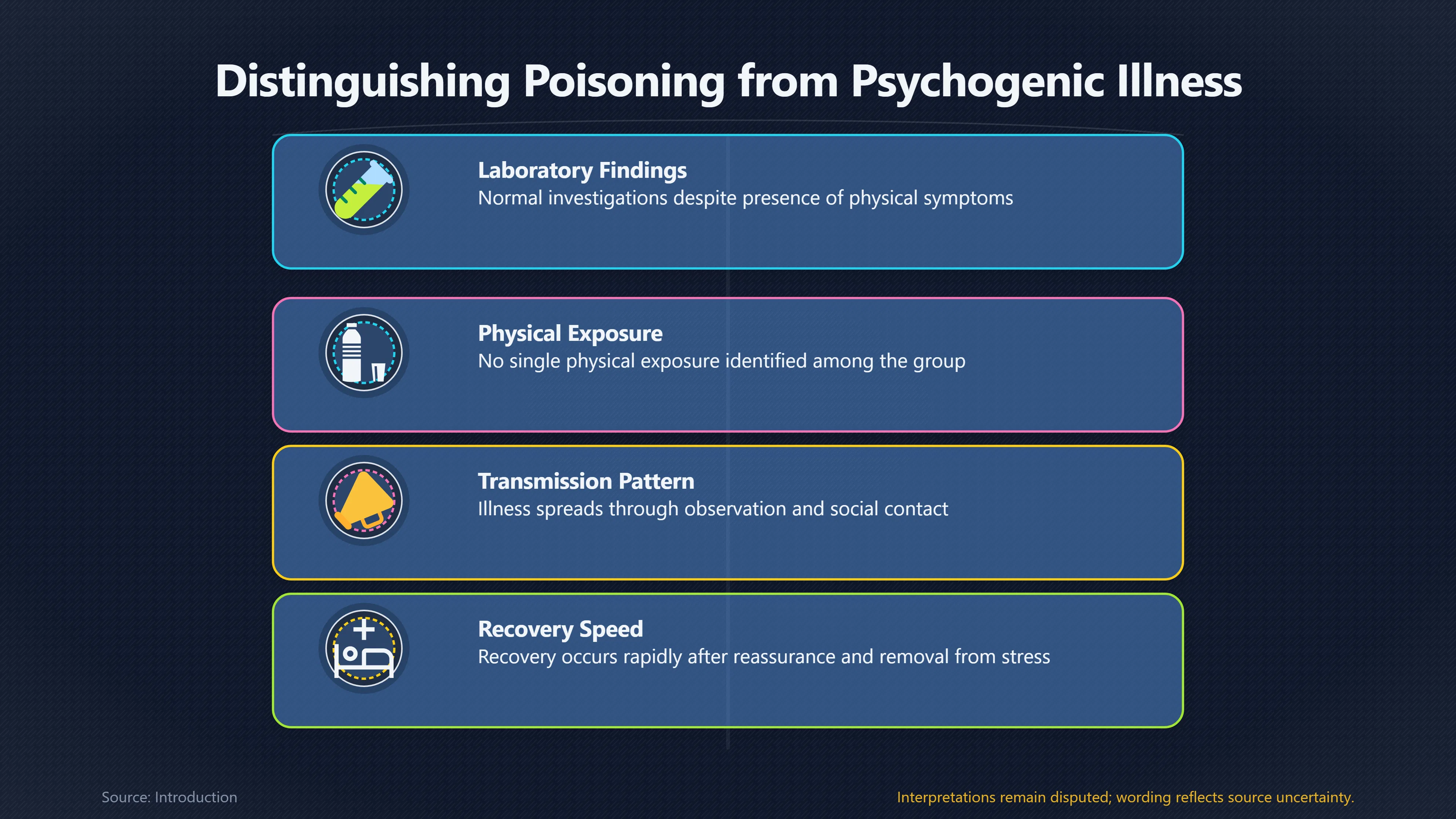
Certain features raise suspicion of mass psychogenic illness rather than poisoning:
Findings suggesting poisoning or infectionFindings suggesting psychogenic illnessConsistent laboratory abnormalitiesNormal investigations despite symptomsClear environmental exposureNo single physical exposure identifiedSymptoms follow recognised toxic or infectious patternsSymptoms vary between individualsIllness spreads according to biological transmissionIllness spreads through observation and social contactRecovery depends on treating the physical causeRecovery often occurs rapidly after reassurance and removal from the stressful setting
Because genuine outbreaks of food poisoning, contaminated drinking water or infectious disease do occur, excluding these possibilities is an essential first step before concluding that an outbreak is psychogenic.[nih.gov]pubmed.ncbi.nlm.nih.govPub Med An investigation into a mass psychogenic illness at Burdwan, West BengalAn investigation into a mass psychogenic illness at Burdwan, West Bengal - PubMed…
The role of rumours and the media
Indian case reports repeatedly emphasise that rumours can become part of the outbreak itself.
During the Burdwan incidents, investigators concluded that intense media coverage influenced how symptoms were expressed and helped sustain anxiety. In the Baruipur episode, widespread belief that a mysterious epidemic had begun amplified fear after the initial deaths.[PubMed]pubmed.ncbi.nlm.nih.govPub Med An investigation into a mass psychogenic illness at Burdwan, West BengalAn investigation into a mass psychogenic illness at Burdwan, West Bengal - PubMed…
Research from comparable South Asian school outbreaks has reached similar conclusions. Once rumours of poisoning or mysterious illness circulate, particularly among closely connected communities, increasing numbers of people may interpret ordinary sensations as evidence that they too have become ill. Modern public health guidance therefore stresses clear, prompt communication alongside medical investigation to prevent unnecessary escalation.[PMC]pmc.ncbi.nlm.nih.govOutbreak of Mass Sociogenic Illness in a School Feeding Program in Northwest Bangladesh, 2010 - PMCNovember 14, 2013…
Why these outbreaks matter
Shared illness outbreaks occupy an important place in India’s wider history of collective fear because they demonstrate how genuine physical suffering can emerge from social processes rather than infectious disease or deliberate fraud.
The Burdwan schools and Baruipur village show different pathways to the same phenomenon: one centred on examination stress among pupils, the other on bereavement and fear within a rural community. Both remind investigators that symptoms should always be treated seriously while avoiding premature conclusions about poisoning, supernatural causes or hidden epidemics.
These cases have also influenced public health practice. They underline the importance of careful medical investigation, responsible reporting, rapid communication with affected communities and reassurance based on evidence. When handled well, most outbreaks resolve quickly without long-term physical illness, even though the distress experienced by those affected is entirely real.[nih.gov]pubmed.ncbi.nlm.nih.govPub Med An investigation into a mass psychogenic illness at Burdwan, West BengalAn investigation into a mass psychogenic illness at Burdwan, West Bengal - PubMed…
Amazon book picks
Further Reading
Books and field guides related to Why Did Unexplained Illness Spread Through Groups?. Use these as the next step if you want deeper reading beyond the article.
Extraordinary Popular Delusions and the Madness of Crowds
Rating: 4.0/5 from 5 Google Books ratings
Provides broad context for collective behavioral episodes.
Mass Hysteria in Schools
Directly covers mass psychogenic illness in educational settings.
Endnotes
1.
Source: pmc.ncbi.nlm.nih.gov
Title: PMCAn epidemic of mass hysteria in a village in West Bengal
Link:https://pmc.ncbi.nlm.nih.gov/articles/PMC2918293/
2.
Source: pmc.ncbi.nlm.nih.gov
Link:https://pmc.ncbi.nlm.nih.gov/articles/PMC10874769/
Source snippet
nih.govAnxiety-related adverse events following immunization (AEFI): A systematic review of published clusters of illness - PMCJanuary 4...
3.
Source: pmc.ncbi.nlm.nih.gov
Link:https://pmc.ncbi.nlm.nih.gov/articles/PMC3828262/
Source snippet
Outbreak of Mass Sociogenic Illness in a School Feeding Program in Northwest Bangladesh, 2010 - PMCNovember 14, 2013...
Published: November 14, 2013
4.
Source: pubmed.ncbi.nlm.nih.gov
Title: Pub Med An investigation into a mass psychogenic illness at Burdwan, West Bengal
Link:https://pubmed.ncbi.nlm.nih.gov/19806834/
Source snippet
An investigation into a mass psychogenic illness at Burdwan, West Bengal - PubMed...
5.
Source: pubmed.ncbi.nlm.nih.gov
Title: Pub Med An epidemic of mass hysteria in a village in West Bengal
Link:https://pubmed.ncbi.nlm.nih.gov/20711292/
Source snippet
2005 Apr;47(2):106-8. doi: 10.4103/0019-5545.55956. AN EPIDEMIC OF MASS HYSTERIA IN A VILLAGE IN WEST BE...
6.
Source: pmc.ncbi.nlm.nih.gov
Link:https://pmc.ncbi.nlm.nih.gov/articles/PMC4884863/
Source snippet
Mass psychogenic illness has been a recurrent phenomenon in Bangladesh over recent times. Objectives. This study was aimed at investigati...
7.
Source: pubmed.ncbi.nlm.nih.gov
Link:https://pubmed.ncbi.nlm.nih.gov/24244685/
Source snippet
2013 Nov 14;8(11):e80420. doi: 10.1371/journal.pone.0080420. eCollection 2013. OUTBREAK OF MASS SOCIOGENIC ILLNESS IN A SCHOOL FEEDING PR...
8.
Source: pubmed.ncbi.nlm.nih.gov
Link:https://pubmed.ncbi.nlm.nih.gov/26584171/
Source snippet
anthrax outbreak: Investigation in a rural block of west Bengal and public health response - PubMedAFFILIATION * ^{1} Associate Professor...
9.
Source: pubmed.ncbi.nlm.nih.gov
Link:https://pubmed.ncbi.nlm.nih.gov/177357/
10.
Source: pubmed.ncbi.nlm.nih.gov
Link:https://pubmed.ncbi.nlm.nih.gov/1966391/
Source snippet
1990 Apr-Jun;34(2):107-16. AN EPIDEMIOLOGICAL INVESTIGATION OF JAPANESE ENCEPHALITIS OUTBREAK IN BURDWAN, DISTRICT OF WEST BENGAL DURING...
Additional References
11.
Source: researchgate.net
Title: (PDF) An investigation into a mass psychogenic illness at Burdwan, West Bengal
Link:https://www.researchgate.net/publication/26873931_An_investigation_into_a_mass_psychogenic_illness_at_Burdwan_West_Bengal
Source snippet
January 1, 2009 — Article PDF Available AN INVESTIGATION INTO A MASS PSYCHOGENIC ILLNESS AT BURDWAN, WEST BENGAL * January 2009 * Indian...
Published: January 1, 2009
12.
Source: youtube.com
Link:https://www.youtube.com/watch?v=4KWfo-xQcZs
Source snippet
India mystery illness: lead and nickel in blood samples taken from hundreds sickened in Eluru city...
13.
Source: youtube.com
Link:https://www.youtube.com/watch?v=W1g5p8jOX3o
Source snippet
Mass Hysteria in Govt School, Students Seen Crying, Shouting & Banging Heads...
14.
Source: youtube.com
Title: Mass Hysteria in Govt School, Students Seen Crying, Shouting & Banging Heads
Link:https://www.youtube.com/watch?v=dQ9VKeOnZfo
Source snippet
Girls Crying, Banging Heads in Uttarakhand Govt School: A Case of Mass Hysteria? | Viral video...
15.
Source: youtube.com
Link:https://www.youtube.com/watch?v=-_8daI548-Y
Source snippet
Jammu Kashmir News | Rajouri's 'Mystery Illness' Linked to Cadmium Toxin...
16.
Source: cambridge.org
Title: Wardle Sh
Link:https://www.cambridge.org/core/journals/the-british-journal-of-psychiatry/article/abs/mass-sociogenic-illness-by-proxy-parentally-reported-epidemic-in-an-elementary-school/CF2D4B6A1C2CF1D592DB127D1EF1A357
Source snippet
Mass Sociogenic Illness by Proxy: Parentally Reported Epidemic in an Elementary School | The British Journal of Psychiatry | Cambridge Co...
17.
Source: youtube.com
Title: Jammu Kashmir News | Rajouri’s ‘Mystery Illness’ Linked to Cadmium Toxin
Link:https://www.youtube.com/watch?v=oZAyoRa2J6Q
Topic Tree