Within Portugal Belief Panics
How Fátima Became a Global Phenomenon
Children's reports of Marian apparitions at Fátima grew into a mass pilgrimage shaped by war, anticlerical politics and contested testimony.
On this page
- The children's testimony and early gatherings
- Crowds, newspapers and the reported miracle
- Church recognition, politics and continuing debate
Page outline Jump by section
Introduction
The Fátima apparitions began in rural Portugal in 1917, when three shepherd children—Lúcia dos Santos and her cousins Francisco and Jacinta Marto—said that the Virgin Mary appeared to them each month between May and October. What started as the testimony of three children quickly became one of the best-known Marian apparition traditions in the world. It also unfolded during an exceptionally turbulent moment in Portuguese history, with the First World War, deep political instability and an aggressively anticlerical republican government shaping how the events were received. Rather than being simply a story of private religious visions, Fátima became a public struggle over belief, authority and national identity.[Minda de Gunzburg Center]ces.fas.harvard.eduMinda de Gunzburg CenterThe Marian Apparitions in Fátima as… | Minda de Gunzburg Center for European StudiesApril 16, 2026…
For historians of collective belief, Fátima is especially significant because it illustrates how a local religious claim grew into a mass public phenomenon through repeated gatherings, newspaper coverage and political conflict. Whether the apparitions are understood as genuine miracles, psychological experiences or products of their historical context depends largely on the observer’s assumptions. What is not disputed is that they transformed Portuguese religious life and continue to shape debates about faith, evidence and politics.
The children’s testimony and the growth of the crowds
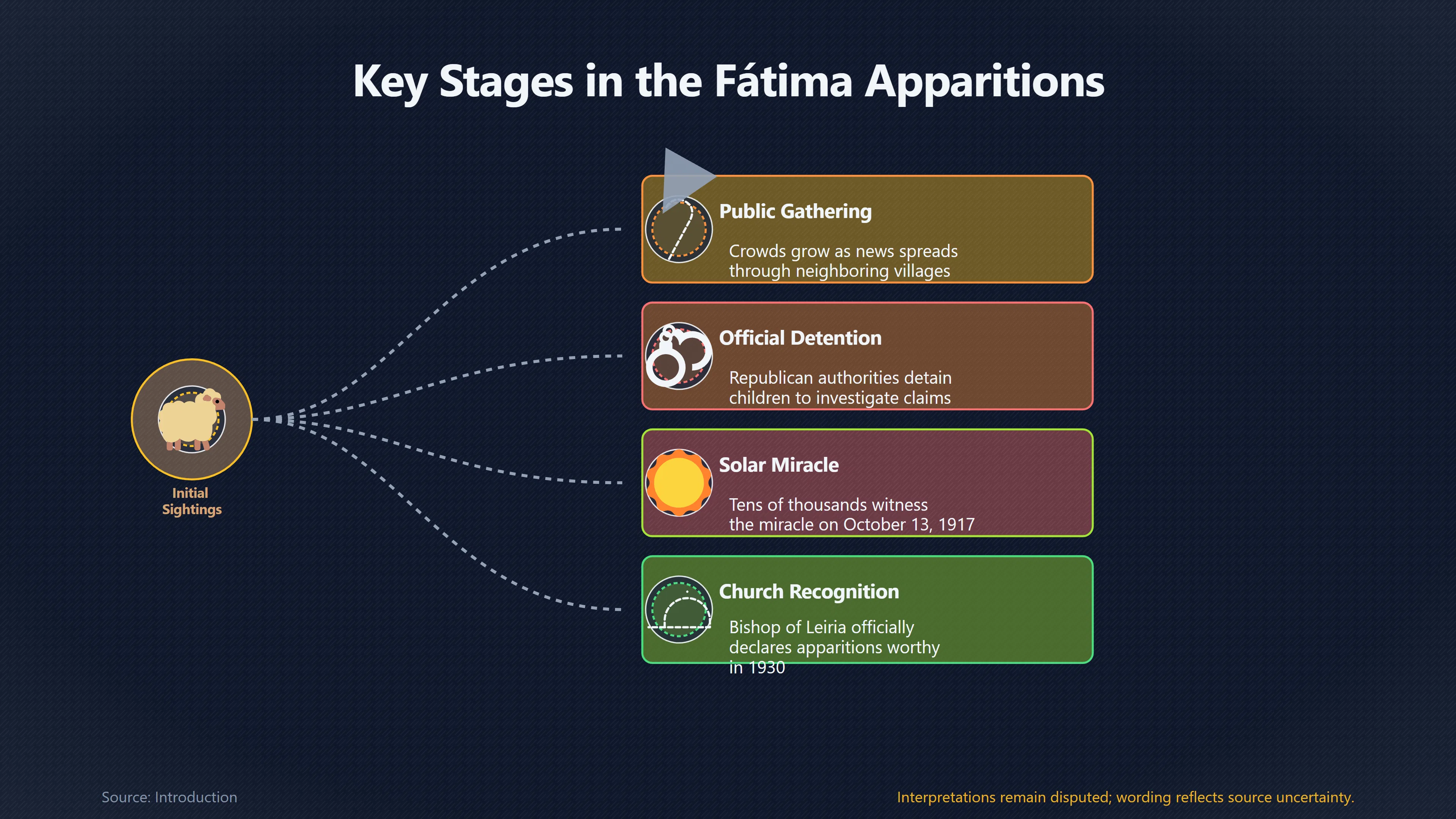
According to the children’s accounts, the first apparition occurred on 13 May 1917 at the Cova da Iria near Fátima. They reported that the Lady asked them to return on the thirteenth day of each month. News spread rapidly through neighbouring villages, drawing curious onlookers, believers, sceptics and journalists.
Attendance increased dramatically over the following months. Early gatherings involved only dozens of people, but by late summer thousands were travelling to the site. The children consistently repeated that they alone could see the figure, although some adults reported unusual atmospheric effects or hearing unexplained sounds. Others experienced nothing unusual at all.
The witnesses came from a wide range of backgrounds. Devout Catholics hoped for confirmation of divine intervention during the hardships of the First World War, while others attended simply to observe what had become an increasingly discussed public event. Newspapers—both sympathetic and hostile—helped spread the story far beyond central Portugal, ensuring that each reported apparition attracted larger crowds.[Minda de Gunzburg Center]ces.fas.harvard.eduMinda de Gunzburg CenterThe Marian Apparitions in Fátima as… | Minda de Gunzburg Center for European StudiesApril 16, 2026…
The children’s testimony also became more politically sensitive after local officials detained them before the expected August apparition. Republican authorities questioned them intensely in an attempt to expose fraud or discourage further gatherings. Although later devotional accounts often describe the detention dramatically, historians generally agree that the incident reflected the government’s determination to prevent what it regarded as a politically troublesome religious movement rather than a systematic campaign against the children themselves.[newsmuseum.pt]newsmuseum.ptFátima and the Church | News MuseumFátima and the Church | News Museum
Crowds, newspapers and the reported miracle
The decisive moment came on 13 October 1917. Tens of thousands of people gathered at the Cova da Iria after the children announced that a public sign would be given. Estimates of attendance vary considerably, but contemporary reports generally place the crowd between roughly 30,000 and 70,000 people.[fatima.org]fatima.orgcircumstances and dialogue of the 1917 apparitionsThe Fatima CenterMay 13, 1917…
Many witnesses later described what became known as the “Miracle of the Sun”. Accounts differed substantially. Some reported seeing the Sun appear to rotate, change colours or move across the sky. Others described dramatic lighting effects or claimed that soaked clothing and muddy ground dried unexpectedly after heavy rain. Yet some observers—including people present—reported seeing nothing unusual.
These differing testimonies are central to modern historical debate. No astronomical observatories recorded any physical movement of the Sun, and no unusual solar event was observed elsewhere on Earth. Historians therefore distinguish between the documented fact that a very large crowd assembled and reported extraordinary experiences, and the supernatural interpretation of those experiences, which lies outside the scope of historical verification. Possible natural explanations proposed by scientists include optical effects caused by looking towards the Sun through thin cloud, atmospheric conditions and the influence of expectation within a large crowd. None of these explanations commands universal agreement among believers, while none confirms the miraculous interpretation either.[Minda de Gunzburg Center]ces.fas.harvard.eduMinda de Gunzburg CenterThe Marian Apparitions in Fátima as… | Minda de Gunzburg Center for European StudiesApril 16, 2026…
The newspapers played an important role in spreading the story. Even journalists who approached the event sceptically sometimes described unusual visual phenomena witnessed by parts of the crowd. This publicity ensured that the events reached readers throughout Portugal and abroad, greatly accelerating Fátima’s emergence as a major pilgrimage destination.[newsmuseum.pt]newsmuseum.ptFátima and the Church | News MuseumFátima and the Church | News Museum

Why politics mattered so much
The apparitions cannot be understood apart from Portugal’s political climate. The First Republic, established in 1910, had introduced sweeping anticlerical reforms that limited the public role of the Catholic Church. Many practising Catholics regarded these measures as an attack on traditional religion, while republican leaders viewed organised Catholicism as a threat to the modern secular state.[Wikipedia]WikipediaFirst Portuguese RepublicFirst Portuguese Republic
Against this background, Fátima became more than a local religious event. For many rural Catholics it symbolised resistance to a government seen as hostile to faith. For many republicans it represented superstition being used to undermine secular authority. The confrontation therefore reflected wider tensions between urban political elites and more conservative rural communities.
Republican newspapers often dismissed the reported apparitions as fraud or popular credulity, while Catholic publications increasingly defended the children’s testimony and encouraged pilgrimage. Officials attempted to restrict religious demonstrations at Fátima, but these efforts generally strengthened the determination of pilgrims rather than suppressing the movement.[newsmuseum.pt]newsmuseum.ptFátima and the Church | News MuseumFátima and the Church | News Museum
Modern historians differ in emphasis. Some argue that conservative political forces quickly recognised Fátima’s symbolic value in opposing the First Republic. Others stress that the movement first grew from genuine popular devotion before later being adopted for political purposes. Most scholars now treat both processes as important: spontaneous religious enthusiasm and political mobilisation reinforced one another rather than existing as separate developments.[Minda de Gunzburg Center]ces.fas.harvard.eduMinda de Gunzburg CenterThe Marian Apparitions in Fátima as… | Minda de Gunzburg Center for European StudiesApril 16, 2026…
Church recognition and continuing debate
The Catholic Church did not immediately endorse the apparitions. Local ecclesiastical authorities spent more than a decade gathering testimony, interviewing witnesses and assessing the claims before the Bishop of Leiria officially declared the apparitions worthy of belief in 1930. This recognition authorised public devotion but did not require Catholics to believe that the apparitions had occurred as historical fact; like other approved private revelations, belief remains voluntary within Catholic teaching.[newsmuseum.pt]newsmuseum.ptFátima and the Church | News MuseumFátima and the Church | News Museum
During the twentieth century, Fátima became intertwined with wider political narratives, particularly through later interpretations of the children’s reported messages concerning Russia and communism. Under António de Oliveira Salazar’s authoritarian Estado Novo regime, devotion to Fátima became closely associated with national Catholic identity, although historians continue to debate whether this represented a state appropriation of an existing popular movement or a deeper partnership between religious and political institutions.[periodicos.ufs.br]periodicos.ufs.br“O milagre de Fátima”: aparições marianas e a cultura política católica anticomunista em Portugal (1917-1930) | Boletim Historiar…
Today the Sanctuary of Fátima is one of the world’s largest Catholic pilgrimage sites, attracting millions of visitors. Believers regard it as a place of prayer, healing and spiritual renewal. Historians, sociologists and psychologists are more likely to study how testimony spread, how expectations influenced large crowds and how political conflict shaped public interpretations. These approaches are not necessarily mutually exclusive: one addresses questions of faith, while the others examine how extraordinary religious claims become influential historical events.

Why Fátima remains important
Fátima is often discussed alongside episodes of mass belief, but it should not simply be labelled an example of “mass hysteria”. That description fails to capture the complexity of what occurred.
Several features make the episode historically distinctive:
- The original claims came from three identifiable children whose testimony remained remarkably consistent over time, despite official questioning.
- Large crowds unquestionably gathered, but eyewitness descriptions of the reported miracle varied considerably rather than forming a single uniform account.
- Political conflict between the Catholic population and the anticlerical First Republic helped transform a local religious experience into a national controversy.
- The Catholic Church delayed formal recognition for thirteen years, illustrating a cautious institutional approach rather than immediate endorsement.
- The event’s influence extended far beyond 1917, shaping Portuguese religious culture, international pilgrimage and debates about the relationship between religion and politics throughout the twentieth century.[newsmuseum.pt]newsmuseum.ptFátima and the Church | News MuseumFátima and the Church | News Museum
For students of collective belief, Fátima demonstrates that public conviction can spread through a combination of personal testimony, repeated communal gatherings, media attention and political circumstances. Whether interpreted as miraculous, psychological or historical, its lasting importance lies in showing how a local episode involving three children became one of the most influential religious events of modern Portugal.
Amazon book picks
Further Reading
Books and field guides related to How Fátima Became a Global Phenomenon. Use these as the next step if you want deeper reading beyond the article.


Miracles
First published 1947. Subjects: Miracles, Nonfiction, Religion & Spirituality, Christianity.

The witch
First published 2017. Subjects: Witchcraft, Witch hunting, Witches, History, Witchcraft, europe.
Our Lady of Fátima
First published 1947. Subjects: Our Lady of Fatima, Fatima, our lady of.
Endnotes
1.
Source: newsmuseum.pt
Title: Fátima and the Church | News Museum
Link:https://www.newsmuseum.pt/en/fatima/fatima-and-church
2.
Source: fatima.org
Title: circumstances and dialogue of the 1917 apparitions
Link:https://fatima.org/circumstances-and-dialogue-of-the-1917-apparitions/
Source snippet
The Fatima CenterMay 13, 1917...
Published: May 13, 1917
3.
Source: Wikipedia
Title: First Portuguese Republic
Link:https://en.wikipedia.org/wiki/First_Portuguese_Republic
4.
Source: periodicos.ufs.br
Link:https://periodicos.ufs.br/historiar/article/view/20196
Source snippet
“O milagre de Fátima”: aparições marianas e a cultura política católica anticomunista em Portugal (1917-1930) | Boletim Historiar...
5.
Source: fatima.ie
Title: WORL D APOSTOLATE OF FATIMA
Link:https://www.fatima.ie/history-of-fatima/
Source snippet
It was the Sunday before the Feast of the Ascention. After attending Mass, the children went to tend their flocks in a place cal...
6.
Source: fatima.org
Title: As is the practice of the Church in similar circums
Link:https://fatima.org/the-church%C2%92s-position-1917-1920/
Source snippet
The Churchs Position (1917-1920) | The Fatima CenterMarch 8, 2017 — THE CHURCHS POSITION (1917-1920) From 1917 to 1920 the Churchs pos...
Published: March 8, 2017
7.
Source: newsmuseum.pt
Title: Fátima e a Igreja: o povo andou sempre à frente | News Museum
Link:https://www.newsmuseum.pt/pt/fatima/fatima-e-igreja-o-povo-andou-sempre-frente
8.
Source: ces.fas.harvard.edu
Link:https://ces.fas.harvard.edu/publications/000199-the-marian-apparitions-in-f%C3%A1tima-as-political-reality-religion-and-politics-in-twentieth-century-portugal
Source snippet
Minda de Gunzburg CenterThe Marian Apparitions in Fátima as… | Minda de Gunzburg Center for European StudiesApril 16, 2026...
Published: April 16, 2026
9.
Source: ojs.revistacontribuciones.com
Link:https://ojs.revistacontribuciones.com/ojs/index.php/clcs/article/view/2063
10.
Source: revistas.rcaap.pt
Link:https://revistas.rcaap.pt/analisesocial/article/view/37141
11.
Source: revistas.ucp.pt
Link:https://revistas.ucp.pt/index.php/humanisticaeteologia/article/view/9407
12.
Source: fatima.org.nz
Link:https://www.fatima.org.nz/?page_id=5
13.
Source: tesorosdelafe.fatima.org.pe
Link:https://tesorosdelafe.fatima.org.pe/articulo-1745-el-milagro-del-sol
14.
Source: visitfatima.pt
Link:https://visitfatima.pt/en/exploring-fatima/history/
Additional References
15.
Source: reddit.com
Link:https://www.reddit.com/r/AskHistorians/comments/1ndpfrg
Source snippet
Are there any independent sources to verify the claims surrounding the miracle of the sun at Fatima?...
16.
Source: youtube.com
Link:https://www.youtube.com/watch?v=YPDEfgnGPCM
Source snippet
Did Mary Appear to 100,000 People? Fatima Myths & Mysteries Explained...
17.
Source: youtube.com
Title: Did Mary Appear to 100,000 People? Fatima Myths & Mysteries Explained
Link:https://www.youtube.com/watch?v=8tFoT-aRoW8
Source snippet
History of Portugal: Republican Revolution (1910) | Educational Audiobook...
18.
Source: youtube.com
Link:https://www.youtube.com/watch?v=TkQoVU5cUJ4
Source snippet
How Our Lady of Fatima Destroyed Communism in Portugal...
19.
Source: researchgate.net
Link:https://www.researchgate.net/publication/237733741_The_Marian_Apparitions_in_Fatima_as_Political_Reality_Religion_and_Politics_in_Twentieth-Century_Portugal
20.
Source: researchgate.net
Link:https://www.researchgate.net/publication/327412792_The_Marian_Apparitions_in_Fatima_as_political_reality_Religion_and_politics_in_twentieth-century_Portugal
21.
Source: researchgate.net
Link:https://www.researchgate.net/publication/327412926_The_Marian_Apparitions_in_Fatima_as_political_reality_Religion_and_politics_in_twentieth-century_Portugal
22.
Source: omilagredefatima.com
Link:https://omilagredefatima.com/en/about
23.
Source: ciencia.ucp.pt
Title: extraordinary order fátima religious affects and the catholic pol
Link:https://ciencia.ucp.pt/en/publications/extraordinary-order-f%C3%A1tima-religious-affects-and-the-catholic-pol/
24.
Source: fatima100.fr
Title: 17 deux articles sur le miracle du 13 octobre 1917
Link:https://www.fatima100.fr/histoire-des-apparitions-de-fatima/17-deux-articles-sur-le-miracle-du-13-octobre-1917
Topic Tree