When Fear Became a Tool of Power
Uzbekistan has no well-documented equivalent of the Salem witch trials, a European dancing plague or a classic nationwide outbreak of mass psychogenic illness.
Page outline Jump by section
Introduction
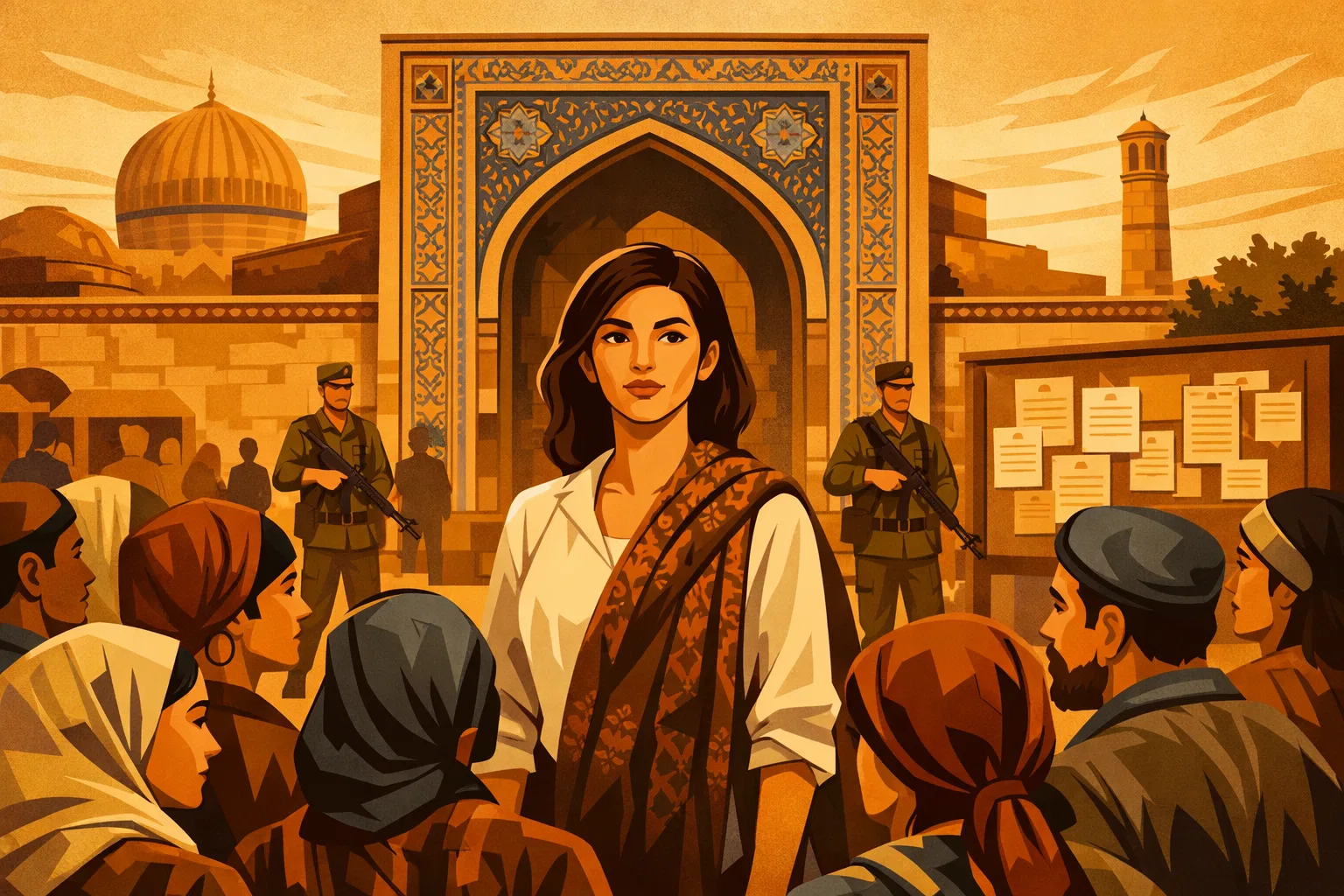
Three episodes are especially revealing. The Soviet assault on veiling turned women’s clothing into a battlefield between revolutionary modernisation and communal honour. After independence, the brief rise of religious vigilantes in Namangan helped create a lasting official fear of uncontrolled Islam. That fear widened after murders, bombings and insurgent attacks, allowing labels such as “Wahhabi”, “extremist” and “Akromiya” to spread far beyond clearly violent organisations. The result was not simply panic in the popular sense. It was a political system of threat-making in which real dangers, uncertain evidence, propaganda, rumour and repression became difficult to separate.[newyorker.com]newyorker.comThe New Yorker They're Only SleepingThe I.M.U., funded by various international sources including Saudi Arabia, Pakistan, and Osama bin Laden, aimed to create an Islamic sta…
Why Uzbekistan’s history does not fit the usual “mass hysteria” story
“Mass hysteria” is often used loosely for almost any episode of collective alarm. Clinically, however, mass psychogenic illness means the rapid spread of genuine physical symptoms within a group without an identified toxic or infectious cause. No comparably strong, well-investigated Uzbek case appears in the accessible medical and historical literature. Reports of school poisoning, fainting or mystery sickness elsewhere in Asia therefore should not be casually transplanted into Uzbekistan’s history.
A better framework is to distinguish four different processes:
- Collective belief: shared religious or healing practices, such as visiting sacred tombs, which do not imply irrationality or social disorder.
- Moral panic: a group or behaviour is portrayed as a threat to the entire social order, often with evidence exaggerated beyond the particular case.
- Security scare: authorities react to real violence but cast suspicion over a much wider population.
- State mythmaking: official language turns a poorly evidenced or disputed organisation into a coherent hidden enemy.
These categories overlap in Uzbekistan because information was tightly controlled for much of the Soviet period and under President Islam Karimov after 1991. Independent reporting was restricted, official versions dominated broadcasting, and researchers often had to reconstruct events from testimony gathered abroad. This makes caution essential: uncertainty in the record is not proof that nothing happened, but neither is an official accusation proof that a secret movement existed as described.[fpc.org.uk]fpc.org.ukMedia landscape in UzbekistanThe total domination of the media environment by censorship and threats to journalists meant there…Read more…
The Soviet unveiling campaign: liberation enforced through fear
The most dramatic early Soviet social campaign in Uzbekistan began in 1927. Communist authorities sought to end women’s seclusion and the wearing of full-body veils, presenting unveiling as a leap from oppression into education, employment and public citizenship. Public ceremonies encouraged women to remove and sometimes burn their veils. Soviet propaganda cast traditional clothing and domestic customs as evidence of ignorance, clerical manipulation and resistance to progress.[Wikipedia]WikipediaOpen source on wikipedia.org.
The underlying abuses were real. Women faced forced marriage, restricted movement, limited schooling and severe dependence on male relatives. Yet the campaign was not simply a humanitarian reform. It also formed part of the Soviet attempt to penetrate households, weaken religious authority and make personal life answerable to the revolutionary state. Officials imagined that a spectacular public gesture—unveiling—would rapidly transform loyalties and beliefs.
Instead, the campaign generated a counter-panic. In many communities, unveiling became associated with sexual dishonour, family collapse and submission to an alien state. Women who complied could be insulted, ostracised, assaulted or killed. Soviet authorities responded by defining attacks on unveiled women as political terror and counter-revolution. Women were therefore caught between two systems of coercion: state pressure to unveil and social pressure to preserve family honour.[Wikipedia]WikipediaOpen source on wikipedia.org.
The episode matters because it shows how moral panic can operate from opposing directions. Soviet campaigners treated the veil as a visible symptom of a diseased old society. Conservative opponents treated unveiled women as agents of immorality. Both sides reduced complex lives to symbols. Education and women’s public participation expanded over time, but the violence of the campaign undermines any simple story in which rational modernity defeated superstition.
Sacred places were suppressed, but belief did not disappear
Religious life in Soviet Uzbekistan did not survive only through formal mosques. Families continued life-cycle rituals, healing practices and visits to the tombs of respected scholars and holy figures. Uzbekistan contains a dense landscape of shrines, especially around Bukhara, Samarkand, Tashkent and the Fergana Valley. Visitors have sought blessing, comfort, fertility, recovery from illness or help with personal difficulties.[uchicago.edu]divinity.uchicago.eduislamic pilgrimage uzbekistan patrick hatcherislamic pilgrimage uzbekistan patrick hatcher
Soviet anti-religious propaganda commonly presented such practices as backward superstition, deception by religious specialists or remnants destined to vanish through education. Shrines lost official protection and pilgrimage could be discouraged or punished, yet local devotion continued in altered and sometimes concealed forms. The endurance of these practices illustrates the limits of ideological campaigns: suppressing public institutions did not eliminate the social relationships through which belief was transmitted.[The Library of Congress]loc.govOpen source on loc.gov.
After independence, pilgrimage became more visible and many sacred sites were restored or promoted as national heritage. This produced a new tension. State institutions could celebrate famous scholars and carefully managed pilgrimage tourism while remaining suspicious of religious activity outside official supervision. Religious authorities also disagreed over practices at shrines, particularly requests for healing or intercession. What outsiders might call “miracle belief” was therefore neither a single panic nor a fringe cult. It was a continuing argument over legitimate religion, custom, medicine and national identity.[Academia]academia.eduOpen source on academia.edu.
Namangan and the fear of an Islamic takeover
The collapse of the Soviet Union created a sudden religious and political opening. Mosques expanded, previously suppressed teaching reappeared, and young activists challenged the state-controlled religious establishment. The sharpest confrontation occurred in Namangan in the Fergana Valley, where activists associated with Tohir Yuldashev and Juma Namangani formed a movement commonly known as Adolat, meaning “Justice”.[The New Yorker]newyorker.comThe New Yorker They're Only SleepingThe I.M.U., funded by various international sources including Saudi Arabia, Pakistan, and Osama bin Laden, aimed to create an Islamic sta…
Adolat was not merely a prayer circle. Its supporters organised neighbourhood patrols, attempted to impose strict conduct and demanded that Islamic law shape the new state. In December 1991, activists confronted President Karimov during a tense public meeting and pressed him to declare an Islamic republic. Once Karimov consolidated power, the government outlawed the movement and arrested its members. Its leaders fled, and Yuldashev and Namangani later helped establish the Islamic Movement of Uzbekistan, an armed organisation that operated from Tajikistan and Afghanistan and developed links with the Taliban and al-Qaeda.[The New Yorker]newyorker.comThe New Yorker They're Only SleepingThe I.M.U., funded by various international sources including Saudi Arabia, Pakistan, and Osama bin Laden, aimed to create an Islamic sta…
This was a real security threat, not an invented panic. Armed militants conducted cross-border operations and sought the overthrow of the Uzbek government. Yet the genuine danger also supplied the template for a much wider fear: any independent religious network could be imagined as an early stage of the same progression from private study to underground organisation and then violence.
That assumption shaped policy for decades. The state recognised tightly supervised forms of religion while treating unsanctioned teaching, informal prayer groups and religious literature as potential gateways to extremism. The effect was to erase distinctions between conservative personal belief, non-violent political Islam and armed insurgency.[crisisgroup.org]crisisgroup.org059 central asia islam and state059 central asia islam and state
How “Wahhabi” became a catch-all accusation
In its precise historical sense, Wahhabism refers to a particular reform tradition originating in Arabia. In 1990s Uzbekistan, however, officials and police increasingly used “Wahhabi” as a flexible label for Muslims outside state-approved structures. It could be applied to men with beards, people attending unofficial mosques, independent preachers or families possessing unauthorised religious material.[The New Yorker]newyorker.comThe New Yorker They're Only SleepingThe I.M.U., funded by various international sources including Saudi Arabia, Pakistan, and Osama bin Laden, aimed to create an Islamic sta…
The escalation began before the major terrorist attacks usually associated with the crackdown. Independent religious leaders disappeared or were arrested during the 1990s. After several officials and police officers were killed in Namangan in late 1997, the authorities detained large numbers of people in the Fergana Valley. Human Rights Watch documented arrests based on religious appearance or association, along with beatings, fabricated evidence and other abuses.[Human Rights Watch]hrw.orgHuman Rights WatchBackground on the Campaign of Religious Persecution10 Aug 2001 — The period 1992 to 1997, when the Uzbek government sou…
Six bombs exploded in Tashkent in February 1999, killing and injuring civilians and apparently targeting the political leadership. The attacks deepened public fear and gave the government a powerful justification for mass arrests. Thousands of Muslims were prosecuted in the following years on accusations involving prohibited groups, underground literature or alleged plans against the state. Some defendants were connected to genuine militant organisations; others were imprisoned for peaceful religious activity or on evidence that rights monitors considered unreliable.[demokratizatsiya.pub]demokratizatsiya.pubInventing Akromiyaby S KENDZIOR · Cited by 34 — Much as the 1999 Tashkent bombings led to the arrest of thousands of inno…
This is the central moral-panic pattern in modern Uzbekistan: a real act of violence makes a broad threat story believable, while secrecy and censorship make that story difficult to test. Visible markers—beards, particular styles of prayer or unofficial study—become substitutes for evidence of violent intent. The authorities’ response can then generate further grievance and underground activity, reinforcing the original claim that repression was necessary.
Andijan and the disputed story of Akromiya
The most consequential conflict between documented events and contested labelling came in Andijan in May 2005. The crisis grew around the trial of 23 local businessmen accused of religious extremism and association with a movement called Akromiya. Supporters described the men as successful employers who supported local welfare. The government presented them as members of a clandestine organisation seeking an Islamic state.[Crisis Group]crisisgroup.orgb038 uzbekistan andijon uprisingb038 uzbekistan andijon uprising
On 12–13 May, armed men attacked government facilities and a prison, freed inmates and seized local officials as hostages. A much larger crowd then gathered in the city centre. Many participants voiced economic and political grievances rather than a clear revolutionary programme. Uzbek security forces opened fire as the confrontation collapsed, killing large numbers of people. The government reported 169 deaths; independent organisations and witnesses gave considerably higher estimates and said many of the dead were unarmed civilians. No independent international inquiry was permitted.[hrw.org]hrw.orgOpen source on hrw.org.
The attackers’ violence and hostage-taking are part of the record and should not be erased. The more difficult question is whether Akromiya existed as the organised revolutionary movement described by official accounts. Some researchers concluded that followers of the imprisoned teacher Akrom Yuldashev formed a genuine religious-business network with shared ethical ideas. Others argued that “Akromiya” was largely constructed by state propagandists from loose personal ties, forced testimony and speculative interpretations of Yuldashev’s writings.[carnegieendowment.org]carnegieendowment.orgthe andijan uprising akramiya and akram yuldashevAndijan on May 13, 2005, one that includes accounts of both the Uzbek government and of the demonstrators. Given Uzbek authorities' refusal…
This uncertainty is not a minor historical detail. By portraying the entire uprising as a pre-planned extremist conspiracy, the government could minimise the importance of unemployment, poverty, injustice and public anger. “Akromiya” became a narrative device that converted a mixed urban revolt—with armed participants, hostages, peaceful demonstrators and ordinary onlookers—into a single hidden plot. Scholar Sarah Kendzior argued that the alleged movement functioned more effectively as a political myth than as a demonstrable organisation.[Demokratizatsiya]demokratizatsiya.pubInventing Akromiyaby S KENDZIOR · Cited by 34 — Much as the 1999 Tashkent bombings led to the arrest of thousands of inno…
Andijan therefore should not be described simply as either an Islamist coup or an entirely peaceful protest. The evidence supports a more uncomfortable account: armed action triggered the crisis, broad social discontent enlarged it, and overwhelming state violence ended it. The refusal to permit an independent investigation ensured that competing stories hardened into rival certainties. Twenty years later, there had still been no credible process of accountability for the killings.[Carnegie Endowment]carnegieendowment.orgthe andijan uprising akramiya and akram yuldashevAndijan on May 13, 2005, one that includes accounts of both the Uzbek government and of the demonstrators. Given Uzbek authorities' refusal…
Reform without abandoning the old threat model
After Karimov’s death in 2016, President Shavkat Mirziyoyev released some religious prisoners, removed many names from official watchlists and presented the country as moving away from the worst abuses of the previous era. Legal changes in 2021 removed certain restrictions, including the formal prohibition on religious dress in public institutions. These measures represented genuine improvement for many families.[Human Rights Watch]hrw.orgHuman Rights Watch Uzbekistan: Backsliding on Religious Freedom PromisesHuman Rights Watch Uzbekistan: Backsliding on Religious Freedom Promises
The underlying system of control, however, remains extensive. Religious organisations must register; private or unauthorised religious education is restricted; imported and distributed religious material is subject to state approval; and missionary activity remains prohibited. International legal reviews have criticised broad grounds for suspending religious organisations and the wide discretion given to officials.[state.gov]state.govOpen source on state.gov.
The word “extremism” continues to carry particular danger because Uzbek law does not consistently limit it to violence or direct incitement. Rights organisations and international monitors have documented prosecutions involving peaceful religious expression, online material and informal study. Reports have also described pressure on men to shave their beards despite the absence of a legal ban.[Human Rights Watch]hrw.orgHuman Rights Watch Uzbekistan: Ensure Fair Appeal In 'Extremism' CaseHuman Rights Watch Uzbekistan: Ensure Fair Appeal In 'Extremism' Case
By 2025 and 2026, observers were still reporting prisoners held on vague religion-related charges and renewed restrictions on independent Muslim practice. The government’s position is that tight supervision protects social harmony and prevents radicalisation. Critics answer that treating unapproved religion as inherently suspicious recreates the mechanism that allowed earlier scares to expand: officials need not prove preparation for violence when the belief, text or association itself is treated as evidence of danger.[USCIRF]uscirf.gov2025 USCIRF Annual Report2025 USCIRF Annual Report
What the Uzbek cases teach about collective fear
Uzbekistan’s history shows why the word “cult” often obscures more than it explains. Adolat exercised coercive authority and some of its leaders later entered armed militancy. The Islamic Movement of Uzbekistan was a genuine insurgent organisation. Akrom Yuldashev’s followers appear to have formed a religious and economic community, but the claim that they constituted the centrally directed terrorist conspiracy described by the state remains disputed. Ordinary independent Muslims swept into mass prosecutions were not thereby members of any cult or violent movement.
The strongest explanations for Uzbekistan’s repeated religious scares are social and political rather than psychological in a narrow clinical sense.
First, rapid change created uncertainty. Soviet institutions collapsed just as religious revival, unemployment, border conflict and new political movements appeared. Namangan’s vigilantes gained attention partly because they promised order when the state looked weak.
Second, genuine militancy encouraged overgeneralisation. Once some former religious activists took up arms, authorities could plausibly claim that peaceful independent networks might be concealed recruitment structures. The difficulty was that suspicion became detached from specific evidence.
Third, censorship magnified official narratives. When independent journalists, witnesses and researchers could not investigate freely, the state possessed an enormous advantage in naming groups, assigning motives and defining casualties. Rumour flourished alongside propaganda because reliable public information was scarce.[cpj.org]cpj.orgCommittee to Protect JournalistsUzbekistan, or Back in the U.S.S.R.Uzbek journalists remain vulnerable to intimidation from the police, s…
Fourth, visible conduct became a shortcut for hidden intention. A beard, veil, private lesson or prohibited recording could be read not simply as religious expression but as a sign of future rebellion. This is a familiar mechanism in moral panics: ambiguous behaviour is reclassified as evidence of membership in a dangerous category.
Finally, repression could strengthen the story it claimed to defeat. Arbitrary detention, torture and exclusion made underground opposition more likely, while the resulting secrecy appeared to confirm official warnings about clandestine networks. The International Crisis Group and other analysts have argued that broad repression did not merely respond to political Islam; it could also deepen the grievances through which militant ideas gained appeal.[Crisis Group]crisisgroup.org059 central asia islam and state059 central asia islam and state
Why this history still matters
The enduring lesson is not that fears of extremism in Uzbekistan were imaginary. Armed groups killed people, took hostages and sought revolutionary change. The error was allowing those facts to erase distinctions between violence, dissent, unconventional belief and private devotion.
That distinction remains culturally important because Uzbekistan is still negotiating the place of religion in public life. Sacred sites are promoted as heritage, approved religious scholarship is celebrated, and the government presents tolerance as part of national identity. At the same time, unsupervised teaching and loosely defined “extremist” expression can still attract punishment.[uzembassy.uk]uzembassy.ukReligious tolerance in UzbekistanReligious tolerance in Uzbekistan
Uzbekistan’s most revealing “panic” history is therefore a history of classification: who was permitted to define true religion, dangerous religion, superstition, modernity and legitimate protest. From the unveiling campaigns of the 1920s to the disputed conspiracy narrative after Andijan, fear repeatedly became most harmful when a person’s clothing, piety or associations were treated as proof of a hidden collective threat.
Amazon book picks
Further Reading
Books and field guides related to When Fear Became a Tool of Power. Use these as the next step if you want deeper reading beyond the article.

The dictator's handbook
Explains incentives behind authoritarian governance and political control.
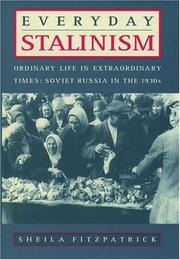
Everyday Stalinism
Illuminates how fear and authoritarian systems functioned in the Soviet world.
Endnotes
1.
Source: demokratizatsiya.pub
Link:https://www.demokratizatsiya.pub/s/DEM-14-4-Kendzior-aaks.pdf
Source snippet
Inventing Akromiyaby S KENDZIOR · Cited by 34 — Much as the 1999 Tashkent bombings led to the arrest of thousands of inno...
2.
Source: fpc.org.uk
Title: Media landscape in Uzbekistan
Link:https://fpc.org.uk/media-landscape-in-uzbekistan/
Source snippet
The total domination of the media environment by censorship and threats to journalists meant there...Read more...
3.
Source: Wikipedia
Link:https://en.wikipedia.org/wiki/Hujum
4.
Source: divinity.uchicago.edu
Title: islamic pilgrimage uzbekistan patrick hatcher
Link:https://divinity.uchicago.edu/sightings/articles/islamic-pilgrimage-uzbekistan-patrick-hatcher
5.
Source: academia.edu
Link:https://www.academia.edu/19304288/Sacred_Sites_Profane_Ideologies_Religious_Pilgrimage_and_the_Uzbek_State
6.
Source: uscirf.gov
Title: 2021 Uzbekistan Report 0
Link:https://www.uscirf.gov/sites/default/files/2021-10/2021%20Uzbekistan%20Report_0.pdf
7.
Source: isdp.eu
Title: 2016 Hartman the May 2005 Andijan Uprising What We Know
Link:https://isdp.eu/wp-content/uploads/2016/06/2016-Hartman-the-May-2005-Andijan-Uprising-What-We-Know.pdf
Published: May 2005
8.
Source: state.gov
Link:https://www.state.gov/reports/2023-report-on-international-religious-freedom/uzbekistan
9.
Source: uscirf.gov
Link:https://www.uscirf.gov/sites/default/files/2026-05/2026%20Uzbekistan%20Country%20Update.pdf
10.
Source: uscirf.gov
Title: 2025 USCIRF Annual Report
Link:https://www.uscirf.gov/sites/default/files/2025-03/2025%20USCIRF%20Annual%20Report.pdf
11.
Source: uscirf.gov
Link:https://www.uscirf.gov/sites/default/files/2026-03/USCIRF_2026_AR%20%282%29.pdf
12.
Source: uzembassy.uk
Title: Religious tolerance in Uzbekistan
Link:https://uzembassy.uk/news/910
13.
Source: Wikipedia
Title: List of mass panic cases
Link:https://en.wikipedia.org/wiki/List_of_mass_panic_cases
14.
Source: Wikipedia
Title: Witch trials in Russia
Link:https://en.wikipedia.org/wiki/Witch_trials_in_Russia
15.
Source: Wikipedia
Title: Islamic Movement of Uzbekistan
Link:https://en.wikipedia.org/wiki/Islamic_Movement_of_Uzbekistan
16.
Source: Wikipedia
Link:https://en.wikipedia.org/wiki/Akromiya
17.
Source: uscirf.gov
Link:https://www.uscirf.gov/node?option=comcontent&page=1584&task=
18.
Source: uscirf.gov
Title: 2023 Annual Report
Link:https://www.uscirf.gov/sites/default/files/2023-05/2023%20Annual%20Report.pdf
19.
Source: uscirf.gov
Link:https://www.uscirf.gov/sites/default/files/2018USCIRFAR.pdf
20.
Source: uscirf.gov
Title: 2009 Annual Report
Link:https://www.uscirf.gov/sites/default/files/2021-04/2009%20Annual%20Report.pdf
21.
Source: uscirf.gov
Link:https://www.uscirf.gov/sites/default/files/KeyFindingsRecommendations.2017AnnualReport.pdf
22.
Source: uscirf.gov
Title: annual report 2010
Link:https://www.uscirf.gov/sites/default/files/resources/annual%20report%202010.pdf
23.
Source: uscirf.gov
Link:https://www.uscirf.gov/node?option=com&page=1597
24.
Source: uscirf.gov
Title: concerned new uzbekistan religion law
Link:https://www.uscirf.gov/countries/uzbekistan/uscirf-concerned-new-uzbekistan-religion-law
25.
Source: state.gov
Link:https://www.state.gov/reports/2021-report-on-international-religious-freedom/uzbekistan
26.
Source: eehb.dspu.edu.ua
Link:https://eehb.dspu.edu.ua/article/view/339333
27.
Source: newyorker.com
Title: The New Yorker They’re Only Sleeping
Link:https://www.newyorker.com/magazine/2002/01/14/theyre-only-sleeping
Source snippet
The I.M.U., funded by various international sources including Saudi Arabia, Pakistan, and Osama bin Laden, aimed to create an Islamic sta...
28.
Source: hrw.org
Link:https://www.hrw.org/legacy/backgrounder/eca/uzbek-aug/persecution.htm
Source snippet
Human Rights WatchBackground on the Campaign of Religious Persecution10 Aug 2001 — The period 1992 to 1997, when the Uzbek government sou...
29.
Source: cpj.org
Link:https://cpj.org/reports/2002/10/uzbek-oct02/
Source snippet
Committee to Protect JournalistsUzbekistan, or Back in the U.S.S.R.Uzbek journalists remain vulnerable to intimidation from the police, s...
30.
Source: carnegieendowment.org
Title: the andijan uprising akramiya and akram yuldashev
Link:https://carnegieendowment.org/russia-eurasia/research/2006/06/the-andijan-uprising-akramiya-and-akram-yuldashev
Source snippet
Andijan on May 13, 2005, one that includes accounts of both the Uzbek government and of the demonstrators. Given Uzbek authorities' refusal...
Published: May 13, 2005
31.
Source: abdn.ac.uk
Link:https://www.abdn.ac.uk/staffpages/uploads/anp053/JRAI%20offprint.pdf
32.
Source: loc.gov
Link:https://www.loc.gov/exhibits/archives/intn.html
33.
Source: crisisgroup.org
Title: 059 central asia islam and state
Link:https://www.crisisgroup.org/rpt/europe-central-asia/uzbekistan/059-central-asia-islam-and-state
34.
Source: hrw.org
Title: Human Rights Watch Creating Enemies of the State
Link:https://www.hrw.org/reports/2004/uzbekistan0304/uzbekistan0304.pdf
35.
Source: hrw.org
Link:https://www.hrw.org/legacy/reports98/uzbekistan/
36.
Source: hrw.org
Title: islamic extremism masks human rights crackdown uzbekistan
Link:https://www.hrw.org/news/1998/05/25/islamic-extremism-masks-human-rights-crackdown-uzbekistan
37.
Source: crisisgroup.org
Title: b038 uzbekistan andijon uprising
Link:https://www.crisisgroup.org/brf/europe-central-asia/uzbekistan/b038-uzbekistan-andijon-uprising
38.
Source: hrw.org
Link:https://www.hrw.org/legacy/campaigns/uzbekistan/andijan/
39.
Source: files.ethz.ch
Title: ETH Zurich Files Asia Briefing, Nr. 38: Uzbekistan
Link:https://www.files.ethz.ch/isn/10744/b038_uzbekistan_andijon.pdf
40.
Source: hrw.org
Link:https://www.hrw.org/legacy/backgrounder/eca/uzbekistan0506/1.htm
41.
Source: hrw.org
Title: 20 years andijan remembering past abuses uzbekistan
Link:https://www.hrw.org/news/2025/05/14/20-years-andijan-remembering-past-abuses-uzbekistan
42.
Source: hrw.org
Title: Human Rights Watch Uzbekistan: Backsliding on Religious Freedom Promises
Link:https://www.hrw.org/news/2023/05/24/uzbekistan-backsliding-religious-freedom-promises
43.
Source: crisisgroup.org
Title: b082 uzbekistan transition
Link:https://www.crisisgroup.org/brf/europe-central-asia/uzbekistan/b082-uzbekistan-transition
44.
Source: uz.usembassy.gov
Title: 2022 report on international religious freedom uzbekistan
Link:https://uz.usembassy.gov/2022-report-on-international-religious-freedom-uzbekistan/
45.
Source: hrw.org
Title: Human Rights Watch Uzbekistan: Ensure Fair Appeal In ‘Extremism’ Case
Link:https://www.hrw.org/news/2023/06/14/uzbekistan-ensure-fair-appeal-extremism-case
46.
Source: rsf.org
Link:https://rsf.org/en/country/uzbekistan
47.
Source: hrw.org
Title: censorship and freedom media uzbekistan
Link:https://www.hrw.org/report/2018/03/28/you-cant-see-them-theyre-always-there/censorship-and-freedom-media-uzbekistan
48.
Source: hrw.org
Title: torture failure habeas corpus and silencing lawyers
Link:https://www.hrw.org/report/2011/12/13/no-one-left-witness/torture-failure-habeas-corpus-and-silencing-lawyers
49.
Source: hrw.org
Title: uzbekistan 6 years no justice andijan victims
Link:https://www.hrw.org/news/2011/05/11/uzbekistan-6-years-no-justice-andijan-victims
50.
Source: hrw.org
Link:https://www.hrw.org/world-report/2025/country-chapters/uzbekistan
51.
Source: main.un.org
Title: islamic movement of uzbekistan
Link:https://main.un.org/securitycouncil/en/sanctions/1267/aq_sanctions_list/summaries/entity/islamic-movement-of-uzbekistan
52.
Source: digitallibrary.un.org
Link:https://digitallibrary.un.org/record/1474806
53.
Source: aph.gov.au
Title: house of representatives committees
Link:https://www.aph.gov.au/parliamentary_business/committees/house_of_representatives_committees?url=pjcis%2Fsix+terrorist%2Fimu.pdf
54.
Source: crisisgroup.org
Link:https://www.crisisgroup.org/europe/central-asia/uzbekistan
55.
Source: crisisgroup.org
Title: starting anew uzbekistan
Link:https://www.crisisgroup.org/opd/europe-central-asia/uzbekistan/starting-anew-uzbekistan
56.
Source: youtube.com
Link:https://www.youtube.com/watch?v=WzAhHz15c_w
57.
Source: ebsco.com
Link:https://www.ebsco.com/research-starters/social-sciences-and-humanities/mass-hysteria
58.
Source: appgfreedomofreligionorbelief.org
Link:https://appgfreedomofreligionorbelief.org/uzbekistan/
59.
Source: healthline.com
Title: mass hysteria
Link:https://www.healthline.com/health/mental-health/mass-hysteria
Additional References
60.
Source: hkw.de
Title: azem bekturova destination tashkent female representation in soviet films
Link:https://www.hkw.de/en/programme/publications/azem-bekturova-destination-tashkent-female-representation-in-soviet-films
Source snippet
Female Representation in Soviet Films29 Nov 2024 — [The Hujum]({{ 'the-hujum/' | relative_url }}) campaign had the goal of 'liberating' and 'emancipating' Central Asian wo...
61.
Source: youtube.com
Title: 27 Years of Fear in Uzbekistan: What Did Karimov Really Create?
Link:https://www.youtube.com/watch?v=nBuONG5dmC0
Source snippet
Uzbekistan's War on Terror This video is highly relevant as it details the state's post-independence campaigns against perceived religiou...
62.
Source: youtube.com
Title: What is Paranja? Explain Paranja, Define Paranja, Meaning of Paranja
Link:https://www.youtube.com/watch?v=QUeXg6Gb6zg
Source snippet
Is Uzbekistan's War On Terrorism Taking A Sinister Turn? (2001)...
63.
Source: youtube.com
Link:https://www.youtube.com/watch?v=ky5Kzyqm37o
Source snippet
Terrorism in Central Asia: Regional Implications...
64.
Source: youtube.com
Title: The Terrible Aftermath of the Andijan Massacre
Link:https://www.youtube.com/watch?v=thdWPvxMyyk
Source snippet
27 Years of Fear in Uzbekistan: What Did Karimov Really Create?...
65.
Source: researchgate.net
Link:https://www.researchgate.net/publication/348045533_Traveler_Motivation_and_Destination_Loyalty_Visiting_Sacred_Places_in_Central_Asia
66.
Source: ohchr.org
Link:https://www.ohchr.org/en/press-releases/2009/10/default-title-248
67.
Source: reddit.com
Link:https://www.reddit.com/r/history/comments/4o8dkd/examples_of_mass_hysteria_through_the_ages/
68.
Source: facebook.com
Link:https://www.facebook.com/smithsonianmagazine/posts/fueled-by-xenophobia-religious-extremism-and-long-brewing-social-tensions-the-wi/702684705057056/
69.
Source: counterextremism.com
Link:https://www.counterextremism.com/threat/islamic-movement-uzbekistan
Topic Tree
Follow this branch
Related pages 192
- Antigua and Barbuda
- Argentina Belief Scares
- Azerbaijan Belief
- Bahrain Beliefs
- North Korea
- +187 more in sidebar