What Did Djibouti Fear, Believe and Misunderstand?
Djibouti does not have a well-documented equivalent of the Salem witch trials, a famous school fainting epidemic or a home-grown apocalyptic sect that can confidently be presented as a national episode of “mass hysteria”.
Page outline Jump by section
Introduction
That distinction matters. Spirit-possession ceremonies were communal ways of interpreting illness, distress and difficult relationships; they were not necessarily outbreaks of contagious panic. The khat controversy, meanwhile, concerned a real stimulant with recognised risks, but officials sometimes described its users in sweeping language that modern readers should treat critically. Djibouti’s tightly controlled media environment also makes local scares, rumours and unofficial responses unusually difficult to reconstruct.[jstor.org]jstor.orgOROMOS, SLAVES, AND THE ZAR SPIRITS:by R Natvig · 1987 · Cited by 85 — The zar cult is a spirit possession cult found in Ethiopia, E…
Why Djibouti’s record is unusually difficult to trace
Djibouti lies at a cultural crossroads between the Horn of Africa, the Red Sea and the Arabian Peninsula. Its Somali and Afar communities have long participated in regional networks of trade, migration, religious learning and healing. Beliefs and practices therefore do not fit neatly within modern national borders. A possession tradition recorded in Ethiopia, Somalia, Yemen or Sudan may also have been familiar in Djibouti, but that does not prove that every regional account describes Djiboutian practice.
The historical record is further shaped by outsiders. Much of the earlier written material came from French colonial officials, physicians and ethnographers. Their reports can preserve valuable details, yet they often treated unfamiliar ceremonies as superstition and local habits as obstacles to productivity or civilisation. Even the language of “cult” in older anthropology usually meant an organised body of ritual practice, not necessarily an abusive or coercive organisation.
Modern reporting has not fully corrected the imbalance. Reporters Without Borders describes Djibouti’s media landscape as overwhelmingly state-controlled, with no independent outlet based inside the country and with sensitive subjects restricted by censorship and self-censorship. That helps explain why local rumours, possession incidents or short-lived religious scares may leave little searchable evidence. Absence from international archives is therefore not proof that nothing happened; it means that dramatic claims require particular caution.[rsf.org]rsf.orgReporters Without Borders Djibouti | RSFReporters Without Borders Djibouti | RSF
Spirit possession was a social practice, not simply “hysteria”
The clearest collective-belief tradition associated specifically with Djibouti is the regional form of spirit possession known in academic literature as zar. Historian Richard Natvig identifies the practice across Ethiopia, Eritrea, Djibouti, Somalia, Sudan, Egypt, Arabia and parts of Iran. He stresses that it was not a single uniform religion: ceremonies, spirits, participants and social meanings varied considerably from place to place.[JSTOR]jstor.orgOROMOS, SLAVES, AND THE ZAR SPIRITS:by R Natvig · 1987 · Cited by 85 — The zar cult is a spirit possession cult found in Ethiopia, E…
Participants commonly understood persistent illness, emotional distress, infertility, family trouble or unusual behaviour as signs that a spirit had attached itself to a person. Ceremonies could involve music, rhythm, dancing, trance, perfumes, clothing and negotiation with the supposed spirit. Rather than expelling it once and for all, the aim was often to recognise and accommodate it, restoring a workable relationship between the afflicted person, the spirit and the surrounding community.
Women were particularly prominent. Research on related communities interprets possession gatherings as spaces where women could receive attention, companionship and forms of expression that ordinary social arrangements did not always permit. A possessed woman’s demands could give culturally intelligible form to exhaustion, marital conflict, grief or bodily suffering. Some scholars have consequently compared the ceremonies to group therapy, although that analogy should not erase their religious meaning for participants.[nih.gov]pmc.ncbi.nlm.nih.govPMCZār Spirit Possession in Iran and African CountriesNIHby F Mianji · 2015 · Cited by 36 — In most African countries, zār is mainly an adult female activity—involving married women mos…
This is not the same thing as a crowd delusion. A possession ceremony could contain highly emotional and contagious behaviour, but it generally operated within an established system of belief. Participants knew the expected songs, roles and remedies. Calling the entire tradition “mass hysteria” would reduce a complex religious and therapeutic institution to a psychiatric label.
Nor should it automatically be called a cult in the modern popular sense. Older sources use that word for a ritual association, while contemporary readers often understand it to mean a coercive group controlled by a manipulative leader. There is little accessible evidence that Djibouti’s possession circles formed a centralised movement demanding exclusive loyalty, isolating members or predicting an imminent apocalypse.

What the spirits reveal about social pressure
Possession beliefs matter to the history of collective behaviour because they show how distress becomes socially meaningful. Symptoms do not arise in a cultural vacuum. Communities supply stories that explain why a person feels overwhelmed, why suffering has appeared at a particular moment and what sort of response might bring relief.
Across the wider Horn of Africa, supernatural explanations have coexisted with Islamic healing, household remedies and biomedical treatment. A person could consult relatives, religious authorities and clinicians without necessarily seeing the choices as mutually exclusive. Research among Somali communities has found that spirit possession may serve as an explanation for experiences resembling anxiety, depression or more severe mental illness. The belief itself should not be mistaken for proof that the sufferer is pretending or that the symptoms are imaginary.[PMC]pmc.ncbi.nlm.nih.govPMCPanic attacks and possession by djinnsPMCPanic attacks and possession by djinns
Gender is especially important. Spirit narratives can provide an indirect language for problems that are difficult to state openly. A ceremony may validate suffering that relatives have dismissed, mobilise practical support or temporarily alter the balance of authority within a household. At the same time, attributing distress entirely to spirits may delay medical care or expose a vulnerable person to frightening or harmful interventions.
The most useful interpretation therefore avoids two extremes. It neither accepts supernatural causation as established fact nor dismisses participants as irrational. It asks what the belief accomplished: who was heard, who gained authority, what symptoms were recognised and which solutions became possible.
The khat scare: real harm and colonial moral panic
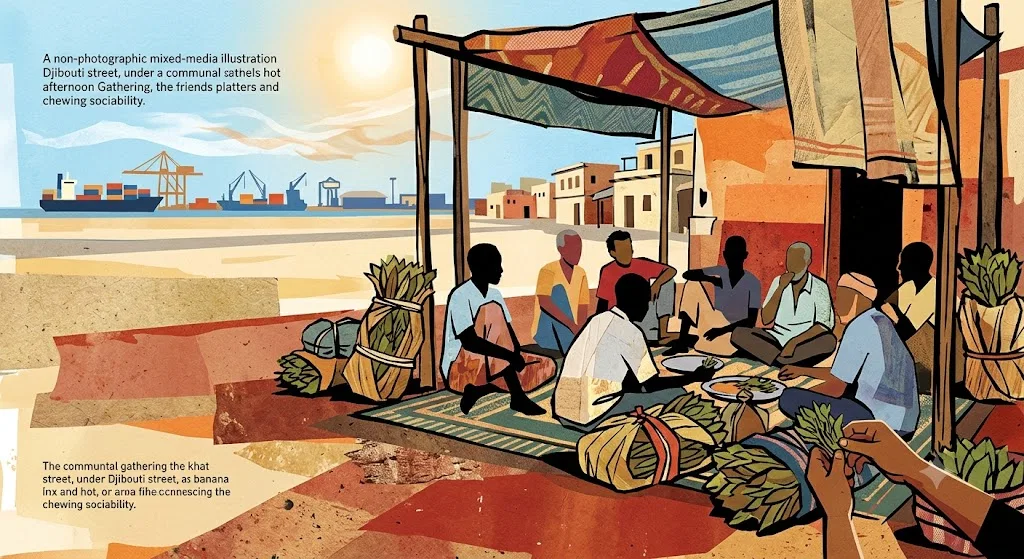
Djibouti’s best-documented social scare concerned khat, the stimulant leaves imported principally from Ethiopia and traditionally chewed in groups. A 1957 report reproduced by the United Nations described khat consumption in Djibouti as a potentially serious “social danger”. It associated chewing with alertness, prolonged conversation, reduced appetite, insomnia and a later depressive phase.[UNODC]unodc.orgBulletin on Narcotics - 1957 Issue 4 - 004…
The report is valuable because it records how the habit had been transformed by transport. Fresh khat is highly perishable, and regular air deliveries made larger quantities available in Djibouti City. Colonial doctors estimated that almost 600 kilograms arrived daily and claimed that a substantial share of the city’s approximately 18,000 residents consumed it. They also described crowds watching the sky when a delivery aircraft was late—a vivid image of a city whose daily rhythm had become tied to the arrival of the leaves.[UNODC]unodc.orgBulletin on Narcotics - 1957 Issue 4 - 004…
Officials linked the practice to household spending, malnutrition, lost sleep, reduced work, marital strain and divorce. Their report claimed that some wage earners spent between 15 and 30 per cent of household income on khat. It culminated in language about a condition “bordering on mass neurosis” and called users enslaved by vice. France classified khat as a narcotic and prohibited its importation, possession, trade and use in April 1957.[UNODC]unodc.orgBulletin on Narcotics - 1957 Issue 4 - 004…
Some concerns were plainly substantial. Heavy stimulant use can interfere with sleep, appetite, finances and family life. Contemporary medical reviews also associate excessive or prolonged khat use with dependence and with worsening psychotic symptoms among vulnerable individuals. Case reports describe acute psychosis after heavy consumption, particularly where there is pre-existing illness, trauma or disruptive patterns such as daily or night-time chewing.[EMRO]emro.who.intEMROWHO EMROEMROWHO EMRO
Yet the colonial account also contains the ingredients of a moral panic:
- An entire population was generalised from selected patients and observations.
- Economic and political problems were attributed to personal weakness, rather than low wages, colonial labour conditions or inequality.
- Male sociability was framed as idleness and degeneration, with little interest in what chewing sessions meant to participants.
- Medical claims merged with moral judgement, even though the same report acknowledged no clear physical withdrawal syndrome and difficulty fitting khat into existing definitions of addiction.
Later research offers a more measured picture. The strongest evidence of psychiatric harm concerns excessive use and people already vulnerable because of mental illness, stress or trauma. A World Health Organization review concluded that moderate use did not appear to cause mental disorders by itself, while noting that the evidence base remained incomplete and that tobacco use and other confounding factors were often poorly controlled.[EMRO]emro.who.intEMROWHO EMROEMROWHO EMRO
The khat controversy is therefore neither a fabricated scare nor a simple public-health success story. It is a case in which a genuine risk was enlarged into a broad theory of social decay. The leaves became a convenient explanation for weak productivity, family hardship and supposedly deficient ambition—problems that also reflected the structure of colonial Djibouti.
Where are the witch panics and apocalyptic groups?
Searchable academic, institutional and journalistic sources do not establish a major Djiboutian witch hunt, satanic panic, UFO religion, mass school-possession outbreak or fatal millenarian movement. Regional material cannot safely be transferred into Djibouti merely because similar languages, beliefs or migration routes cross its borders.
That restraint is particularly important with witchcraft accusations. Such accusations have caused serious violence elsewhere in Africa, especially against women, children, older people and people with disabilities. International guidelines warn that vague laws against witchcraft can unintentionally validate the idea that supernatural harm is a legally provable offence, rather than protecting those who are accused. But general African evidence is not enough to claim a Djiboutian witch panic without identifiable cases, dates, victims and records.[thenewhumanitarian.org]thenewhumanitarian.orgThe New Humanitarian Child witchcraft allegations on the riseThe New Humanitarian Child witchcraft allegations on the rise
The same caution applies to apocalyptic movements. East Africa has produced prophetic and millenarian organisations, some of which became violent, but the best-known cases arose in countries such as Uganda, Kenya, Tanzania and Rwanda. Djibouti’s inclusion in the wider region does not make those events part of its national history.[Mail & Guardian]mg.co.zaMail & Guardian Africa's plethora of apocalyptic cultsMail & Guardian Africa's plethora of apocalyptic cults
The lack of a famous case may itself be revealing. Djibouti’s small population, restricted press and limited historical scholarship make local episodes less visible internationally. Religious scares may also have been managed privately through families, neighbourhoods and religious authorities rather than becoming court cases or newspaper spectacles.
How to distinguish belief, panic and illness
Djibouti’s evidence makes clear why broad labels can mislead. Several different phenomena may look similar from outside but require different explanations.
A possession tradition is an established cultural framework for interpreting distress. It may include trance and intense group emotion without being a sudden epidemic.
Mass psychogenic illness involves real symptoms spreading through a group without an identified physical agent sufficient to explain the pattern. African school outbreaks elsewhere have included fainting, trembling, screaming and convulsions, often during periods of institutional stress. No comparably well-documented Djiboutian case has yet emerged from the accessible literature.[PMC]pmc.ncbi.nlm.nih.govOpen source on nih.gov.
A moral panic occurs when an issue is portrayed as a threat to the whole social order, often through exaggerated claims about a supposedly deviant group. The 1957 khat campaign came closest to this pattern, although the substance also presented genuine health and household risks.
A rumour panic is driven by rapidly circulating claims about danger, conspiracy or supernatural attack. Djibouti’s restricted information environment may encourage rumours by limiting independent verification, but individual rumours should not be promoted into historical episodes without corroboration.[Reporters Without Borders]rsf.orgReporters Without Borders Djibouti | RSFReporters Without Borders Djibouti | RSF
A coercive religious movement requires evidence about leadership, control, exploitation and harm. Unfamiliar ritual practice, minority belief or enthusiastic devotion is not enough to justify the label “cult”.

Why this history still matters
Djibouti’s contribution to the history of contagious belief is less a catalogue of spectacular panics than a lesson in interpretation. The same behaviour can be described as possession, illness, therapy, superstition or social protest depending on who is speaking. Colonial physicians saw social degeneration in khat sessions; participants may also have seen friendship, stimulation and relief from exhausting work. Outsiders saw irrational spirits; women within possession circles may have found recognition and a language for suffering.
These competing descriptions have consequences. A supernatural interpretation can provide meaning and community, but it can also obstruct clinical care. A public-health campaign can reduce harm, but it can become punitive when officials portray a whole population as morally defective. A shortage of reliable reporting can prevent panic, rumour and abuse from being documented at all.
The most defensible account of Djibouti therefore resists the temptation to invent a dramatic national “hysteria”. What can be shown is more subtle: collective beliefs about spirits helped communities organise distress, while khat became the focus of a recurring struggle over health, masculinity, work, family responsibility and state control. The cultural importance lies precisely in that boundary—between lived suffering and supernatural explanation, and between legitimate concern and the exaggerations of moral panic.
Amazon book picks
Further Reading
Books and field guides related to What Did Djibouti Fear, Believe and Misunderstand?. Use these as the next step if you want deeper reading beyond the article.

The Fortunes of Africa
Provides historical context for colonialism, society and belief across Africa.

Spirits, Saints, and Somalis
Covers spirit beliefs and healing traditions relevant to Djibouti.
Endnotes
1.
Source: jstor.org
Link:https://www.jstor.org/stable/pdf/219657.pdf
Source snippet
OROMOS, SLAVES, AND THE ZAR SPIRITS:by R Natvig · 1987 · Cited by 85 — The zar cult is a spirit possession cult found in Ethiopia, E...
2.
Source: jstor.org
Link:https://www.jstor.org/stable/25653241
Source snippet
LIDWIEN KAPTEIJNS AND JAY SPAULDING Middle-class...by L Kapteijns · 1994 · Cited by 17 — attitudes; however, in Djibouti women of t...
3.
Source: unodc.org
Link:https://www.unodc.org/unodc/en/data-and-analysis/bulletin/bulletin_1957-01-01_4_page005.html
Source snippet
Bulletin on Narcotics - 1957 Issue 4 - 004...
4.
Source: article19.org
Title: djibouti media and the law
Link:https://www.article19.org/resources/djibouti-media-and-the-law/
Source snippet
ARTICLE 19Djibouti: Media and the law16 Oct 2015 — The years 2011 and 2012 saw a disturbing trend of increased legal and extra-legal repr...
5.
Source: jstor.org
Link:https://www.jstor.org/stable/665379
6.
Source: pmc.ncbi.nlm.nih.gov
Title: PMCPanic attacks and possession by djinns
Link:https://pmc.ncbi.nlm.nih.gov/articles/PMC3533684/
7.
Source: emro.who.int
Title: EMROWHO EMRO
Link:https://www.emro.who.int/emhj-volume-23-2017/volume-23-issue-3/khat-use-and-related-addiction-mental-health-and-physical-disorders-the-need-to-address-a-growing-risk.html
8.
Source: iris.who.int
Link:https://iris.who.int/bitstreams/8ccf99c0-67be-4428-8249-3018204d4cd1/download
9.
Source: applications.emro.who.int
Link:https://applications.emro.who.int/emhj/v23/03/EMHJ_2017_23_03_236_244.pdf?ua=1&ua=1
10.
Source: cisp.cachefly.net
Title: CISPUncovering our Hidden Shame
Link:https://cisp.cachefly.net/assets/articles/attachments/88172_addressing_witchcraft_accusations_and_ritual_attacks_in_africa.pdf
11.
Source: pmc.ncbi.nlm.nih.gov
Link:https://pmc.ncbi.nlm.nih.gov/articles/PMC3588562/
12.
Source: applications.emro.who.int
Title: em ment 103 en
Link:https://applications.emro.who.int/docs/em_ment_103_en.pdf
13.
Source: applications.emro.who.int
Link:https://applications.emro.who.int/docs/em_rc9_13_en.pdf
14.
Source: iris.who.int
Link:https://iris.who.int/bitstreams/1e31ef59-1263-44af-bd23-6b956a4a91c5/download
15.
Source: applications.emro.who.int
Link:https://applications.emro.who.int/docs/Flagship-initiative-substance-use-eng.pdf
16.
Source: iris.who.int
Link:https://iris.who.int/bitstream/handle/10665/263497/PMC2480814.pdf
17.
Source: iris.who.int
Link:https://iris.who.int/bitstreams/3481568b-67e3-45ca-b02d-42d3e5f11509/download
18.
Source: applications.emro.who.int
Link:https://applications.emro.who.int/dsaf/dsa702.pdf
19.
Source: jstor.org
Link:https://www.jstor.org/stable/26800264
20.
Source: jstor.org
Link:https://www.jstor.org/stable/41474981
21.
Source: jstor.org
Link:https://www.jstor.org/stable/40467341
22.
Source: jstor.org
Link:https://www.jstor.org/stable/4393606
23.
Source: jstor.org
Link:https://www.jstor.org/stable/465307
24.
Source: jstor.org
Link:https://www.jstor.org/stable/656225
25.
Source: jstor.org
Link:https://www.jstor.org/stable/26775453
26.
Source: unodc.org
Title: UNOD C
Link:https://www.unodc.org/unodc/en/data-and-analysis/bulletin/bulletin_1980-01-01_3_page009.html
27.
Source: unodc.org
Title: Bulletin on Narcotics
Link:https://www.unodc.org/unodc/en/data-and-analysis/bulletin/bulletin_1959-01-01_2_page007.html
28.
Source: unodc.org
Title: UNOD C
Link:https://www.unodc.org/unodc/en/data-and-analysis/bulletin/bulletin_1987-01-01_1_page002.html
29.
Source: unodc.org
Title: WDR25 B1 Key findings
Link:https://www.unodc.org/documents/data-and-analysis/WDR_2025/WDR25_B1_Key_findings.pdf
30.
Source: unodc.org
Title: UNOD C
Link:https://www.unodc.org/unodc/en/data-and-analysis/bulletin/bulletin_1958-01-01_4_page009.html
31.
Source: unodc.org
Link:https://www.unodc.org/pdf/east_africa_programme.pdf
32.
Source: unodc.org
Link:https://www.unodc.org/documents/data-and-analysis/statistics/WDR2012/Prepub_2012_draft_full.pdf
33.
Source: unodc.org
Link:https://www.unodc.org/unodc/en/data-and-analysis/bulletin/bulletin_1966-01-01_1_page002.html
34.
Source: unodc.org
Link:https://www.unodc.org/roseap/uploads/archive/documents/2014/05/gsda/clean/2014_Global_Synthetic_Drugs_Assessment_Global_Overview.pdf
35.
Source: state.gov
Link:https://www.state.gov/report/custom/649571d35d
36.
Source: rsf.org
Title: Reporters Without Borders Djibouti | RSF
Link:https://rsf.org/en/country/djibouti
37.
Source: pmc.ncbi.nlm.nih.gov
Title: PMCZār Spirit Possession in Iran and African Countries
Link:https://pmc.ncbi.nlm.nih.gov/articles/PMC4801492/
Source snippet
NIHby F Mianji · 2015 · Cited by 36 — In most African countries, zār is mainly an adult female activity—involving married women mos...
38.
Source: thenewhumanitarian.org
Title: The New Humanitarian Child witchcraft allegations on the rise
Link:https://www.thenewhumanitarian.org/report/89858/rights-child-witchcraft-allegations-rise
39.
Source: cdn.penalreform.org
Link:https://cdn.penalreform.org/wp-content/uploads/2022/10/PRI-submission-to-OHCHR-on-accusations-of-witchcraft-and-ritual-attacks.pdf
40.
Source: mg.co.za
Title: Mail & Guardian Africa’s plethora of apocalyptic cults
Link:https://mg.co.za/news/south-africa/2000-03-24-africa-s-plethora-of-apocalyptic-cults/
41.
Source: africa.ocindex.net
Link:https://africa.ocindex.net/country/djibouti
Additional References
42.
Source: semanticscholar.org
Link:https://www.semanticscholar.org/paper/Oromos%2C-Slaves%2C-and-the-Zar-Spirits%3A-A-Contribution-Natvig/783d3616a4087ceb323500c3b2495d62644e4a72
Source snippet
Semantic ScholarOromos, Slaves, and the Zar Spirits: A Contribution to...The zar cult is a spirit possession cult found in Ethiopia, Eri...
43.
Source: icnl.org
Link:https://www.icnl.org/wp-content/uploads/Djibouti_hrdjib.pdf
Source snippet
Human Rights in Djibouti | ICNLDjibouti has no independent media. Journalists and human rights activists face systematic persecution...
44.
Source: youtube.com
Title: Herbal stimulant, khat derailing Djibouti’s economy
Link:https://www.youtube.com/watch?v=PJQ7BYjsryY
Source snippet
Djibouti's Quiet Break | How the Last French African Colony Gained Independence (1977)...
45.
Source: youtube.com
Title: Djibouti’s khat addiction holding back development
Link:https://www.youtube.com/watch?v=Qm7JsVxvZso
Source snippet
Herbal stimulant, khat derailing Djibouti's economy...
46.
Source: researchgate.net
Link:https://www.researchgate.net/publication/301725636_Witchcraft_beliefs_and_the_erosion_of_social_capital_Evidence_from_Sub-Saharan_Africa_and_beyond
47.
Source: academia.edu
Link:https://www.academia.edu/55507893/spirits_and_selves_in_Northern_Sudan_the_cultural_therapeutics_of_possession_and_trance
48.
Source: facebook.com
Link:https://www.facebook.com/groups/1022560929298411/posts/1034212641466573/
49.
Source: encyclopedia.com
Link:https://www.encyclopedia.com/environment/encyclopedias-almanacs-transcripts-and-maps/african-religions-new-religious-movements
50.
Source: facebook.com
Link:https://www.facebook.com/mountainbeacon2600/photos/bontoc-school-explains-student-incident-as-no-demons-just-distressby-frank-cimat/122252269916122796/
51.
Source: studocu.com
Link:https://www.studocu.com/nl-be/document/universiteit-gent/anthropology-of-affect-and-materiality/spirits-and-selves-in-northern-sudan-the-cultural-therapeutics-of-possession-and-trance/86946077
Topic Tree
Follow this branch
Related pages 192
- Antigua and Barbuda
- Argentina Belief Scares
- Azerbaijan Belief
- Bahrain Beliefs
- North Korea
- +187 more in sidebar