Within North Korea
Why Did North Korean Crowds Weep Together?
The vast mourning scenes of 1994 and 2011 mixed genuine loss, inherited funeral customs, emotional contagion and fear of appearing disloyal.
On this page
- What happened after Kim Il sung and Kim Jong il died
- How culture, coercion and emotional contagion overlapped
- Why neither fake tears nor total devotion explains the evidence
Page outline Jump by section
Introduction
The huge public displays of grief that followed the deaths of Kim Il-sung in 1994 and Kim Jong-il in 2011 are among the most recognisable images of North Korea. Television footage showed crowds collapsing to the ground, wailing openly, beating their chests and weeping in public squares. To outside observers, these scenes often appeared either completely staged or proof of extraordinary devotion to the ruling family.
The evidence suggests a more complicated reality. Historians, psychologists, journalists and researchers who study North Korea generally argue that the mourning combined several forces at once: genuine sadness among many citizens, lifelong political socialisation, traditional Korean expectations about public mourning, emotional contagion within large crowds, and a powerful fear of punishment for appearing insufficiently loyal. Understanding these overlapping influences is more informative than reducing the events to either “fake tears” or unquestioning worship.[CBS News]cbsnews.comCBS News Loss, fear, threats drive N. Korean mass griefCBS NewsLoss, fear, threats drive N. Korean mass grief - CBS NewsDecember 21, 2011…
What happened after Kim Il-sung and Kim Jong-il died?
When North Korea’s founding leader Kim Il-sung died in July 1994, the government organised an extended period of national mourning. State media broadcast continuous images of grieving citizens, workplaces held memorial meetings, public entertainment largely stopped, and millions of people were expected to participate in commemorative activities.
The death of Kim Jong-il in December 2011 followed a remarkably similar pattern. A state funeral committee announced an official mourning period, citizens were directed to visit memorial sites, public ceremonies filled the calendar, and the funeral procession through Pyongyang was broadcast as a defining national event. Snow-covered streets lined with vast crowds became one of the best-known images of the succession to Kim Jong-un.[dailynk.com]dailynk.comDaily NK12 Days of Mourning for Kim12 Days of Mourning for Kim - North Korea News — Daily NK | Latest DPRK Updates 2026December 19, 2011…
State television focused on emotional scenes: elderly people crying uncontrollably, soldiers kneeling in grief, children sobbing and crowds stretching their arms towards portraits of the deceased leader. These images also served a political purpose by demonstrating apparent national unity at a potentially unstable moment of leadership transition.[CBS News]cbsnews.comCBS News Son of Kim Jong Il leads N. Korea mourningCBS NewsSon of Kim Jong Il leads N. Korea mourning - CBS NewsDecember 20, 2011…
How culture, coercion and emotional contagion overlapped
The mourning cannot be understood through a single explanation because several influences reinforced one another.
Many people experienced genuine loss. Older generations had lived through decades in which Kim Il-sung was presented as the founder, liberator and protector of the state. For citizens who had known no alternative political system and had been educated from childhood to regard him as a paternal figure, his death represented a profound emotional shock. Even some defectors later recalled authentic grief in 1994.[CBS News]cbsnews.comCBS News Loss, fear, threats drive N. Korean mass griefCBS NewsLoss, fear, threats drive N. Korean mass grief - CBS NewsDecember 21, 2011…
Public mourning has deep cultural roots. Korean funeral traditions have historically encouraged visible expressions of grief. Loud crying, communal mourning and emotional display are not unique to North Korea, although the state amplified and politicised these traditions on an exceptional scale. Existing cultural expectations therefore made official ceremonies more emotionally powerful than they might otherwise have been.
Crowds amplify emotion. Psychologists have long observed that emotions spread through groups. When thousands of people gather in a highly charged setting, seeing others cry can make grief feel more immediate and socially expected. Emotional contagion does not require deception; people often experience stronger feelings simply because those around them do. This mechanism helps explain why some public displays became increasingly intense once ceremonies began.[arXiv]arxiv.orgSocial Contagion Theory: Examining Dynamic Social Networks and Human BehaviorSeptember 24, 2011…
Fear also mattered. North Korea is a highly surveilled society where political loyalty has significant consequences. Citizens knew that neighbours, workplace officials and local party representatives could observe their behaviour. Even if explicit rules about exactly how much someone should cry were absent, uncertainty itself encouraged people to display unmistakable grief rather than risk appearing indifferent.[DailyNK]dailynk.comthe rules of mourning c1994The Rules of Mourning, c.1994 - North Korea News — Daily NK | Latest DPRK Updates 2026December 28, 2011…

Why 1994 and 2011 were not identical
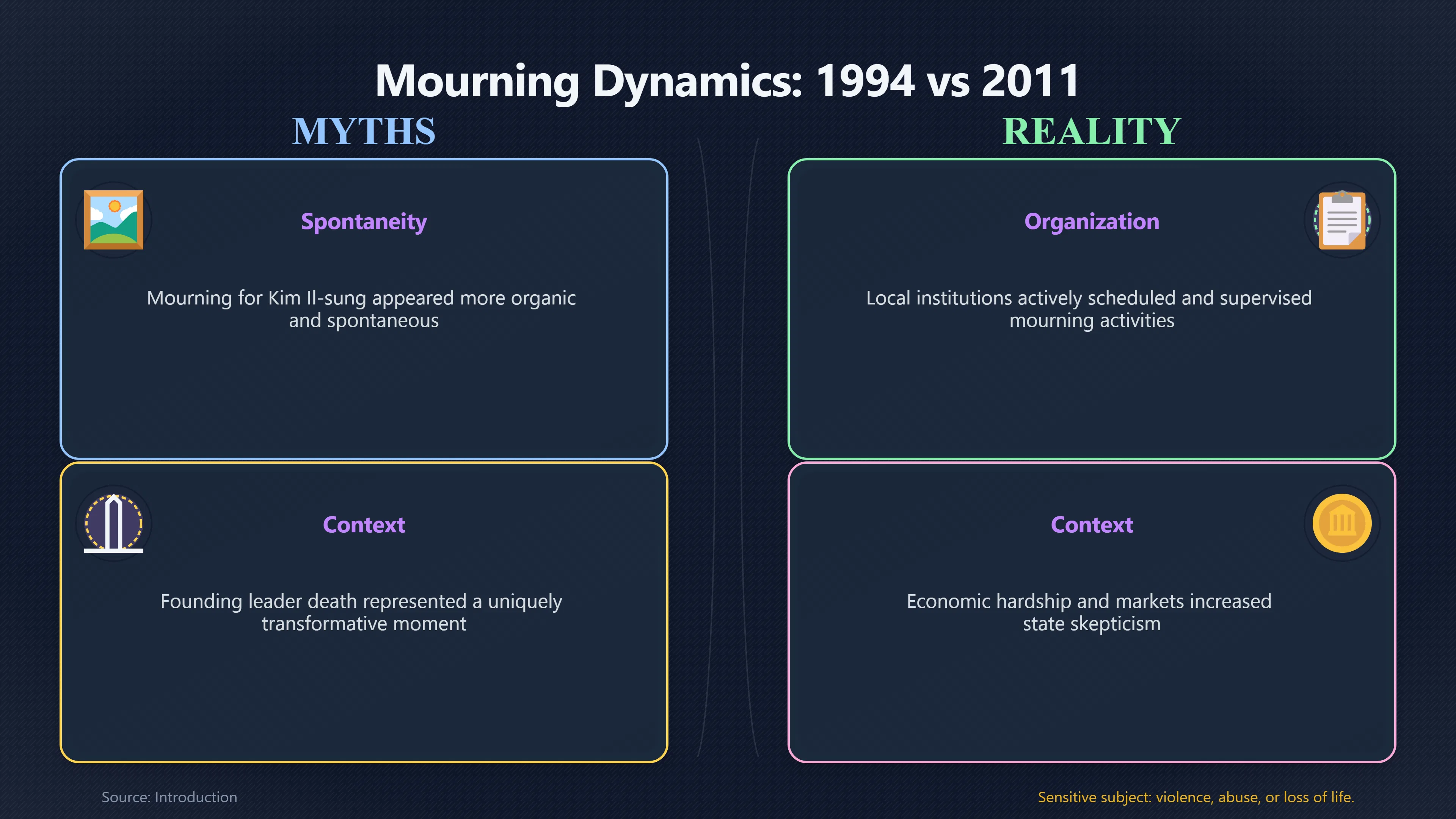
Accounts from defectors and researchers frequently suggest that mourning after Kim Il-sung’s death in 1994 was, on average, more spontaneous than after Kim Jong-il’s death in 2011.
Several explanations have been proposed.
First, Kim Il-sung had founded the state and had remained the dominant public figure throughout its existence. Many older citizens had never experienced another national leader. His death therefore represented a uniquely transformative moment.
Second, by 2011 North Korea had endured famine, economic hardship and the gradual spread of informal markets. Many citizens reportedly viewed the state with greater scepticism than they had in the early 1990s.
Third, reports from inside the country suggested that local organisations more actively scheduled and supervised mourning activities in 2011. Defector testimony describes factories, neighbourhood organisations and other institutions organising attendance at memorial sites, with many participants viewing the events as obligatory rather than voluntary. These accounts cannot represent every region or citizen, but they consistently describe a stronger element of organisation than in 1994.[DailyNK]dailynk.comDaily NKHands In Pockets, Mechanical GriefDaily NKHands In Pockets, Mechanical Grief
Why neither fake tears nor total devotion explains the evidence
Outside North Korea, the mourning has often been portrayed in absolute terms. One popular interpretation claims everyone was pretending. Another assumes the crowds reflected universal, sincere devotion to the ruling family.
Neither fits the available evidence.
Former residents describe mixed motives even within the same gathering. One person might genuinely mourn a leader viewed as the nation’s founder. Another might worry about family safety if seen showing insufficient emotion. Someone else could become caught up in the collective atmosphere despite beginning with only modest feelings. Still another might simply imitate those nearby because the social expectations were obvious.
The country’s closed nature makes precise measurement impossible. Independent polling cannot be conducted, private conversations are difficult to verify and most international observers only see official footage. Researchers therefore tend to avoid sweeping conclusions about what “all North Koreans” believed or felt.[The Guardian]theguardian.comOpen source on theguardian.com.

Why these mourning scenes remain culturally important
The funerals of 1994 and 2011 have become defining examples in discussions of collective behaviour under authoritarian rule because they illustrate how genuine emotion, political ritual and social pressure can operate simultaneously.
They also demonstrate the difficulty of interpreting public behaviour in societies where participation is expected. Visible grief cannot automatically be read as private belief, but neither should it automatically be dismissed as mere acting. Human emotions are shaped by memory, culture, fear, habit and the behaviour of those nearby, and all of these forces were present during North Korea’s periods of national mourning.
For historians and social psychologists, the episodes are therefore best understood not as simple cases of mass hysteria, but as moments when inherited mourning customs, lifelong political education, crowd psychology and coercive state power combined to produce extraordinary displays of collective emotion.[cbsnews.com]cbsnews.comCBS News Loss, fear, threats drive N. Korean mass griefCBS NewsLoss, fear, threats drive N. Korean mass grief - CBS NewsDecember 21, 2011…
Amazon book picks
Further Reading
Books and field guides related to Why Did North Korean Crowds Weep Together?. Use these as the next step if you want deeper reading beyond the article.

The cleanest race
First published 2010. Subjects: North Korean Propaganda, Social aspects, Korean National characteristics, Social conditions, Nationalism.

Without you, there is no us
First published 2014. Subjects: Politics and government, Elite (Social sciences), Social conditions, Education and state, Biography.
Nothing to envy
First published 2009. Subjects: Koreans, Social conditions, Case studies, Economic conditions, Nonfiction.
Real North Korea
First published 2013. Subjects: Korea (north), politics and government, Korea, foreign relations.
Endnotes
1.
Source: dailynk.com
Title: Daily NK12 Days of Mourning for Kim
Link:https://www.dailynk.com/english/12-days-of-mourning-for-kim/
Source snippet
12 Days of Mourning for Kim - North Korea News — Daily NK | Latest DPRK Updates 2026December 19, 2011...
Published: December 19, 2011
2.
Source: dailynk.com
Title: Daily NKDistrust Behind the Tears
Link:https://www.dailynk.com/english/distrust-behind-the-tears/
Source snippet
Distrust Behind the Tears - North Korea News — Daily NK | Latest DPRK Updates 2026...
3.
Source: arxiv.org
Link:https://arxiv.org/abs/1109.5235
Source snippet
Social Contagion Theory: Examining Dynamic Social Networks and Human BehaviorSeptember 24, 2011...
Published: September 24, 2011
4.
Source: dailynk.com
Title: the rules of mourning c1994
Link:https://www.dailynk.com/english/the-rules-of-mourning-c1994/?tztc=1
Source snippet
The Rules of Mourning, c.1994 - North Korea News — Daily NK | Latest DPRK Updates 2026December 28, 2011...
Published: December 28, 2011
5.
Source: dailynk.com
Title: Daily NKHands In Pockets, Mechanical Grief
Link:https://www.dailynk.com/english/hands-in-pockets-mechanical-grief/
6.
Source: dailynk.com
Title: Where Are the Black Armbands?
Link:https://www.dailynk.com/english/where-are-the-black-armbands/
7.
Source: cbsnews.com
Title: CBS News Loss, fear, threats drive N. Korean mass grief
Link:https://www.cbsnews.com/news/loss-fear-threats-drive-n-korean-mass-grief/
Source snippet
CBS NewsLoss, fear, threats drive N. Korean mass grief - CBS NewsDecember 21, 2011...
Published: December 21, 2011
8.
Source: theguardian.com
Link:https://www.theguardian.com/world/2011/dec/19/north-koreans-kim-jong-il
9.
Source: en.yna.co.kr
Link:https://en.yna.co.kr/view/AEN20111228007600315
10.
Source: cbsnews.com
Title: CBS News Son of Kim Jong Il leads N. Korea mourning
Link:https://www.cbsnews.com/news/son-of-kim-jong-il-leads-n-korea-mourning/
Source snippet
CBS NewsSon of Kim Jong Il leads N. Korea mourning - CBS NewsDecember 20, 2011...
Published: December 20, 2011
11.
Source: cbsnews.com
Title: CBS News Veil of secrecy in North Korea for Kim funeral
Link:https://www.cbsnews.com/news/veil-of-secrecy-in-north-korea-for-kim-funeral/
Source snippet
CBS NewsVeil of secrecy in North Korea for Kim funeral - CBS News...
12.
Source: theguardian.com
Title: North Korea holds funeral for Kim Jong-il | Kim Jong-il | The Guardian
Link:https://www.theguardian.com/world/2011/dec/28/kim-jong-il-funeral-north-korea
Additional References
13.
Source: youtube.com
Title: Grieving in North Korea reaches new levels of hysteria over Kim Jong-il
Link:https://www.youtube.com/watch?v=TTbdQ6PkN8A
Source snippet
People crying on the streets after death of Kim Jong-Il...
14.
Source: youtube.com
Title: Scenes of mass grief at funeral for Kim Jong Il
Link:https://www.youtube.com/watch?v=JSLnuos5pkw
Source snippet
Public outpouring of grief at Kim Jong Il's death continues...
15.
Source: cambridge.org
Link:https://www.cambridge.org/core/journals/perspectives-on-politics/article/how-does-an-ideology-spread-archival-evidence-from-an-extreme-case/10A9906D79ECAF28F2C8292D3BF7121B
16.
Source: hasp.ub.uni-heidelberg.de
Link:https://hasp.ub.uni-heidelberg.de/journals/asien/article/view/15307
17.
Source: kci.go.kr
Link:https://www.kci.go.kr/kciportal/ci/sereArticleSearch/ciSereArtiView.kci?sereArticleSearchBean.artiId=ART001840641
18.
Source: kci.go.kr
Link:https://www.kci.go.kr/kciportal/ci/sereArticleSearch/ciSereArtiView.kci?sereArticleSearchBean.artiId=ART003069965
19.
Source: youtube.com
Title: North Korean TV shows funeral grief
Link:https://www.youtube.com/watch?v=StMUWG7ad2s
Source snippet
Grieving in North Korea reaches new levels of hysteria over Kim Jong-il...
20.
Source: deseret.com
Title: Loss, fear, threats drive North Korea’s mass grief – Deseret News
Link:https://www.deseret.com/2011/12/22/20239604/loss-fear-threats-drive-north-korea-s-mass-grief/
21.
Source: youtube.com
Title: Public outpouring of grief at Kim Jong Il’s death continues
Link:https://www.youtube.com/watch?v=mki6zS6hkp0
Source snippet
North Korean TV shows funeral grief...
22.
Source: scholar.kyobobook.co.kr
Title: kyobobook.co.kr북한 국가장례가 인민대중의 애도정서에 미치는 영향: 김일성, 김정일 사례를 중심으로
Link:https://scholar.kyobobook.co.kr/article/detail/4040069066128
Topic Tree