Within Afghanistan Panics
How a False Accusation Killed Farkhunda
A false claim of Quran burning became fatal within minutes, revealing how sacred outrage, crowd action and failed policing can combine.
On this page
- The accusation and the gathering crowd
- Why the rumour became instantly believable
- Police failure, public outrage and memory
Page outline Jump by section
Introduction
On 19 March 2015, a false accusation that a young Afghan woman had burned a copy of the Quran led to one of the most shocking episodes of mob violence in modern Afghanistan. Within a short time, a crowd in central Kabul beat, ran over and burned 27-year-old Farkhunda Malikzada while police largely failed to stop the attack. Investigators later found no evidence that she had desecrated the Quran. Instead, the accusation itself proved enough to convince hundreds of people that immediate punishment was justified.[The Guardian]theguardian.comThe GuardianAfghan woman killed by mob in Kabul was innocent, says investigator | Afghanistan | The GuardianMarch 22, 2015…

Farkhunda’s killing has become a defining example of how rumours, religious outrage, crowd psychology and institutional failure can combine with devastating consequences. It is not primarily a story about religious belief alone. Rather, it demonstrates how an unverified claim, delivered at the right moment and in a highly charged environment, can overwhelm evidence, due process and even the efforts of some individuals to intervene.
The accusation and the gathering crowd
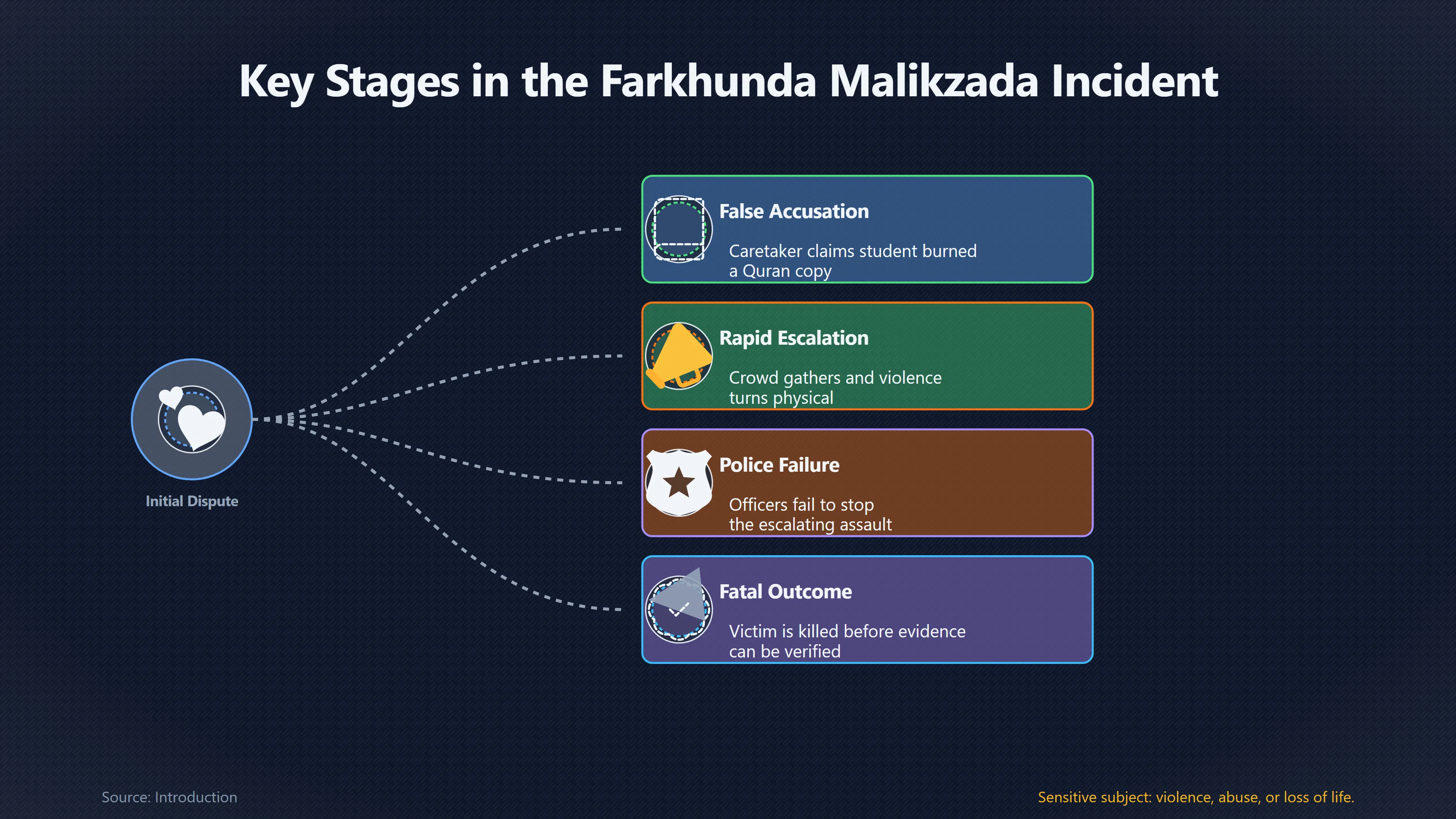
Farkhunda was a practising Muslim and a religious student. According to multiple investigations and reporting at the time, she had argued with the caretaker of the Shah-Do Shamshira shrine in Kabul over the sale of amulets and charms that she believed were being marketed in ways inconsistent with Islamic teaching. During or after this dispute, the caretaker accused her of burning the Quran.[The Guardian]theguardian.comThe GuardianAfghan woman killed by mob in Kabul was innocent, says investigator | Afghanistan | The GuardianMarch 22, 2015…
The accusation spread almost immediately among people nearby. Few, if any, witnesses attempted to verify what had happened before reacting. Instead, the allegation itself became treated as proof.
As the crowd grew:
- People shouted that she had insulted Islam.
- More bystanders joined after hearing only fragments of the story.
- Violence escalated rapidly from shouting to physical assault.
- Mobile-phone recordings captured parts of the attack, allowing later investigators to reconstruct events.[Human Rights Watch]hrw.orgOpen source on hrw.org.
Investigators later concluded that no Quran had been burned. The allegation that justified the violence was false.[The Guardian]theguardian.comThe GuardianAfghan woman killed by mob in Kabul was innocent, says investigator | Afghanistan | The GuardianMarch 22, 2015…
Why the rumour became instantly believable
The speed with which the accusation spread cannot be explained simply by individual prejudice. Several broader social pressures made such a rumour unusually powerful.
First, allegations involving religious desecration carry exceptional emotional weight. Even before any evidence can be examined, many people may feel that sacred values require immediate defence. In this case, outrage replaced investigation almost instantly.
Second, Afghanistan’s long experience of war, insecurity and political instability had weakened confidence in formal institutions. Crowds sometimes assumed that immediate action was more effective than waiting for courts or police. Vigilante justice therefore became easier to justify in moments of collective anger.[Human Rights Watch]hrw.orgOpen source on hrw.org.
Third, the accusation spread through face-to-face communication in a dense public space. Each new person entering the crowd encountered not an unanswered question but an apparent consensus. Social psychologists have long noted that once enough people appear convinced of a claim, others often accept it with little independent verification. In rapidly developing situations, rumours can become more persuasive simply because many people seem already to believe them.[arXiv]arxiv.orgAnalysing How People Orient to and Spread Rumours in Social Media by Looking at Conversational ThreadsNovember 23, 2015…
The case therefore illustrates a classic rumour panic: certainty emerged long before evidence.

Why so few people challenged the crowd
One of the disturbing aspects of the case is that many witnesses did not simply observe events but actively participated or encouraged the violence.
Crowd behaviour can reduce an individual’s sense of personal responsibility. Instead of making independent moral judgements, participants may follow what appears to be the group’s shared understanding. Public expressions of outrage also create pressure on bystanders, who may fear appearing sympathetic to someone already labelled a blasphemer.
Videos from the scene suggest that the accusation itself became more important than any attempt to establish whether it was true. Once Farkhunda had been publicly identified as guilty, evidence ceased to matter to many of those present.[Human Rights Watch]hrw.orgOpen source on hrw.org.
The episode therefore reflects not mass psychogenic illness but a rapidly spreading moral panic in which an unverified accusation produced collective certainty and violent action.
Police failure, public outrage and memory
The attack unfolded in the presence of police officers. Although some officers attempted limited interventions, investigations found that police failed overall to protect Farkhunda from the mob despite having opportunities to do so. Human Rights Watch argued that stronger intervention could likely have prevented the killing and called for accountability for officers who stood by.[Human Rights Watch]hrw.orgOpen source on hrw.org.
The murder provoked an unusually strong public reaction across Afghanistan.
Women’s rights activists organised demonstrations demanding justice. One of the most memorable moments came during Farkhunda’s funeral, when women carried her coffin themselves, breaking with a custom in which men normally perform that role. The procession became a powerful symbol of resistance to violence against women and demands for legal accountability.[Human Rights Watch]hrw.orgHuman Rights WatchWorld Report 2016: Afghanistan | Human Rights Watch…
The judicial response, however, became controversial. Initial trials moved quickly, resulting in convictions for several attackers and prison sentences for police officers who had failed to intervene. Appeals later reduced a number of sentences, and human rights organisations criticised both the rushed trials and later reductions as evidence of continuing weaknesses in Afghanistan’s justice system.[Human Rights Watch]hrw.orgHuman Rights WatchDispatches: Afghanistan’s Legal System Fails Farkhunda, Again | Human Rights WatchMarch 9, 2016…

What the case reveals about false accusations
Farkhunda’s killing demonstrates several recurring features of deadly rumour panics.
- A trusted accusation outweighed evidence. People acted on an allegation before investigators could establish the facts.
- Sacred values intensified emotional reactions. Alleged religious desecration was treated as requiring immediate punishment.
- Crowd dynamics amplified certainty. Each participant reinforced the belief of others, making doubt increasingly difficult.
- Institutional failure magnified the harm. Police were unable or unwilling to stop escalating violence, allowing the crowd to act as judge and executioner.
- Later proof of innocence could not reverse the damage. By the time investigators established that the accusation was false, Farkhunda had already been killed.[hrw.org]hrw.orgOpen source on hrw.org.
These mechanisms are not unique to Afghanistan, but the country’s combination of conflict, fragile institutions and intense sensitivity surrounding religion created conditions in which such rumours could become lethal with exceptional speed.
Why Farkhunda’s case still matters
More than a decade later, Farkhunda’s death remains one of Afghanistan’s most significant modern examples of the destructive power of a false accusation. It is frequently cited by journalists, human rights organisations and scholars as a warning about vigilantism, gender-based violence and the dangers of treating rumours as established fact.
The case also illustrates an important distinction in the study of collective fear. The crowd was not reacting to an imaginary event in the sense of inventing a threat from nothing. Rather, it responded to a specific allegation that was accepted without verification. The panic lay in the rapid collapse of evidence-based judgement under the pressure of shared outrage.
For historians of collective belief and moral panic, Farkhunda’s killing stands as a stark reminder that rumours need not circulate for days or weeks to become dangerous. Under the right social conditions, a false accusation can become accepted truth within minutes, with irreversible consequences.
Amazon book picks
Further Reading
Books and field guides related to How a False Accusation Killed Farkhunda. Use these as the next step if you want deeper reading beyond the article.
Extraordinary Popular Delusions and the Madness of Crowds
Rating: 4.0/5 from 5 Google Books ratings
Examines how collective belief can overwhelm evidence.


No good men among the living
Illustrates institutional failures during wartime Afghanistan.

Ghost Wars 12-copy floor
First published 2004. Subjects: History, Nonfiction, Politics, United States, United States. Central Intelligence Agency.
Endnotes
1.
Source: theguardian.com
Link:https://www.theguardian.com/world/2015/mar/22/afghan-woman-killed-mob-kabul-innocent
Source snippet
The GuardianAfghan woman killed by mob in Kabul was innocent, says investigator | Afghanistan | The GuardianMarch 22, 2015...
Published: March 22, 2015
2.
Source: hrw.org
Link:https://www.hrw.org/news/2015/03/20/afghanistan-probe-police-response-womans-killing
3.
Source: hrw.org
Link:https://www.hrw.org/news/2019/03/19/justice4farkhunda-afghanistan-4-years
Source snippet
#Justice4Farkhunda in Afghanistan, 4 Years On | Human Rights WatchMarch 19, 2019 — #JUSTICE4FARKHUNDA IN AFGHANISTAN, 4 YEARS ON Print Do...
Published: March 19, 2019
4.
Source: hrw.org
Link:https://www.hrw.org/news/2015/07/07/dispatches-11th-hour-justiceforfarkhunda
5.
Source: hrw.org
Link:https://www.hrw.org/world-report/2016/country-chapters/afghanistan
Source snippet
Human Rights WatchWorld Report 2016: Afghanistan | Human Rights Watch...
6.
Source: arxiv.org
Link:https://arxiv.org/abs/1511.07487
Source snippet
Analysing How People Orient to and Spread Rumours in Social Media by Looking at Conversational ThreadsNovember 23, 2015...
Published: November 23, 2015
7.
Source: hrw.org
Link:https://www.hrw.org/news/2016/03/09/dispatches-afghanistans-legal-system-fails-farkhunda-again
Source snippet
Human Rights WatchDispatches: Afghanistan’s Legal System Fails Farkhunda, Again | Human Rights WatchMarch 9, 2016...
Published: March 9, 2016
8.
Source: hrw.org
Link:https://www.hrw.org/news/2015/05/06/dispatches-not-much-justiceforfarkhunda
9.
Source: hrw.org
Title: Afghan Government Ignoring Violence Against Women | Human Rights Watch
Link:https://www.hrw.org/news/2018/05/30/afghan-government-ignoring-violence-against-women
Additional References
10.
Source: youtube.com
Title: Afghan Activists Relive The Killing Of Farkhunda
Link:https://www.youtube.com/watch?v=GcSnX5IAGj4
Source snippet
Kabul lynching: 'Killed for speaking her mind' - BBC News...
11.
Source: youtube.com
Title: Was Justice Served Over Mob Killing Of Farkhunda?
Link:https://www.youtube.com/watch?v=pG4eobZ4EGA
Source snippet
Family Of Afghan Woman Mourns Devout Life Cut Short...
12.
Source: youtube.com
Title: Mob Killing Of Farkhunda Remembered In Afghanistan
Link:https://www.youtube.com/watch?v=5qM8FyRO1eU
Source snippet
Was Justice Served Over Mob Killing Of Farkhunda?...
13.
Source: youtube.com
Title: Four Men to Be Hanged for Role in Kabul Killing
Link:https://www.youtube.com/watch?v=xQJiqyEoedo
Source snippet
Mob Killing Of Farkhunda Remembered In Afghanistan...
14.
Source: youtube.com
Title: 11 policemen jailed over Farkhunda mob death
Link:https://www.youtube.com/watch?v=4bMG55oGGRg
Source snippet
Four Men to Be Hanged for Role in Kabul Killing...
15.
Source: investing.com
Title: Judge sentences 11 Afghan police over lynching of woman in Kabul By Reuters
Link:https://www.investing.com/news/world-news/judge-sentences-11-afghan-police-over-lynching-of-woman-in-kabul-342449
16.
Source: youtube.com
Title: Afghans demand justice for Farkhunda
Link:https://www.youtube.com/watch?v=_y6keF84wVM
Source snippet
11 policemen jailed over Farkhunda mob death...
17.
Source: pajhwok.com
Title: Fact-finding team confirms Farkhunda’s innocence – Pajhwok Afghan News
Link:https://pajhwok.com/2015/04/02/fact-finding-team-confirms-farkhundas-innocence/
18.
Source: youtube.com
Title: Kabul lynching: ‘Killed for speaking her mind’
Link:https://www.youtube.com/watch?v=jMmx51SQWS8
Source snippet
Afghans demand justice for Farkhunda...
19.
Source: jewishvirtuallibrary.org
Title: international religious freedom report for 2015
Link:https://jewishvirtuallibrary.org/international-religious-freedom-report-for-2015
Topic Tree