Within Brunei Panics
Who Decides Which Beliefs Are Acceptable?
Brunei's authorities answered spiritual scares through approved healing while restricting teachings officially labelled deviant.
On this page
- How approved religious healing entered schools
- Why ritual restored order and institutional control
- How deviant labels shaped minority movements
Page outline Jump by section
Introduction
In Brunei, questions about spiritual healing are closely tied to questions about religious authority. Rather than leaving exorcism, faith healing or responses to alleged spirit disturbances entirely to private practitioners, the state has gradually promoted officially approved Islamic healing while restricting teachings and healers considered religiously deviant. This approach has shaped public responses to school possession scares, rumours of black magic and alternative religious movements. It also illustrates a broader feature of Brunei’s system of governance: religious belief is not treated solely as a private matter but as an area in which state institutions actively define acceptable practice, supervise religious expertise and intervene when they believe public order or Islamic orthodoxy is at risk.[Sage Journals]journals.sagepub.comSage JournalsHybrid Pathways to Orthodoxy in Brunei Darussalam: Bureaucratised Exorcism, Scientisation and the Mainstreaming of Deviant-D…
This does not mean that all Bruneians interpret spiritual experiences in the same way. Many people continue to believe in possession, sorcery or other unseen influences, while others favour psychological or medical explanations. What distinguishes Brunei is that the official response increasingly channels such concerns through state-recognised religious institutions rather than independent healers or competing religious authorities.[Sage Journals]journals.sagepub.comSage JournalsHybrid Pathways to Orthodoxy in Brunei Darussalam: Bureaucratised Exorcism, Scientisation and the Mainstreaming of Deviant-D…
Who decides which beliefs are acceptable?
Since independence, Brunei has developed one of Southeast Asia’s most centralised systems of Islamic administration. Under the national ideology of Malay Islamic Monarchy (Melayu Islam Beraja, or MIB), the Ministry of Religious Affairs, the State Mufti, the Islamic Religious Council and associated agencies exercise extensive authority over Islamic teaching and public religious life. Independent religious organisations have little room to develop outside this framework, and official interpretations of Sunni Islam dominate public religious communication.[Kyoto Review of Southeast Asia]kyotoreview.orgKyoto Review of Southeast AsiaIslamic Authority and the State in Brunei Darussalam - Kyoto Review of Southeast Asia…
This institutional structure gives the state significant classificatory power. Authorities do not merely regulate religious gatherings; they also determine which teachings are orthodox, which require correction and which are formally declared “deviant”. Official fatwas and government guidance have prohibited a range of movements and teachings, including groups such as Al-Arqam and Ahmadiyya, alongside organisations or individuals judged to have departed from accepted Islamic doctrine. These decisions have practical consequences because public promotion of prohibited teachings can lead to investigation or prosecution under Brunei’s legal framework.[refworld.org]refworld.org2016 Report on International Religious Freedom - Brunei | RefworldAugust 15, 2017…
For historians and sociologists, this is significant because belief itself becomes part of state administration. The boundaries between religious doctrine, public order and governance are deliberately narrow, meaning that questions about supernatural claims often become questions about official religious legitimacy as well.
How approved religious healing entered schools
Brunei’s best-known episodes of alleged spirit possession in schools illustrate this relationship between healing and state authority.
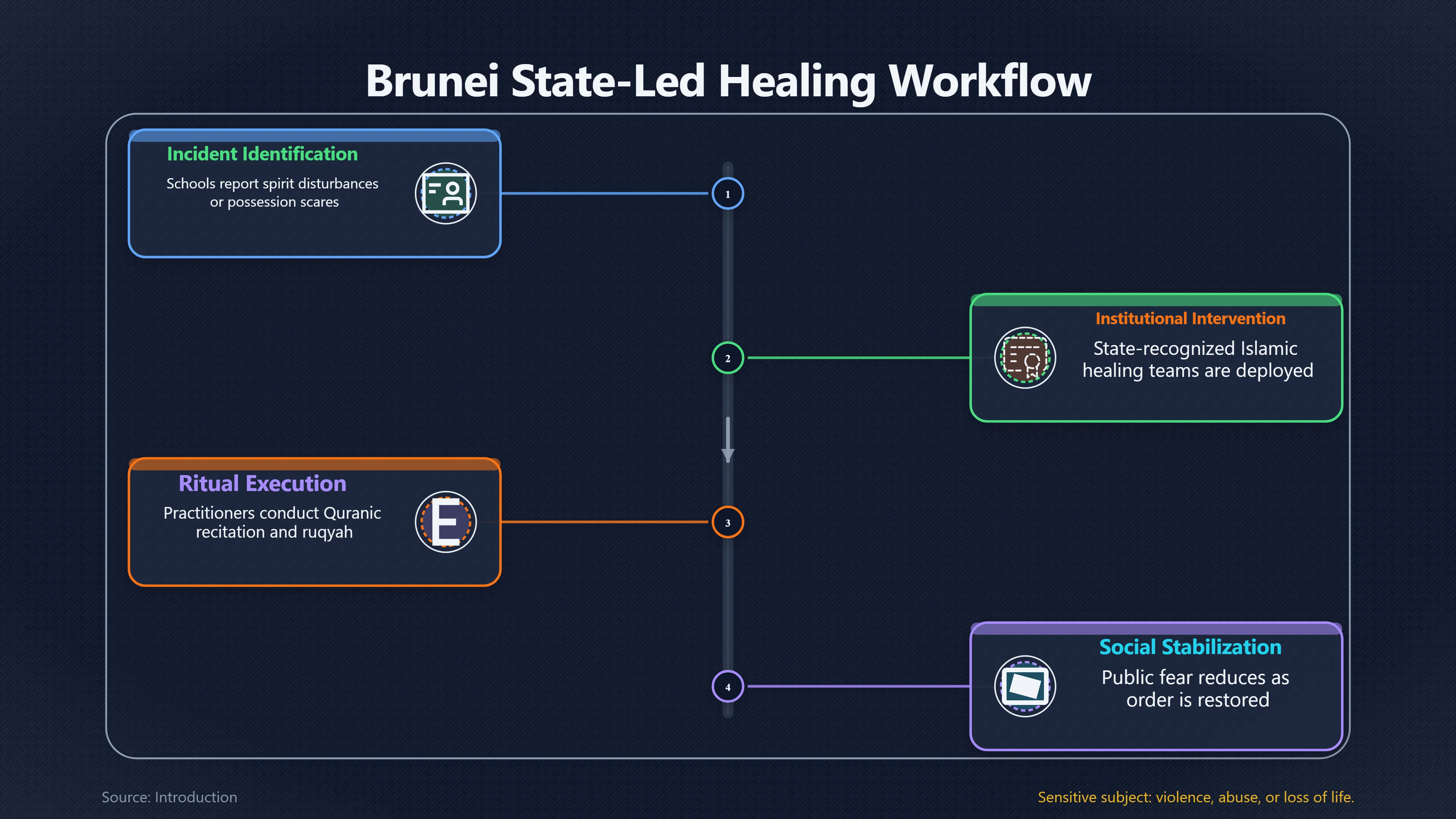
During the 2010 outbreaks affecting several schools, many pupils, teachers and families interpreted the events through familiar ideas about spirit disturbance. Instead of treating the incidents solely as medical or psychological emergencies, schools also invited recognised Islamic healers to conduct Quranic recitation and exorcism-like rituals. According to sociologist Dominik Müller, these interventions included organised Islamic healing teams rather than informal village practitioners, and at least one reported intervention included non-Muslim pupils because the priority was restoring order within the school community.[Sage Journals]journals.sagepub.comSage JournalsHybrid Pathways to Orthodoxy in Brunei Darussalam: Bureaucratised Exorcism, Scientisation and the Mainstreaming of Deviant-D…
The choice of healer mattered. Officially recognised practitioners represented religious legitimacy as well as therapeutic assistance. Their presence reassured parents that authorities were responding in a manner consistent with state-approved Islam while simultaneously calming rumours that supernatural forces had overwhelmed the schools.
Researchers studying the outbreaks do not argue that the religious rituals prove or disprove supernatural explanations. Instead, they suggest the interventions also had important social functions: reducing fear, providing a culturally meaningful explanation and demonstrating that recognised institutions remained in control during a period of uncertainty.[Sage Journals]journals.sagepub.comSage JournalsHybrid Pathways to Orthodoxy in Brunei Darussalam: Bureaucratised Exorcism, Scientisation and the Mainstreaming of Deviant-D…
Why ritual restored order and institutional control
Brunei’s preferred model of religious healing differs from older traditions centred on independent spiritual specialists.
Earlier Malay societies often relied on local healers or shamans for illnesses attributed to sorcery or spirit attack. In modern Brunei, however, authorities have increasingly promoted forms of healing described as compliant with Islamic law, particularly Quran-based healing and exorcism known as ruqyah practices. At the same time, traditional healers associated with magical techniques or syncretic beliefs have been subjected to surveillance, investigation or rehabilitation if officials believed their activities crossed into prohibited religious territory.[Sage Journals]journals.sagepub.comSage JournalsHybrid Pathways to Orthodoxy in Brunei Darussalam: Bureaucratised Exorcism, Scientisation and the Mainstreaming of Deviant-D…
A prominent example is the growth of Darusysyifa’ Warrafahah, an officially recognised Islamic healing organisation established in Brunei in 2007 and inspired by a well-known Malaysian model. The organisation trains certified Islamic healers and treats a wide range of conditions, from physical ailments to anxiety, insomnia, alleged spirit disturbance and reports of possession. It also distinguishes its methods from practices associated with prohibited magic or unapproved ritual specialists.[Sage Journals]journals.sagepub.comSage JournalsHybrid Pathways to Orthodoxy in Brunei Darussalam: Bureaucratised Exorcism, Scientisation and the Mainstreaming of Deviant-D…
This distinction matters because it transforms healing into a form of institutional governance. Instead of discouraging belief in possession altogether, the state encourages believers to seek help from approved practitioners whose methods reinforce accepted religious teaching.

How deviant labels reshaped minority movements
Brunei’s religious authorities distinguish between accepted Islamic healing and practices they classify as “deviant”. The label carries legal, social and religious weight.
Government agencies have maintained units responsible for monitoring religious doctrine, investigating complaints and organising counselling or “faith rehabilitation” for people associated with prohibited teachings. Researchers have documented confidential reporting systems, investigations of suspected practitioners and programmes intended to return individuals to officially approved belief. Many cases end with counselling or warnings rather than criminal trials, although enforcement powers remain available where authorities judge them necessary.[Sage Journals]journals.sagepub.comSage JournalsHybrid Pathways to Orthodoxy in Brunei Darussalam: Bureaucratised Exorcism, Scientisation and the Mainstreaming of Deviant-D…
This approach has also affected traditional healers. During the early 2000s, authorities publicly reported arrests of numerous practitioners accused of operating as unauthorised spiritual healers or promoting prohibited beliefs. Official concern focused particularly on practices involving black magic, spirit intermediaries or teachings considered incompatible with Sunni orthodoxy.[Sage Journals]journals.sagepub.comSage JournalsHybrid Pathways to Orthodoxy in Brunei Darussalam: Bureaucratised Exorcism, Scientisation and the Mainstreaming of Deviant-D…
For minority religious movements, the consequences extend beyond theology. Being officially declared deviant can lead to restrictions on public activity, limitations on religious publication and heightened official scrutiny. Human rights organisations and international religious freedom reports have repeatedly noted that Brunei maintains a publicly identified list of banned religious groups and prohibits the promotion of teachings outside officially accepted limits for Muslims.[Refworld]refworld.org2016 Report on International Religious Freedom - Brunei | RefworldAugust 15, 2017…
Why this matters for understanding collective belief
Brunei demonstrates that collective fear does not necessarily produce weaker state authority. In some societies, possession scares encourage competing religious entrepreneurs or new spiritual movements. In Brunei, the opposite pattern is often visible.
When reports of possession, black magic or supernatural disturbance emerge, the response generally reinforces established institutions rather than creating space for alternative authorities. Religious healers, teachers, government officials and Islamic bureaucracies work together to frame the event within recognised religious boundaries. This helps explain why episodes such as the school disturbances became not only stories about fear but also demonstrations of institutional religious authority.[Sage Journals]journals.sagepub.comSage JournalsHybrid Pathways to Orthodoxy in Brunei Darussalam: Bureaucratised Exorcism, Scientisation and the Mainstreaming of Deviant-D…
From a governance perspective, approved healing serves several purposes simultaneously:
- It provides a culturally familiar response for people who believe spiritual forces are involved.
- It reassures families that recognised authorities are managing the crisis.
- It discourages reliance on unofficial healers or alternative religious movements.
- It reinforces the state’s definition of orthodox religious practice.[Sage Journals]journals.sagepub.comSage JournalsHybrid Pathways to Orthodoxy in Brunei Darussalam: Bureaucratised Exorcism, Scientisation and the Mainstreaming of Deviant-D…
A distinctive model of religious regulation
Brunei’s experience is unusual because spiritual healing and religious regulation have become closely intertwined. Rather than rejecting supernatural explanations outright, the state accepts that many citizens interpret unusual experiences through a religious lens while insisting that only officially sanctioned interpretations and treatments should guide the response.
For scholars of collective belief, this makes Brunei an important example of how governments can shape not only laws and institutions but also the socially acceptable ways of explaining fear, illness and unexplained events. School possession scares, approved Quranic healing and campaigns against “deviant” teachings are therefore best understood as connected parts of a single system in which religious orthodoxy, public reassurance and state authority reinforce one another.[sagepub.com]journals.sagepub.comSage JournalsHybrid Pathways to Orthodoxy in Brunei Darussalam: Bureaucratised Exorcism, Scientisation and the Mainstreaming of Deviant-D…
Amazon book picks
Further Reading
Books and field guides related to Who Decides Which Beliefs Are Acceptable?. Use these as the next step if you want deeper reading beyond the article.

The Spirit Catches You and You Fall Down
Examines healing, belief and institutional authority.
Extraordinary Popular Delusions and the Madness of Crowds
Rating: 4.0/5 from 5 Google Books ratings
Explores how shared beliefs become socially powerful.
Endnotes
1.
Source: 1997-2001.state.gov
Link:https://1997-2001.state.gov/global/human_rights/1997_hrp_report/brunei.html
Source snippet
State.gov1997 Human Rights Report - Brunei...
2.
Source: refworld.org
Link:https://www.refworld.org/reference/annualreport/usdos/2017/en/118425
Source snippet
2016 Report on International Religious Freedom - Brunei | RefworldAugust 15, 2017...
Published: August 15, 2017
3.
Source: agc.gov.bn
Title: Attorney General’s Chambers
Link:https://www.agc.gov.bn/AGC%20Site%20Pages/RELIGIOUS%20COUNCIL%20AND%20KADIS%20COURTS%20ACT%20-%20SL.aspx
Source snippet
RELIGIOUS COUNCIL AND KADIS COURTS ACT - SL...
4.
Source: mora.gov.bn
Link:https://www.mora.gov.bn/SitePages/Pengumuman.aspx?itemid=3720
Source snippet
November 30, 2024 — Image: HINDARI DAN CEGAH AJARAN SESAT 30 November 2024 HINDARI DAN CEGAH AJARAN SESAT بِسْمِ ٱللّٰهِ ٱلرَّحْمٰنِ ٱلر...
Published: November 30, 2024
5.
Source: kheu.gov.bn
Link:https://www.kheu.gov.bn/Lists/Pengumuman/NewDisplayItem.aspx?ID=616
Source snippet
HINDARI DAN CEGAH AJARAN SESATNovember 6, 2023 — HINDARI DAN CEGAH AJARAN SESAT Kementerian Hal Ehwal Ugama melalui Jabatan Hal Ehwal S...
Published: November 6, 2023
6.
Source: mora.gov.bn
Title: KHE U – Laman Utama
Link:https://www.mora.gov.bn/SitePages/Bahagian%20Penguatkuasaan%20Ugama.aspx
Source snippet
KHEU – Laman Utama - Bahagian Penguatkuasaan UgamaNovember 6, 2023 — Bahagian Penguatkuasaan Ugama [Input] [Input] [Input] [Input] BAHAGI...
Published: November 6, 2023
7.
Source: refworld.org
Link:https://www.refworld.org/reference/annualreport/usdos/2016/en/111748
8.
Source: refworld.org
Link:https://www.refworld.org/reference/annualreport/usdos/2006/en/37544
9.
Source: mufti.gov.bn
Title: Jabatan Mufti Kerajaan
Link:https://www.mufti.gov.bn/Terbitan/Possessed%20%21%20Its%20Treatment%20And%20Prevention.aspx
10.
Source: journals.sagepub.com
Link:https://journals.sagepub.com/doi/10.1177/186810341803700106
Source snippet
Sage JournalsHybrid Pathways to Orthodoxy in Brunei Darussalam: Bureaucratised Exorcism, Scientisation and the Mainstreaming of Deviant-D...
11.
Source: kyotoreview.org
Link:https://kyotoreview.org/issue-23/islamic-authority-and-the-state-in-brunei-darussalam/
Source snippet
Kyoto Review of Southeast AsiaIslamic Authority and the State in Brunei Darussalam - Kyoto Review of Southeast Asia...
12.
Source: journals.sagepub.com
Link:https://journals.sagepub.com/doi/abs/10.1177/186810341803700106
13.
Source: journals.sagepub.com
Link:https://journals.sagepub.com/doi/10.1177/186810341803700101
Additional References
14.
Source: youtube.com
Title: RTB Brunei News: Sultan on Monitoring Authenticity of Religious Teaching
Link:https://www.youtube.com/watch?v=3D5stNFREBU
Source snippet
Culture of Brunei and the Malay Islamic Monarchy Philosophy...
15.
Source: youtube.com
Title: Brunei Enacts New Penal Laws Amid International Condemnation
Link:https://www.youtube.com/watch?v=u4-wIDmsd74
Source snippet
Brunei's History, Sharia Law, and Absolute Monarchy...
16.
Source: youtube.com
Title: Culture of Brunei and the Malay Islamic Monarchy Philosophy
Link:https://www.youtube.com/watch?v=1lPuWDtjpLA
Source snippet
24 Hours in Brunei: South East Asia's Sharia State...
17.
Source: youtube.com
Title: 24 Hours in Brunei: South East Asia’s Sharia State
Link:https://www.youtube.com/watch?v=-OLmdhBAz4o
Source snippet
Brunei Enacts New Penal Laws Amid International Condemnation...
18.
Source: researchgate.net
Link:https://www.researchgate.net/publication/325788902_Hybrid_Pathways_to_Orthodoxy_in_Brunei_Darussalam_Bureaucratised_Exorcism_Scientisation_and_the_Mainstreaming_of_Deviant-Declared_Practices
19.
Source: journalofislamiclaw.com
Link:https://journalofislamiclaw.com/current/article/view/muller
20.
Source: researchgate.net
Link:https://www.researchgate.net/publication/303906181_Paradoxical_Normativities_in_Brunei_Darussalam_and_Malaysia_Islamic_Law_and_the_ASEAN_Human_Rights_Declaration?_tp=eyJjb250ZXh0Ijp7InBhZ2UiOiJzY2llbnRpZmljQ29udHJpYnV0aW9ucyIsInByZXZpb3VzUGFnZSI6bnVsbCwic3ViUGFnZSI6bnVsbH19
21.
Source: cris.fau.de
Link:https://cris.fau.de/publications/240679937/
22.
Source: hasp.ub.uni-heidelberg.de
Link:https://hasp.ub.uni-heidelberg.de/journals/iaf/article/view/3728
23.
Source: cris.fau.de
Title: de Brunei’s Sharia Penal Code Order: Punitive Turn or the Art of Non-Punishment?
Link:https://cris.fau.de/publications/270736202/?lang=en_GB
Topic Tree