Within Bangladesh Panics
How Online Accusations Turned Into Communal Violence
False or manipulated online accusations repeatedly helped mobilise crowds against vulnerable religious minorities.
On this page
- The Ramu attacks and the disputed Facebook image
- How rumours became collective punishment
- The recurring pattern in later attacks
Page outline Jump by section
Introduction
False or manipulated allegations of blasphemy shared online have repeatedly acted as catalysts for communal violence in Bangladesh. In these incidents, a rumour—often centred on an alleged Facebook post insulting Islam—spread rapidly through social media, messaging apps and local networks before crowds assembled and attacked religious minorities, especially Buddhist and Hindu communities. Investigations have frequently found that the original online material was fabricated, manipulated, posted from fake accounts or falsely attributed to the eventual victims.[PMC]pmc.ncbi.nlm.nih.govFebruary 24, 2023…

These episodes are best understood not as spontaneous eruptions caused by social media alone, but as examples of how digital rumours interacted with long-standing religious tensions, local political rivalries and weak trust in institutions. The online accusation became the immediate trigger, while deeper social pressures shaped why the rumour was believed and why entire communities were punished for the alleged actions of an individual.
The Ramu attacks and the disputed Facebook image
The defining case occurred on the night of 29–30 September 2012 in Ramu, Cox’s Bazar. Rumours spread that a local Buddhist man had posted or shared an image on Facebook insulting the Quran. Within hours, thousands of people gathered and attacked Buddhist neighbourhoods, destroying temples, monasteries and homes before the violence spread to neighbouring districts. Government reports and later investigations concluded that the Facebook allegation itself was deeply misleading. The image had been associated with the victim through a fake or manipulated Facebook profile rather than being evidence that he had deliberately published it.[refworld.org]refworld.org2012 Report on International Religious Freedom - Bangladesh | Refworld…
The scale of destruction shocked Bangladesh. More than twenty Buddhist temples and monasteries were damaged or destroyed, together with large numbers of homes and businesses. Historic manuscripts, statues and religious artefacts that had survived for centuries were lost in a single night. The government condemned the attacks, deployed additional security forces and later funded reconstruction of many damaged religious sites.[Refworld]refworld.org2012 Report on International Religious Freedom - Bangladesh | Refworld…
The Ramu attacks became a turning point because they demonstrated how an apparently simple social-media allegation could mobilise thousands of people before any meaningful verification occurred. Later academic work has treated Ramu as the first major Bangladeshi example of digitally amplified communal violence driven by misinformation rather than verified evidence.[PMC]pmc.ncbi.nlm.nih.govFebruary 24, 2023…
How rumours became collective punishment
The most striking feature of these incidents is not simply that rumours spread quickly, but that responsibility expanded from one accused individual to an entire religious community.
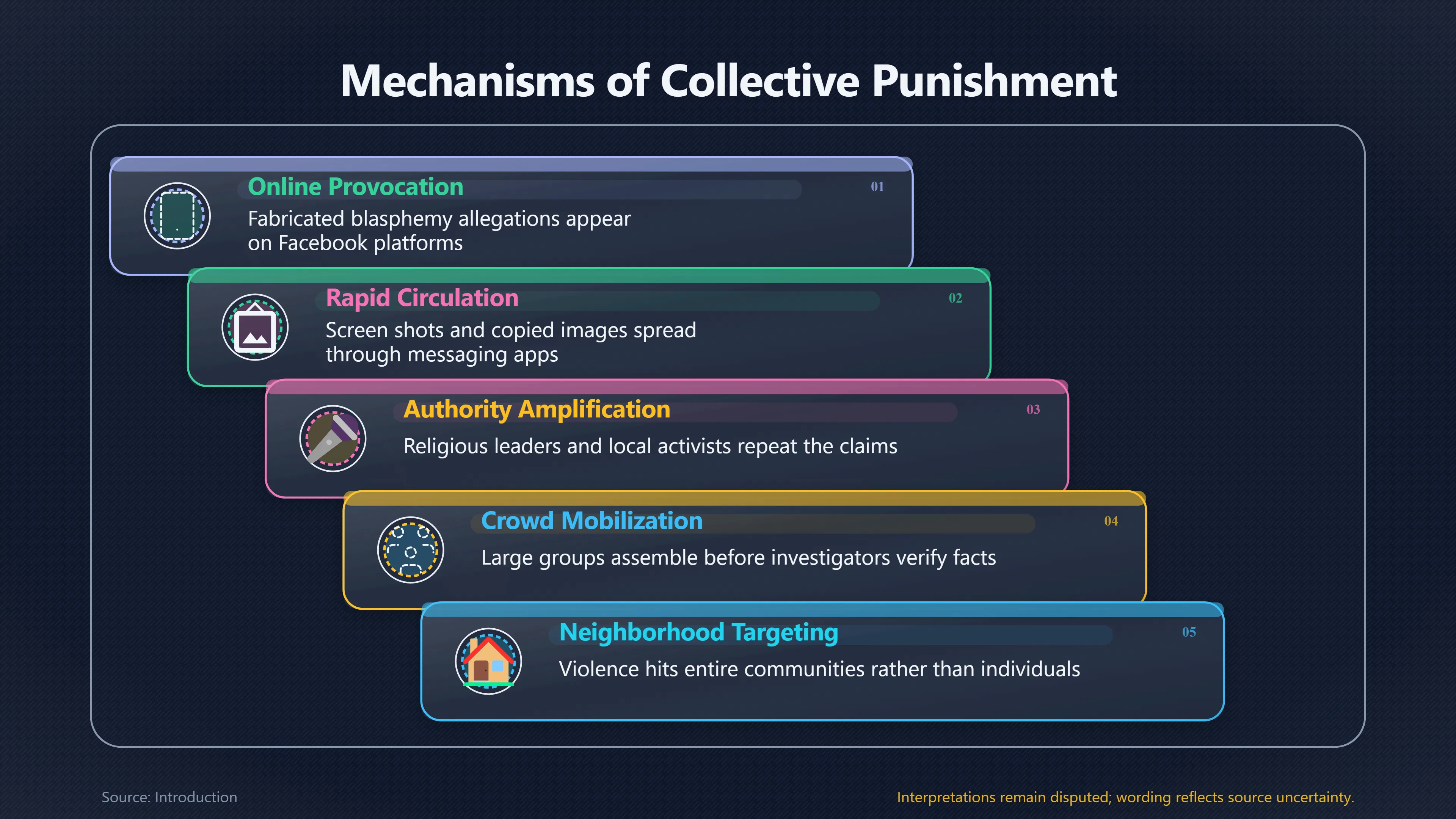
Several recurring mechanisms appear across documented cases:
- A provocative allegation appeared online, usually claiming that someone had insulted Islam through Facebook.
- Screenshots and copied images circulated faster than the original content, making independent verification difficult.
- Religious leaders, local activists or influential residents repeated the allegation, giving it greater credibility.
- Crowds assembled before investigators could establish the facts.
- Violence targeted entire neighbourhoods rather than the individual accused, with homes, temples and businesses attacked regardless of whether residents had any connection to the alleged post.[PMC]pmc.ncbi.nlm.nih.govFebruary 24, 2023…
This pattern resembles a classic rumour panic. The online accusation supplied a morally shocking story that appeared to justify immediate action, while emotional reactions spread through existing social relationships rather than careful examination of evidence. Once large crowds formed, participation itself became a form of social confirmation: people interpreted the size of the gathering as proof that the accusation must be true.
Researchers studying these incidents argue that social media accelerated older forms of rumour rather than creating an entirely new phenomenon. Before widespread internet access, false stories could circulate through villages, mosques or marketplaces. Facebook dramatically increased the speed, reach and apparent authenticity of such claims by providing screenshots that many users assumed were genuine.[PMC]pmc.ncbi.nlm.nih.govFebruary 24, 2023…
The recurring pattern in later attacks
Ramu was not an isolated episode. Similar allegations appeared repeatedly during the following decade.
In Pabna (2013), violence against Hindu communities followed accusations that offensive material had appeared on Facebook under the name of a Hindu youth. Subsequent investigations questioned whether the account and posts had been genuine.[PMC]pmc.ncbi.nlm.nih.govFebruary 24, 2023…
In Comilla (2014), another alleged Facebook insult became the immediate justification for attacks on Hindu homes and temples. Researchers examining the case found recurring evidence of fabricated or manipulated online material used to inflame local tensions.[PMC]pmc.ncbi.nlm.nih.govFebruary 24, 2023…
In Rangpur (2017), a Hindu man was accused of posting offensive religious content on Facebook. Investigators later reported that the account involved had likely been created fraudulently using his identity, yet the allegation still triggered deadly violence against his community before those doubts became widely known.[PMC]pmc.ncbi.nlm.nih.govFebruary 24, 2023…
The pattern continued in Bhola (2019) and during the Durga Puja violence in Comilla in 2021, where allegations concerning religious desecration spread rapidly through online and offline networks before attacks expanded beyond the original locations. While each incident had distinct local circumstances, scholars identify striking similarities in how rumours circulated, how verification failed and how collective punishment followed.[PMC]pmc.ncbi.nlm.nih.govFebruary 24, 2023…
Why the rumours spread so effectively
Digital technology alone does not explain these episodes. Researchers point instead to the interaction between technology and local social conditions.
Facebook became Bangladesh’s dominant social-media platform during the 2010s, reaching tens of millions of users, including many first-time internet users with limited experience of verifying digital content. Screenshots, edited images and copied posts often travelled through private groups or messaging networks where corrections arrived much later than the original accusation.[PMC]pmc.ncbi.nlm.nih.govFebruary 24, 2023…
Equally important were pre-existing political and communal tensions. Academic studies and human-rights reporting argue that violence frequently reflected disputes over land, local political competition or longstanding prejudice as much as genuine outrage over religion. In this interpretation, the blasphemy allegation functioned less as the underlying cause than as a socially powerful justification for attacks that might otherwise have lacked public support.[ecoi.net]ecoi.netUSDOS – US Department of State (Author): “2012 International Religious Freedom Report - Bangladesh”, Document #1333071 - ecoi.netMay 20…
This helps explain why attacks typically focused on property belonging to religious minorities rather than solely on locating the individual accused. Entire communities became symbolic stand-ins for an alleged offence committed by one person—or, in several documented cases, by nobody at all.

What changed after Ramu?
The repeated use of fabricated online evidence prompted increasing concern among Bangladeshi authorities, journalists and researchers about misinformation and communal violence.
Police investigations in several cases concluded that Facebook accounts had been impersonated, manipulated or created specifically to provoke unrest. Civil-society organisations and fact-checkers began promoting digital verification and warning against sharing inflammatory content before its authenticity had been established. Researchers also called for stronger moderation systems, faster fact-checking and improved digital literacy to reduce the likelihood that false rumours could trigger real-world violence.[nih.gov]pmc.ncbi.nlm.nih.govFebruary 24, 2023…
Nevertheless, experience has shown that technical solutions alone are insufficient. False accusations continue to be dangerous because they resonate with wider political and communal divisions. Even when later investigations expose fabricated evidence, the physical destruction and displacement caused by mob attacks cannot easily be undone.
Why these episodes matter
The history of online blasphemy rumours in Bangladesh illustrates how modern communication technologies can revive very old patterns of collective fear. Instead of rumours spreading only by word of mouth, edited images and fake social-media posts now provide apparently concrete “proof” that can travel nationwide within hours.
For historians of moral panics and collective belief, these incidents demonstrate that the central problem was not mass deception by technology itself, but the rapid conversion of an unverified accusation into collective certainty. The online rumour supplied the spark; existing social tensions, religious polarisation and crowd dynamics supplied the fuel. The result was a recurring pattern in which vulnerable minority communities paid the price for allegations that were often shown, too late, to have been false or manipulated.[nih.gov]pmc.ncbi.nlm.nih.govFebruary 24, 2023…
Amazon book picks
Further Reading
Books and field guides related to How Online Accusations Turned Into Communal Violence. Use these as the next step if you want deeper reading beyond the article.
Extraordinary Popular Delusions and the Madness of Crowds
Rating: 4.0/5 from 5 Google Books ratings
Shows how false beliefs can spread collectively.

![Cover for The Death of Truth [Hardcover] Michiko Kakutani](https://covers.openlibrary.org/b/id/9237737-M.jpg)
The Death of Truth [Hardcover] Michiko Kakutani
First published 2018. Subjects: United states, politics and government, 2017-2021, Political culture, Truth, Culture conflict, Subjectivity.
Likewar
Social media has been weaponized, as state hackers and rogue terrorists have seized upon Twitter and Facebook to create chaos and destruc...
Endnotes
1.
Source: pmc.ncbi.nlm.nih.gov
Link:https://pmc.ncbi.nlm.nih.gov/articles/PMC9999606/
Source snippet
February 24, 2023...
Published: February 24, 2023
2.
Source: refworld.org
Link:https://www.refworld.org/reference/annualreport/usdos/2013/en/41158
Source snippet
2012 Report on International Religious Freedom - Bangladesh | Refworld...
3.
Source: amnesty.org
Link:https://www.amnesty.org/en/latest/news/2012/10/bangladesh-arsonists-must-face-justice/
Source snippet
Amnesty InternationalBangladesh: Minority communities must be protected and arsonists face justice - Amnesty International...
4.
Source: arxiv.org
Link:https://arxiv.org/abs/1812.08660
5.
Source: arxiv.org
Link:https://arxiv.org/abs/2007.12841
6.
Source: ecoi.net
Link:https://www.ecoi.net/en/document/1333071.html
Source snippet
USDOS – US Department of State (Author): “2012 International Religious Freedom Report - Bangladesh”, Document #1333071 - ecoi.netMay 20...
7.
Source: hrw.org
Link:https://www.hrw.org/world-report/2012/country-chapters/bangladesh
8.
Source: hrw.org
Link:https://www.hrw.org/world-report/2013/country-chapters/bangladesh
Additional References
9.
Source: frontiersin.org
Link:https://www.frontiersin.org/journals/sociology/articles/10.3389/fsoc.2023.1067726/full
Source snippet
RECENT INCIDENCES OF “FAKE NEWS” AND RUMORS ABOUT MINORITIES ON SOCIAL MEDIA In the last decade, against minorities have taken place in B...
10.
Source: socialscienceresearch.org
Title: Spreading Fake News in the Virtual Realm in Bangladesh: Assessment of Impact
Link:https://socialscienceresearch.org/index.php/GJHSS/article/download/3404/3-Spreading-Fake-News_html/34709?inline=1
Source snippet
X. 18. CONCLUSION Facebook has become a panic of spreading rumors and fake news in Bangladesh along with the world. The impact of spreadi...
11.
Source: youtube.com
Link:https://www.youtube.com/watch?v=Z4x4aQSlFN8
Source snippet
Bangladesh: Hindus' homes set ablaze, temple vandalized over 18-year-old's FB post I Full Report...
12.
Source: youtube.com
Link:https://www.youtube.com/watch?v=zvnawrxlUKQ
Source snippet
Bangladesh Temple Attacks: 5 Killed, Scores Injured In Brutal Violence During Durga Pujo...
13.
Source: youtube.com
Link:https://www.youtube.com/watch?v=8LEZ08Z5qHE
Source snippet
Bangladesh: Hindu homes and temple destroyed after FB post goes viral...
14.
Source: youtube.com
Title: Temples destroyed during wave of attacks restored to former glory
Link:https://www.youtube.com/watch?v=L8dXYR5CXYo
Source snippet
Bangladesh Violence: Hindus Targeted, Homes Looted After Prophet Post Row | What Is The Matter?...
15.
Source: hinduexistence.org
Link:https://hinduexistence.org/2017/11/13/jihadi-mob-sets-upon-hindu-village-in-rangpur-over-rumoured-facebook-post-from-fake-account/
16.
Source: aljazeera.com
Title: Al Jazeera How Facebook posts sparked Bangladeshi anger | Features | Al Jazeera
Link:https://www.aljazeera.com/features/2012/10/17/how-facebook-posts-sparked-bangladeshi-anger
17.
Source: news.sky.com
Title: temples attacked over facebook koran images 10468495
Link:https://news.sky.com/story/temples-attacked-over-facebook-koran-images-10468495
18.
Source: youtube.com
Title: Bangladesh: Hindu homes and temple destroyed after FB post goes viral
Link:https://www.youtube.com/watch?v=8LEb4cVbbCA
Topic Tree