Within Afghanistan Panics
Were Afghan Schoolgirls Really Being Poisoned?
Repeated school illnesses blurred the line between genuine attack fears, contagious distress and official claims made before evidence was complete.
On this page
- How the poisoning scares spread
- What medical investigations found
- Why the attack narrative endured
Page outline Jump by section
Introduction
From 2009 onwards, repeated reports of mysterious illnesses among Afghan schoolgirls became one of the country’s most persistent public scares. Students described strange smells, dizziness, headaches, nausea, weakness, breathing difficulties and fainting, prompting emergency hospitalisations and widespread fears that opponents of girls’ education were poisoning schools. Given Afghanistan’s long history of attacks on schools, these fears were entirely plausible to many parents and officials.
Yet years of medical investigations repeatedly failed to find convincing evidence of poison, toxic gas or contaminated water in the great majority of these incidents. Instead, investigators from Afghan authorities working with international organisations increasingly concluded that many of the outbreaks were examples of mass psychogenic illness—real physical symptoms spreading through fear, stress and social contagion rather than through exposure to a chemical agent. This conclusion has remained controversial because it exists alongside the equally well-documented reality that Afghan girls’ education has faced genuine threats and violence.[newsweek.com]newsweek.comAre the Taliban Poisoning Afghan Schoolgirls? The EvidenceAre the Taliban Poisoning Afghan Schoolgirls? The Evidence - NewsweekJuly 9, 2012…
Were Afghan schoolgirls really being poisoned?
The simplest answer is that some incidents may have involved genuine assaults or deliberate intimidation, but the best-studied outbreaks produced no scientific evidence of poisoning.
Beginning with widely publicised cases in 2009, dozens of schools across several provinces reported clusters of illness. Ambulances carried large numbers of pupils to hospital, local officials frequently announced poison attacks, and frightened parents often withdrew daughters from school while investigations were underway.
The symptoms were remarkably consistent from one event to another:
- sudden dizziness or light-headedness;
- headaches;
- nausea;
- fainting or apparent loss of consciousness;
- weakness;
- anxiety;
- reports of unusual smells immediately before symptoms appeared.
The absence of fatalities despite hundreds—and eventually thousands—of reported illnesses puzzled investigators. Most pupils recovered quickly, often within hours, and laboratory testing repeatedly failed to detect known poisons.[newsweek.com]newsweek.comAre the Taliban Poisoning Afghan Schoolgirls? The EvidenceAre the Taliban Poisoning Afghan Schoolgirls? The Evidence - NewsweekJuly 9, 2012…
How the poisoning scares spread
The reports did not spread in a social vacuum. Afghanistan at the time was experiencing an armed conflict in which girls’ education had become politically charged.
Schools had genuinely been:
- burned;
- bombed;
- threatened;
- forced to close;
- targeted by insurgent intimidation campaigns.
Against that background, rumours of poisoning seemed believable. A strange smell in a classroom or one student collapsing could rapidly convince classmates that an attack was underway.
Several mechanisms reinforced one another:
- Fear among pupils. Many girls already attended school under persistent anxiety about possible attacks.
- Rapid media coverage. Reports often appeared before medical investigations had begun.
- Official statements. Local authorities sometimes attributed incidents to poisoning immediately, reinforcing public expectations.
- Community rumours. Stories of previous alleged poisonings circulated widely between provinces.
The Global Coalition to Protect Education from Attack documented numerous alleged poisoning incidents and noted that even where scientific evidence was lacking, the resulting fear seriously disrupted girls’ education. In one Kunduz case, panic reportedly kept around 1,500 girls away from school.[Refworld]refworld.orgEducation under Attack 2014 - Afghanistan | Refworld…
A self-reinforcing cycle
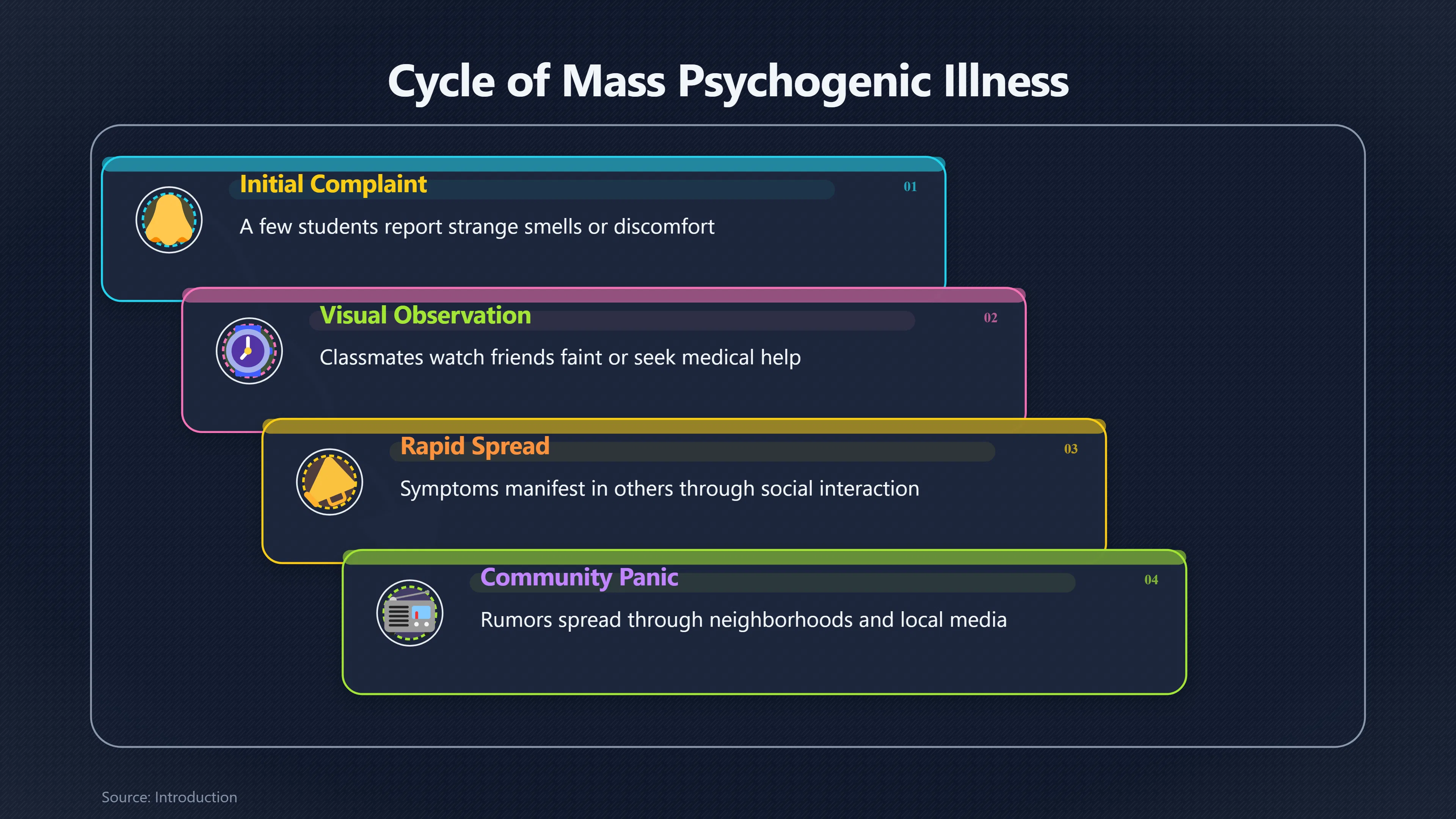
Many outbreaks followed a recognisable pattern.
A few students first complained of a smell or physical discomfort. As classmates watched ambulances arrive or saw friends faint, additional pupils rapidly developed similar symptoms. Parents rushed to schools, rumours spread through neighbourhoods and local media, and attendance collapsed even after no toxin could be identified.
This pattern is well recognised in medical literature describing mass psychogenic illness, especially in schools and other close-knit communities under high stress.[Iris]iris.who.intIris Manual for investigatingIris Manual for investigating
What medical investigations found
International and Afghan investigations were unusually extensive.
According to reporting based on confidential United Nations and World Health Organization investigations, hundreds of samples—including blood, urine and water—were collected during repeated incidents beginning in 2009. Investigators consistently reported that they found no conclusive evidence of deliberate poisoning.[Newsweek]newsweek.comAre the Taliban Poisoning Afghan Schoolgirls? The EvidenceAre the Taliban Poisoning Afghan Schoolgirls? The Evidence - NewsweekJuly 9, 2012…
Environmental investigations typically examined possible explanations such as:
- contaminated drinking water;
- airborne chemicals;
- pesticides;
- industrial pollution;
- gas leaks;
- infectious disease.
Repeated testing failed to identify an environmental cause that could explain the pattern of illness across affected schools.[Newsweek]newsweek.comAre the Taliban Poisoning Afghan Schoolgirls? The EvidenceAre the Taliban Poisoning Afghan Schoolgirls? The Evidence - NewsweekJuly 9, 2012…
Medical investigators instead noted several features commonly associated with mass psychogenic illness:
- symptoms were largely subjective rather than showing signs of toxic injury;
- patients usually recovered quickly;
- laboratory tests were normal;
- girls were overwhelmingly affected, while male staff were often not;
- symptoms spread through observation of others becoming ill rather than following a clear exposure pattern.
These findings closely matched international guidance used by the World Health Organization when investigating suspected toxic outbreaks in schools.[Iris]iris.who.intIris Manual for investigatingIris Manual for investigating
Why the attack narrative endured
Scientific findings alone did not end public belief in poisoning.
One reason was that the underlying fear rested on real experience rather than fantasy. Throughout the conflict, militant groups had attacked schools, teachers and pupils. Parents therefore had genuine reasons to believe that enemies of girls’ education might employ new methods.
Several factors made poisoning stories especially resilient.
Real violence made rumours credible. Because attacks on schools genuinely occurred, the idea of chemical attacks did not seem impossible.
Investigations took time. Initial reports often spread much faster than laboratory results.
Visible illness demanded an explanation. The girls’ symptoms were genuine and sometimes dramatic. Being told that no poison had been found did not erase what families had witnessed.
Political incentives differed. Local officials, insurgent groups and media outlets sometimes advanced competing narratives before evidence was complete.
Consequently, many communities continued to believe poisoning had occurred even after investigators reported negative laboratory findings.[Newsweek]newsweek.comAre the Taliban Poisoning Afghan Schoolgirls? The EvidenceAre the Taliban Poisoning Afghan Schoolgirls? The Evidence - NewsweekJuly 9, 2012…
Understanding mass psychogenic illness without dismissing the victims
Mass psychogenic illness does not mean that sufferers imagined their symptoms or deliberately pretended to be ill.
Instead, it describes outbreaks in which psychological stress produces genuine physical symptoms that spread through observation, expectation and social interaction. Symptoms such as dizziness, nausea, headaches and fainting are entirely real even when no toxin can be identified.
Medical researchers have documented comparable school outbreaks in many countries over several decades. Investigations commonly find:
- no infectious disease;
- no environmental toxin;
- rapid recovery;
- clustering among socially connected groups;
- spread accelerated by fear, uncertainty and intense attention.
The Afghan cases fit many of these established characteristics while occurring under exceptionally stressful wartime conditions.[Iris]iris.who.intIris Manual for investigatingIris Manual for investigating
Why these scares remain important
The Afghan schoolgirl poisoning episodes remain significant because they illustrate how difficult it can be to separate genuine danger from contagious fear during prolonged conflict.
The country simultaneously experienced:
- real attacks on education;[openasia.org]openasia.orgOpen AsiaDecember 29, 2014 — ATTACKS ON SCHOOL STUDENTS, TEACHERS AND OTHER EDUCATION PERSONNEL In addition to schools being damaged, destroyed or…
- widespread distrust of official information;
- repeated rumours of poisoning;
- convincing physical symptoms among pupils;
- medical investigations finding little or no evidence of toxic exposure.
That combination makes the episodes poor examples of simple “mass hysteria” and equally poor examples of proven chemical attacks. Instead, they demonstrate how fear can become contagious in communities already living with authentic threats.
The legacy extends beyond the individual incidents. The scares disrupted education, deepened parental anxiety and became an enduring example in discussions of mass psychogenic illness worldwide. They have also been cited during later school illness scares in other countries as a reminder that dramatic symptoms alone cannot establish poisoning without supporting medical evidence, while also showing why populations exposed to sustained violence may reasonably distrust reassuring official explanations.
Amazon book picks
Further Reading
Books and field guides related to Were Afghan Schoolgirls Really Being Poisoned?. Use these as the next step if you want deeper reading beyond the article.
Extraordinary Popular Delusions and the Madness of Crowds
Rating: 4.0/5 from 5 Google Books ratings
Relevant to mass belief and panic.

The Rules of Contagion
First published 2020. Subjects: New York Times reviewed, Social psychology, Social networks, Epidemics, Contagion (Social psychology).

Endnotes
1.
Source: newsweek.com
Title: Are the Taliban Poisoning Afghan Schoolgirls? The Evidence
Link:https://www.newsweek.com/are-taliban-poisoning-afghan-schoolgirls-evidence-65587
Source snippet
Are the Taliban Poisoning Afghan Schoolgirls? The Evidence - NewsweekJuly 9, 2012...
Published: July 9, 2012
2.
Source: refworld.org
Link:https://www.refworld.org/reference/annualreport/gcpea/2014/104923
Source snippet
Education under Attack 2014 - Afghanistan | Refworld...
3.
Source: iris.who.int
Title: Iris Manual for investigating
Link:https://iris.who.int/bitstream/handle/10665/342818/9789240021754-eng.pdf
4.
Source: hero.epa.gov
Link:https://hero.epa.gov/reference/11895/
Source snippet
psychogenic illness attributed to toxic exposure at a high schoolMASS PSYCHOGENIC ILLNESS ATTRIBUTED TO TOXIC EXPOSURE AT A HIGH SCHOOL J...
Additional References
5.
Source: sciencedirect.com
Link:https://www.sciencedirect.com/science/article/pii/S0736467915010598
Source snippet
February 1, 2016 — THE JOURNAL OF EMERGENCY MEDICINE Volume 50, Issue 2, February 2016, Pages e47-e52 Outbreak of Mysterious...
Published: February 1, 2016
6.
Source: nejm.org
Link:https://www.nejm.org/doi/abs/10.1056/NEJM200001133420206
Source snippet
Jones, M.D., Allen S. Craig, M.D., Debbie Hoy, R.N., Elaine W. Gunter, M.T., David L. Ashley, Ph.D., Dana B...
7.
Source: asprtracie.hhs.gov
Title: mass psychogenic illness attributed to toxic exposure at a high school
Link:https://asprtracie.hhs.gov/technical-resources/resource/5775/mass-psychogenic-illness-attributed-to-toxic-exposure-at-a-high-school
Source snippet
(2000). Mass Psychogenic Illness Attributed to Toxic Exposure at a High School. The New E...
8.
Source: cbsnews.com
Title: Attack Fear Keeps Afghan Girls From School
Link:https://www.cbsnews.com/news/attack-fear-keeps-afghan-girls-from-school/
Source snippet
CBS NewsMay 14, 2009 — ATTACK FEAR KEEPS AFGHAN GIRLS FROM SCHOOL May 14, 2009 / 2:06 PM EDT / AP Add CBS News on Google Only a few dozen...
Published: May 14, 2009
9.
Source: pubmed.ncbi.nlm.nih.gov
Link:https://pubmed.ncbi.nlm.nih.gov/20592616/
Source snippet
2010 Sep;21(5):744-7. doi: 10.1097/EDE.0b013e3181e9edc4. FREQUENCY AND PREDICTORS OF MASS PSYCHOGENIC ILLNESS Lisa A Page^{ 1 }, Catherin...
10.
Source: pubmed.ncbi.nlm.nih.gov
Link:https://pubmed.ncbi.nlm.nih.gov/40537604/
Source snippet
2026 Mar;61(3):405-422. doi: 10.1007/s00127-025-02949-6. Epub 2025 Jun 19. FACTORS RELATED TO THE OCCURRENCE OF MASS PSYCHOGENIC ILLNESS...
11.
Source: openasia.org
Title: Open Asia
Link:https://openasia.org/en/2014/12/afghanistan-global-coalition-to-protect-education-from-attack/
Source snippet
December 29, 2014 — ATTACKS ON SCHOOL STUDENTS, TEACHERS AND OTHER EDUCATION PERSONNEL In addition to schools being damaged, destroyed or...
Published: December 29, 2014
12.
Source: nejm.org
Link:https://www.nejm.org/doi/full/10.1056/NEJM200001133420206
13.
Source: pubmed.ncbi.nlm.nih.gov
Link:https://pubmed.ncbi.nlm.nih.gov/15080215/
14.
Source: youtube.com
Link:https://www.youtube.com/watch?v=137XMz31ORs
Topic Tree