Within Latvia's Strange Beliefs
Was Latvia's Werewolf Really a Guardian?
Thiess claimed werewolves served God by fighting witches for the harvest, challenging everything his judges believed about evil.
On this page
- What Thiess told the court
- Werewolves, witches and the harvest
- Evidence, retellings and later mythmaking
Page outline Jump by section
Introduction
The trial of Thiess of Kaltenbrun, usually dated to 1691–1692 in Swedish Livonia, is one of the most unusual legal records from the territory that now includes parts of Latvia. Instead of denying that he was a werewolf, the elderly peasant insisted that he and others like him were God’s servants. Their task, he claimed, was to descend into Hell, fight witches and the Devil, and recover stolen grain and livestock so that the harvest would succeed. Far from presenting himself as a servant of evil, Thiess argued that werewolves protected ordinary people. His testimony baffled the judges because it overturned the official Christian picture of the werewolf as a demonic creature. Today the case is valued not as evidence that people really transformed into wolves, but as an exceptionally rare window into popular rural beliefs that differed sharply from elite religious teaching.[Google Books]books.google.comBooks Old Thiess, a Livonian Werewolf: A Classic Case in Comparative PerspectiveGoogle BooksOld Thiess, a Livonian Werewolf: A Classic Case in Comparative Perspective - Carlo Ginzburg, Bruce Lincoln - Google BooksMarc…
Was Latvia’s Werewolf Really a Guardian?
Although the trial took place in Livonia rather than within the borders of the modern Latvian state, it belongs naturally in Latvia’s cultural history because it reflects the beliefs of the Baltic countryside during the seventeenth century. The surviving court record shows a striking clash between local folk traditions and the theology of judges educated in Lutheran ideas about witchcraft and the Devil.[Google Books]books.google.comBooks Old Thiess, a Livonian Werewolf: A Classic Case in Comparative PerspectiveGoogle BooksOld Thiess, a Livonian Werewolf: A Classic Case in Comparative Perspective - Carlo Ginzburg, Bruce Lincoln - Google BooksMarc…
Rather than describing a curse or a monstrous transformation, Thiess presented werewolves as defenders of the community. He said they were “the hounds of God” who opposed Satan. According to his account, werewolves travelled into Hell on specific nights of the year to fight witches who had stolen the fertility of the fields. Victory meant that grain, livestock and prosperity would return to the living world; defeat meant poor harvests and hardship. This was an explanation for agricultural fortune that was completely at odds with the expectations of the court.[Google Books]books.google.comBooks Old Thiess, a Livonian Werewolf: A Classic Case in Comparative PerspectiveGoogle BooksOld Thiess, a Livonian Werewolf: A Classic Case in Comparative Perspective - Carlo Ginzburg, Bruce Lincoln - Google BooksMarc…
What Thiess Told the Court
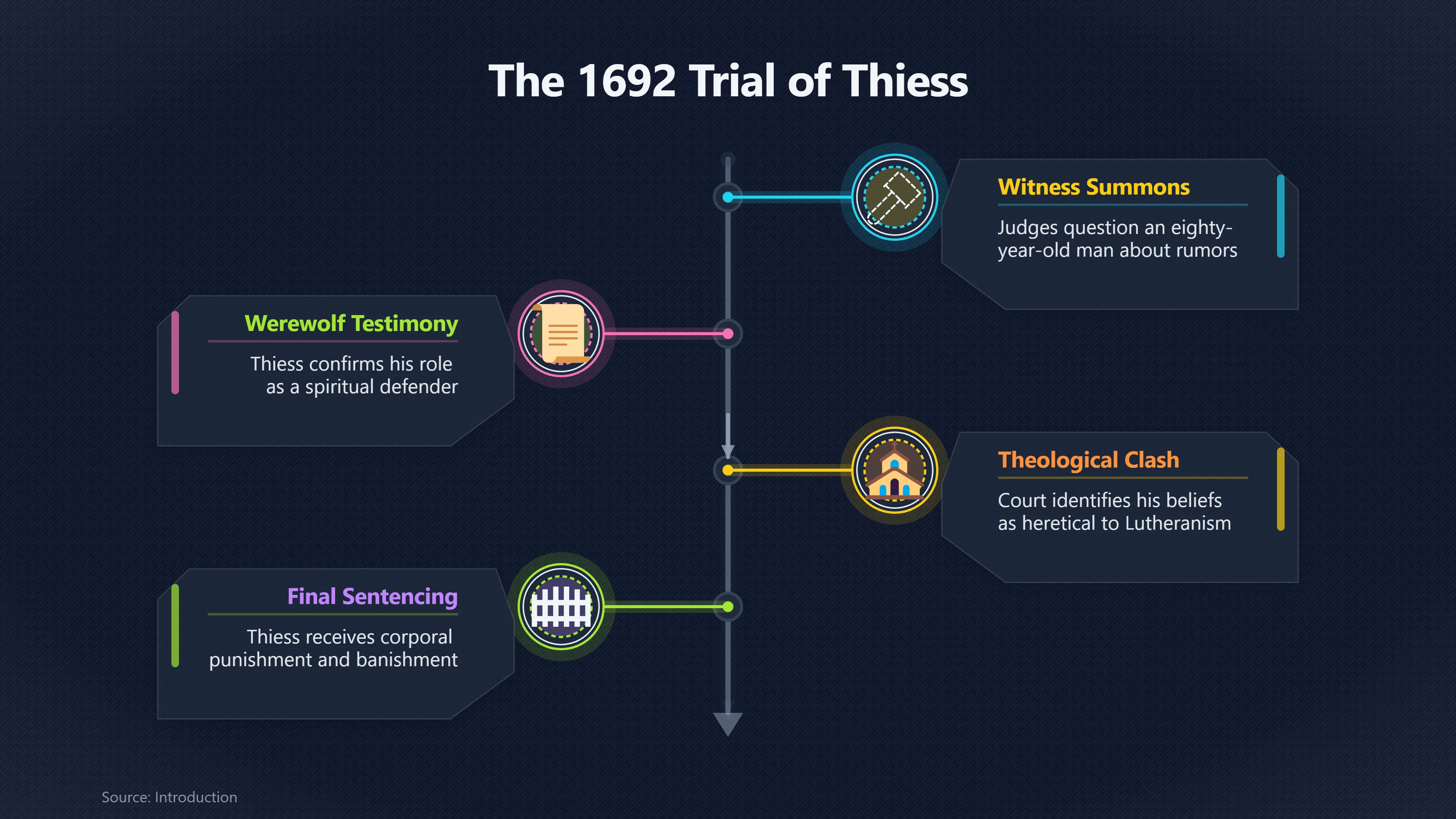
Thiess was already in his eighties when he appeared before the court. He had been called as a witness in another matter, but the judges questioned him about long-standing rumours that he claimed to be a werewolf. Instead of withdrawing the story, he confirmed it willingly.[Wikipedia]WikipediaThiess of KaltenbrunThiess of Kaltenbrun
His testimony included several memorable details:
- He said werewolves transformed and travelled into Hell on three nights each year.
- Their enemies were witches and the Devil, not ordinary people.
- The battles were fought with iron rods, while the witches defended themselves with broom handles.
- He claimed his own broken nose came from one of these supernatural fights, naming a local man whom he identified as a witch.
- He insisted that successful battles ensured healthy crops, livestock and general prosperity for the coming season.[emotionsblog.history.qmul.ac.uk]emotionsblog.history.qmul.ac.ukan account of the trial of a livonian werewolf in jurgensburg in 1692The History of Emotions Blog…
To modern readers the story sounds fantastical, but its importance lies in the fact that Thiess presented it calmly as an accepted truth rather than as a confession of evil. Witnesses reportedly described him as mentally sound, forcing the judges to confront someone who sincerely held beliefs outside accepted church doctrine rather than someone they could dismiss as obviously incapable.[Wikipedia]WikipediaThiess of KaltenbrunThiess of Kaltenbrun

Werewolves, Witches and the Harvest
The harvest lay at the centre of Thiess’s worldview. In many early modern rural communities, crop failure threatened survival, so beliefs developed to explain why fields flourished one year and failed the next. Thiess’s account imagined an invisible struggle in which supernatural defenders recovered the grain that witches had hidden in Hell.
This differs sharply from the better-known stereotype of the werewolf as a savage predator. In Thiess’s version, werewolves resembled protectors rather than monsters. Historians have compared the story with other European traditions in which selected individuals claimed to undertake spiritual journeys to defend their communities. Carlo Ginzburg famously linked Thiess to the Italian benandanti, peasants who likewise claimed to fight witches for the fertility of the crops. While the comparison remains influential, later scholars have debated how close the traditions really were and whether they arose independently from similar agricultural concerns.[Google Books]books.google.comBooks Old Thiess, a Livonian Werewolf: A Classic Case in Comparative PerspectiveGoogle BooksOld Thiess, a Livonian Werewolf: A Classic Case in Comparative Perspective - Carlo Ginzburg, Bruce Lincoln - Google BooksMarc…
The testimony also reveals how differently peasants and educated officials could understand the same words. To Thiess, calling himself a werewolf expressed loyalty to God. To the judges, the very word implied association with the Devil, making his explanation appear not merely strange but theologically dangerous.[Google Books]books.google.comBooks Old Thiess, a Livonian Werewolf: A Classic Case in Comparative PerspectiveGoogle BooksOld Thiess, a Livonian Werewolf: A Classic Case in Comparative Perspective - Carlo Ginzburg, Bruce Lincoln - Google BooksMarc…
Why the Judges Rejected His Story
The court did not convict Thiess because it believed he really became a wolf. Instead, the judges regarded his teachings as heretical because they encouraged a religious worldview outside orthodox Christianity.
In Lutheran theology, salvation came through God rather than through magical journeys undertaken by special individuals. Thiess’s insistence that supernatural harvest battles were essential to the welfare of society suggested an alternative religious system. The court therefore concluded that his teachings could mislead others, sentencing him to corporal punishment and banishment rather than treating him as a heroic defender of the community.[Wikipedia]WikipediaThiess of KaltenbrunThiess of Kaltenbrun
The outcome also highlights an important distinction in the history of belief. The case was not a classic witch panic in which neighbours denounced an alleged witch for causing local misfortune. Instead, it was a collision between official theology and an older body of folk belief that the authorities considered unacceptable.

Evidence, Retellings and Later Mythmaking
Thiess is unusually well documented because part of the court record survives. That makes his case much stronger historically than later folklore about werewolves, which often survives only through oral tradition. Modern historians therefore treat the trial as a rare primary source showing an individual’s own explanation of his beliefs, even though the testimony was filtered through legal proceedings.[Google Books]books.google.comBooks Old Thiess, a Livonian Werewolf: A Classic Case in Comparative PerspectiveGoogle BooksOld Thiess, a Livonian Werewolf: A Classic Case in Comparative Perspective - Carlo Ginzburg, Bruce Lincoln - Google BooksMarc…
The case has attracted repeated reinterpretation. Some scholars see traces of ancient ritual traditions or ecstatic religious practices. Others argue that such comparisons can be pushed too far and that Thiess should instead be understood within the specific social conditions of seventeenth-century Livonia, where Baltic German elites judged the beliefs of local peasants through the lens of Christian demonology. Recent scholarship has increasingly focused on the trial itself, its language and its historical context rather than searching for a single hidden pagan religion behind the testimony.[Google Books]books.google.comBooks Old Thiess, a Livonian Werewolf: A Classic Case in Comparative PerspectiveGoogle BooksOld Thiess, a Livonian Werewolf: A Classic Case in Comparative Perspective - Carlo Ginzburg, Bruce Lincoln - Google BooksMarc…
Popular retellings often exaggerate the story by presenting Thiess as a medieval monster hunter or by implying that the court accepted the existence of benevolent werewolves. The surviving record supports neither interpretation. The judges rejected his religious claims, while historians value the case because it captures a remarkable moment when a peasant confidently described a worldview that official religion could neither absorb nor easily explain.[Google Books]books.google.comBooks Old Thiess, a Livonian Werewolf: A Classic Case in Comparative PerspectiveGoogle BooksOld Thiess, a Livonian Werewolf: A Classic Case in Comparative Perspective - Carlo Ginzburg, Bruce Lincoln - Google BooksMarc…
Amazon book picks
Further Reading
Books and field guides related to Was Latvia's Werewolf Really a Guardian?. Use these as the next step if you want deeper reading beyond the article.
The werewolf in lore and legend
Introduces historical werewolf traditions including early modern beliefs.



Endnotes
1.
Source: books.google.com
Title: Books Old Thiess, a Livonian Werewolf: A Classic Case in Comparative Perspective
Link:https://books.google.com/books/about/Old_Thiess_a_Livonian_Werewolf.html?id=BOHSDwAAQBAJ
Source snippet
Google BooksOld Thiess, a Livonian Werewolf: A Classic Case in Comparative Perspective - Carlo Ginzburg, Bruce Lincoln - Google BooksMarc...
2.
Source: emotionsblog.history.qmul.ac.uk
Title: an account of the trial of a livonian werewolf in jurgensburg in 1692
Link:https://emotionsblog.history.qmul.ac.uk/2013/03/an-account-of-the-trial-of-a-livonian-werewolf-in-jurgensburg-in-1692/
Source snippet
The History of Emotions Blog...
3.
Source: Wikipedia
Title: Thiess of Kaltenbrun
Link:https://en.wikipedia.org/wiki/Thiess_of_Kaltenbrun
4.
Source: history.com
Title: But gradually, the educated
Link:https://www.history.com/articles/werewolf-trials-europe-witches
Source snippet
Before America Had [Witch Trials]({{ 'witch-trials-1a628f/' | relative_url }}), Europe Had Werewolf Trials | HISTORYOctober 15, 2021 — WEREWOLVES LOSE THEIR BITE Werewolf trials contin...
Published: October 15, 2021
5.
Source: play.google.com
Title: Carlo Ginzburg Old Thiess a Livonian Werewolf
Link:https://play.google.com/store/books/details/Carlo_Ginzburg_Old_Thiess_a_Livonian_Werewolf?id=BOHSDwAAQBAJ
Additional References
6.
Source: scielo.org.mx
Title: Carlo Ginzburg y Bruce Lincoln, Old Thiess, a Livonian Werewolf
Link:https://www.scielo.org.mx/scielo.php?lng=es&nrm=iso&pid=S0185-26202022000200269&script=sci_arttext_plus&tlng=es
Source snippet
A Classic Case in Comparative PerspectiveMarch 31, 2023 — SCIELO ESTUDIOS DE HISTORIA MODERNA Y CONTEMPORÁNEA DE MÉXICO Print version ISS...
Published: March 31, 2023
7.
Source: reiseragency.it
Title: Old Thiess, a Livonian Werewolf | Reiser
Link:https://reiseragency.it/en/libro/old-thiess-livonian-werewolf
Source snippet
Literary AgencyApril 13, 2022 — History OLD THIESS, A LIVONIAN WEREWOLF A CLASSIC CASE IN COMPARATIVE PERSPECTIVE Carlo Ginzburg ISBN: 97...
Published: April 13, 2022
8.
Source: boneandsickle.com
Title: A Werewolf in Court – Bone and Sickle
Link:https://www.boneandsickle.com/2025/11/25/a-werewolf-in-court/
Source snippet
"November 25, 2025 — A WEREWOLF IN COURT BY BONEANDSICKLE | NOVEMBER 25, 2025 Audio Player [https://media.blubrry.com/boneandsickle/content..."](https://media.blubrry.com/boneandsickle/content...")...
Published: November 25, 2025
9.
Source: podcasts.apple.com
Link:https://podcasts.apple.com/us/podcast/a-werewolf-in-court/id1375785636?i=1000738349973
Source snippet
Werewolf in Court - Bone and Sickle - Apple PodcastsNovember 25, 2025 — * NOVEMBER 25, 2025 * EPISODE 150 * 22 MIN A WEREWOLF IN COURT Bo...
Published: November 25, 2025
10.
Source: ccsenet.org
Link:https://ccsenet.org/journal/index.php/res/article/view/0/48122
11.
Source: openroadmedia.com
Link:https://openroadmedia.com/ebook/old-thiess-a-livonian-werewolf/9780226674551
12.
Source: press.uchicago.edu
Link:https://press.uchicago.edu/ucp/books/book/chicago/O/bo46813477.html
13.
Source: youtube.com
Title: The Werewolf’s Dark Family Tree Explained
Link:https://www.youtube.com/watch?v=TyWkeSh62no
Source snippet
The Werewolf That Fought for God | Thiess of Kaltenbrun...
14.
Source: youtube.com
Title: Was This Old Man a Werewolf?
Link:https://www.youtube.com/watch?v=9yd7QU4ehdU
Source snippet
Servants of Evil or "God's Hounds"? The Complex History of Werewolves...
15.
Source: youtube.com
Title: Servants of Evil or “God’s Hounds”? The Complex History of Werewolves
Link:https://www.youtube.com/watch?v=424CA5JXRJ0
Source snippet
Skyforger - Dieva suns (Official Video)...
Topic Tree