When Faith Became a Threat in Saint Vincent
Saint Vincent and the Grenadines does not have a well-documented history of spectacular witch trials, dancing plagues or school-wide fainting epidemics.
Page outline Jump by section
Introduction
This history matters because it shows how something resembling a moral panic can arise without a single dramatic outbreak. Anxiety accumulated around unfamiliar worship, African-derived spirituality, working-class gatherings and alleged supernatural practices. The supposed threat was not proved by evidence of organised violence or mass delusion. It was largely constructed through colonial definitions of respectable religion, public order and sanity.
When worship became a public threat
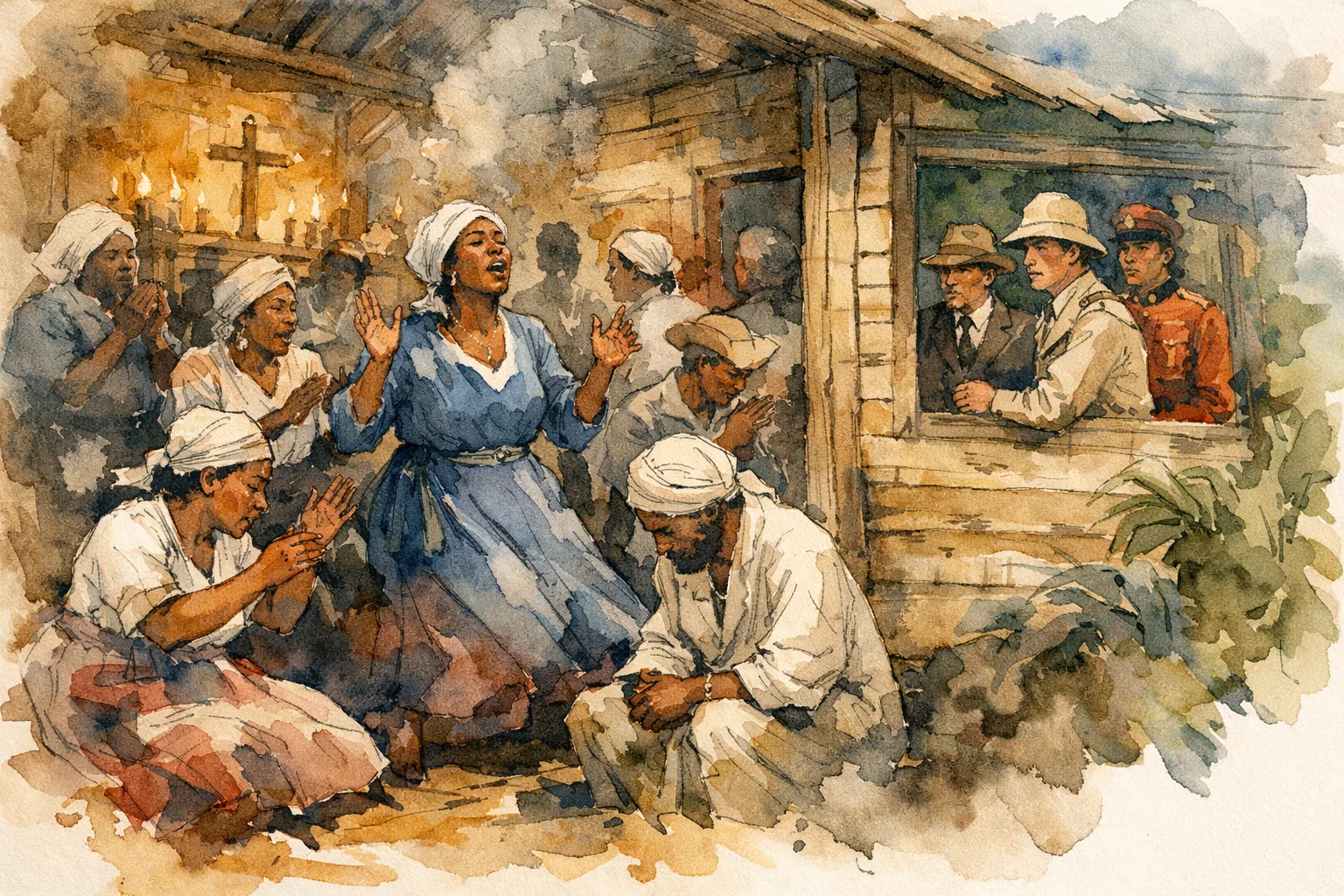
Spiritual Baptist practice combines Christian belief with forms of worship shaped by African-Caribbean religious experience. Followers identify as Christians, but services may involve forceful prayer, rhythmic movement, singing, spirit possession, dreams, healing and baptism by immersion. In Saint Vincent, adherents were commonly called Shakers because worshippers’ bodies might tremble or shake when understood to be under the influence of the Holy Spirit. “Converted” was another local name.[Wikipedia]WikipediaSpiritual BaptistSpiritual Baptist
To believers, these experiences demonstrated spiritual power. To many colonial officials, missionaries and socially influential observers, they appeared undisciplined and alarming. The disagreement was not simply theological. It reflected a hierarchy in which restrained, European-led church worship was treated as legitimate, while expressive religious forms associated with poorer Black communities were more readily described as noise, superstition or disorder.
Official hostility eventually took the form of a public inquiry. According to the University of Glasgow’s research on African religious heritage in the eastern Caribbean, the inquiry concluded that the Shakers should not be accepted as a religious body but prosecuted as a public nuisance. The resulting Shakerism Prohibition Ordinance came into force on 1 October 1912.[University of Glasgow]gla.ac.ukUniversity of Glasgow Research ProjectsUniversity of GlasgowResearch Projects - Grenada's African Religious HeritageIn 1912, the St. Vincent Shakerism Prohibition Ordinance was…
The ordinance did not merely address excessive noise under an ordinary public-order law. It singled out a particular religious identity and manner of worship. Historical research indicates that it restricted Shaker meetings and places of worship, while colonial descriptions associated the movement with behaviour considered indecent, immoral or mentally abnormal. Members were fined, imprisoned and sentenced to hard labour.[dokumen.pub]dokumen.pubShakerism) Prohibition Ordinance made worship in a style defined by the laws as associated with Shouting, and Shakerism, illegal.134 In…
Was this a moral panic?
The term “moral panic” describes a situation in which a person, practice or group is presented as a serious threat to social values, often through exaggerated claims and demands for exceptional control. The suppression of Saint Vincent’s Shakers fits that pattern better than it fits the modern idea of “mass hysteria”.
There is no strong evidence that the population suddenly shared one delusional belief or developed contagious physical symptoms. Nor is there evidence that the Spiritual Baptists formed a secret destructive sect of the kind implied by the casual modern use of “cult”. They were an identifiable Christian religious community whose practices offended colonial expectations.
Several features nevertheless made the campaign panic-like:
- Unfamiliar bodily behaviour was pathologised. Shaking, trance and spirit possession were interpreted by outsiders as evidence of instability rather than understood within the believers’ religious framework.
- Noise became a symbol of wider disorder. Loud worship could cause genuine disputes, but complaints about sound expanded into condemnation of an entire faith.
- African-derived religion was treated as suspect. Colonial observers commonly classified Black spiritual practices as superstition, fraud, witchcraft or social danger while granting institutional Christian churches a presumption of legitimacy.
- Gatherings of poorer people caused political anxiety. Independent religious meetings created leadership, solidarity and networks outside institutions controlled by colonial authorities.
- The state adopted a disproportionate remedy. Instead of regulating specific nuisances, it criminalised the religious practice itself.
The panic was therefore not simply fear of supernatural belief. It was fear of who was gathering, how they worshipped and whether their spiritual independence might weaken established authority.
Obeah, healing and the fear of hidden harm
The Shaker controversy developed within a wider Caribbean world in which the colonial label “obeah” carried enormous emotional and political weight. Obeah is not one uniform church or doctrine. Historians use the term for a varied field of African-Caribbean spiritual work that may include healing, protection, divination, charms and attempts to influence unseen forces. Practitioners themselves have not always accepted the name, particularly because authorities and Christian critics frequently used it as an accusation.[ed.ac.uk]research.ed.ac.ukwitchcraft poison law and atlantic slaverywitchcraft poison law and atlantic slavery
Colonial governments often blurred the boundaries between harmful sorcery, herbal medicine, religious ritual and fraud. Historian Diana Paton argues that Caribbean law helped create “obeah” as a broad criminal category rather than neutrally identifying a single existing religion. Earlier laws had stressed witchcraft and supernatural danger; after emancipation, legislation increasingly described practitioners as cheats exploiting the credulous. Both framings allowed governments to police forms of spiritual authority that operated outside recognised churches and medicine.[ed.ac.uk]research.ed.ac.ukwitchcraft poison law and atlantic slaverywitchcraft poison law and atlantic slavery
In Vincentian life, beliefs about spells, spirits and spiritually dangerous objects have persisted alongside Christianity. A 2026 account by a journalist raised in Saint Vincent and the Grenadines recalls childhood warnings that another person might use an ordinary borrowed possession to cast a spell. She also describes the close association between obeah and herbal treatment, including remedies sought by families facing epilepsy or asthma. Some practices were harmless or drew upon real knowledge of plants; others could expose sick people to poisonous substances, burns, rashes or delays in obtaining effective medical care.[The Guardian]theguardian.comThe Guardian Why does the often maligned Caribbean obeah tradition endure?The Guardian Why does the often maligned Caribbean obeah tradition endure?
Such memories should not be used to portray Vincentians as unusually superstitious. Similar attempts to combine prayer, folk medicine and supernatural explanation occur worldwide, especially when formal healthcare is inaccessible or a frightening illness has no obvious cause. The important distinction is between belief itself and the social harm that may follow. A family consulting a healer is not evidence of collective hysteria. A community persecuting someone accused of causing illness, or authorities exploiting supernatural fear to criminalise a minority, would be a different matter.
The category of obeah also became useful in social conflict because it could imply hidden coercion. A suspected practitioner might be feared as someone capable of poisoning, cursing or manipulating others. Yet colonial officials sometimes shared these fears even while claiming to suppress irrationality. Across the British Caribbean, planters and administrators treated African spiritual specialists not only as deceivers but as possible organisers of resistance. Anti-obeah policy therefore mixed genuine concern about poisoning and fraud with racial assumptions and fear of Black political autonomy.[University of Edinburgh Research]research.ed.ac.ukwitchcraft poison law and atlantic slaverywitchcraft poison law and atlantic slavery
How prohibition spread the faith
The ban did not eliminate Spiritual Baptist worship. It drove services underground, encouraged members to adapt their public identity and pushed some believers to migrate. Research on the movement describes persecution in Saint Vincent as one factor in its spread through the eastern Caribbean. Later prohibitions in Trinidad and Tobago and Grenada used closely related language against worshippers labelled Shouters or Shakers.[gla.ac.uk]gla.ac.ukUniversity of Glasgow Research ProjectsUniversity of GlasgowResearch Projects - Grenada's African Religious HeritageIn 1912, the St. Vincent Shakerism Prohibition Ordinance was…
This regional history complicates the image of an isolated Vincentian scare. People, preachers and religious ideas moved between islands. So did newspapers, colonial administrators and legal precedents. Saint Vincent’s 1912 ordinance became an important early model for treating expressive Afro-Christian worship as a special public-order problem. Trinidad and Tobago adopted its Shouters Prohibition Ordinance in 1917, while Grenada later passed legislation against Shaker meetings.[obeahhistories.org]obeahhistories.orgshouters prohibition ordinanceshouters prohibition ordinance
Suppression could even strengthen group identity. When authorities called worshippers Shakers or Shouters, adherents increasingly promoted the more dignified name Spiritual Baptist. Prohibition also created shared memories of police raids, court appearances and endurance. A movement dismissed as chaotic gradually developed recognised organisations, churches and leaders.
The experience resembles other moral panics in which repression helps produce the solidarity officials feared. By defining scattered congregations as one dangerous body, the state encouraged believers to understand themselves as members of a common persecuted tradition.
The long road to religious freedom
Enforcement appears to have weakened before the law was formally removed. Historical accounts place the most active period of prosecution in the decades after 1912, with regulation becoming less effective by the later 1930s. Labour unrest and political change also created new opportunities for working-class religious communities to demand recognition.[Manchester Hive]manchesterhive.comOpen source on manchesterhive.com.
Political organiser George McIntosh became an important advocate for the Shakers’ rights. Ebenezer Theodore Joshua, later Saint Vincent’s first chief minister, continued the campaign. Robert Milton Cato, a barrister who would eventually lead the country to independence, represented Spiritual Baptists in a successful 1951 court case. The prosecution’s failure on 21 May became a symbolic liberation even though the 1912 ordinance technically remained in force.[searchlight.vc]searchlight.vcto spiritual baptists of svgto spiritual baptists of svg
The Legislative Council finally repealed the ban on 22 March 1965 through Ordinance Number 7 of 1965. That meant the law had remained on the statute book for more than 52 years. The repeal was supported by Joshua’s government and by Cato in opposition, turning religious freedom into a point of political agreement rather than a concession to a marginal sect.[gov.vc]gov.vcTHE AGENCY FOR PUBLIC INFORMATIONThe colonial government on October 1, 1912 outlawed the Spiritual Baptist religion through the Shakerism…
Recognition continued in stages. In 2002, Parliament passed the Spiritual Baptist (Official Recognition of Freedom to Worship Day) Act, formally acknowledging 21 May. In August 2024, legislators unanimously approved the creation of a national public holiday commemorating Spiritual Baptist liberation. The government presented the measure as an attempt to correct a historic injustice suffered under colonial rule.[gov.vc]gov.vcSpiritual Baptist Liberation Day to be Named NationalMay 21, 1951 is being observed by Spiritual Baptist as their Liberation Day following the victory of a court case where they were represe…
The new holiday changes the public meaning of practices once treated as signs of backwardness. Shaking, shouting and spirit-led worship have moved from the category of prohibited nuisance to nationally recognised heritage. The transition does not erase disagreements about theology, healing or supernatural belief, but it reverses the assumption that unfamiliar religion may be criminalised merely because dominant institutions find it disturbing.

What the case reveals
Saint Vincent and the Grenadines offers a valuable warning against treating official records as neutral descriptions of supposedly irrational groups. Most surviving evidence was produced by governments, courts, churches and newspapers with the power to decide which practices counted as religion and which counted as disorder. When such sources describe a minority as primitive, hysterical or dangerous, they often reveal as much about elite fears as about the people being described.
The Spiritual Baptist story also demonstrates why the word “cult” is especially unhelpful here. The movement was not built around one all-powerful leader, a closed compound or a programme of mass coercion. It consisted of congregations practising an Afro-Caribbean form of Christianity. “Shaker” and “Shouter” were labels based on visible features of worship, and they often carried ridicule. “Spiritual Baptist” better reflects the community’s own religious identity.
Nor should the prohibition be reduced to a simple contest between science and superstition. Colonial critics were themselves working within a moral and theological system that treated some supernatural claims as legitimate and others as evidence of savagery or madness. Established churches accepted prayer, miracles and divine intervention while condemning spirit possession and African-derived ritual as irrational. The dividing line was therefore shaped by race, class and political power as well as by belief.
The central collective fear in this history was not that Vincentian society succumbed to one contagious delusion. It was that officials and influential institutions converted discomfort with a minority religion into a durable legal threat. The harm came through surveillance, imprisonment, hard labour, stigma and forced concealment. Its most important modern legacy is the recognition that moral panics can be embedded in ordinary administration: an inquiry, a nuisance complaint, a hostile label and a law that survives long after the original alarm has faded.
Amazon book picks
Further Reading
Books and field guides related to When Faith Became a Threat in Saint Vincent. Use these as the next step if you want deeper reading beyond the article.

Creole religions of the Caribbean
Places Spiritual Baptists and obeah within regional religious history.
Caribbean Religions: An Introduction
Explains Afro-Caribbean Christianity and related traditions.
Endnotes
1.
Source: gov.vc
Title: Spiritual Baptist Liberation Day to be Named National
Link:https://www.gov.vc/index.php/media-center/3532-spiritual-baptist-liberation-day-to-be-named-national-holiday
Source snippet
May 21, 1951 is being observed by Spiritual Baptist as their Liberation Day following the victory of a court case where they were represe...
Published: May 21, 1951
2.
Source: Wikipedia
Title: Spiritual Baptist
Link:https://en.wikipedia.org/wiki/Spiritual_Baptist
3.
Source: gov.vc
Link:https://www.gov.vc/images/pdf_documents/May_21_Public_Holiday.pdf
Source snippet
THE AGENCY FOR PUBLIC INFORMATIONThe colonial government on October 1, 1912 outlawed the Spiritual Baptist religion through the Shakerism...
Published: October 1, 1912
4.
Source: dokumen.pub
Link:https://dokumen.pub/the-cultural-politics-of-obeah-religion-colonialism-and-modernity-in-the-caribbean-world-1107615992-978-1107615991.html
Source snippet
(Shakerism) Prohibition Ordinance made worship in a style defined by the laws as associated with Shouting, and Shakerism, illegal.134 In...
5.
Source: researchgate.net
Title: 333159626 The Spiritual Baptist Religion
Link:https://www.researchgate.net/publication/333159626_The_Spiritual_Baptist_Religion
Source snippet
ResearchGate(PDF) The Spiritual Baptist Religion16 May 2019 — 1912 Shakerism Prohibition Ordinance in St Vincent depicts the Shakers' rel...
Published: May 2019
6.
Source: cambridge.org
Title: University Press & Assessment4
Link:https://www.cambridge.org/core/books/cultural-politics-of-obeah/obeah-and-its-meanings-in-the-postemancipation-era/6A7F011F3389E7AB4E0211657CE0545C
7.
Source: Wikipedia
Link:https://en.wikipedia.org/wiki/Obeah
8.
Source: searchlight.vc
Title: to spiritual baptists of svg
Link:https://www.searchlight.vc/dr-fraser/2009/05/22/to-spiritual-baptists-of-svg/
9.
Source: Wikipedia
Title: List of mass panic cases
Link:https://en.wikipedia.org/wiki/List_of_mass_panic_cases
10.
Source: Wikipedia
Title: Mass psychogenic illness
Link:https://en.wikipedia.org/wiki/Mass_psychogenic_illness
11.
Source: searchlight.vc
Title: george mcintosh struggle liberation shakers spiritual baptists
Link:https://www.searchlight.vc/dr-fraser/2024/08/30/george-mcintosh-struggle-liberation-shakers-spiritual-baptists/
12.
Source: searchlight.vc
Title: spiritual baptists arrive early celebrate liberation day
Link:https://www.searchlight.vc/front-page/2026/05/22/spiritual-baptists-arrive-early-celebrate-liberation-day/
13.
Source: searchlight.vc
Title: dr fraser writes book on spiritual baptists
Link:https://www.searchlight.vc/news/2011/08/26/dr-fraser-writes-book-on-spiritual-baptists/
14.
Source: searchlight.vc
Title: spiritual baptists svg persecution elevation
Link:https://www.searchlight.vc/our-readers-opinions/2025/05/23/spiritual-baptists-svg-persecution-elevation/
15.
Source: cambridge.org
Link:https://www.cambridge.org/core/books/cultural-politics-of-obeah/creole-slave-society-obeah-and-the-law/614D64A80BF1F8CCF008F662FC7AD8D3
16.
Source: history.com
Title: mysterious illnesses mass hysteria
Link:https://www.history.com/articles/mysterious-illnesses-mass-hysteria
17.
Source: nalis.gov.tt
Link:https://www.nalis.gov.tt/resources/tt-content-guide/baptist-liberation-day/
18.
Source: gla.ac.uk
Title: University of Glasgow Research Projects
Link:https://www.gla.ac.uk/schools/humanities/research/historyresearch/researchprojects/grenadaheritage/banningthespiritualbaptistfaith/
Source snippet
University of GlasgowResearch Projects - Grenada's African Religious HeritageIn 1912, the St. Vincent Shakerism Prohibition Ordinance was...
19.
Source: warwick.ac.uk
Title: paton trevor
Link:https://warwick.ac.uk/fac/arts/english/events/warvan-copy/prog/paton_trevor.pdf
Source snippet
University of WarwickObeah Acts: Producing and Policing the Boundaries of...by D Paton · 2009 · Cited by 136 — Shakerism and Shouters pr...
20.
Source: research.ed.ac.uk
Title: witchcraft poison law and atlantic slavery
Link:https://www.research.ed.ac.uk/en/publications/witchcraft-poison-law-and-atlantic-slavery/
21.
Source: theguardian.com
Title: The Guardian Why does the often maligned Caribbean obeah tradition endure?
Link:https://www.theguardian.com/news/2026/jun/17/why-does-the-often-maligned-caribbean-obeah-tradition-endure
22.
Source: obeahhistories.org
Title: shouters prohibition ordinance
Link:https://obeahhistories.org/shouters-prohibition-ordinance/
23.
Source: newsday.co.tt
Title: new book contextualises spiritual baptist struggle
Link:https://newsday.co.tt/2024/03/24/new-book-contextualises-spiritual-baptist-struggle/
24.
Source: manchesterhive.com
Link:https://www.manchesterhive.com/display/9781526114921/9781526114921.00015.xml
25.
Source: stvincenttimes.com
Link:https://www.stvincenttimes.com/st-vincent-parliament-unanimously-passes-bill-for-spiritual-baptist-public-holiday-on-may-21/
26.
Source: facebook.com
Link:https://www.facebook.com/stvincenttimes/posts/st-vincent-times-the-truth-was-painfully-obvious-i-was-being-punished-for-having/1193298899482673/
27.
Source: facebook.com
Link:https://www.facebook.com/groups/269202760462518/posts/1616675435715237/
28.
Source: theguardian.com
Title: carol morley the falling mass hysteria is a powerful group activity
Link:https://www.theguardian.com/film/2015/mar/29/carol-morley-the-falling-mass-hysteria-is-a-powerful-group-activity
29.
Source: theguardian.com
Title: was ripon school gripped by mass psychogenic illness
Link:https://www.theguardian.com/science/2015/nov/14/was-ripon-school-gripped-by-mass-psychogenic-illness
30.
Source: stvincenttimes.com
Link:https://www.stvincenttimes.com/author/eddy-smith/
31.
Source: stvincenttimes.com
Title: svg to celebrate spiritual baptist day on thursday
Link:https://www.stvincenttimes.com/svg-to-celebrate-spiritual-baptist-day-on-thursday/
32.
Source: healthline.com
Title: mass hysteria
Link:https://www.healthline.com/health/mental-health/mass-hysteria
33.
Source: jeromehandler.com
Link:https://jeromehandler.com/wp-content/uploads/Obeah_healing_Bilby-04.pdf
Additional References
34.
Source: youtube.com
Title: Video Showcase- A Moment In Black History(George Augustus Mc Intosh)
Link:https://www.youtube.com/watch?v=7XBITw1UAj0
Source snippet
Dr Adrian Fraser Historian| Garifuna| slavery| St Vincent and the Grenadines Independence...
35.
Source: youtube.com
Title: Ring the Bell Shout Hallelujah! documentary trailer
Link:https://www.youtube.com/watch?v=8JxRzbwpeSM
Source snippet
Video Showcase- A Moment In Black History(George Augustus McIntosh)...
36.
Source: youtube.com
Link:https://www.youtube.com/watch?v=HE6TO3oTKsQ
Source snippet
Spiritual Baptist from St Vincent...
37.
Source: instagram.com
Link:https://www.instagram.com/p/Dakm1ZWAY4O/
38.
Source: abebooks.com
Link:https://www.abebooks.com/9780977898176/Shakers-Spiritual-Baptists-Struggle-Survival-0977898172/plp
39.
Source: uwipress.com
Link:https://www.uwipress.com/author/adrian-fraser/
40.
Source: facebook.com
Link:https://www.facebook.com/iwnsvg/posts/doris-frederick-formerly-doris-charles-a-former-diplomat-under-the-ruling-unity-/1056732203168716/
41.
Source: facebook.com
Link:https://www.facebook.com/Searchlight1/posts/fellow-vincentians-today-we-celebrate-the-forty-first-anniversary-of-our-nations/3383447728390368/
42.
Source: amazon.co.uk
Link:https://www.amazon.co.uk/Shakers-Spiritual-Baptists-Struggle-Grenadines-ebook/dp/B00BX5FP7E?tag=searcht-20
43.
Source: facebook.com
Link:https://www.facebook.com/nbcsvg/posts/the-second-leg-of-the-three-part-lecture-series-on-the-spiritual-baptist-movemen/1076496771167194/
Topic Tree
Follow this branch
Related pages 192
- Antigua and Barbuda
- Argentina Belief Scares
- Azerbaijan Belief
- Bahrain Beliefs
- North Korea
- +187 more in sidebar