Within Madagascar
How a Poison Ordeal Became State Terror
Madagascar's poison ordeal turned supernatural accusation into a deadly system of justice, enrichment and political control.
On this page
- How the ordeal decided guilt
- Why officials and accusers benefited
- Abolition, memory and disputed death tolls
Page outline Jump by section
Introduction
The Tangena ordeal was far more than a traditional poison test. In nineteenth-century Madagascar, especially during the reign of Queen Ranavalona I (1828–1861), it became a state-sanctioned system for identifying and punishing alleged witches, political enemies, suspected criminals and, increasingly, Christians. What distinguished it from many other witch persecutions was that accusations were backed by royal authority and enforced through an official judicial process rather than by informal mob violence. Modern historians therefore increasingly describe the Tangena ordeal as an organised campaign of witch-hunting that combined deeply held religious beliefs with political control, economic incentives and royal justice rather than as a simple episode of collective hysteria.[ascleiden.nl]ascleiden.nlwitch hunting central madagascarAfrican Studies Centre LeidenWitch-hunting in central Madagascar 1828-1861 | African Studies Centre Leiden…

The ordeal illustrates how belief in supernatural danger could become embedded within government itself. Officials, accusers and the monarchy all had reasons to support a system that presented deadly poison as a divine judge while reinforcing state authority across the Merina kingdom.
How the ordeal decided guilt
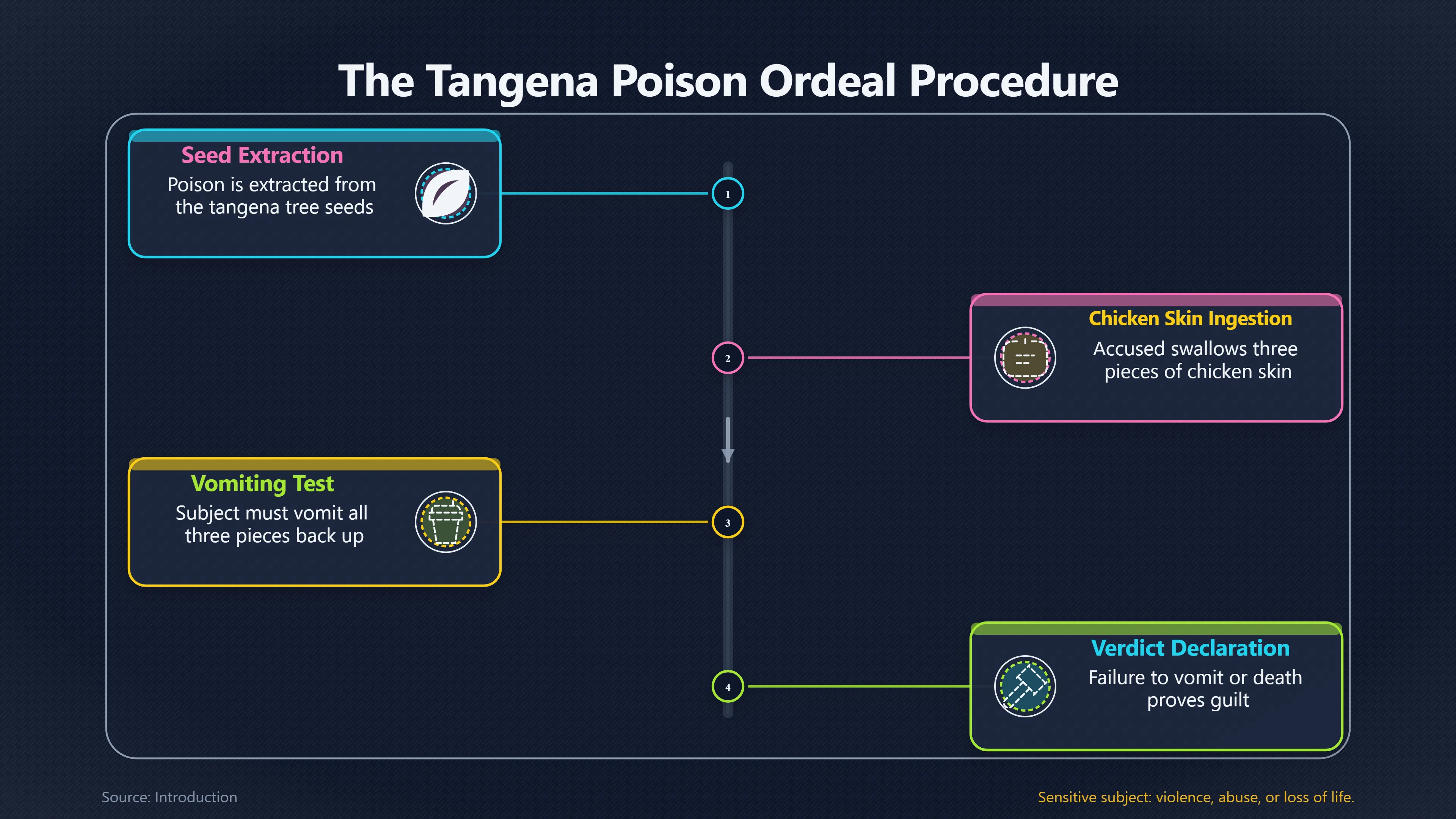
The Tangena ordeal centred on poison extracted from the seeds of the tangena tree (Cerbera manghas), whose toxins interfere with the heart and can cause fatal cardiac arrest. The accused typically swallowed the poison after ingesting three pieces of chicken skin. If all three pieces were vomited back up, innocence was declared. Death, failure to vomit all three pieces or inability to complete the ritual was interpreted as proof of guilt.[Wikipedia]WikipediaOpen source on wikipedia.org.
To modern readers the procedure appears arbitrary, but within the Merina kingdom it rested on a widespread belief that supernatural justice would protect the innocent. Contemporary Malagasy traditions described the ordeal not merely as poisoning but as an oath in which divine forces would reveal hidden truth. This belief was powerful enough that even some people convinced of their innocence reportedly accepted the ordeal voluntarily, trusting that justice would prevail despite its obvious dangers.[Wikipedia]WikipediaOpen source on wikipedia.org.
Although poison ordeals existed elsewhere in Africa and beyond, Tangena was unusual because it became integrated into the kingdom’s formal judicial system. The state treated the ordeal as legitimate evidence rather than as a private religious ritual.
Why witchcraft accusations became a tool of government
Historian Stephen Ellis argues that the persecutions under Ranavalona I are best understood as political action conducted through the language of witchcraft. Allegations of harmful supernatural power—known in Merina society as mosavy—identified people considered threats to the social and political order. Rather than targeting only supposed sorcerers, accusations increasingly reached those viewed as disloyal or disruptive.[African Studies Centre Leiden]ascleiden.nlwitch hunting central madagascarAfrican Studies Centre LeidenWitch-hunting in central Madagascar 1828-1861 | African Studies Centre Leiden…
During Ranavalona’s reign, the categories of people subjected to Tangena expanded to include:
- People accused of witchcraft.
- Suspected thieves and other alleged criminals.
- Political rivals and opponents.
- Christians suspected of placing loyalty to a foreign religion above loyalty to the crown.
- Individuals caught up in wider investigations affecting families or entire communities.[Wikipedia]WikipediaRanavalona IRanavalona I
The result was that supernatural accusation became inseparable from governance. Instead of merely responding to rumours of witchcraft, the state actively employed those accusations to strengthen royal authority and suppress perceived challenges.
Why officials and accusers benefited
The Tangena system endured not simply because people believed in it, but because influential groups could profit from it.
Those found guilty often lost their property, with confiscated wealth divided between the state and those who had brought the accusation. This created incentives for false accusations arising from personal disputes, inheritance conflicts or local rivalries. Earlier safeguards limiting malicious accusations weakened over time, making abuse easier. Ellis argues that these material incentives help explain why witch-hunting expanded so dramatically during the period.[African Studies Centre Leiden]ascleiden.nlwitch hunting central madagascarAfrican Studies Centre LeidenWitch-hunting in central Madagascar 1828-1861 | African Studies Centre Leiden…
Officials also benefited politically. The ordeal provided an apparently objective method of resolving difficult cases without relying on witness testimony or lengthy investigations. Because the verdict was attributed to supernatural judgement rather than human decision-making, responsibility for executions appeared to rest with divine justice instead of individual officials.
This combination of sincere religious belief, legal authority and financial reward transformed Tangena from an occasional judicial practice into an efficient instrument of state control.
From justice to state terror
Under Ranavalona I, Tangena reached an unprecedented scale. Earlier Merina rulers had used poison ordeals, but the nineteenth century saw their application broaden dramatically. Contemporary estimates suggest that between 20 and 50 per cent of those forced to undergo the ordeal died, either immediately or soon afterwards from poisoning.[Wikipedia]WikipediaOpen source on wikipedia.org.
Nineteenth-century reports estimated around 1,000 deaths annually before Ranavalona’s accession, rising to roughly 3,000 per year during her reign. Some contemporary observers claimed that as many as 100,000 people in Imerina died through Tangena in 1838 alone, representing around one-fifth of the region’s population. These figures remain highly controversial because they rely on nineteenth-century estimates rather than comprehensive demographic records, but historians broadly agree that mortality reached an extraordinary scale and affected families throughout the central highlands.[Wikipedia]WikipediaOpen source on wikipedia.org.
The campaign also intersected with the persecution of Christianity. Missionary accounts document executions, imprisonment, exile and compulsory poison ordeals for converts who refused to abandon their faith. Modern scholarship treats missionary casualty figures cautiously because many accounts were written by opponents of the regime, yet there is broad agreement that Christians were among the groups most frequently targeted by Tangena during periods of intensified repression.[Cambridge University Press & Assessment]cambridge.orgCambridge University Press & AssessmentRe-Reading Missionary Publications: The Case of European and Malagasy Martyrologies, 1837-1937 | S…
Was this a witch panic or organised persecution?
Describing Tangena simply as “mass hysteria” obscures how the system actually worked.
Several features distinguish it from a spontaneous witch panic:
- The monarchy officially authorised the ordeal.
- Royal officials supervised its administration.
- Courts accepted the outcome as legally binding.
- Confiscation of property rewarded successful accusations.
- The targets extended well beyond alleged witches to include political and religious opponents.[African Studies Centre Leiden]ascleiden.nlwitch hunting central madagascarAfrican Studies Centre LeidenWitch-hunting in central Madagascar 1828-1861 | African Studies Centre Leiden…
That does not mean popular belief was unimportant. The ordeal depended on widespread confidence that supernatural forces would reveal guilt. Without that shared belief, the state’s claims to legitimacy would have been much harder to sustain. The persecution therefore combined genuine religious conviction with deliberate political exploitation.
Abolition, memory and disputed death tolls
The Tangena ordeal was formally abolished in 1863 under King Radama II. One symbolic reform declared that those who had died through the ordeal should no longer be regarded as guilty of sorcery, allowing families to rebury relatives in ancestral tombs with honour. Contemporary accounts describe widespread reinterments because so many households had lost family members through the poison trials.[Wikipedia]WikipediaOpen source on wikipedia.org.
The practice did not disappear immediately. Reports indicate that poison ordeals continued secretly in parts of the central highlands and more openly elsewhere despite the official ban. Later rulers reaffirmed the prohibition, signalling that the state no longer recognised Tangena as a legitimate form of justice.[Wikipedia]WikipediaOpen source on wikipedia.org.
Historians also continue to debate the overall human cost. Older works often repeated dramatic claims that Madagascar’s population halved during Ranavalona’s reign, attributing the decline to Tangena alongside warfare, forced labour, disease and slavery. More recent scholarship treats these demographic estimates with caution, arguing that nineteenth-century population figures are too uncertain to support precise calculations. While the exact death toll remains disputed, there is little disagreement that Tangena was one of the deadliest judicial practices in Madagascar’s recorded history.[Wikipedia]WikipediaRanavalona IRanavalona I
Why the Tangena ordeal remains important
The Tangena ordeal remains central to understanding Madagascar’s history because it demonstrates how fear of hidden supernatural harm can be transformed into an instrument of government. Rather than arising from uncontrolled public panic, the persecutions drew their power from the partnership between widely shared beliefs and state institutions capable of enforcing them.
For historians of witch-hunting, Tangena offers an important comparison with the better-known European witch trials. Both relied on beliefs about invisible evil, but Madagascar’s poison ordeal shows how a government could institutionalise those beliefs through an officially sanctioned judicial procedure that simultaneously reinforced political authority, redistributed wealth and eliminated perceived enemies. It stands as one of the clearest examples of state-directed witch persecution in nineteenth-century Africa.

Amazon book picks
Further Reading
Books and field guides related to How a Poison Ordeal Became State Terror. Use these as the next step if you want deeper reading beyond the article.

The Spirit Catches You and You Fall Down
Helps explain differing interpretations of illness and possession.

The anthropology of religion, magic, and witchcraft
Explains belief, ritual and accusations in comparative perspective.
A History of Madagascar
Explains the Tangena ordeal within nineteenth-century Madagascar.
The Island of Madagascar: A History
Covers royal justice, belief and colonial interpretations.
Endnotes
1.
Source: Wikipedia
Link:https://en.wikipedia.org/wiki/Tangena
2.
Source: Wikipedia
Title: Ranavalona I
Link:https://en.wikipedia.org/wiki/Ranavalona_I
3.
Source: cambridge.org
Link:https://www.cambridge.org/core/journals/studies-in-church-history-subsidia/article/abs/rereading-missionary-publications-the-case-of-european-and-malagasy-martyrologies-18371937/81FC0965C75C07B156FA423869196E50
Source snippet
Cambridge University Press & AssessmentRe-Reading Missionary Publications: The Case of European and Malagasy Martyrologies, 1837-1937 | S...
4.
Source: ascleiden.nl
Title: witch hunting central madagascar 1828 1861
Link:https://www.ascleiden.nl/publications/witch-hunting-central-madagascar
Source snippet
African Studies Centre LeidenWitch-hunting in central Madagascar 1828-1861 | African Studies Centre Leiden...
5.
Source: military-history.fandom.com
Title: Ranavalona I
Link:https://military-history.fandom.com/wiki/Ranavalona_I
Source snippet
I | Military Wiki | FandomPRESERVATION AND EXPANSION OF REALM File:Madagascar-expansion of Merina rule under Ranavalona I.png Extent an...
Additional References
6.
Source: everything.explained.today
Link:https://everything.explained.today/Ranavalona_I/
Source snippet
I ExplainedREIGN Ranavalona's 33-year reign was characterized by her effort to strengthen the domestic authority of the Kingdom of Imerin...
7.
Source: historychronicler.com
Title: Ranavalona the Cruel: The Mad Queen of Madagascar
Link:https://historychronicler.com/ranavalona-the-cruel-the-mad-queen-of-madagascar/
Source snippet
History ChroniclerDecember 18, 2025 — RANAVALONA THE CRUEL: THE MAD QUEEN OF MADAGASCAR ByKevin Eberle December 18, 2025April 7, 2026 0 C...
Published: December 18, 2025
8.
Source: historyatlas.com
Title: on madagascar the reign of queen ranavalona
Link:https://www.historyatlas.com/events/on-madagascar-the-reign-of-queen-ranavalona/
Source snippet
1835 CE: The reign of Madagascarene Queen Ranavalona I (Ranavalona the Cruel), … | History AtlasTHE REIGN OF MADAGASCARENE QUEEN RANAVALO...
9.
Source: everything.explained.today
Link:https://everything.explained.today/Tangena/
Source snippet
The trial utilized seeds of the tree species Cerbe...
10.
Source: youtube.com
Title: The Most Cruel And Evil Female Dictator in African History
Link:https://www.youtube.com/watch?v=_nviTMcXBe0
Source snippet
The Horrific Reign of Ranavalona I of Madagascar...
11.
Source: youtube.com
Title: Ranavalona Madagascar’s Forgotten Evil Queen
Link:https://www.youtube.com/watch?v=BkGzdY_q5fI
Source snippet
The Most Cruel And Evil Female Dictator in African History - Queen Ranavalona I of Madagascar...
12.
Source: academic.oup.com
Link:https://academic.oup.com/book/44040/chapter-abstract/373133321
Source snippet
oup.comWitch-Hunting in Central Madagascar 1828–1861Madagascar 1828–1861 | Charlatans, Spirits and Rebels in Africa: The Stephen Ellis Re...
13.
Source: africabib.org
Link:https://africabib.org/rec.php?DB=p&RID=243945655
Source snippet
Witch-Hunting in Central Madagascar, 1828-1861Title: | Witch-Hunting in Central Madagascar, 1828-1861 Author: | Ellis, Stephe...
15.
Source: youtube.com
Title: Queen Ranavalona I of Madagascar
Link:https://www.youtube.com/watch?v=u_JZm4-FT64
Source snippet
Ranavalona Madagascar's Forgotten Evil Queen...
Topic Tree