Within Burkina Faso
Can Women Accused of Witchcraft Return Home?
Refuge centres can prevent immediate violence, but lasting safety depends on mediation, livelihoods and acceptance back home.
On this page
- Life inside refuge centres such as Delwende
- Why shelter can make exile permanent
- Mediation, reintegration and legal protection
Page outline Jump by section
Introduction
For women in Burkina Faso who are driven from their homes after being accused of witchcraft, reaching a refuge centre is often the difference between life and death. It is not, however, the end of the story. Shelters can provide physical safety, food, medical care and a community of people with similar experiences, but they cannot by themselves repair broken family relationships or remove the stigma that made exile necessary. The greatest challenge is often not escaping violence but deciding whether it is safe—or even possible—to return home. Research on Burkina Faso’s reception centres shows that long-term protection depends on careful mediation with families, economic independence and sustained local support, yet many women remain permanently displaced despite these efforts.[Global Africa]globalafricasciences.orgGlobal Africaart-10-07-en | GA SciencesJune 20, 2025…
Life inside refuge centres such as Delwende
The best-known shelter is the Delwende Centre in Ouagadougou, operated by the Roman Catholic Church with support from public authorities and humanitarian partners. Since the 1960s it has provided refuge for hundreds of women expelled from their communities after accusations that they had caused deaths, illness or other misfortune through witchcraft. Human rights reports over many years have described Delwende as a place where women seek safety because returning immediately to their villages could expose them to assault or even death.[Refworld]refworld.org2012 Country Reports on Human Rights Practices - Burkina Faso | Refworld…
Life in these centres extends well beyond emergency accommodation. Residents commonly receive:
- food, clothing and basic healthcare;
- emotional and social support from staff and other residents;
- assistance obtaining identity documents or public services;
- opportunities to take part in income-generating activities such as gardening, small-scale agriculture or craft production.
Recent field research argues that successful centres function as “protective spaces” rather than simple shelters. They create new social networks and practical knowledge that help women regain dignity after exclusion. Some programmes deliberately link residents to local social and solidarity economy projects so that they can earn an income instead of remaining entirely dependent on charity.[Global Africa]globalafricasciences.orgGlobal Africaart-10-07-en | GA SciencesJune 20, 2025…
Why shelter can make exile permanent
The existence of a safe refuge also reveals a difficult reality. Many women stay for years, sometimes for the rest of their lives.
This is not usually because they prefer institutional life. Instead, returning home may still be dangerous. Family members who initiated the accusation may refuse reconciliation, neighbours may continue to believe the allegations, and local leaders may fear renewed conflict if the woman comes back. Even where no immediate violence is expected, persistent suspicion can make everyday life impossible.[Global Africa]globalafricasciences.orgGlobal Africaart-10-07-en | GA SciencesJune 20, 2025…
Older women face additional obstacles. Many arrive after losing their homes, farmland or inheritance. If property has already been redistributed among relatives, returning may reopen disputes over land and family authority. Widows or women without influential relatives often have few people willing to advocate for them. In these circumstances, remaining in a shelter may appear safer than attempting an uncertain return.[Refworld]refworld.org2012 Country Reports on Human Rights Practices - Burkina Faso | Refworld…
Researchers therefore describe a paradox: the shelter protects people from immediate harm but can also become evidence that they no longer belong in their original community. Safety is achieved, but social exclusion continues.[Global Africa]globalafricasciences.orgGlobal Africaart-10-07-en | GA SciencesJune 20, 2025…

Can women accused of witchcraft return home?
Return is possible in some cases, but it is rarely straightforward.
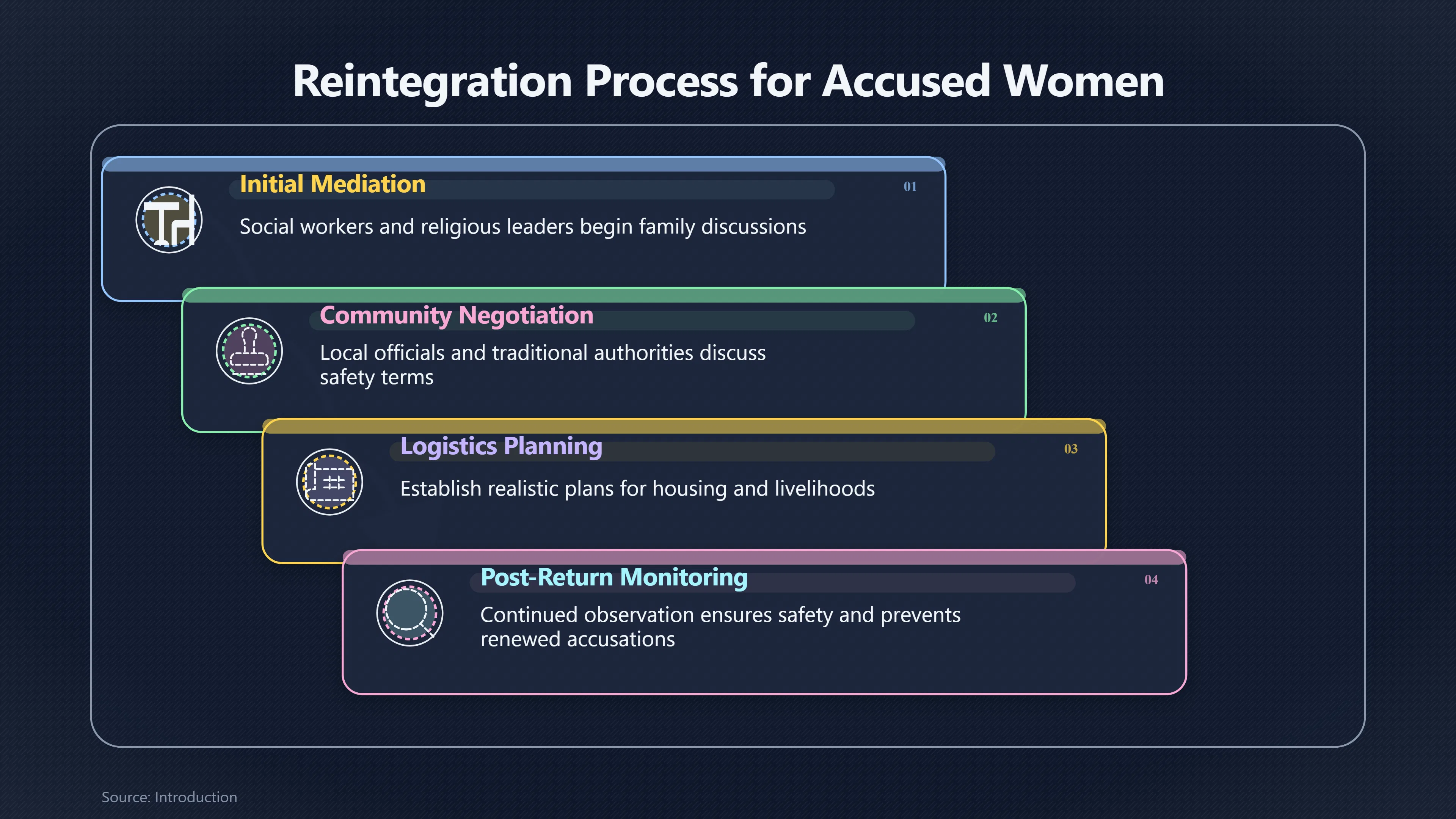
Successful reintegration usually depends on prolonged negotiation rather than a single decision. Social workers, religious leaders, local officials and respected traditional authorities may spend months discussing the case with relatives and village leaders before a return is considered safe. The aim is not simply to transport someone home but to reduce the risk that accusations will resume after they arrive.[Refworld]refworld.org2010 Country Reports on Human Rights Practices - Burkina Faso | RefworldApril 8, 2011…
Several conditions tend to improve the chances of reintegration:
- relatives willing to publicly accept the woman’s return;
- mediation involving trusted local leaders;
- realistic plans for housing and livelihoods;
- continued monitoring after resettlement;
- community education challenging violence against accused women.
Even under favourable conditions, outcomes remain mixed. Long-term research in Burkina Faso concludes that reintegration projects have achieved important individual successes but have not eliminated the social isolation and stigma experienced by many former residents.[ProGRES]progres.ujkz.gov.bfPro GRESPro GRESPro GRESPro GRES
Mediation, reintegration and legal protection
Burkina Faso has increasingly recognised that protecting accused women requires more than emergency shelter.
Government ministries have worked with churches, charities and local organisations on public awareness campaigns, mediation initiatives and support for reception centres. Human rights reporting has also documented official efforts to educate communities about the harm caused by witchcraft accusations and to encourage negotiated reconciliation where possible.[Refworld]refworld.org2010 Country Reports on Human Rights Practices - Burkina Faso | RefworldApril 8, 2011…
Legal reforms have strengthened protection against abuse. Legislation introduced in the mid-2010s made the physical or psychological abuse of women accused of witchcraft a criminal offence. While this created an important legal framework, enforcement remains difficult because many victims are reluctant to report relatives, fear retaliation or believe that formal prosecution would permanently destroy family relationships.[Refworld]refworld.org2015 Country Reports on Human Rights Practices - Burkina Faso | Refworld…
The law therefore operates alongside social mediation rather than replacing it. Criminal sanctions may deter violence, but rebuilding trust usually depends on local negotiation and gradual changes in community attitudes.

The limits of protection
Recent scholarship argues that the central lesson from Burkina Faso’s shelters is that protection is a process rather than a place.
Emergency refuge can prevent immediate violence, but lasting security depends on rebuilding social relationships, restoring economic independence and creating local networks willing to defend returning women against renewed accusations. Where these wider conditions are absent, shelters risk becoming permanent communities of exile rather than temporary places of recovery.[Global Africa]globalafricasciences.orgGlobal Africaart-10-07-en | GA SciencesJune 20, 2025…
This helps explain why the history of witchcraft accusations in Burkina Faso cannot be understood simply through the number of women living in centres such as Delwende. The more revealing question is how many are able to leave safely. Current evidence suggests that while shelters save lives and innovative reintegration programmes have improved prospects for some residents, returning home remains one of the most difficult and uncertain stages of protection.[ProGRES]progres.ujkz.gov.bfPro GRESPro GRESPro GRESPro GRES
Amazon book picks
Further Reading
Books and field guides related to Can Women Accused of Witchcraft Return Home?. Use these as the next step if you want deeper reading beyond the article.

The Spirit Catches You and You Fall Down
First published 1997. Subjects: Asian Americans, Attitude, Attitude of Health Personnel, Child, Communication.

The Penguin book of witches
First published 2014. Subjects: Witchcraft, History, Witchcraft, europe.
Half the sky
First published 2009. Subjects: Sociology, New York Times bestseller, Crimes against, Case studies, Nonfiction.
Endnotes
1.
Source: refworld.org
Link:https://www.refworld.org/reference/annualreport/usdos/2013/en/95113
Source snippet
2012 Country Reports on Human Rights Practices - Burkina Faso | Refworld...
2.
Source: refworld.org
Link:https://www.refworld.org/reference/annualreport/usdos/2016/en/109855
Source snippet
2015 Country Reports on Human Rights Practices - Burkina Faso | Refworld...
3.
Source: refworld.org
Link:https://www.refworld.org/reference/annualreport/usdos/2011/en/78815
Source snippet
2010 Country Reports on Human Rights Practices - Burkina Faso | RefworldApril 8, 2011...
Published: April 8, 2011
4.
Source: globalafricasciences.org
Title: Global Africaart-10-07-en | GA Sciences
Link:https://www.globalafricasciences.org/issue-10/art-10-07-en
Source snippet
June 20, 2025...
Published: June 20, 2025
5.
Source: progres.ujkz.gov.bf
Title: Pro GRESPro GRES
Link:https://progres.ujkz.gov.bf/publications/11153/details
6.
Source: globalafricasciences.org
Title: art-10-07-en | GA Sciences
Link:https://www.globalafricasciences.org/fr/issue-10/art-10-07-en
Source snippet
June 20, 2025 — Critical issues SHELTERS FOR “WITCHES”, SAFE SPACES AND PRODUCERS OF PROTECTIVE KNOWLEDGE: THE SOCIAL REINTEGRATION OF PE...
Published: June 20, 2025
8.
Source: burkinafaso.un.org
Link:https://burkinafaso.un.org/fr/315456-au-centre-delwend%C3%A9-de-sakoula-onu-femmes-et-unfpa-redonnent-espoir-aux-femmes-victimes-d
Source snippet
Centre Delwendé de Sakoula, ONU Femmes et UNFPA redonnent espoir aux femmes victimes d’exclusion sociale | Les Nations Unies au Burkina F...
9.
Source: cjpburkina.org
Link:https://cjpburkina.org/2026/03/19/reinsertion-sociale-si-les-accusations-de-sorcellerie-touchent-majoritairement-les-femmes-les-hommes-aussi-en-sont-victimes-lhistoire-de-ouedraogo-moussa-nom-demprunt-en-est-un/
Source snippet
L’histoire de Ouédraogo Moussa (nom d’emprunt) en est une illustration poignante. - CJP BURKINAMarch 19, 2026 — RÉINSERTION SOCIALE: SI...
Published: March 19, 2026
10.
Source: youtube.com
Title: ‘Witchcraft’ in Africa: Many women find it hard to prove innocence
Link:https://www.youtube.com/watch?v=wV0ubcWkC4k
Source snippet
Ghana: Accused of witchcraft, hundreds of women banished to camps • FRANCE 24 English...
11.
Source: youtube.com
Link:https://www.youtube.com/watch?v=UzmXXWPIAXU
Source snippet
Inside Ghana's last 'witch camps' • FRANCE 24 English...
12.
Source: youtube.com
Title: Young Woman Shelters Elderlies Accused Of Witchcraft
Link:https://www.youtube.com/watch?v=fc1QdZVkIj8
Source snippet
Inside Kukuo witches camp: "My son only came to check if I was dead."...
13.
Source: youtube.com
Title: Inside Ghana’s last ‘witch camps’ • FRANCE 24 English
Link:https://www.youtube.com/watch?v=didjLZkEoRI
Source snippet
Young Woman Shelters Elderlies Accused Of Witchcraft...
14.
Source: researchgate.net
Link:https://www.researchgate.net/publication/392978088_Je_ne_veux_pas_mourir_ici_Perception_de_la_mort_chez_les_femmes_accusees_de_sorcellerie_vivant_dans_les_centres_d%27accueil_au_Burkina_Faso
15.
Source: ecoi.net
Link:https://www.ecoi.net/de/dokument/1028439.html
16.
Source: youtube.com
Title: Inside Kukuo witches camp: “My son only came to check if I was dead.”
Link:https://www.youtube.com/watch?v=uxD-6AeM8Vk
17.
Source: horizon.documentation.ird.fr
Title: Horizon Documentationمعارف وقائّيّة، ومعرفة وسائل
Link:https://horizon.documentation.ird.fr/exl-doc/pleins_textes/2025-10/010094697.pdf
Topic Tree