Within Dutch Panics
Was Tulip Mania Really a National Delusion?
Tulip prices really surged and collapsed, but later writers transformed a limited trading craze into a legend of nationwide ruin.
On this page
- What happened in the winter market
- Who actually traded and lost money
- How satire became accepted history
Page outline Jump by section
Introduction
Tulip Mania is often presented as the classic example of an entire nation succumbing to irrational collective madness. According to the familiar story, ordinary Dutch people abandoned common sense, paid absurd sums for tulip bulbs, and then watched their country descend into financial ruin when prices collapsed in 1637. Modern historical research paints a much more complicated picture. There really was a speculative boom in rare tulip bulbs, and prices for some varieties reached extraordinary levels before falling sharply. However, the idea that the Netherlands as a whole was gripped by a nationwide delusion is largely a later creation, built from satire, moralising literature and repeated retellings rather than contemporary evidence.[degruyterbrill.com]degruyterbrill.comDe Gruyter Brill TulipmaniaDe Gruyter BrillTulipmania…September 15, 2008…
For the history of collective beliefs and panics in the Netherlands, Tulip Mania is therefore valuable not only as a case of speculative excitement but also as an example of how myths about mass irrationality can become more influential than the historical events themselves.
What happened in the winter market?
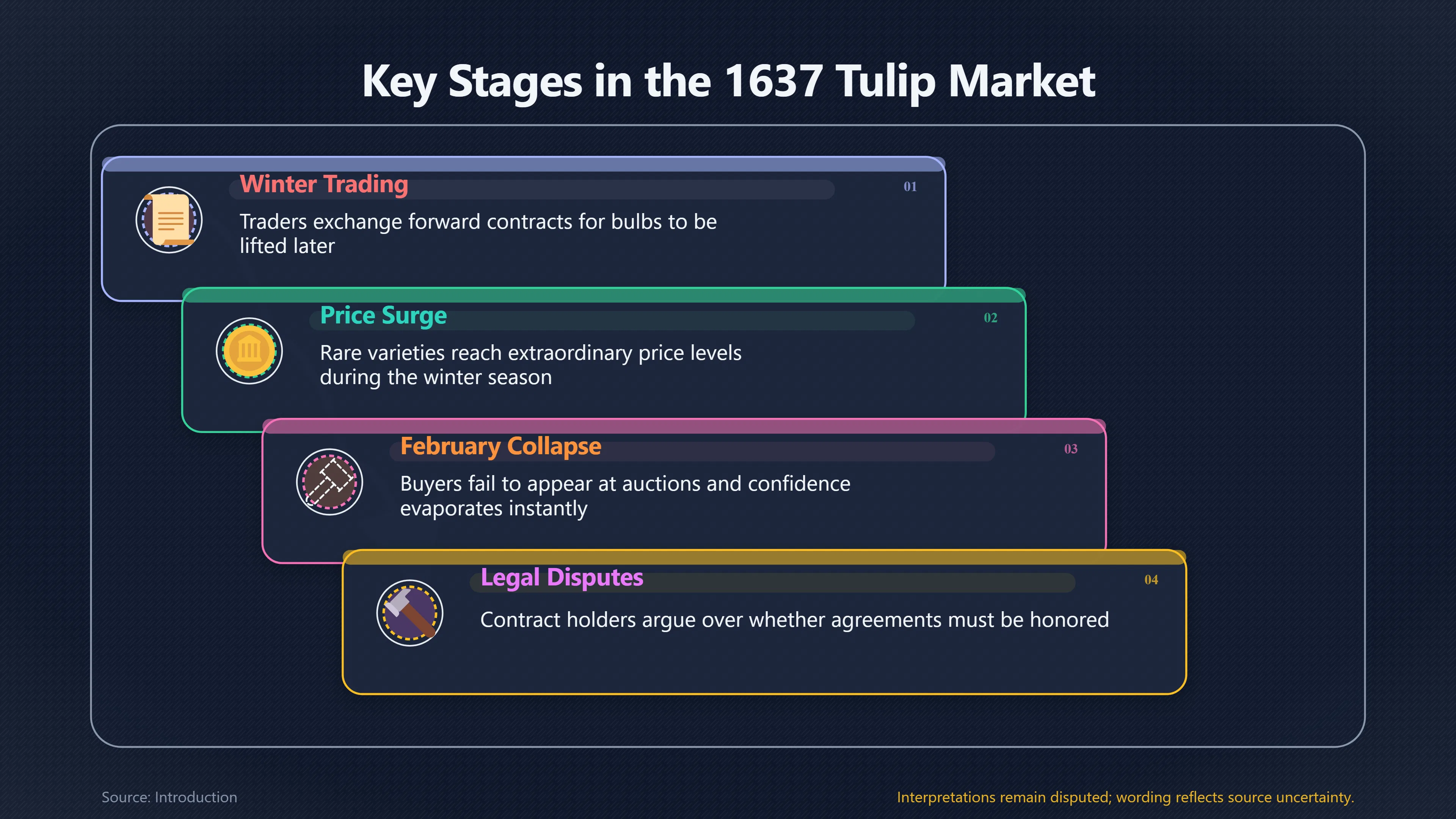
The famous boom occurred during the winter of 1636–37, when traders bought and sold contracts for tulip bulbs that would only be lifted from the ground months later. These were effectively forward contracts rather than exchanges of physical flowers. Rare tulip varieties had already become luxury goods because they were difficult to reproduce, fashionable among wealthy collectors, and prized for unusual colour patterns created by mosaic viruses affecting the bulbs.[Chicago Journals]journals.uchicago.eduChicago Journals Tulipmania | Journal of Political Economy: Vol 97, No 3Chicago Journals Tulipmania | Journal of Political Economy: Vol 97, No 3
During the winter trading season, prices for some of the most sought-after varieties rose rapidly. In early February 1637, buyers at several auctions suddenly failed to appear or refused previously agreed prices. Confidence evaporated and prices fell just as quickly as they had risen. The collapse disrupted outstanding contracts and led to legal disputes over whether buyers had to honour agreements, but it did not produce the nationwide economic collapse described in many later accounts.[uchicago.edu]journals.uchicago.eduChicago Journals Tulipmania | Journal of Political Economy: Vol 97, No 3Chicago Journals Tulipmania | Journal of Political Economy: Vol 97, No 3
The speculative phase itself lasted only a short time. It was not a decades-long frenzy but an intense winter market concentrated in a limited period before the trading system broke down.
Who actually traded and lost money?
One of the biggest misconceptions is that everyone in Dutch society—from labourers to aristocrats—joined the speculation.
Archival research by historian Anne Goldgar tells a different story. By examining surviving contracts, probate records and commercial documents, she found that participants were largely merchants, skilled craftsmen and other relatively prosperous townspeople with established commercial connections. The market was socially narrow rather than national in scope.[degruyterbrill.com]degruyterbrill.comDe Gruyter Brill TulipmaniaDe Gruyter BrillTulipmania…September 15, 2008…
Several important points emerge from the evidence:
- Most Dutch people never traded tulips at all.
- The highest prices were paid for exceptionally rare bulbs rather than ordinary flowers.
- Much trading involved contracts instead of immediate cash payments.
- Few documented bankruptcies can be directly linked to the collapse.
- There is little evidence that Dutch commerce, banking or industry suffered lasting damage.[degruyterbrill.com]degruyterbrill.comDe Gruyter Brill TulipmaniaDe Gruyter BrillTulipmania…September 15, 2008…
This does not mean nobody lost money. Some traders undoubtedly suffered significant losses, particularly those holding expensive contracts when confidence disappeared. But the financial damage appears to have been concentrated among a relatively small commercial network rather than spread across Dutch society.
How satire became accepted history
The enduring legend owes much to the way contemporaries responded to the speculation.
When prices collapsed, Dutch writers produced satirical pamphlets, songs and illustrated broadsheets mocking speculators for greed and social ambition. These works were not neutral reporting. They were moral commentaries intended to ridicule people who appeared to value quick wealth over honest work. Exaggeration was part of their purpose.[Oxford Historical Society]history.ox.ac.ukOpen source on ox.ac.uk.
The decisive transformation came much later. In the nineteenth century, Scottish journalist Charles Mackay incorporated these satirical sources into his enormously influential book Extraordinary Popular Delusions and the Madness of Crowds. Mackay treated colourful anecdotes as straightforward history, helping establish the image of an entire nation driven insane by flowers. Because his book remained widely read, later writers repeated the same stories with little investigation of the original evidence.[ox.ac.uk]history.ox.ac.ukOpen source on ox.ac.uk.
As a result, satire gradually acquired the authority of historical fact. Stories of people exchanging houses for bulbs, universal bankruptcy and national ruin became embedded in popular culture despite weak documentary support.
Was it really a speculative bubble?
Modern historians and economists broadly agree that prices rose to extraordinary levels and that speculation occurred. Where they differ is in explaining why.
Economist Peter Garber argues that much of the price movement reflected features of markets for rare luxury goods. New and fashionable flower varieties often command exceptionally high prices before becoming more widely available, and this pattern has appeared repeatedly in horticultural markets. Garber accepts that the final weeks of trading may represent a genuine speculative bubble but questions whether the entire episode should be treated as irrational mass behaviour.[Chicago Journals]journals.uchicago.eduChicago Journals Tulipmania | Journal of Political Economy: Vol 97, No 3Chicago Journals Tulipmania | Journal of Political Economy: Vol 97, No 3
Anne Goldgar approaches the subject from cultural history rather than economics. She argues that the most revealing aspect was not financial collapse but what tulips represented within Dutch Golden Age society. Rare bulbs became symbols of status, learning, taste and participation in elite social networks. The controversy reflected wider anxieties about commerce, wealth and changing social values rather than simple greed.[De Gruyter Brill]degruyterbrill.comDe Gruyter Brill TulipmaniaDe Gruyter BrillTulipmania…September 15, 2008…
These interpretations differ in emphasis, but both reject the familiar image of universal national madness.

Why the myth proved so durable
The story survived because it is unusually useful as a moral lesson.
It appears to demonstrate several appealing ideas at once:
- Markets can become detached from reality.
- Crowds are easily swept into irrational behaviour.
- Luxury and speculation invite punishment.
- Economic booms contain the seeds of their own collapse.
These themes have made Tulip Mania an irresistible comparison whenever later bubbles emerge, from railway shares to internet stocks, cryptocurrencies and other speculative assets. Yet historians increasingly caution against treating the Dutch episode as a simple template for every modern boom. The historical evidence suggests a much smaller, more localised market than the legend implies.[history.com]history.comThe Real Story Behind the 17th-Century ‘Tulip Mania’ Financial Crash | HISTORYThe Real Story Behind the 17th-Century ‘Tulip Mania’ Financial Crash | HISTORY…
Ironically, the real example of contagious belief may be the story itself. Once Mackay’s dramatic narrative entered popular culture, it was repeated in textbooks, journalism and financial commentary for generations, often without returning to seventeenth-century records.
What Tulip Mania tells us about collective belief
Within the broader history of Dutch collective beliefs and social scares, Tulip Mania occupies an unusual place. Unlike witch persecutions or moral panics, it did not involve widespread persecution or fear of hidden enemies. Instead, its significance lies in the gap between documented events and later memory.
The historical episode involved a genuine speculative surge among a limited circle of traders, followed by a rapid market collapse and legal uncertainty over contracts. The later legend transformed this into a national morality play about irrational crowds and economic catastrophe. Modern scholarship therefore treats Tulip Mania as both a real financial episode and a cautionary example of how satire, repetition and selective storytelling can create one of history’s most enduring myths about collective irrationality.[degruyterbrill.com]degruyterbrill.comDe Gruyter Brill TulipmaniaDe Gruyter BrillTulipmania…September 15, 2008…
Amazon book picks
Further Reading
Books and field guides related to Was Tulip Mania Really a National Delusion?. Use these as the next step if you want deeper reading beyond the article.
Extraordinary Popular Delusions and the Madness of Crowds
Rating: 4.0/5 from 5 Google Books ratings
Historically influential account that shaped the tulip mania narrative.

Manias, panics, and crashes
Places tulip speculation within the history of financial manias.


Endnotes
1.
Source: degruyterbrill.com
Title: De Gruyter Brill Tulipmania
Link:https://www.degruyterbrill.com/document/doi/10.7208/9780226301303/html
Source snippet
De Gruyter BrillTulipmania...September 15, 2008...
Published: September 15, 2008
2.
Source: history.com
Title: The Real Story Behind the 17th-Century ‘Tulip Mania’ Financial Crash | HISTORY
Link:https://www.history.com/articles/tulip-mania-financial-crash-holland
Source snippet
The Real Story Behind the 17th-Century ‘Tulip Mania’ Financial Crash | HISTORY...
3.
Source: journals.uchicago.edu
Title: Chicago Journals Tulipmania | Journal of Political Economy: Vol 97, No 3
Link:https://www.journals.uchicago.edu/doi/10.1086/261615
4.
Source: history.ox.ac.uk
Link:https://www.history.ox.ac.uk/tulipmania-garden-historians-perspective
5.
Source: aeaweb.org
Title: American Economic Association Famous First Bubbles
Link:https://www.aeaweb.org/articles?id=10.1257%2Fjep.4.2.35
Source snippet
American Economic AssociationFamous First Bubbles - American Economic Association...
6.
Source: Wikipedia
Title: Tulip mania
Link:https://en.wikipedia.org/wiki/Tulip_mania
7.
Source: press.uchicago.edu
Link:https://press.uchicago.edu/ucp/books/book/chicago/T/bo5414939.html
8.
Source: guides.loc.gov
Title: tulip mania
Link:https://guides.loc.gov/business-booms-busts/tulip-mania
Source snippet
Highsmith, photographer. Tulip beds at Longwood Gardens in Kennett Square, Pennsylvania, one of...
9.
Source: historyguild.org
Title: Tulip mania: the classic story of a Dutch financial bubble is mostly wrong
Link:https://historyguild.org/tulip-mania-the-classic-story-of-a-dutch-financial-bubble-is-mostly-wrong/
Source snippet
History GuildFebruary 28, 2022 — TULIP MANIA: THE CLASSIC STORY OF A DUTCH FINANCIAL BUBBLE IS MOSTLY WRONG Feb 28, 2022 Image: Tulip man...
Published: February 28, 2022
10.
Source: books.google.com
Link:https://books.google.com/books/about/Tulipmania.html?id=gViwLbCJ7X0C
11.
Source: books.google.com
Link:https://books.google.com/books/about/Tulipmania.html?id=BhkRm6f7BpsC
12.
Source: historynewsnetwork.org
Title: Forget what you know about the Tulip bubble — History News Network
Link:https://www.historynewsnetwork.org/blog/50556
13.
Source: reviews.history.ac.uk
Title: history.ac.uk Reviews in History
Link:https://reviews.history.ac.uk/review/666/print/
14.
Source: pressblog.uchicago.edu
Title: press release goldgar tulipmania
Link:https://pressblog.uchicago.edu/2007/05/23/press-release-goldgar-tulipmania.html
15.
Source: books.google.com
Link:https://books.google.com/books/about/Tulipmania.html?id=blifmAEACAAJ
16.
Source: journals.uchicago.edu
Link:https://www.journals.uchicago.edu/doi/pdfplus/10.1086/261615
17.
Source: journals.uchicago.edu
Link:https://www.journals.uchicago.edu/doi/abs/10.1086/261615?journalCode=jpe&mobileUi=0
18.
Source: openlibrary.org
Link:https://openlibrary.org/books/OL29547421M/Tulipmania
Additional References
19.
Source: youtube.com
Title: The World’s First Financial Bubble?
Link:https://www.youtube.com/watch?v=QL5-YbvmYLE
Source snippet
You can watch The Tulip Mania Myth Debunked: History's First Viral Panic to understand how Calvinist moralists and 19th-century sensation...
20.
Source: mises.org
Title: The Truth about Tulipmania | Mises Institute
Link:https://mises.org/mises-daily/truth-about-tulipmania
Source snippet
December 22, 2021 — THE TRUTH ABOUT TULIPMANIA The Truth about Tulipmania Tulipmania—the famous bubble in tulip prices in the Dutch Repub...
Published: December 22, 2021
21.
Source: youtube.com
Title: The Tulip Mania Myth Debunked: History’s First Viral Panic
Link:https://www.youtube.com/watch?v=p04WwQ5dopg
Source snippet
What happened when Dutch society became obsessed with Tulips?...
22.
Source: cambridge.org
Link:https://www.cambridge.org/core/journals/financial-history-review/article/explaining-the-timing-of-tulipmanias-boom-and-bust-historical-context-sequestered-capital-and-market-signals/20BEB345A7BB4BF2E84C07F9077361A1
23.
Source: encyclopedia.com
Link:https://www.encyclopedia.com/social-sciences/applied-and-social-sciences-magazines/great-tulip-mania
24.
Source: independent.co.uk
Link:https://www.independent.co.uk/news/world/world-history/tulip-mania-the-classic-story-of-a-dutch-financial-bubble-is-mostly-wrong-a8209751.html
25.
Source: theguardian.com
Link:https://www.theguardian.com/books/2008/oct/11/anne-goldgar
26.
Source: youtube.com
Title: What happened when Dutch society became obsessed with Tulips?
Link:https://www.youtube.com/watch?v=M2qn4zsPfiY
Source snippet
THE FLOWER THAT COST MORE THAN A HOUSE...
27.
Source: mises.org
Title: The Dutch Monetary Environment During Tulipmania | Mises Institute
Link:https://mises.org/quarterly-journal-austrian-economics/dutch-monetary-environment-during-tulipmania
28.
Source: youtube.com
Title: Tulip Mania Myth
Link:https://www.youtube.com/watch?v=hM4PHYjHHKY
Source snippet
The World's First Financial Bubble? - Tulip Mania - European History - Part 1...
Topic Tree