Within Uzbekistan
Why Unveiling Became a Life or Death Choice
The Soviet unveiling drive promised liberation but trapped women between state coercion and communal punishment.
On this page
- How the Soviet unveiling campaign began
- Honour, resistance and violence against women
- Liberation, coercion and the campaign's legacy
Page outline Jump by section
Introduction
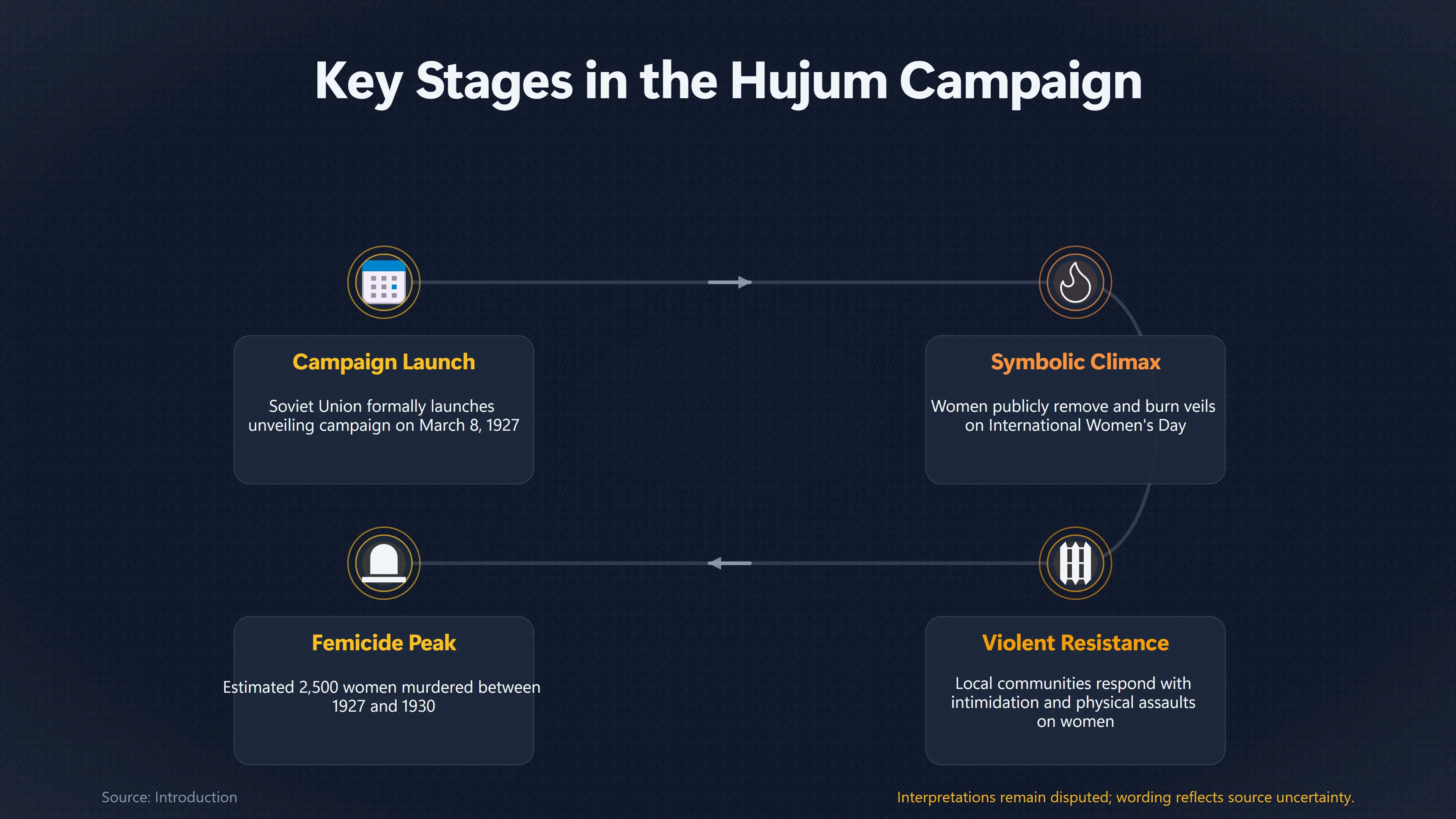
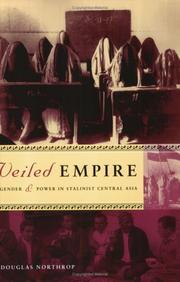
The Hujum was the Soviet Union’s campaign to end the seclusion and veiling of women in Central Asia, formally launched on 8 March 1927. In Uzbekistan, it quickly became far more than a dispute over clothing. The campaign transformed the veil into a political symbol, forcing women to choose between two powerful and often dangerous systems of authority. On one side stood a revolutionary state that treated unveiling as proof of loyalty to socialism and modernity. On the other stood families, neighbourhoods and religious leaders who increasingly viewed unveiling as a betrayal of honour, faith and community. The result was a wave of intimidation, assaults and murders that made the simple act of removing a veil a life-or-death decision for many women. Historians now regard the Hujum as both an attempt at women’s emancipation and an example of how coercive state reform could provoke violent social resistance.[Cambridge University Press & Assessment]cambridge.orgUniversity Press & Assessment Douglas NorthropVeiled Empire: Gender & Power in Stalinist Central Asia. Cornell University Press 2004. xvii pp. ISBN 0801439442. | Comparative Studies i…
How the Soviet unveiling campaign began
The Bolsheviks believed that genuine socialist transformation required changing family life as well as politics and economics. In Central Asia, officials identified women’s seclusion, limited education, child marriage, polygamy and the wearing of the full-body veil as obstacles to creating an equal socialist society. Unveiling therefore became a central objective rather than a secondary reform.[Cambridge University Press & Assessment]cambridge.orgUniversity Press & Assessment Douglas NorthropVeiled Empire: Gender & Power in Stalinist Central Asia. Cornell University Press 2004. xvii pp. ISBN 0801439442. | Comparative Studies i…
The campaign reached its symbolic climax on International Women’s Day in 1927. Across Uzbekistan, organised ceremonies encouraged women to remove and sometimes publicly burn their veils. Communist newspapers celebrated these events as evidence that women were rejecting oppression and embracing a new social order. Officials expected the dramatic public acts to trigger a rapid cultural transformation.[Wikipedia]WikipediaOpen source on wikipedia.org.
The campaign, however, underestimated the social meaning of veiling. For many families, the veil represented not merely religious observance but respectability, family honour and the boundaries between household and public life. Removing it under state pressure could therefore be interpreted as an attack on the authority of husbands, fathers and local community leaders rather than simply a personal choice about dress.[Cambridge University Press & Assessment]cambridge.orgUniversity Press & Assessment Douglas NorthropVeiled Empire: Gender & Power in Stalinist Central Asia. Cornell University Press 2004. xvii pp. ISBN 0801439442. | Comparative Studies i…
Honour, resistance and violence against women
Resistance emerged quickly and often violently. In many towns and villages, women who unveiled faced insults, threats, exclusion from their communities and physical assault. Some were forced to put the veil back on within days of public ceremonies. Others were attacked by relatives who believed they had disgraced the family or endangered its standing within the community.[Wikipedia]WikipediaOpen source on wikipedia.org.
The most extreme response was murder. Historians describe these killings as deliberate acts intended not only to punish individual women but also to frighten others into remaining veiled. The violence communicated that local patriarchal authority, rather than Soviet law, would determine acceptable female behaviour. Many perpetrators were husbands or other male relatives, although neighbours and members of local communities also participated.[ResearchGate]researchgate.netResearch Gate Femicide as terrorism: The case of uzbekistan's unveiling murdersFemicide as terrorism: The case of uzbekistan's unveiling murdersDecember 1, 2011…
Estimating the number of victims is difficult because Soviet reporting was incomplete and later historians have interpreted the archival evidence differently. Some scholars cite several hundred documented killings during the late 1920s, while others estimate that as many as 2,500 women may have been murdered between 1927 and 1930 in connection with the unveiling campaign. The higher figure remains influential in the historical literature but should be understood as an estimate rather than a universally accepted total.[ResearchGate]researchgate.netResearch Gate Femicide as terrorism: The case of uzbekistan's unveiling murdersFemicide as terrorism: The case of uzbekistan's unveiling murdersDecember 1, 2011…
Several individual murders became emblematic of the campaign’s human cost. The killing of the young actress Tursunoy Saidazimova after she embraced public life and abandoned traditional expectations became one of the Soviet state’s best-known examples of what it portrayed as “feudal” violence against women. Such cases were widely publicised in newspapers, theatre and propaganda to justify continued intervention in Central Asian society.[Wikipedia]WikipediaOpen source on wikipedia.org.

Why clothing became a battlefield over identity
The Hujum cannot be understood simply as a conflict between religious conservatives and progressive reformers. Modern historians emphasise that several different struggles overlapped.
For Soviet authorities, unveiling demonstrated that the revolution had entered everyday life and weakened traditional authority.
For many local communities, however, the campaign appeared to represent outside domination rather than voluntary liberation. Because it was organised by an officially atheist government that sought to reshape family life, resistance often reflected opposition to Soviet rule as much as attachment to particular religious practices.[Cambridge University Press & Assessment]cambridge.orgUniversity Press & Assessment Douglas NorthropVeiled Empire: Gender & Power in Stalinist Central Asia. Cornell University Press 2004. xvii pp. ISBN 0801439442. | Comparative Studies i…
The picture was also more complicated than a simple division between male opponents and female supporters. Some Uzbek women actively campaigned for education, employment and unveiling, writing in reformist publications and participating in women’s organisations. Others preferred to remain veiled or complied with the wishes of husbands and relatives because the personal risks of resistance were overwhelming. Recent scholarship has highlighted this diversity of female experiences rather than treating women as passive victims of either side.[indexacademicdocs.org]indexacademicdocs.orgThe Unveiling Campaign in Uzbekistan and Its Local SupportThe Unveiling Campaign in Uzbekistan and Its Local Support
Liberation through coercion
The Hujum remains controversial because it combined genuine reform with heavy-handed state coercion.
The campaign challenged practices that limited many women’s freedom, including restricted access to education, employment and public life. Over the following decades, women in Uzbekistan became far more visible in schools, workplaces and government institutions than they had been before Soviet rule.[indexacademicdocs.org]indexacademicdocs.orgThe Unveiling Campaign in Uzbekistan and Its Local SupportThe Unveiling Campaign in Uzbekistan and Its Local Support
At the same time, participation was rarely left entirely to individual choice. Local Communist officials monitored compliance, public ceremonies encouraged collective pressure, and family practices increasingly became tests of political loyalty. Women often found themselves caught between two coercive systems: a state demanding visible proof of emancipation and communities demanding visible proof of conformity. Rather than empowering women to choose freely, the campaign frequently transferred control over women’s appearance from families to the state.[SSRN]papers.ssrn.comThe Mask Wars and Social Control: Lessons from the 1927 Unveiling Campaign in Soviet Uzbekistan by Rob Kahn:: SSRN…
This contradiction explains why historians are reluctant to describe the Hujum simply as either liberation or oppression. It was both an attack on entrenched gender inequality and an attempt to impose revolutionary power through highly symbolic interventions in private life.[Cambridge University Press & Assessment]cambridge.orgUniversity Press & Assessment Douglas NorthropVeiled Empire: Gender & Power in Stalinist Central Asia. Cornell University Press 2004. xvii pp. ISBN 0801439442. | Comparative Studies i…
The campaign’s lasting legacy
Although the initial campaign produced fierce resistance, Soviet power gradually succeeded in transforming public life. Over subsequent decades, veiling became far less common in Uzbekistan than it had been before 1927, and women participated more widely in education, professions and political organisations. These changes resulted from a combination of state policy, urbanisation, expanding education and broader social transformation rather than the unveiling campaign alone.[Cambridge University Press & Assessment]cambridge.orgUniversity Press & Assessment Douglas NorthropVeiled Empire: Gender & Power in Stalinist Central Asia. Cornell University Press 2004. xvii pp. ISBN 0801439442. | Comparative Studies i…
The Hujum nevertheless left a lasting historical memory because it exposed the dangers of forcing rapid cultural change through state power. It demonstrated that reforms aimed at improving women’s status could themselves place women in extreme danger when governments ignored the social structures surrounding family honour, religious identity and community authority.
Within the broader history of collective fears in Uzbekistan, the Hujum is significant because it shows how symbolic politics can transform ordinary personal behaviour into a perceived existential threat. A piece of clothing became a test of loyalty, morality and identity, producing fear on both sides: Soviet leaders feared the persistence of “backward” traditions, while many local communities feared the destruction of religion, honour and established ways of life. Women bore the greatest cost of that confrontation.[cambridge.org]cambridge.orgUniversity Press & Assessment Douglas NorthropVeiled Empire: Gender & Power in Stalinist Central Asia. Cornell University Press 2004. xvii pp. ISBN 0801439442. | Comparative Studies i…
Endnotes
1.
Source: cambridge.org
Title: University Press & Assessment Douglas Northrop
Link:https://www.cambridge.org/core/journals/comparative-studies-in-society-and-history/article/douglas-northrop-veiled-empire-gender-power-in-stalinist-central-asia-cornell-university-press-2004-xvii1392-pp-isbn-0801439442/31C1865382C87AA412FDC433C4FE2A70
Source snippet
Veiled Empire: Gender & Power in Stalinist Central Asia. Cornell University Press 2004. xvii pp. ISBN 0801439442. | Comparative Studies i...
2.
Source: indexacademicdocs.org
Title: The Unveiling Campaign in Uzbekistan and Its Local Support
Link:https://www.indexacademicdocs.org/pdf/204/92780/1591880
3.
Source: Wikipedia
Link:https://en.wikipedia.org/wiki/Hujum
4.
Source: papers.ssrn.com
Link:https://papers.ssrn.com/sol3/papers.cfm?abstract_id=4220266
Source snippet
The Mask Wars and Social Control: Lessons from the 1927 Unveiling Campaign in Soviet Uzbekistan by Rob Kahn:: SSRN...
5.
Source: researchgate.net
Title: Research Gate Femicide as terrorism: The case of uzbekistan’s unveiling murders
Link:https://www.researchgate.net/publication/295711538_Femicide_as_terrorism_The_case_of_uzbekistan%27s_unveiling_murders
Source snippet
Femicide as terrorism: The case of uzbekistan's unveiling murdersDecember 1, 2011...
Published: December 1, 2011
6.
Source: researchgate.net
Title: The Unveiling Campaign in Uzbekistan and Its Local Support
Link:https://www.researchgate.net/publication/390851314_The_Unveiling_Campaign_in_Uzbekistan_and_Its_Local_Support
Source snippet
April 1, 2025 — THE UNVEILING CAMPAIGN IN UZBEKISTAN AND ITS LOCAL SUPPORT * April 2025 * Avrasya İncelemeleri Dergisi / Journal of Euras...
Published: April 1, 2025
7.
Source: cambridge.org
Link:https://www.cambridge.org/core/journals/comparative-studies-in-society-and-history/article/abs/douglas-northrop-veiled-empire-gender-power-in-stalinist-central-asia-cornell-university-press-2004-xvii1392-pp-isbn-0801439442/31C1865382C87AA412FDC433C4FE2A70
Additional References
8.
Source: dergipark.org.tr
Title: Dergipark The Unveiling Campaign in Uzbekistan and Its Local Support
Link:https://dergipark.org.tr/tr/pub/iuavid/article/1591880
Source snippet
The Unveiling Campaign in Uzbekistan and Its Local Support - Avrasya İncelemeleri DergisiApril 16, 2025 — THE UNVEILING CAMPAIGN IN UZBEK...
Published: April 16, 2025
9.
Source: youtube.com
Title: Marianne Ruth Kamp | Women’s roles in Soviet-era Uzbekistan | Rashi Podcast 4
Link:https://www.youtube.com/watch?v=55q4t6cA5Bc
Source snippet
Regime Change through Women's Liberation: The Soviets to the Bush Doctrine...
10.
Source: youtube.com
Title: Regime Change through Women’s Liberation: The Soviets to the Bush Doctrine
Link:https://www.youtube.com/watch?v=YxfggeHsmAM
Source snippet
What is Paranja? Explain Paranja, Define Paranja, Meaning of Paranja...
11.
Source: youtube.com
Title: What is Paranja? Explain Paranja, Define Paranja, Meaning of Paranja
Link:https://www.youtube.com/watch?v=QUeXg6Gb6zg
Source snippet
Rano Turaeva - Decolonizing Gender Studies in Central Asia...
12.
Source: youtube.com
Title: History of hijab and paranja in Uzbekistan
Link:https://www.youtube.com/watch?v=-EB92pCTr7M
Source snippet
Marianne Ruth Kamp | Women's roles in Soviet-era Uzbekistan | Rashi Podcast 4...
13.
Source: inlibrary.uz
Link:https://inlibrary.uz/index.php/science-research/article/view/138786
Source snippet
1927–1930-YILLARDAGI “HUJUM” HARAKATI VA PARANJI TASHLASH JARAYONINING IJTIMOIY OQIBATLARI | Modern Science and ResearchNovember 2, 2025...
Published: November 2, 2025
14.
Source: degruyterbrill.com
Link:https://www.degruyterbrill.com/document/doi/10.1515/9780295802473-009/html
15.
Source: eca.unwomen.org
Link:https://eca.unwomen.org/en/stories/press-release/2024/11/launch-of-the-regional-hearherstory-campaign-as-part-of-the-global-16-days-of-activism-against-gender-based-violence-initiative
16.
Source: cabinet.ox.ac.uk
Link:https://www.cabinet.ox.ac.uk/tubeteika-uzbekistan-0
17.
Source: youtube.com
Title: Rano Turaeva
Link:https://www.youtube.com/watch?v=X51c1khTFIo
Topic Tree