Within Fiji Belief Scares
Was the Tuka Movement Really a Cult?
The Tuka movement mixed prophecy with resistance, while colonial officials recast its political challenge as dangerous fanaticism.
On this page
- Navosavakadua's Prophecy and Political Message
- How Colonial Officials Suppressed the Movement
- Why the Cargo Cult Label Misleads
Page outline Jump by section
Introduction
The Tuka movement was one of the most important indigenous religious and political movements in colonial Fiji, yet it is often misunderstood. To British administrators in the late nineteenth century, it appeared to be a dangerous “cult” whose beliefs threatened public order. To many of its followers, however, it was a prophetic movement that promised the restoration of Fijian autonomy, dignity and spiritual authority after the upheavals of British annexation. Modern historians increasingly argue that the colonial government’s description of Tuka tells us as much about imperial fears as it does about the movement itself. Rather than viewing Tuka simply as irrational fanaticism or an early “cargo cult”, scholars now interpret it as a sophisticated form of anti-colonial resistance expressed through religion and prophecy.[dukeupress.edu]dukeupress.eduNeither Cargo nor Cult: Ritual Politics and the Colonial Imagination in FijiJune 1, 1995…
Was the Tuka Movement Really a Cult?
Calling Tuka a “cult” reflects the language of colonial officials rather than an objective description. British administrators and missionaries used the term because the movement rejected aspects of the new colonial order, challenged missionary Christianity and attracted committed followers around the prophet Navosavakadua. The label implied dangerous irrationality and helped justify surveillance, arrests and exile.[dukeupress.edu]dukeupress.eduNeither Cargo nor Cult: Ritual Politics and the Colonial Imagination in FijiJune 1, 1995…
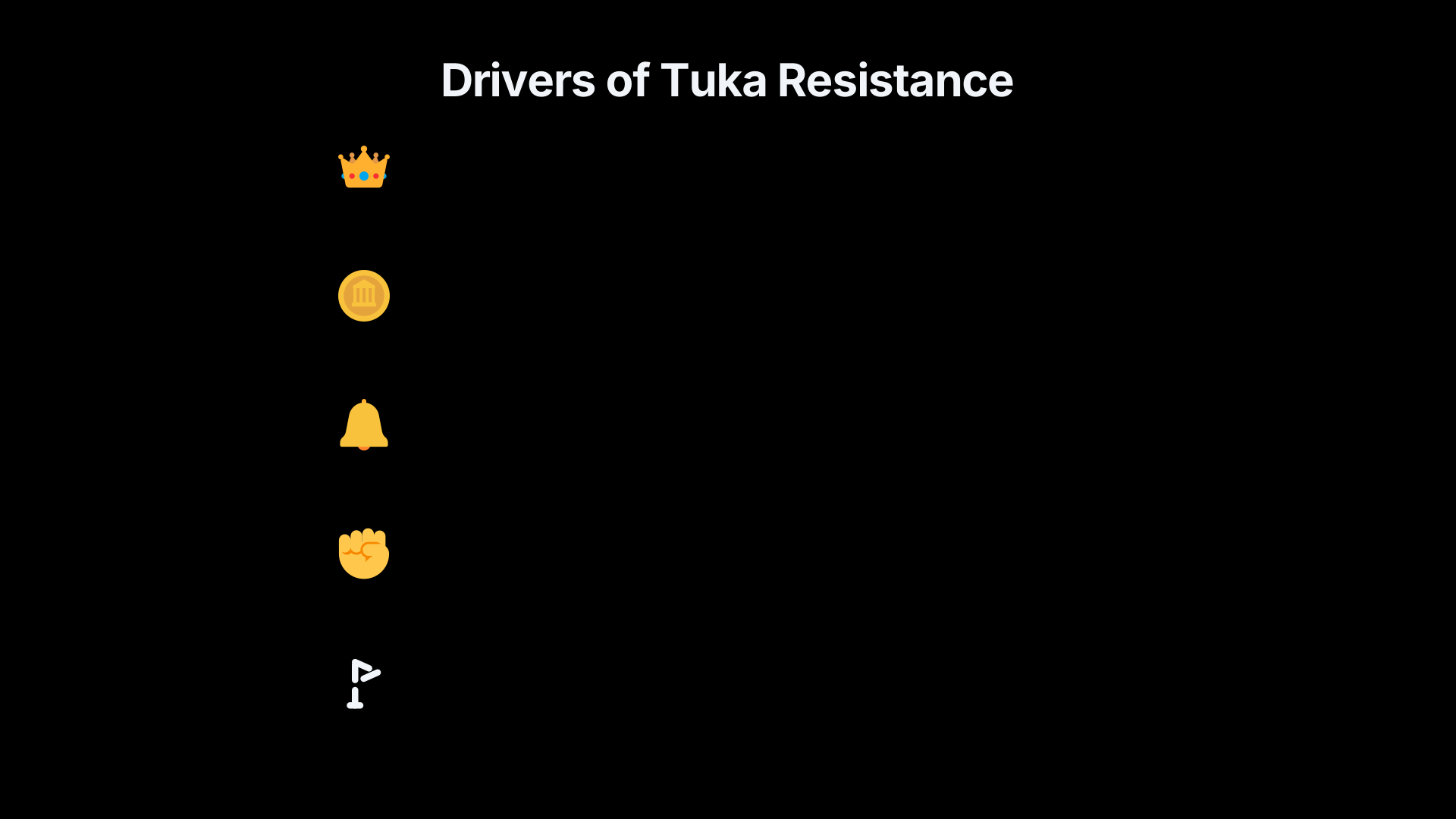
Modern scholarship is far more cautious. Historians point out that Tuka combined religion, politics and social protest in ways familiar from many anti-colonial movements around the world. Its followers were not merely waiting for miracles. They were responding to dramatic political changes including:
- the British annexation of Fiji in 1874;
- the erosion of traditional political authority;
- new taxation and labour demands;
- expanding missionary influence;
- resentment towards chiefs seen as cooperating with colonial rule.
Within that setting, prophecy offered a language through which people could imagine reversing an unjust political order. What officials dismissed as superstition often carried practical political meaning.[dukeupress.edu]dukeupress.eduNeither Cargo nor Cult: Ritual Politics and the Colonial Imagination in FijiJune 1, 1995…
Navosavakadua’s Prophecy and Political Message
Navosavakadua emerged from Fiji’s interior highlands during the 1880s as an oracle priest and prophetic leader. He drew upon established indigenous religious traditions rather than inventing an entirely new belief system. His teachings predicted that colonial domination would eventually end, ancestral spiritual power would return and foreign authority would be overturned.[dukeupress.edu]dukeupress.eduNeither Cargo nor Cult: Ritual Politics and the Colonial Imagination in FijiJune 1, 1995…
These prophecies addressed immediate political realities. Many indigenous Fijians had experienced profound disruption after cession to Britain. Colonial administration relied upon selected chiefs, missionary churches reshaped village life and the government imposed new legal and economic obligations. For followers of Tuka, religious renewal and political restoration were inseparable goals.
The movement also reflected the transition from military resistance to symbolic resistance. Open warfare against colonial forces had become increasingly difficult. Prophecy, ritual and expectations of divine intervention became alternative ways of imagining national recovery without abandoning opposition to colonial rule. This helps explain why officials regarded Tuka as politically dangerous even when its activities were primarily religious.[dukeupress.edu]dukeupress.eduNeither Cargo nor Cult: Ritual Politics and the Colonial Imagination in FijiJune 1, 1995…
How Colonial Officials Suppressed the Movement
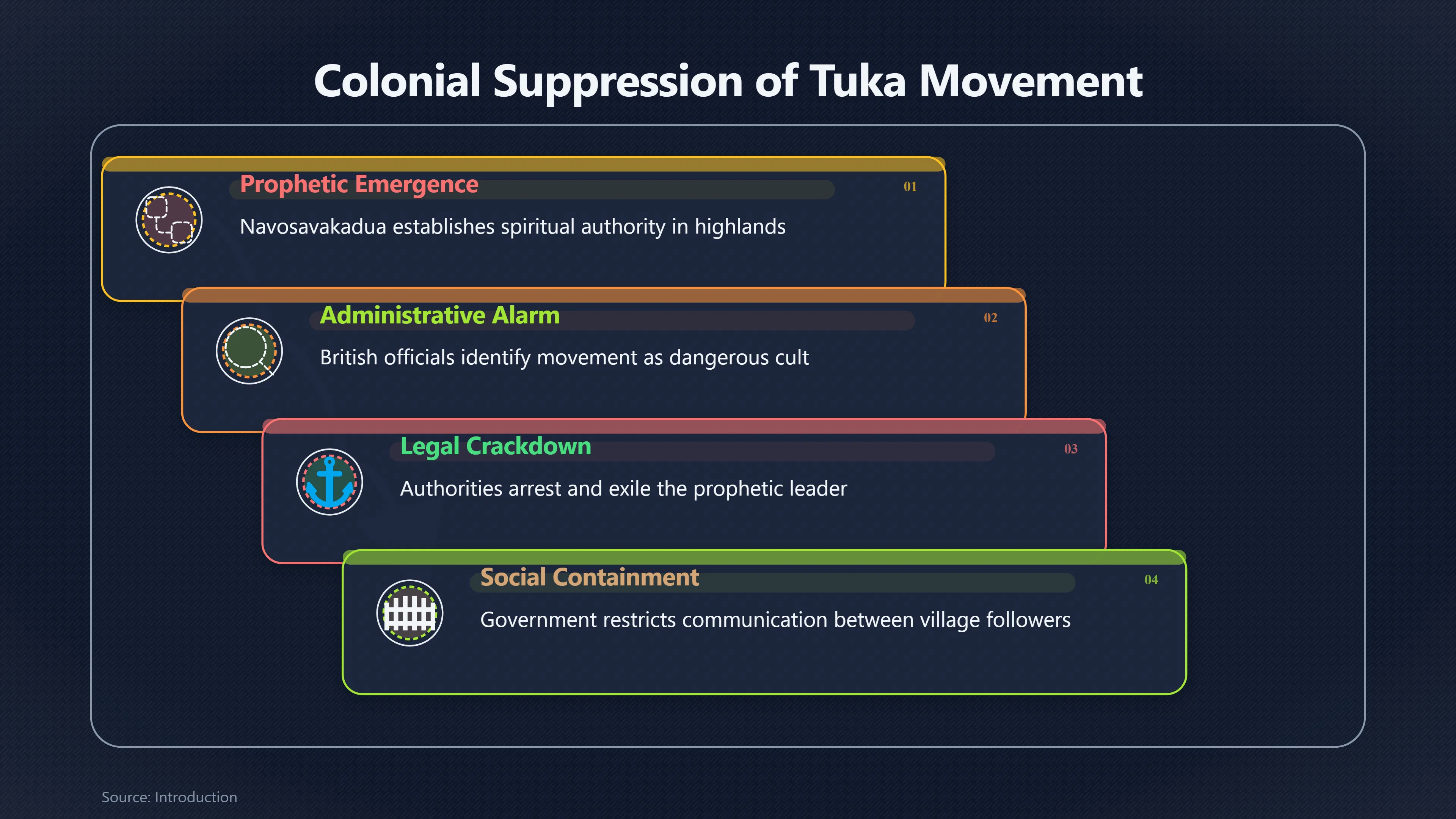
British authorities interpreted the movement through the lens of imperial security. Official reports frequently portrayed Tuka beliefs as contagious, deceptive or fanatical. Administrators worried that villages influenced by Navosavakadua might refuse colonial authority or inspire wider resistance.
The government’s response included repeated efforts to dismantle the movement:
- arresting Navosavakadua;
- exiling him to remote islands;
- monitoring villages believed to support him;
- prosecuting suspected organisers;
- restricting communication between followers.
These actions were not solely religious policy. They were intended to preserve the system of indirect colonial rule, which depended upon recognised chiefs and missionary institutions cooperating with government officials. Any alternative source of legitimacy threatened that arrangement.[dukeupress.edu]dukeupress.eduNeither Cargo nor Cult: Ritual Politics and the Colonial Imagination in FijiJune 1, 1995…
The language used by administrators is revealing. Official records often described belief itself as something capable of “spreading” through villages, turning political dissent into a form of social contagion. Such descriptions resemble later colonial responses elsewhere in the Pacific, where governments frequently interpreted indigenous prophetic movements as dangerous outbreaks requiring administrative containment rather than negotiation.

Why the “Cargo Cult” Label Misleads
For much of the twentieth century, anthropologists commonly described Tuka as one of the earliest Pacific “cargo cults”. This interpretation suggested that followers expected supernatural rituals to bring European wealth or manufactured goods.
Today many scholars argue that this framework distorts the movement.
Martha Kaplan’s influential study Neither Cargo nor Cult challenged both parts of the traditional label. She argues that British officials actively constructed the image of a mysterious “Tuka cult” through administrative reports, while later scholars too readily accepted those colonial descriptions. The movement’s central concerns were political authority, land, leadership and indigenous history rather than magical acquisition of imported goods.[dukeupress.edu]dukeupress.eduNeither Cargo nor Cult: Ritual Politics and the Colonial Imagination in FijiJune 1, 1995…
This does not mean that prophetic expectations played no role. Like many millenarian movements, Tuka anticipated dramatic transformations in society. However, reducing those hopes to fantasies about European material goods overlooks the movement’s far broader objectives.
The cargo cult label also encourages readers to interpret Pacific societies through stereotypes of irrationality or misunderstanding. Modern historians instead emphasise that indigenous people were responding intelligently to colonial conquest using cultural and religious traditions that already carried political authority.
Why Colonial Authorities Saw a Cult Scare
The fear surrounding Tuka was partly rooted in genuine administrative concerns. British officials had only recently established authority over Fiji, and resistance in the interior had not entirely disappeared. A movement capable of attracting followers across districts naturally raised fears about rebellion.
Yet the colonial reaction also reflected broader imperial assumptions.
Officials often interpreted indigenous religious innovation as evidence of instability rather than recognising it as legitimate political expression. By describing Navosavakadua as a dangerous prophet and his followers as credulous believers, colonial authorities transformed a political dispute into a problem of irrational belief. This justified extraordinary policing while avoiding engagement with underlying grievances over governance, taxation and local autonomy.[dukeupress.edu]dukeupress.eduNeither Cargo nor Cult: Ritual Politics and the Colonial Imagination in FijiJune 1, 1995…
Seen in this light, the “cult scare” surrounding Tuka was not simply a misunderstanding. It was also a strategy of colonial governance. Framing resistance as fanaticism helped reinforce the legitimacy of British rule while delegitimising indigenous alternatives.
Why the Movement Still Matters
The Tuka movement remains significant because it illustrates how religious language can become a vehicle for political resistance and how governments may use labels such as “cult” to frame opposition as irrational or dangerous.
Its history also serves as a caution against reading colonial archives uncritically. Administrative reports provide valuable evidence, but they reflect the priorities and anxieties of those who produced them. Comparing those records with oral traditions and later historical research reveals a more complex picture in which prophecy, cultural identity and political protest were deeply intertwined.
Within Fiji’s wider history, Tuka stands as one of the clearest examples of how colonial fears shaped public narratives about indigenous belief. Rather than representing a simple episode of mass delusion, it demonstrates how religious movements can become the focus of official panic when they challenge existing structures of power.[dukeupress.edu]dukeupress.eduNeither Cargo nor Cult: Ritual Politics and the Colonial Imagination in FijiJune 1, 1995…
Amazon book picks
Further Reading
Books and field guides related to Was the Tuka Movement Really a Cult?. Use these as the next step if you want deeper reading beyond the article.
The Birth of the Modern World,
Explains imperial expansion and anti-colonial movements.


God is red
Helpful comparative perspective on indigenous spirituality under colonialism.
Endnotes
1.
Source: dukeupress.edu
Title: Neither Cargo nor Cult: Ritual Politics and the Colonial Imagination in Fiji
Link:https://www.dukeupress.edu/neither-cargo-nor-cult
Source snippet
June 1, 1995...
Published: June 1, 1995
2.
Source: degruyterbrill.com
Title: Neither Cargo nor Cult
Link:https://www.degruyterbrill.com/document/doi/10.1515/9780822381914/html
Source snippet
Your documents are now available to view. Kaplan, Martha. Neither Cargo nor Cult: Ritual Politics and the Colonial Imagination in Fiji, N...
3.
Source: degruyterbrill.com
Title: Neither Cargo nor Cult
Link:https://www.degruyterbrill.com/de/document/doi/10.1515/9780822381914/html
Source snippet
Ritual Politics and the Colonial Imagination in Fiji, New York, USA: Duke University Press, 1995. [https://doi.org/10.1515/9780822381914](https://doi.org/10.1515/9780822381914) K...
4.
Source: books.google.com
Title: Neither Cargo nor Cult
Link:https://books.google.com/books/about/Neither_Cargo_nor_Cult.html?id=C9SC0QEACAAJ
Source snippet
Cargo nor Cult: Ritual Politics and the Colonial Imagination in Fiji - Martha Kaplan - Google BooksJune 15, 1995 — NEITHER CARGO NOR CULT...
Published: June 15, 1995
5.
Source: books.google.com
Title: Neither Cargo Nor Cult
Link:https://books.google.com/books/about/Neither_Cargo_Nor_Cult.html?id=3ey0ms3khaAC
Source snippet
Cargo Nor Cult: Ritual Politics and the Colonial Imagination in Fiji - Martha Kaplan - Google BooksJune 15, 1995 — NEITHER CARGO NOR CULT...
Published: June 15, 1995
6.
Source: youtube.com
Title: Cargo Cults: When WWII Supplies Became a Religion
Link:https://www.youtube.com/watch?v=2cPKc-lH4No
Source snippet
Cargo Cults...
7.
Source: youtube.com
Title: Cargo Cults
Link:https://www.youtube.com/watch?v=i69HiC4PBeI
Source snippet
How WWII Created a NEW Religion In The Jungle...
8.
Source: youtube.com
Title: The Man Who Convinced a Tribe to WORSHIP America
Link:https://www.youtube.com/watch?v=wnxguoXUKUs
Source snippet
Cargo cults...
9.
Source: youtube.com
Title: Cargo cults
Link:https://www.youtube.com/watch?v=IM-hdoevo5M
Additional References
10.
Source: degruyterbrill.com
Title: De Gruyter Brill Neither Cargo nor Cult
Link:https://www.degruyterbrill.com/document/doi/10.1515/9780822381914/html?lang=en
Source snippet
Neither Cargo nor Cult...June 15, 1995 — NEITHER CARGO NOR CULT Ritual Politics and the Colonial Imagination in Fiji * Martha Kaplan Lang...
Published: June 15, 1995
11.
Source: academic.oup.com
Link:https://academic.oup.com/hawaii-scholarship-online/book/18395/chapter-abstract/176470876?login=false
Source snippet
and the Tuka Movement | Disturbing History: Resistance in Early Colonial Fiji | Hawai'i Scholarship Online | Oxford AcademicOctober 15, 2...
12.
Source: bibliovault.org
Link:https://www.bibliovault.org/BV.book.epl?ISBN=9780822315933
Source snippet
Neither Cargo nor Cult: Ritual Politics and the Colonial Imagination in Fiji (9780822315933): Martha Kaplan - BiblioVault...
13.
Source: goodreads.com
Link:https://www.goodreads.com/book/show/2332991.Neither_Cargo_nor_Cult
14.
Source: philtar.ac.uk
Link:https://www.philtar.ac.uk/encyclopedia/westoc/tuka.html
15.
Source: colab.ws
Link:https://colab.ws/articles/10.1525%2Fae.1990.17.1.02a00010
16.
Source: youtube.com
Title: How WWII Created a NEW Religion In The Jungle
Link:https://www.youtube.com/watch?v=b0a9mOtf0UU
Source snippet
The Man Who Convinced a Tribe to WORSHIP America...
17.
Source: anthrosource.onlinelibrary.wiley.com
Link:https://anthrosource.onlinelibrary.wiley.com/doi/abs/10.1525/ae.1990.17.1.02a00010
18.
Source: youtube.com
Title: A Fijian village with an amazing story!
Link:https://www.youtube.com/watch?v=MtGHOZbCcaA
Source snippet
Cargo Cults: When WWII Supplies Became a Religion...
19.
Source: readings.com.au
Title: Neither Cargo nor Cult: Ritual Politics and the Colonial Imagination in Fiji
Link:https://www.readings.com.au/product/9780822315933/neither-cargo-nor-cult-ritual-politics-and-the-colonial-imagination-in-fiji–martha-kaplan–1995–9780822315933
Topic Tree