Within Burundi Beliefs
Who Benefits When Someone Is Called a Witch?
Witchcraft claims in Burundi have turned fear and misfortune into permission to attack vulnerable people.
On this page
- How accusations spread after illness, death or misfortune
- Why vulnerable people become targets
- The 2025 killings and the role of political power
Page outline Jump by section
Introduction
In Burundi, accusations of witchcraft have often functioned less as claims about the supernatural than as a means of persecution. When unexplained illness, sudden death or economic hardship strikes a community, suspicion can quickly settle on individuals who are already vulnerable. Once someone is branded a witch, the accusation may justify intimidation, assault, dispossession or even murder, despite the absence of evidence that any supernatural harm occurred. The result is not simply a story about traditional beliefs, but about how fear can become a form of social and political violence.

This pattern remains significant because witchcraft allegations do not arise in isolation. They intersect with local disputes over land and inheritance, social exclusion, weak access to justice, and, at times, the influence of political actors who can encourage or exploit collective fear. Burundi therefore illustrates how rumours about witchcraft can become mechanisms of coercion rather than isolated expressions of belief.
How accusations spread after illness, death or misfortune
Witchcraft accusations in Burundi commonly emerge after events that demand an explanation but have no obvious cause. A child’s death, repeated illness, crop failure, livestock losses or a series of accidents may lead neighbours to search for someone to blame. Rather than accepting uncertainty, communities sometimes identify an alleged witch whose supposed hidden actions explain visible suffering.
Rumours often spread through conversation rather than formal investigation. Once respected local figures, relatives or community members repeat an accusation, it can gain credibility simply through repetition. Fear encourages confirmation bias: ordinary disagreements or unusual behaviour are reinterpreted as signs of secret supernatural activity.
This process is self-reinforcing. A person who denies the accusation may be viewed as deceptive, while silence can be interpreted as guilt. Because witchcraft is understood as invisible, the absence of physical evidence does not necessarily weaken the accusation. In effect, the allegation becomes difficult to disprove.
Researchers studying witchcraft accusations across parts of sub-Saharan Africa have noted that these episodes frequently appear during periods of uncertainty, economic stress or rapid social change. In Burundi, long-term political instability, displacement, poverty and recurring insecurity have created conditions in which rumours can spread rapidly and where communities may seek personal rather than structural explanations for misfortune.
Why vulnerable people become targets
Those accused are rarely selected at random. Accusations often fall on people whose social position already makes them vulnerable.
Common targets include:
- Older women, particularly widows living alone.
- Elderly people who lack strong family protection.
- Individuals involved in inheritance or land disputes.
- People regarded as socially isolated or eccentric.
- Families already marginalised by poverty or disability.
The accusation itself can produce material benefits for others. Removing someone from a community may allow relatives or neighbours to seize land, housing or livestock. In other cases, branding an opponent a witch becomes a way to settle long-standing personal conflicts without relying on legal institutions.
This helps explain why human rights organisations increasingly describe witchcraft accusations as a protection issue rather than a religious question. The central problem is not whether people believe in witchcraft, but how those beliefs can be mobilised to justify violence against individuals who have limited means of defending themselves.
When rumours become collective violence
Most accusations do not end in homicide, but the risk increases when rumours become public and crowds begin to act collectively.
Mob violence typically follows a recognisable pattern:
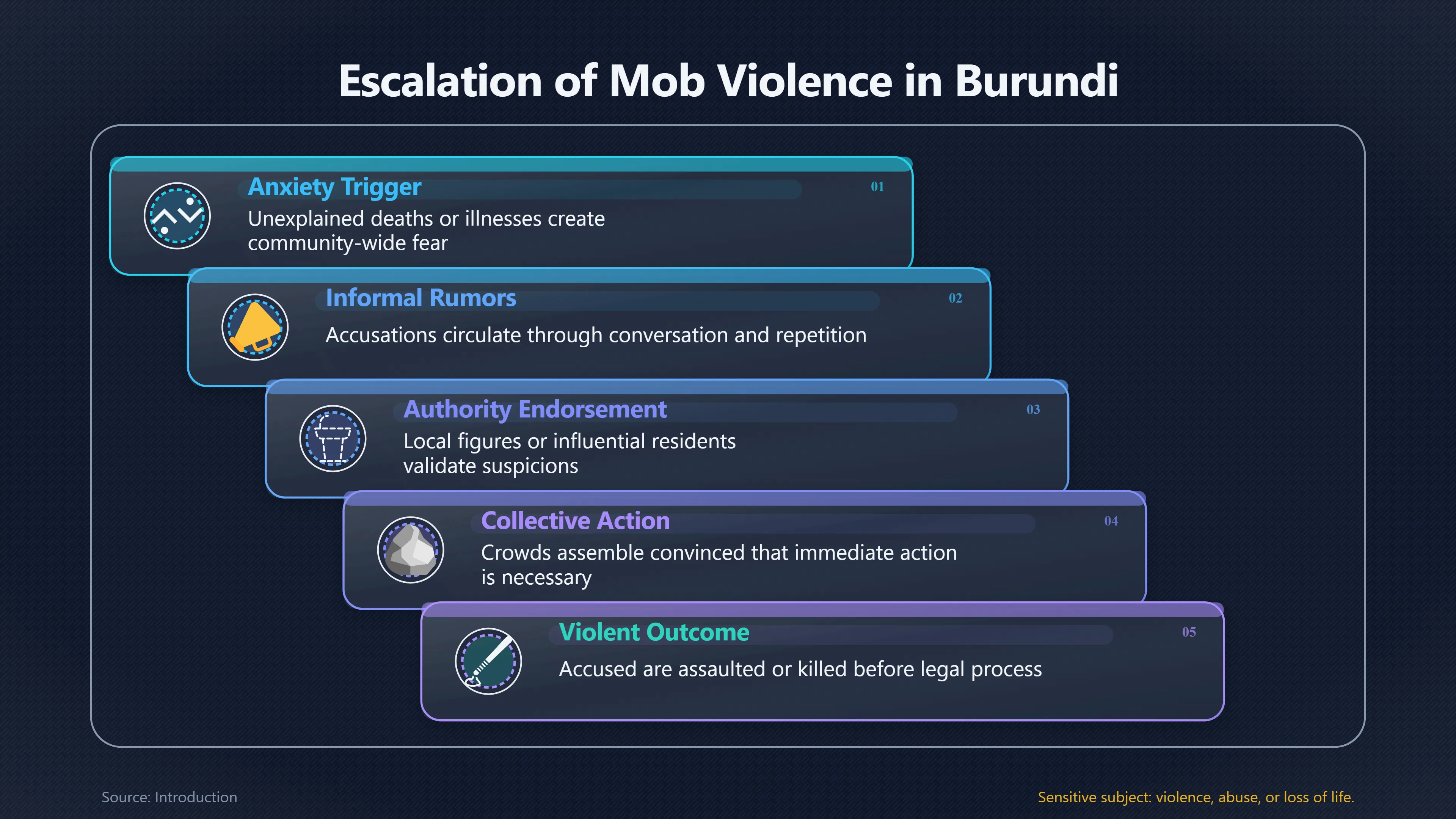
- An unexplained death or illness creates anxiety.
- Informal accusations circulate within the community.
- Local authority figures or influential residents endorse the suspicion.
- Crowds assemble, convinced that immediate action is necessary.
- The accused are assaulted, expelled or killed before any legal process can occur.
Because these attacks are framed as protecting the community from hidden danger, participants may see themselves as preventing future harm rather than committing a crime. This moral framing makes intervention by neighbours or local officials more difficult unless state authorities act quickly.
The pattern resembles witch hunts documented elsewhere in Africa, but in Burundi it has acquired additional significance because of the country’s broader history of political violence and weak accountability in some rural areas.
The 2025 killings and the role of political power
The dangers of witchcraft accusations became dramatically visible in June 2025 in Gasarara village, Nyabiraba Commune, Bujumbura Province. According to multiple local reports, six people were publicly killed after being accused of causing unexplained deaths through witchcraft. Witnesses reported that two victims were burned alive while four others were beaten to death with clubs and stones. The accusations reportedly followed a series of unexplained deaths in the community rather than any criminal investigation or material evidence.[SOS Médias Burundi]sosmediasburundi.orgSOS Médias BurundiBujumbura – Gasarara: six people killed in a witch hunt led by Imbonerakure - SOS Médias BurundiJuly 2, 2025…
The incident drew particular attention because witnesses alleged that members of the Imbonerakure, the youth league associated with Burundi’s ruling CNDD-FDD party, led the attack under the supervision of a local party official. If those accounts are accurate, the episode illustrates how political influence can magnify communal violence rather than merely failing to prevent it.[SOS Médias Burundi]sosmediasburundi.orgSOS Médias BurundiBujumbura – Gasarara: six people killed in a witch hunt led by Imbonerakure - SOS Médias BurundiJuly 2, 2025…
The wider political context matters. Human Rights Watch has documented longstanding allegations that Imbonerakure members have participated in intimidation, assaults, arbitrary detention and killings of perceived opponents, while exercising considerable influence in many local communities. That environment may reduce confidence that vulnerable people will receive effective protection when collective violence begins.[Human Rights Watch]hrw.orgHuman Rights WatchWorld Report 2025: Burundi | Human Rights Watch…
The Gasarara killings therefore cannot be understood simply as a spontaneous outburst of superstition. They also demonstrate how informal power structures, local political authority and community fear can combine to produce lethal violence.
Why these accusations persist
Several factors help explain why witchcraft accusations continue despite legal systems that criminalise assault and murder.
First, many cases arise where medical or scientific explanations for illness remain inaccessible or poorly understood. A sudden death may receive no formal investigation, leaving rumours to fill the gap.
Second, local justice systems may struggle to resolve land conflicts, inheritance disputes or neighbourhood disagreements. Witchcraft allegations can become an alternative means of removing an unwanted person from the community.
Third, fear spreads faster than evidence. Once enough people believe that an invisible threat exists, social pressure discourages dissent. Individuals who defend the accused may themselves become objects of suspicion.
Finally, broader political conditions matter. Where communities have limited trust in institutions or where influential local actors exercise power with little accountability, collective punishment becomes easier to organise.

Why this matters in Burundi’s wider history
Burundi’s history of conflict demonstrates how rumours and fear can legitimise violence against selected groups. Witchcraft accusations represent one expression of that broader pattern. Instead of targeting people because of ethnicity or political affiliation, these episodes identify alleged witches as dangerous outsiders whose removal is portrayed as necessary for communal safety.
For historians and human rights researchers, this makes witchcraft accusations an important example of persecution rather than evidence for supernatural beliefs. The accusations reveal how communities under stress search for identifiable culprits, how vulnerable people become convenient targets, and how violence can be justified through claims that cannot be tested or disproved.
Seen in this light, the central question is not whether witchcraft exists, but who gains when someone is called a witch. In Burundi, the answer has too often involved those seeking revenge, property, local influence or political authority, while the costs have been borne by people least able to protect themselves.
Amazon book picks
Further Reading
Books and field guides related to Who Benefits When Someone Is Called a Witch?. Use these as the next step if you want deeper reading beyond the article.


Mistakes Were Made (But Not by Me)
Helps explain persistence of false accusations and rumor.
Endnotes
1.
Source: sosmediasburundi.org
Link:https://www.sosmediasburundi.org/en/2025/07/03/bujumbura-gasarara-six-people-killed-in-a-witch-hunt-led-by-imbonerakure/
Source snippet
SOS Médias BurundiBujumbura – Gasarara: six people killed in a witch hunt led by Imbonerakure - SOS Médias BurundiJuly 2, 2025...
Published: July 2, 2025
2.
Source: hrw.org
Link:https://www.hrw.org/world-report/2026/country-chapters/burundi
Source snippet
Human Rights WatchWorld Report 2026: Burundi | Human Rights Watch...
3.
Source: hrw.org
Link:https://www.hrw.org/world-report/2025/country-chapters/burundi
Source snippet
Human Rights WatchWorld Report 2025: Burundi | Human Rights Watch...
4.
Source: sosmediasburundi.org
Link:https://www.sosmediasburundi.org/en/2026/01/26/burundi-over-400-people-killed-in-2025-imbonerakure-and-security-forces-singled-out-by-the-iteka-league/
Source snippet
Burundi: over 400 people killed in 2025, Imbonerakure and security forces singled out by the Iteka League - SOS Médias BurundiJanuary 26...
5.
Source: sosmediasburundi.org
Link:https://www.sosmediasburundi.org/en/2025/09/03/convicted-of-a-non-existent-offense-rachelle-mfatukobiri-88-years-old-jailed-for-six-years-in-mpimba/
Source snippet
SOS Médias BurundiSeptember 3, 2025 — 3 September 2025 PCN Criminalité CONVICTED OF A NON-EXISTENT OFFENSE: RACHELLE MFATUKOBIRI, 88 YEA...
Published: September 3, 2025
6.
Source: hrw.org
Title: Bye-bye Arusha Accords as Burundi solidifies one-party rule | Human Rights Watch
Link:https://www.hrw.org/news/2025/09/02/bye-bye-arusha-accords-as-burundi-solidifies-one-party-rule
Source snippet
September 2, 2025 — BYE-BYE ARUSHA ACCORDS AS BURUNDI SOLIDIFIES ONE-PARTY RULE Print Donate Now September 2, 2025 9:00AM EDT | Commentar...
Published: September 2, 2025
7.
Source: hrw.org
Link:https://www.hrw.org/news/2025/08/20/burundi-as-risk-factors-multiply-extend-the-special-rapporteurs-mandate
8.
Source: hrw.org
Title: Burundi: Elections Without Opposition | Human Rights Watch
Link:https://www.hrw.org/news/2025/06/12/burundi-elections-without-opposition
9.
Source: sosmediasburundi.org
Link:https://www.sosmediasburundi.org/en/2025/05/06/ngozi-a-man-detained-for-witchcraft-his-family-denounces-political-persecution/
10.
Source: hrw.org
Title: official complicity and impunity
Link:https://www.hrw.org/report/2010/03/26/mob-justice-burundi/official-complicity-and-impunity
11.
Source: hrw.org
Link:https://www.hrw.org/fr/world-report/2025/country-chapters/burundi
12.
Source: hrw.org
Link:https://www.hrw.org/africa/burundi
Additional References
13.
Source: ecoi.net
Link:https://www.ecoi.net/en/document/2130326.html
Source snippet
OHCHR – UN Office of the High Commissioner for Human Rights (Author): “Burundi: UN experts alarmed by increase in serious human rights vi...
14.
Source: uk.marketscreener.com
Link:https://uk.marketscreener.com/news/italy-arrests-burundi-man-over-2014-murders-of-three-catholic-nuns-ce7e5cd9da8cf427
Source snippet
arrests Burundi man over 2014 murders of three Catholic nuns | MarketScreener UKFebruary 26, 2026 — ITALY ARRESTS BURUNDI MAN OVER 2014 M...
Published: February 26, 2026
15.
Source: youtube.com
Link:https://www.youtube.com/watch?v=vOL4TIahIFY
Source snippet
Human Rights Day and Albinism: Muluka Anne Miti Drummond on Witchcraft Accusations & Ritual Attacks...
16.
Source: youtube.com
Title: Modern Witch Hunts and Human Rights | Kirsty Brimelow KC
Link:https://www.youtube.com/watch?v=pzyuoaMMMKI
Source snippet
Witchcraft accusations persecution violence Africa Witchcraft Accusations in Ghana with John Azumah Salem Witch Trials History | End Witc...
17.
Source: youtube.com
Title: Witchcraft Accusations in Ghana with John Azumah
Link:https://www.youtube.com/watch?v=HuXREurd5C0
Source snippet
Victoria Canning: Criminology Perspectives on Witchcraft Persecution, Violence, and Torture...
18.
Source: youtube.com
Link:https://www.youtube.com/watch?v=J7QmtCQoEiI
Source snippet
The agony of Congo's 'child witches'...
19.
Source: researchgate.net
Link:https://www.researchgate.net/publication/342898556_Who%27s_the_witch_Social_exclusion_of_older_Mossi_women_accused_of_Witchcraft_in_Burkina_Faso_Africa
20.
Source: cbsnews.com
Link:https://www.cbsnews.com/amp/news/witchcraft-accusations-killings-burundi-official-says/
21.
Source: theprint.in
Link:https://theprint.in/world/exclusive-un-says-congo-rebels-killed-scores-of-farmers-m23-suggests-smear/2708421/
22.
Source: amnesty.org
Link:https://www.amnesty.org/en/location/africa/east-africa-the-horn-and-great-lakes/burundi/report-burundi/
Topic Tree