Within Germany's Strange Panics
Why Did Rhine Communities Dance Uncontrollably?
The dancing outbreaks of 1374 show how stress, religious expectation and shared behaviour could produce real bodily distress.
On this page
- What happened in the 1374 outbreaks
- Religious meanings and ritual responses
- Stress, contagion and competing explanations
Page outline Jump by section
Introduction
The dancing outbreaks that spread along the Rhine in 1374 are among the most remarkable episodes of collective behaviour in European history. Beginning around the region of Aachen and rapidly appearing in towns across the Rhine valley, groups of men and women were reported to dance, leap, shout and convulse for hours or even days, apparently unable to stop. To medieval observers this was not entertainment but a frightening affliction that demanded religious intervention. Modern historians generally reject simple supernatural or medical explanations, instead viewing the outbreaks as the product of intense psychological stress acting within a culture that expected divine punishment and miraculous healing. Although many details remain uncertain, the Rhine dancing mania provides one of the clearest historical examples of how shared beliefs, social pressure and genuine physical distress could combine into a contagious public event.[Europeana]europeana.euSaint John's Dance | EuropeanaSaint John's Dance | EuropeanaJune 24, 2015…
What happened in the 1374 outbreaks?
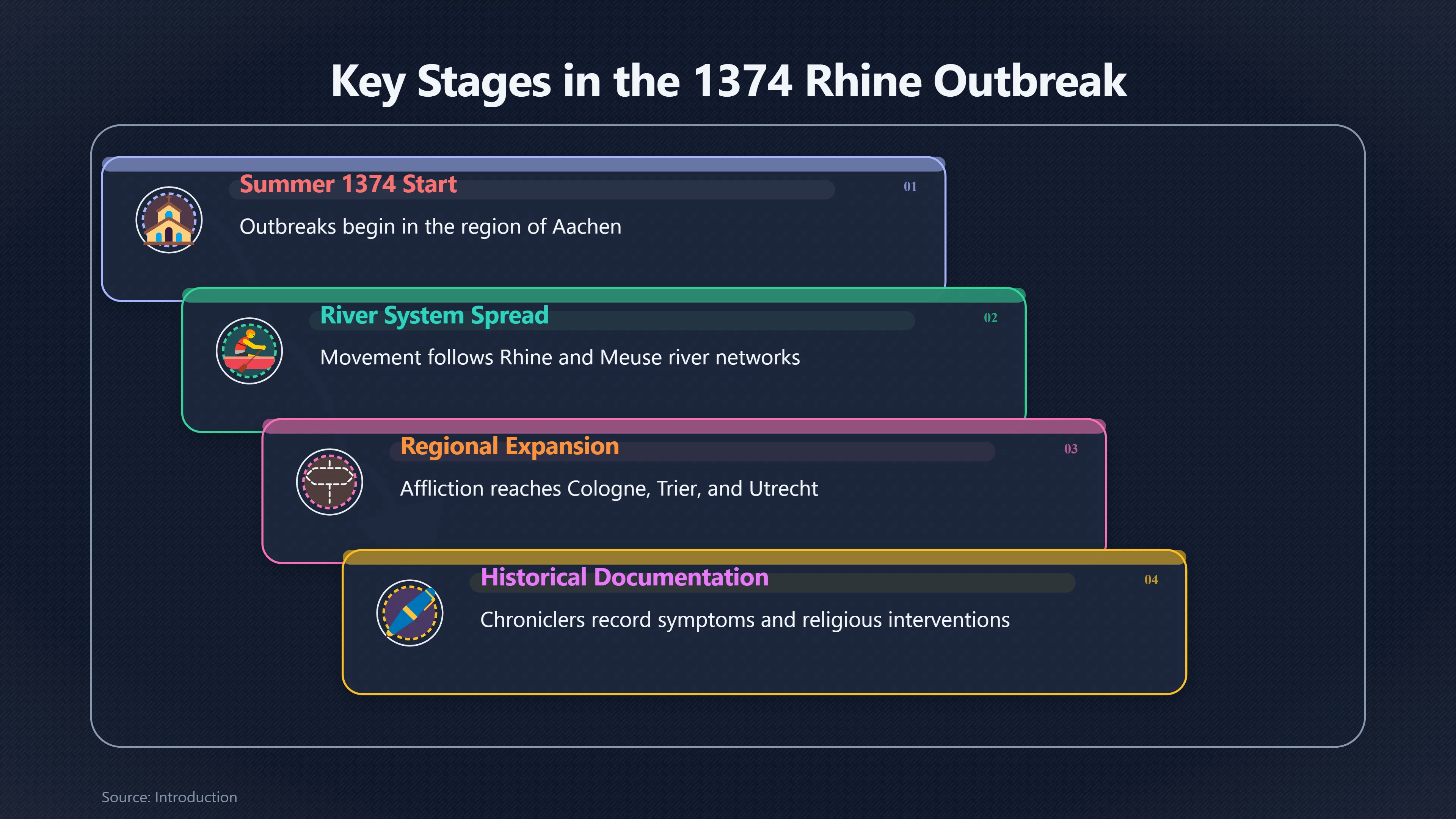
The best-documented outbreak began in the summer of 1374 around Aachen, then one of the most important cities in the Holy Roman Empire. Contemporary chroniclers described groups of people moving through streets and public spaces in an uncontrolled dance. Witnesses reported frantic jumping, spinning, shouting and exhaustion, with some sufferers collapsing before resuming their movements. The behaviour spread remarkably quickly through settlements connected by the Rhine and Meuse river systems, reaching places including Liège, Maastricht, Cologne, Trier, Metz, Ghent and Utrecht before appearing farther afield.[ScienceDirect]sciencedirect.comIn a spin: the mysterious dancing epidemic of 1518 - ScienceDirect…
The speed of the spread has led historians to think less in terms of a disease transmitted biologically than of an idea or expectation transmitted socially. Medieval trade routes, pilgrimage networks and regular communication between towns allowed reports of the strange affliction to travel quickly. As news arrived, communities already familiar with stories of miraculous punishments or saintly intervention may have become more susceptible to similar experiences.[ScienceDirect]sciencedirect.comIn a spin: the mysterious dancing epidemic of 1518 - ScienceDirect…
It is important not to exaggerate the evidence. Later retellings often claim that hundreds or even thousands danced continuously until they died. Medieval chronicles certainly describe severe suffering, but they vary widely in numbers, symptoms and outcomes. They were written to record remarkable events rather than to provide precise medical observations, and later authors frequently combined separate outbreaks into a single dramatic narrative. Historians therefore distinguish between the well-supported fact that widespread dancing outbreaks occurred and the less certain claims about their scale and death toll.[persee.fr]persee.frrnord 0035 2624 1981 numPerséeLa dansomanie de 1374: hérésie ou maladie? - Persée…
Why did medieval people think it was happening?
For people living along the Rhine, the events made sense within a religious worldview rather than a medical one. Afflictions that seemed impossible to control could be understood as divine punishment, demonic influence or the work of saints whose favour had been lost.
The episodes became associated with both Saint John the Baptist and, increasingly in later centuries, Saint Vitus. Those believed to be afflicted were sometimes taken to chapels or shrines dedicated to these saints, where prayers, masses and ritual observances were expected to bring relief. Rather than treating the dancers as criminals or entertainers, communities generally regarded them as people suffering from a terrifying condition requiring spiritual assistance.[Europeana]europeana.euSaint John's Dance | EuropeanaSaint John's Dance | EuropeanaJune 24, 2015…
This religious framework also shaped how the behaviour spread. If people believed that a saint could inflict involuntary dancing on entire communities, then witnessing apparent victims or hearing convincing reports could reinforce expectations that others might experience the same fate. Modern scholars do not interpret this as simple superstition but as evidence that cultural beliefs influence how psychological distress is experienced and expressed.[ScienceDirect]sciencedirect.comIn a spin: the mysterious dancing epidemic of 1518 - ScienceDirect…
Stress, contagion and competing explanations
The central historical debate is not whether the outbreaks happened, but what caused them.
John Waller has argued that the Rhine outbreaks are best understood as episodes of mass psychogenic illness or collective stress responses. According to this interpretation, the dancers were experiencing genuine involuntary behaviour rather than pretending or participating in organised festivities. Extreme hardship created fertile conditions for dissociative states, while shared religious expectations provided a culturally recognised script for how such distress might appear.[ScienceDirect]sciencedirect.comIn a spin: the mysterious dancing epidemic of 1518 - ScienceDirect…
Several circumstances made the Rhine region particularly vulnerable in 1374:
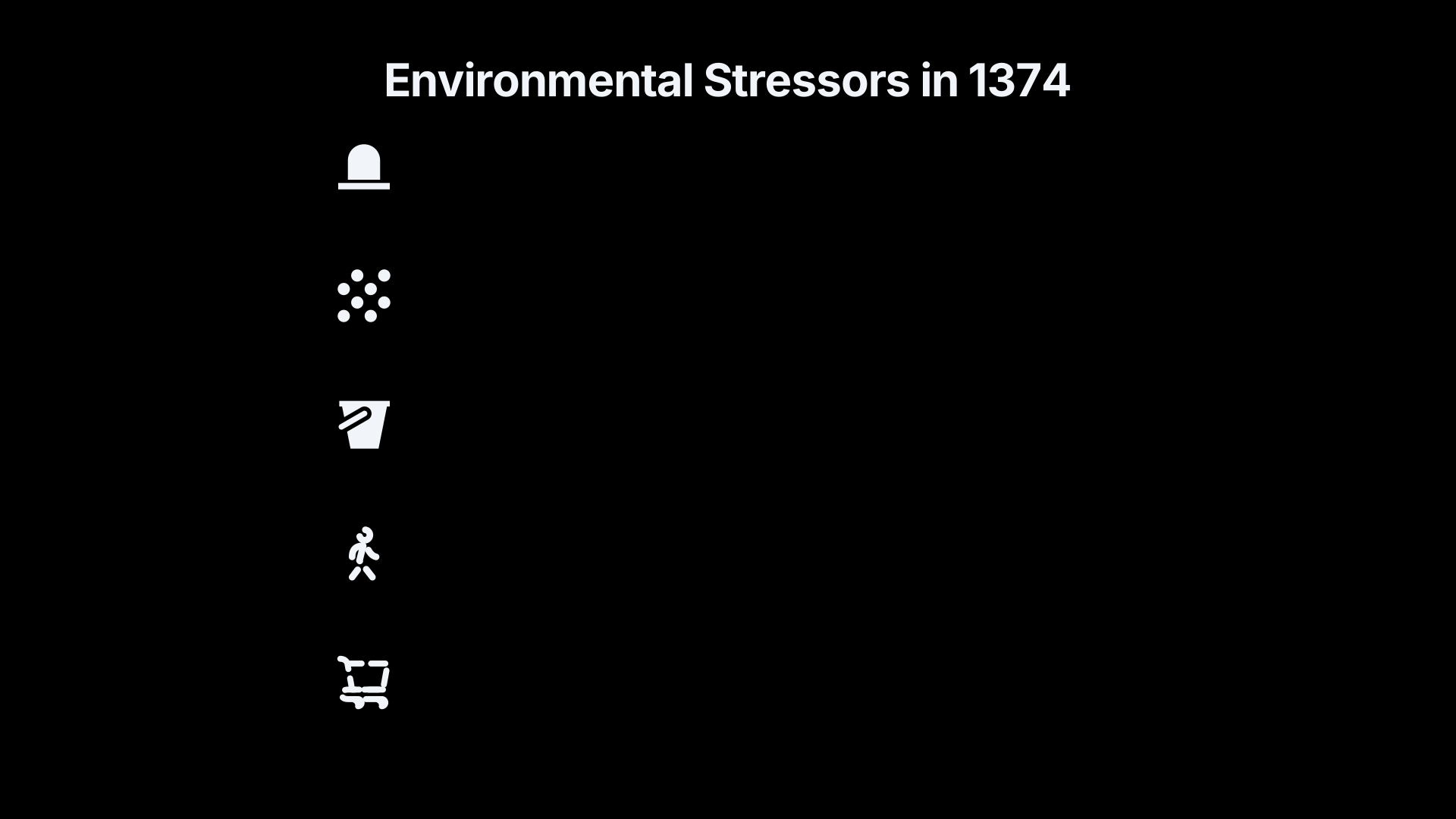
- Communities were still living with the demographic and psychological consequences of the Black Death.
- Warfare, economic insecurity and repeated crop failures had increased uncertainty.
- Severe flooding along the Rhine and Moselle shortly before the outbreak caused widespread destruction and hardship.
- Strong traditions surrounding saints, miracles and divine punishment shaped how unexplained suffering was interpreted.[ScienceDirect]sciencedirect.comIn a spin: the mysterious dancing epidemic of 1518 - ScienceDirect…
Other explanations have attracted attention but are generally viewed as less convincing.
The long-popular ergot poisoning theory suggested that contaminated rye infected with a fungus caused hallucinations or convulsions. However, ergotism usually produces symptoms unlike the sustained, coordinated dancing described in medieval accounts, and it cannot easily explain why the behaviour spread primarily through observation and social contact rather than shared food supplies.[ScienceDirect]sciencedirect.comIn a spin: the mysterious dancing epidemic of 1518 - ScienceDirect…
Some earlier writers suggested the dancers belonged to secret religious sects or heretical movements. While a few medieval chroniclers used language suggesting a “sect”, modern historical analysis finds little evidence for an organised movement behind the outbreaks. Most contemporary observers described an affliction rather than a voluntary religious campaign.[Persée]persee.frrnord 0035 2624 1981 numPerséeLa dansomanie de 1374: hérésie ou maladie? - Persée…
Why the Rhine mattered
The geography of the outbreak was not accidental. Nearly all the major medieval dancing epidemics occurred in communities connected by the Rhine and Moselle river systems. These waterways linked prosperous trading towns where merchants, pilgrims, clergy and travellers exchanged not only goods but also stories, rumours and religious ideas.
The Rhine also contained dense networks of churches, shrines and pilgrimage destinations. Once the belief developed that a saint’s curse or blessing was involved, sufferers could be directed towards recognised places of healing. The same religious infrastructure that offered comfort also reinforced shared expectations about what the illness meant and how it should be treated.[ScienceDirect]sciencedirect.comIn a spin: the mysterious dancing epidemic of 1518 - ScienceDirect…
Rather than viewing the Rhine as somehow uniquely prone to irrationality, historians instead see it as a region where communication networks, common religious traditions and repeated social crises combined to make collective behavioural outbreaks more likely.
What historians think today
Most modern historians agree on several broad conclusions while remaining cautious about details.
First, the outbreaks were probably real events rather than inventions of chroniclers. Independent accounts from different places point to an unusual pattern of involuntary collective behaviour.[Europeana]europeana.euSaint John's Dance | EuropeanaSaint John's Dance | EuropeanaJune 24, 2015…
Second, the dancers were almost certainly experiencing genuine distress. Modern interpretations reject the idea that the participants were simply pretending or engaging in organised festivities. Contemporary descriptions consistently portray fear, exhaustion and loss of control.[Medievalists.net]medievalists.netDancing plagues and mass hysteriaDancing plagues and mass hysteria
Third, no single biological cause adequately explains why the outbreaks spread through connected communities over time while closely following local systems of belief. The strongest current interpretation combines psychological stress with cultural expectation, recognising that severe emotional strain can produce authentic physical symptoms that become socially contagious within particular historical settings.[ScienceDirect]sciencedirect.comIn a spin: the mysterious dancing epidemic of 1518 - ScienceDirect…
Finally, historians are increasingly careful about separating documented evidence from later legend. Popular accounts often blur the 1374 Rhine outbreaks with the better-known Strasbourg dancing episode of 1518 or repeat dramatic claims unsupported by contemporary records. Treating each outbreak as a distinct historical case provides a more accurate picture of how collective behaviour evolved across late medieval Europe.[sciencedirect.com]sciencedirect.comIn a spin: the mysterious dancing epidemic of 1518 - ScienceDirect…
Why the Rhine dancing mania still matters
The 1374 outbreaks remain culturally important because they illustrate how collective beliefs can shape real physical experiences without requiring fraud or supernatural explanations. They show that extreme stress does not affect people only as individuals; under particular social and cultural conditions, communities may develop shared patterns of behaviour that appear extraordinary to later generations.
For Germany’s wider history of collective belief and public fear, the Rhine dancing mania also marks an early example of a recurring pattern: crises interpreted through prevailing religious ideas, responses organised around shared cultural expectations, and later generations struggling to separate historical fact from dramatic legend. It continues to be studied not because it offers a single mystery to solve, but because it reveals how psychology, religion, environment and society can interact during periods of exceptional strain.[sciencedirect.com]sciencedirect.comIn a spin: the mysterious dancing epidemic of 1518 - ScienceDirect…
Amazon book picks
Further Reading
Books and field guides related to Why Did Rhine Communities Dance Uncontrollably?. Use these as the next step if you want deeper reading beyond the article.


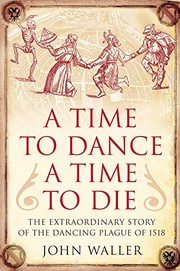
A time to dance, a time to die
Explains medieval and early modern dancing outbreaks and their interpretations.
Endnotes
1.
Source: europeana.eu
Title: Saint John’s Dance | Europeana
Link:https://www.europeana.eu/en/stories/st-johns-dance-why-cant-they-stop-dancing
Source snippet
Saint John's Dance | EuropeanaJune 24, 2015...
Published: June 24, 2015
2.
Source: sciencedirect.com
Link:https://www.sciencedirect.com/science/article/pii/S0160932708000379
Source snippet
In a spin: the mysterious dancing epidemic of 1518 - ScienceDirect...
3.
Source: medievalists.net
Title: Dancing plagues and mass hysteria
Link:https://www.medievalists.net/2013/04/dancing-plagues-and-mass-hysteria/
4.
Source: sciencedirect.com
Title: The Dancing Plague: a public health conundrum
Link:https://www.sciencedirect.com/science/article/abs/pii/S0033350697000346
5.
Source: persee.fr
Title: rnord 0035 2624 1981 num 63 249 3777
Link:https://www.persee.fr/doc/rnord_0035-2624_1981_num
Source snippet
PerséeLa dansomanie de 1374: hérésie ou maladie? - Persée...
Additional References
6.
Source: youtube.com
Link:https://www.youtube.com/watch?v=nWImzWylwCw
Source snippet
"Dancing plague" 1374 OR 1518 OR "mass hysteria" OR "dancing mania" The Dancing Plague Of 1518 😨 Zack D. Films...
7.
Source: abnormalways.com
Title: The Real Timeline of Dancing Mania from Then to Now
Link:https://abnormalways.com/dancing-mania/timeline-of-dancing-mania/
Source snippet
Abnormal WaysMay 31, 2023 — TIMELINE OF DANCING MANIA I’ve surveyed all the records and would like to begin by taking you through the ear...
Published: May 31, 2023
8.
Source: museums.eu
Title: st johns dance why cant they stop dancing
Link:https://museums.eu/article/details/110582/st-johns-dance-why-cant-they-stop-dancing
Source snippet
John’s Dance – why can’t they stop dancing? | Museums.EUJune 24, 2015 — ARTICLE INFORMATION Type Article Author Małgorzata Szynkielewska...
Published: June 24, 2015
9.
Source: youtube.com
Title: The Plague That Made People Dance Themselves to Death
Link:https://www.youtube.com/watch?v=TKhVE-pP7hA
Source snippet
WHY DID PEOPLE DANCE THEMSELVES TO DEATH? What was the dancing plague | Choreomania. History Calling...
10.
Source: academic.oup.com
Link:https://academic.oup.com/book/33517/chapter-abstract/287850272
Source snippet
in the Late Middle Ages: Decadence and Death | Ringleaders of Redemption: How Medieval Dance Became Sacred | Oxford AcademicJanuary 21, 2...
11.
Source: cambridge.org
Title: Unlike m
Link:https://www.cambridge.org/core/journals/the-drama-review/article/it-caught-me/514420DE98AA68DA7F08C307D94D5B14
Source snippet
“It caught me” | TDR | Cambridge CoreSeptember 5, 2025 — In various episodes of choreomania, bodily intensities could not be fully contai...
Published: September 5, 2025
12.
Source: degruyterbrill.com
Link:https://www.degruyterbrill.com/journal/key/mial/23/2/html
Source snippet
Image: Cite this Cite this Tanz als Krankheit, Tanz als Therapie. Die Formierung eines religiös-medizinischen Konzepts (15. und 16. Jahrh...
13.
Source: guinnessworldrecords.com
Link:https://www.guinnessworldrecords.com/world-records/69603-worst-outbreak-of-dancing-mania
14.
Source: youtube.com
Link:https://www.youtube.com/watch?v=ZfSd2gO5tbk
Source snippet
The Dancing Plague | The History Show...
15.
Source: youtube.com
Link:https://www.youtube.com/watch?v=3cP8OyzOnII
Source snippet
The Plague That Made People Dance Themselves to Death...
Topic Tree