Within Tanzania
What Really Happened in Tanzania's Laughter Epidemic?
The famous outbreak involved real distress, social transmission and far more than laughter alone.
On this page
- From Kashasha School to the Wider District
- Why Doctors Rejected Infection and Poisoning
- Stress, Independence and the Myths Added Later
Page outline Jump by section
Introduction
The Tanganyika laughter epidemic was a real and well-documented outbreak of distress that began on 30 January 1962 at a girls’ boarding school in Kashasha, near Lake Victoria, only weeks after Tanganyika had gained independence. Despite its popular name, it was never simply a case of people laughing because something was funny. Those affected experienced involuntary bouts of laughter alongside crying, anxiety, pain, breathing difficulties, fainting and other physical symptoms that disrupted schools, families and villages for well over a year. Modern researchers regard it as one of the world’s best-known examples of mass psychogenic illness—a situation in which genuine physical and emotional symptoms spread through social and psychological processes rather than through infection or poisoning.[ResearchGate]researchgate.net249929567 The laughter of the 1962 Tanganyika 'laughter epidemicResearchGate(PDF) The laughter of the 1962 Tanganyika ‘laughter epidemic’January 1, 2007…
From Kashasha School to the Wider District
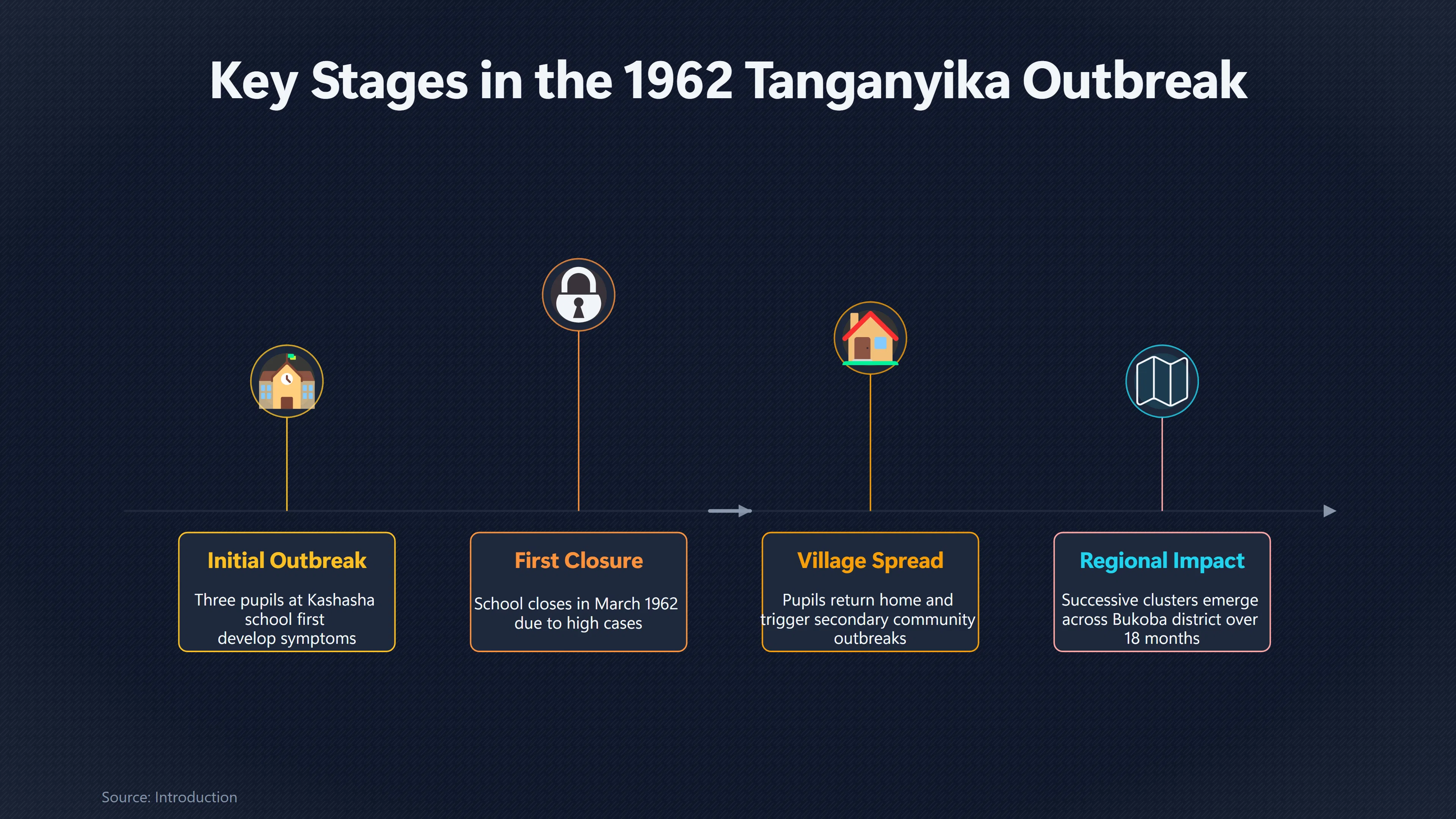
The outbreak began at a mission-run girls’ boarding school in Kashasha, where three pupils first developed unusual episodes of laughter and emotional distress. Over the following weeks the number of affected students rose rapidly. By the time the school closed in March 1962, 95 of its 159 pupils had experienced attacks. When the school reopened in May, another wave affected dozens more students, forcing a second closure.[ResearchGate]researchgate.net249929567 The laughter of the 1962 Tanganyika 'laughter epidemicResearchGate(PDF) The laughter of the 1962 Tanganyika ‘laughter epidemic’January 1, 2007…
Closing the school unintentionally helped the outbreak spread. Many pupils returned to their home villages, and similar episodes soon appeared among relatives and neighbours. One of the earliest secondary outbreaks occurred in Nshamba, where more than 200 villagers—mostly young people—experienced attacks over several weeks. Other schools and nearby communities were affected in turn, producing a chain of outbreaks across the Bukoba district rather than one continuous event.[ResearchGate]researchgate.net249929567 The laughter of the 1962 Tanganyika 'laughter epidemicResearchGate(PDF) The laughter of the 1962 Tanganyika ‘laughter epidemic’January 1, 2007…
Popular summaries often state that around 1,000 people were affected and that 14 schools eventually closed. Those figures broadly describe the cumulative regional impact, but they can create a misleading impression that everyone was laughing simultaneously. In reality, the epidemic unfolded in successive clusters over roughly 18 months, with symptoms appearing, subsiding and reappearing in different communities.[ResearchGate]researchgate.net249929567 The laughter of the 1962 Tanganyika 'laughter epidemicResearchGate(PDF) The laughter of the 1962 Tanganyika ‘laughter epidemic’January 1, 2007…
What the Symptoms Were Really Like
The label “laughter epidemic” captures only one part of the story. Medical reports describe a far wider range of symptoms, including:
- uncontrollable laughing and crying
- restlessness and agitation
- episodes of fear and anxiety
- fainting
- breathing difficulties
- pain and weakness
- skin rashes in some cases
- difficulty concentrating in school.
Attacks varied enormously. Some lasted only a few hours, while others continued for several days before easing and sometimes recurring. Teachers were largely unaffected, while adolescent girls and young people formed the overwhelming majority of cases.[ResearchGate]researchgate.net249929567 The laughter of the 1962 Tanganyika 'laughter epidemicResearchGate(PDF) The laughter of the 1962 Tanganyika ‘laughter epidemic’January 1, 2007…
This matters because later retellings often portray the event as comic or bizarre. Contemporary medical accounts instead describe children and young adults who were genuinely distressed and unable to control their symptoms.
Why Doctors Rejected Infection and Poisoning
Investigators searched for conventional medical explanations but found little evidence to support them.
Several observations argued against an infectious disease:
- no consistent fever or other signs of infection were present;
- the pattern of spread followed close social relationships rather than simple physical exposure;
- many teachers and other adults who spent time with the pupils remained unaffected;
- no infectious organism could be identified.
Environmental poisoning was also considered. However, investigators found no convincing evidence of contaminated food, water or chemicals that could explain why outbreaks appeared, disappeared and then resurfaced in socially connected groups.[ResearchGate]researchgate.net249929567 The laughter of the 1962 Tanganyika 'laughter epidemicResearchGate(PDF) The laughter of the 1962 Tanganyika ‘laughter epidemic’January 1, 2007…
As a result, doctors concluded that the outbreak was best explained as what is now generally called mass psychogenic illness (MPI), previously known as epidemic hysteria. Modern researchers prefer the newer term because it emphasises that the symptoms are genuine rather than imagined.[ResearchGate]researchgate.net249929567 The laughter of the 1962 Tanganyika 'laughter epidemicResearchGate(PDF) The laughter of the 1962 Tanganyika ‘laughter epidemic’January 1, 2007…

Why Stress Became the Leading Explanation
Mass psychogenic illness usually develops under conditions of sustained emotional pressure within tightly connected groups. Researchers have suggested that several factors made the affected communities particularly vulnerable.
First, the outbreak occurred immediately after Tanganyika achieved independence in December 1961. Independence brought optimism but also uncertainty, rapid social change and rising expectations for schools and young people.[PMC]pmc.ncbi.nlm.nih.govOpen source on nih.gov.
Second, the original outbreak occurred in a disciplined boarding-school environment where pupils lived, studied and slept together. Such settings have frequently been associated with mass psychogenic illness because emotions, fears and physical reactions can spread rapidly through constant observation and interaction.[PMC]pmc.ncbi.nlm.nih.govPMCEpisodes of mass hysteria in African schools: A study of literaturePMCEpisodes of mass hysteria in African schools: A study of literature
Third, the affected students reportedly faced considerable educational and family pressure. Later analyses suggest that these stresses may have provided the background conditions that allowed an initial cluster of symptoms to spread socially rather than biologically. No single stressful event has ever been identified, and researchers generally see the epidemic as arising from multiple overlapping pressures rather than one dramatic trigger.[PMC]pmc.ncbi.nlm.nih.govOpen source on nih.gov.
Why “Contagious Laughter” Is a Myth
One of the biggest misconceptions is that laughter itself spread like a virus.
Christian Hempelmann’s detailed re-examination of the historical evidence argues that many later accounts distorted the event by presenting it as contagious amusement or by suggesting that a joke somehow triggered months of uncontrolled laughter. The original medical reports support neither claim. Instead, laughter was only one symptom among many in a broader syndrome of emotional and physical distress.[ResearchGate]researchgate.net249929567 The laughter of the 1962 Tanganyika 'laughter epidemicResearchGate(PDF) The laughter of the 1962 Tanganyika ‘laughter epidemic’January 1, 2007…
Similarly, there is no credible evidence that the epidemic resulted from:
- laughing gas;
- deliberate poisoning;
- an unknown virus;
- supernatural forces;
- deliberate hoaxes by the students.
While rumours and speculation have continued for decades, none has gained support from the available medical evidence.[ResearchGate]researchgate.net249929567 The laughter of the 1962 Tanganyika 'laughter epidemicResearchGate(PDF) The laughter of the 1962 Tanganyika ‘laughter epidemic’January 1, 2007…
Why the Event Still Matters
The Tanganyika laughter epidemic remains one of the most frequently cited examples of mass psychogenic illness because it demonstrates how powerful social environments can be in shaping genuine physical symptoms.
The case also reminds readers to avoid dismissive language. Describing the outbreak as “mass hysteria” without explanation can wrongly imply that those affected were pretending or behaving irrationally. Modern medicine instead recognises that stress can produce involuntary bodily reactions, including pain, fainting, shaking, breathing changes and altered behaviour, even when no infection or toxin is present.[PMC]pmc.ncbi.nlm.nih.govPMCEpisodes of mass hysteria in African schools: A study of literaturePMCEpisodes of mass hysteria in African schools: A study of literature
The epidemic has become part of Tanzania’s social history not because it was mysterious in a supernatural sense, but because it illustrates the complex relationship between psychology, community, education and periods of rapid social change. Far from being an amusing historical curiosity, it remains an important case study in how collective stress can manifest as real illness across schools, families and villages.[ResearchGate]researchgate.net249929567 The laughter of the 1962 Tanganyika 'laughter epidemicResearchGate(PDF) The laughter of the 1962 Tanganyika ‘laughter epidemic’January 1, 2007…
Amazon book picks
Further Reading
Books and field guides related to What Really Happened in Tanzania's Laughter Epidemic?. Use these as the next step if you want deeper reading beyond the article.
Extraordinary Popular Delusions and the Madness of Crowds
Rating: 4.0/5 from 5 Google Books ratings
Places famous collective episodes in historical context.
The Wisdom of Crowds:Why the Many Are Smarter Than the Few an...
Useful background on collective behaviour.

Endnotes
1.
Source: researchgate.net
Title: 249929567 The laughter of the 1962 Tanganyika ‘laughter epidemic’
Link:https://www.researchgate.net/publication/249929567The_laughter_of_the_1962_Tanganyika%27laughter_epidemic%27
Source snippet
ResearchGate(PDF) The laughter of the 1962 Tanganyika ‘laughter epidemic’January 1, 2007...
Published: January 1, 2007
2.
Source: pmc.ncbi.nlm.nih.gov
Title: PMCEpisodes of mass hysteria in African schools: A study of literature
Link:https://pmc.ncbi.nlm.nih.gov/articles/PMC3588562/
3.
Source: pmc.ncbi.nlm.nih.gov
Link:https://pmc.ncbi.nlm.nih.gov/articles/PMC4543217/
4.
Source: youtube.com
Title: Can Laughter Kill You?
Link:https://www.youtube.com/watch?v=qpJKn8qdq4M
Source snippet
The Tanganyika Laughter Epidemic...
5.
Source: youtube.com
Title: The Tanganyika Laughter Epidemic
Link:https://www.youtube.com/watch?v=wu6_NUWlQ_c
Source snippet
244 - The Tanganyika Laughter Epidemic: When Stress Went Viral in 1962...
6.
Source: veriarch.com
Title: tanganyika laughter epidemic
Link:https://veriarch.com/tanganyika-laughter-epidemic
Source snippet
Medical officers A. M. Rankin and P. J. Philip investigated the outbreak and published their findings in the Central African Journal of M...
7.
Source: scribd.com
Title: Laughter epidemic
Link:https://www.scribd.com/document/873123331/Laughter-epidemic
8.
Source: pmc.ncbi.nlm.nih.gov
Link:https://pmc.ncbi.nlm.nih.gov/articles/PMC4988490/
9.
Source: theblackarchive.net
Link:https://theblackarchive.net/en/case/12
10.
Source: pmc.ncbi.nlm.nih.gov
Link:https://pmc.ncbi.nlm.nih.gov/articles/PMC1227860/
11.
Source: pubmed.ncbi.nlm.nih.gov
Link:https://pubmed.ncbi.nlm.nih.gov/13951715/
Additional References
12.
Source: medicalindependent.ie
Title: Mass psychogenic illness was no laughing matter for the kids of Tanganyika
Link:https://www.medicalindependent.ie/life/the-dorsal-view/mass-psychogenic-illness-was-no-laughing-matter-for-the-kids-of-tanganyika/
Source snippet
Medical IndependentAugust 21, 2021 — MASS PSYCHOGENIC ILLNESS WAS NO LAUGHING MATTER FOR THE KIDS OF TANGANYIKA By Mindo - 21st Aug 2021...
Published: August 21, 2021
13.
Source: jamiiforums.com
Title: tanganyika laughter epidemic ugonjwa wa kucheka of 1962.1718274
Link:https://www.jamiiforums.com/threads/tanganyika-laughter-epidemic-ugonjwa-wa-kucheka-of-1962.1718274/
Source snippet
Tanganyika laughter epidemic (Ugonjwa wa kucheka) of 1962 | JamiiForums TanzaniaApril 22, 2020 — Tanganyika laughter epidemic (Ugonjwa wa...
Published: April 22, 2020
14.
Source: youtube.com
Link:https://www.youtube.com/watch?v=mB0HwyzHYRE
Source snippet
Can Laughter Kill You? - The Mysterious Tanganyika Laughter Epidemic of 1962...
15.
Source: livelyhistory.com
Link:https://livelyhistory.com/articles/tanganyika-laughter-epidemic-1962
Source snippet
Sarah Kimani...
16.
Source: journals.co.za
Link:https://journals.co.za/doi/10.10520/AJA00089176_6171
17.
Source: nejm.org
Link:https://www.nejm.org/doi/abs/10.1056/NEJM200001133420206
18.
Source: sciencedirect.com
Link:https://www.sciencedirect.com/science/article/pii/S2213323215000225
19.
Source: youtube.com
Title: East African Laughing Epidemic – History Documentary
Link:https://www.youtube.com/watch?v=pGVvD7hlYzI
Source snippet
The Tanganyika Laughter Epidemic of 1962...
20.
Source: youtube.com
Link:https://www.youtube.com/watch?v=AWprpDloucc
21.
Source: atlasobscura.com
Title: the 1962 laughter epidemic of tanganyika was no joke
Link:https://www.atlasobscura.com/articles/the-1962-laughter-epidemic-of-tanganyika-was-no-joke
Topic Tree