Within Latvia's Strange Beliefs
Why Did a Religious Revival Frighten Latvia's Elites?
The Moravian revival offered Latvian peasants literacy, fellowship and dignity, while landlords feared independent organisation among serfs.
On this page
- Why peasants embraced the movement
- Why landlords and clergy feared it
- Literacy, manuscripts and national awakening
Page outline Jump by section
Introduction
The Moravian revival in eighteenth-century Vidzeme was not feared because it predicted the end of the world or encouraged rebellion. Instead, it unsettled Latvia’s ruling elites because it allowed serfs to organise independently, read and write in greater numbers, and develop networks of mutual support that lay partly outside the control of landlords and the established Lutheran Church. What began in the 1730s as a Protestant renewal movement inspired by the Moravian Church rapidly became one of the most influential popular religious movements in Latvian history. Although its followers preached personal faith, moral discipline and Christian fellowship rather than political revolution, many Baltic German estate owners saw any autonomous peasant organisation as a potential threat to the social order. Historians increasingly argue that the movement’s greatest long-term significance lay not in religious controversy itself but in the literacy, confidence and community institutions that later helped prepare the ground for the Latvian national awakening.[University of Latvia]research.lu.lvUniversity of LatviaThe Vidzeme Moravians-the “awakener” of Latvians’ national awakening - University of Latvia…
Why peasants embraced the movement
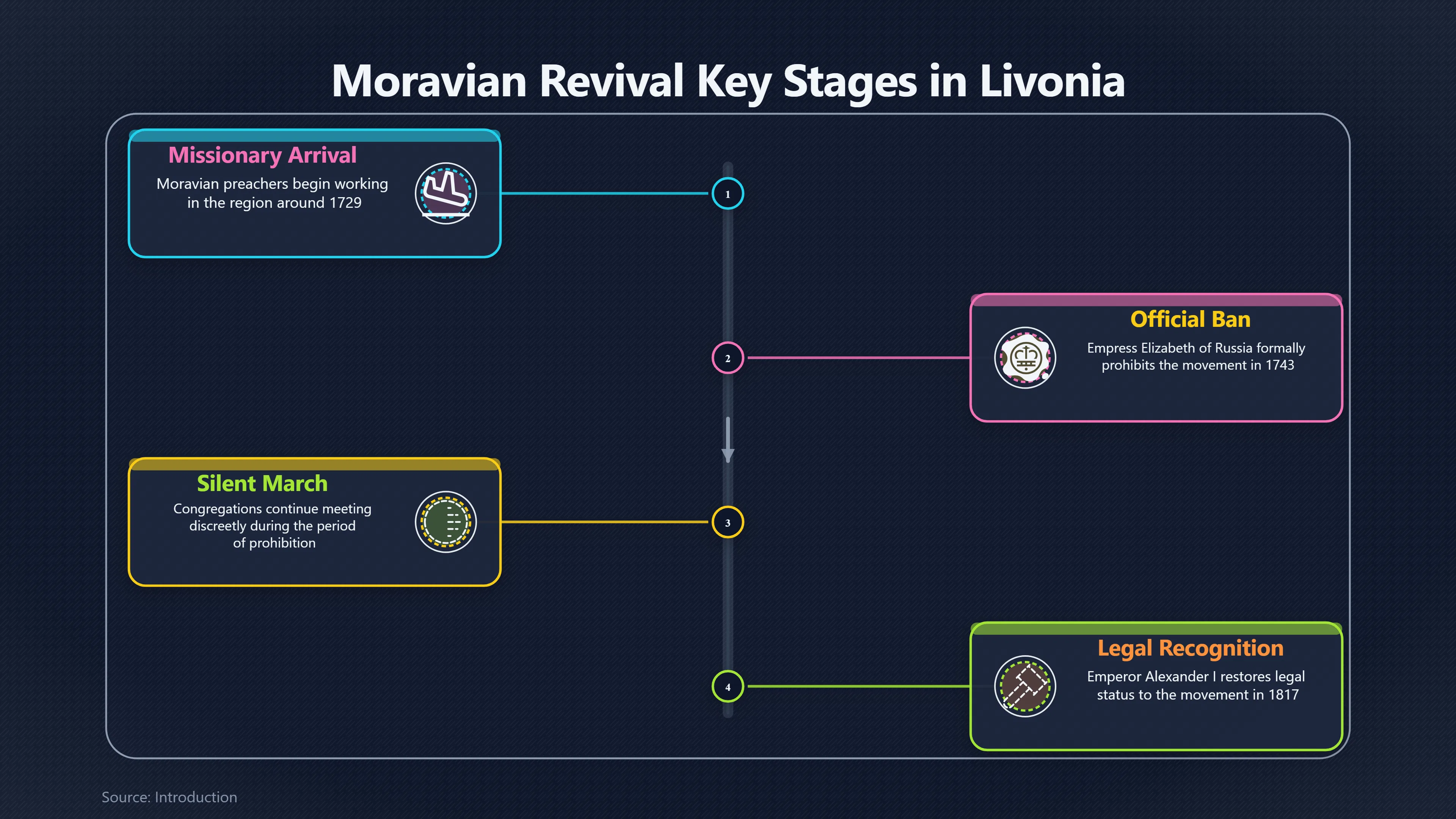
The Moravian, or Herrnhut, revival reached Livonia after missionaries connected with Count Nikolaus Ludwig von Zinzendorf’s renewed Moravian Church began working in the region around 1729. They arrived in a countryside still recovering from the Great Northern War, where most Latvian-speaking inhabitants lived as serfs under Baltic German landlords.[LSM]eng.lsm.lv500 Years of Latvian Books: The Moravian brethren and the spread of literacy / Article…
The movement appealed to many peasants for reasons that were both spiritual and practical.
Unlike much of the established church hierarchy, Moravian preachers encouraged ordinary believers to participate actively in religious life. Small meetings allowed men and women to pray, sing, testify and discuss scripture together rather than remaining passive listeners. The movement stressed an emotional, personal relationship with Christianity, making faith feel more immediate and accessible than formal parish worship alone.[lu.lv]research.lu.lvUniversity of LatviaMedia Use and Social Influence Among the Moravian Brethren in the Baltic Region with a Focus on Modern-Day Latvia - U…
Equally important was the sense of dignity it offered. Although Moravian missionaries did not campaign to abolish serfdom, they treated Latvian peasants as fellow Christians capable of leadership, learning and spiritual responsibility. Local congregations trained lay leaders from among the peasantry itself, giving individuals experience in organising meetings, teaching others and maintaining community discipline.[University of Latvia]research.lu.lvUniversity of LatviaMedia Use and Social Influence Among the Moravian Brethren in the Baltic Region with a Focus on Modern-Day Latvia - U…
The revival also encouraged sobriety, mutual assistance and practical education. Contemporary observers often remarked that Moravian communities gained reputations for industriousness and lower levels of drunkenness and disorder, further strengthening internal solidarity.[University of Latvia]research.lu.lvUniversity of LatviaThe Vidzeme Moravians-the “awakener” of Latvians’ national awakening - University of Latvia…
Why landlords and clergy feared it
The anxiety surrounding the revival arose less from theology than from governance.
Baltic German landlords depended upon a highly hierarchical society in which serfs remained economically dependent and socially fragmented. Large gatherings of peasants outside manor supervision, especially those organised through their own networks, naturally attracted suspicion. Estate owners worried that independent religious meetings could become centres of collective action or weaken traditional patterns of obedience, even though the Moravians themselves generally preached loyalty, moral conduct and peaceful behaviour.[lu.lv]research.lu.lvUniversity of LatviaMedia Use and Social Influence Among the Moravian Brethren in the Baltic Region with a Focus on Modern-Day Latvia - U…
Many Lutheran clergy also regarded the movement as an unwelcome competitor. Moravian meetings encouraged forms of worship, testimony and lay leadership that blurred the clergy’s monopoly over religious instruction. While some pastors initially supported the revival, others increasingly criticised it as religious enthusiasm that undermined church discipline and parish authority.[Europeana]europeana.euExpanding the writing community | EuropeanaExpanding the writing community | Europeana…
Official concern eventually translated into state action. In 1743, under Empress Elizabeth of Russia, the Moravian movement was formally banned in Livonia. The prohibition did not eliminate the revival; instead, many congregations continued meeting discreetly during what later became known as the movement’s “silent march”. Legal recognition returned only under Emperor Alexander I in 1817.[Europeana]europeana.euExpanding the writing community | EuropeanaExpanding the writing community | Europeana…
The episode illustrates an important distinction within Latvia’s history of collective fear. This was not a panic about supernatural danger like a witch hunt. Rather, it was an elite fear that a popular religious movement might reshape social relationships by giving serfs new forms of organisation beyond manor and parish control.

Literacy, manuscripts and the growth of a reading culture
Perhaps the Moravian revival’s most enduring achievement was its contribution to literacy.
Because believers were encouraged to read devotional works, copy texts and record their own religious experiences, reading and writing spread far beyond the narrow circles previously served by clergy and officials. Handwritten sermons, hymns, autobiographies, letters and devotional collections circulated from household to household, creating a remarkable manuscript culture among Latvian-speaking peasants.[researchgate.net]researchgate.netOpen source on researchgate.net.
Rather than relying solely on printed books, congregations constantly copied manuscripts by hand. Each copied text reinforced literacy while allowing ideas to travel through village networks. Researchers describe this as one of the largest vernacular manuscript traditions in eighteenth- and nineteenth-century Latvia.[ResearchGate]researchgate.netOpen source on researchgate.net.
Modern collections preserve hundreds of these manuscripts, including autobiographical writings, prayers, sermons and internal community rules. They provide unusually direct evidence of ordinary Latvian voices at a time when written records were otherwise dominated by educated German-speaking elites. The collections have been recognised as an important part of Latvia’s documentary heritage because they illuminate both religious life and the emergence of Latvian written culture.[lnrmm.gov.lv]lnrmm.gov.lvunesco 2UNESCO – LNRMMSeptember 11, 2025…
Some historians estimate that literacy in strong Moravian districts reached exceptionally high levels by the end of the eighteenth century, helping create an unusually broad reading public among the peasantry. While exact figures remain debated, there is broad agreement that Moravian educational practices significantly expanded literacy compared with surrounding areas.[Europeana]europeana.euExpanding the writing community | EuropeanaExpanding the writing community | Europeana…
From religious revival to national awakening
The Moravian movement did not begin as a nationalist project. Its members sought religious renewal, not political independence.
Nevertheless, later developments gave the movement lasting historical importance. By encouraging education, self-expression and local leadership, Moravian congregations helped produce some of the first generations of literate Latvian peasants capable of participating in public life. Their manuscript culture familiarised ordinary people with reading and writing in Latvian, while community organisation fostered habits of cooperation that extended beyond individual estates.[lu.lv]research.lu.lvUniversity of LatviaThe Vidzeme Moravians-the “awakener” of Latvians’ national awakening - University of Latvia…
Researchers have also identified Moravian manuscript traditions that copied and circulated historical writings critical of Baltic German domination. Such texts demonstrate how religious reading communities later became channels through which broader historical and cultural ideas could spread among Latvian readers.[old.historia.lv]old.historia.lvKļaviņš, K. The Baltic Enlightenment and Perceptions of Medieval Latvian HistoryKļaviņš, K. The Baltic Enlightenment and Perceptions of Medieval Latvian History
For this reason, several modern historians describe the Vidzeme Moravian movement as an important precursor—or even an early “awakener”—of the nineteenth-century Latvian national awakening. The connection is indirect rather than inevitable: religious revival did not automatically produce nationalism, but it helped create the educated rural communities from which later national leaders, teachers and readers emerged.[University of Latvia]research.lu.lvUniversity of LatviaThe Vidzeme Moravians-the “awakener” of Latvians’ national awakening - University of Latvia…
Why the episode matters in Latvia’s history of collective fear
The Moravian revival demonstrates that episodes of social alarm do not always centre on irrational belief. Sometimes the fear belongs primarily to those in power.
Landlords and parts of the religious establishment interpreted expanding peasant organisation as a challenge to existing authority, even though the movement itself largely promoted piety, discipline and communal responsibility rather than revolt. The resulting restrictions reflected concerns about governance and social control as much as theology.
Within Latvia’s wider history of unusual beliefs and social scares, the Moravian revival therefore stands apart from witch persecutions, miracle rumours or later “cult” controversies. It shows how a peaceful religious awakening could become politically sensitive simply because it encouraged literacy, fellowship and independent organisation among people who had previously possessed very little collective autonomy. Its long-term legacy was not mass hysteria but the gradual emergence of a more educated and self-confident Latvian peasantry whose cultural influence would extend far beyond the revival itself.[University of Latvia]research.lu.lvUniversity of LatviaThe Vidzeme Moravians-the “awakener” of Latvians’ national awakening - University of Latvia…


Endnotes
1.
Source: eng.lsm.lv
Link:https://eng.lsm.lv/article/culture/literature/27.07.2024-500-years-of-latvian-books-the-moravian-brethren-and-the-spread-of-literacy.a562832/
Source snippet
500 Years of Latvian Books: The Moravian brethren and the spread of literacy / Article...
2.
Source: eng.lsm.lv
Title: Latvia’s got personality: the Moravian Brethren / Article
Link:https://eng.lsm.lv/article/features/features/latvias-got-personality-the-moravian-brethren.a413263/
Source snippet
Latvia's got personality: the Moravian Brethren / Article...
3.
Source: europeana.eu
Title: Expanding the writing community | Europeana
Link:https://www.europeana.eu/en/exhibitions/herrnhutian-manuscripts/expanding-the-writing-community
Source snippet
Expanding the writing community | Europeana...
4.
Source: researchgate.net
Link:https://www.researchgate.net/publication/360541981_Latvian_Moravian_Manuscripts_Historical_Overview_and_Research_Perspectives
5.
Source: lnrmm.gov.lv
Title: unesco 2
Link:https://lnrmm.gov.lv/en/unesco-2/
Source snippet
UNESCO – LNRMMSeptember 11, 2025...
Published: September 11, 2025
6.
Source: old.historia.lv
Title: Kļaviņš, K. The Baltic Enlightenment and Perceptions of Medieval Latvian History
Link:https://old.historia.lv/publikacijas/akadeemiskie_raksti/klavins003.htm
7.
Source: historia.lv
Link:https://www.historia.lv/raksts/klavins-k-baltic-enlightenment-and-perceptions-medieval-latvian-history-journal-baltic
Source snippet
8, pp. 213-224. | Historia...
8.
Source: europeana.eu
Title: Herrnhutian manuscripts | Europeana
Link:https://www.europeana.eu/en/exhibitions/herrnhutian-manuscripts
9.
Source: researchgate.net
Link:https://www.researchgate.net/publication/374319029_A_Territory_of_Threat_The_Banning_of_the_Herrnhut_Communities_in_Livonia_and_Local_Society_in_1743
10.
Source: research.lu.lv
Link:https://research.lu.lv/en/publications/vidzemes-br%C4%81%C4%BCu-draudze-latvie%C5%A1u-nacion%C4%81l%C4%81s-atmodas-modin%C4%81t%C4%81ja/
Source snippet
University of LatviaThe Vidzeme Moravians-the “awakener” of Latvians’ national awakening - University of Latvia...
11.
Source: research.lu.lv
Link:https://research.lu.lv/en/publications/media-use-and-social-influence-among-the-moravian-brethren-in-the/
Source snippet
University of LatviaMedia Use and Social Influence Among the Moravian Brethren in the Baltic Region with a Focus on Modern-Day Latvia - U...
12.
Source: research.lu.lv
Link:https://research.lu.lv/en/publications/hernhuutlaste-k%C3%A4sikirjade-l%C3%A4ti-keelest-xviii-sajandil-ja-xix-saja/
Source snippet
University of LatviaThe Latvian language of the manuscripts of the Moravian Brethren in the 18 >th> and early 19 >th> centuries: Influenc...
13.
Source: research.lu.lv
Title: lv Vidzemes brāļu draudze-latviešu nacionālās atmodas “modinātāja”
Link:https://research.lu.lv/lv/publications/vidzemes-br%C4%81%C4%BCu-draudze-latvie%C5%A1u-nacion%C4%81l%C4%81s-atmodas-modin%C4%81t%C4%81ja/
14.
Source: research.lu.lv
Title: lv Arturs Baumanis’ Trilogy: Spiritual movement in the cultural space of Livonia
Link:https://research.lu.lv/en/publications/artura-baumanlcedila-rom%C4%81nu-trilogija-gar%C4%ABg%C4%81s-kust%C4%ABbas-nostiprin%C4%81/
15.
Source: research.lu.lv
Link:https://research.lu.lv/lv/publications/media-use-and-social-influence-among-the-moravian-brethren-in-the/
Additional References
16.
Source: cambridge.org
Link:https://www.cambridge.org/core/journals/church-history/article/moravian-missions-believers-and-the-halleherrnhut-controversy-17271737/99AFD71F6E4A4BEF3D2DA29E6013FDFB
Source snippet
Moravian Missions, Believers, and the Halle-Herrnhut Controversy, 1727–1737 | Church History | Cambridge CoreFebruary 13, 2026 — Gerhard...
Published: February 13, 2026
17.
Source: youtube.com
Title: The Herrnhut Revival: The Moravians and the Birth of Protestant Missions
Link:https://www.youtube.com/watch?v=e396bUmUfIA
Source snippet
The Moravians: From Persecution to Global Revival...
18.
Source: scholarlypublishingcollective.org
Link:https://scholarlypublishingcollective.org/psup/moravian-history/article/21/2/143/287869/Governing-the-Living-Community-of-Jesus-Johann
19.
Source: gutenberg.org
Link:https://www.gutenberg.org/files/2099/2099-h/2099-h.htm
20.
Source: scriptamusica.lv
Link:https://scriptamusica.lv/index.php/mar/article/view/124
21.
Source: christianhistoryinstitute.org
Link:https://christianhistoryinstitute.org/magazine/article/ch-151-we-learned-to-love
22.
Source: youtube.com
Title: Jesus, Thy Blood and Righteousness
Link:https://www.youtube.com/watch?v=DgY4jY5CbdQ
Source snippet
The Herrnhut Revival: The Moravians and the Birth of Protestant Missions...
23.
Source: youtube.com
Title: The Small Village That Started a 100-Year Prayer Meeting
Link:https://www.youtube.com/watch?v=ydPvdXTLnm0
Source snippet
The Moravians & John Wesley Explained...
24.
Source: paperzz.com
Title: Lutheran Spirituality in Central Eastern Europe
Link:https://paperzz.com/doc/7812652/lutheran-spirituality-in-central-eastern-europe
25.
Source: vestnesis.lv
Title: Kāda tad bija Vidzeme, kad to aprakstīja Broce
Link:https://www.vestnesis.lv/ta/id/59604
Topic Tree