Within Brazilian Belief Panics
Who Had the Right to Believe Padre Cicero?
Padre Cicero's disputed miracle transformed Juazeiro into a pilgrimage centre and raised lasting questions about who may declare an event sacred.
On this page
- The reported miracle at Juazeiro
- Pilgrims, clergy and competing authority
- How devotion reshaped regional identity
Page outline Jump by section
Introduction
The story of Padre Cícero is not simply about whether a miracle happened. It is about who had the authority to decide. In 1889, reports that a consecrated communion host turned into blood while being received by the lay religious woman Maria de Araújo transformed the small settlement of Juazeiro, in Ceará, into one of Brazil’s greatest pilgrimage destinations. Church authorities investigated and ultimately rejected the alleged miracle, imposing sanctions on Padre Cícero. Ordinary believers, however, continued to regard both the priest and the event as sacred. The resulting struggle between popular devotion and official religious authority shaped the history of north-eastern Brazil and remains one of the country’s most influential examples of disputed miraculous belief.

Who Had the Right to Believe Padre Cícero?
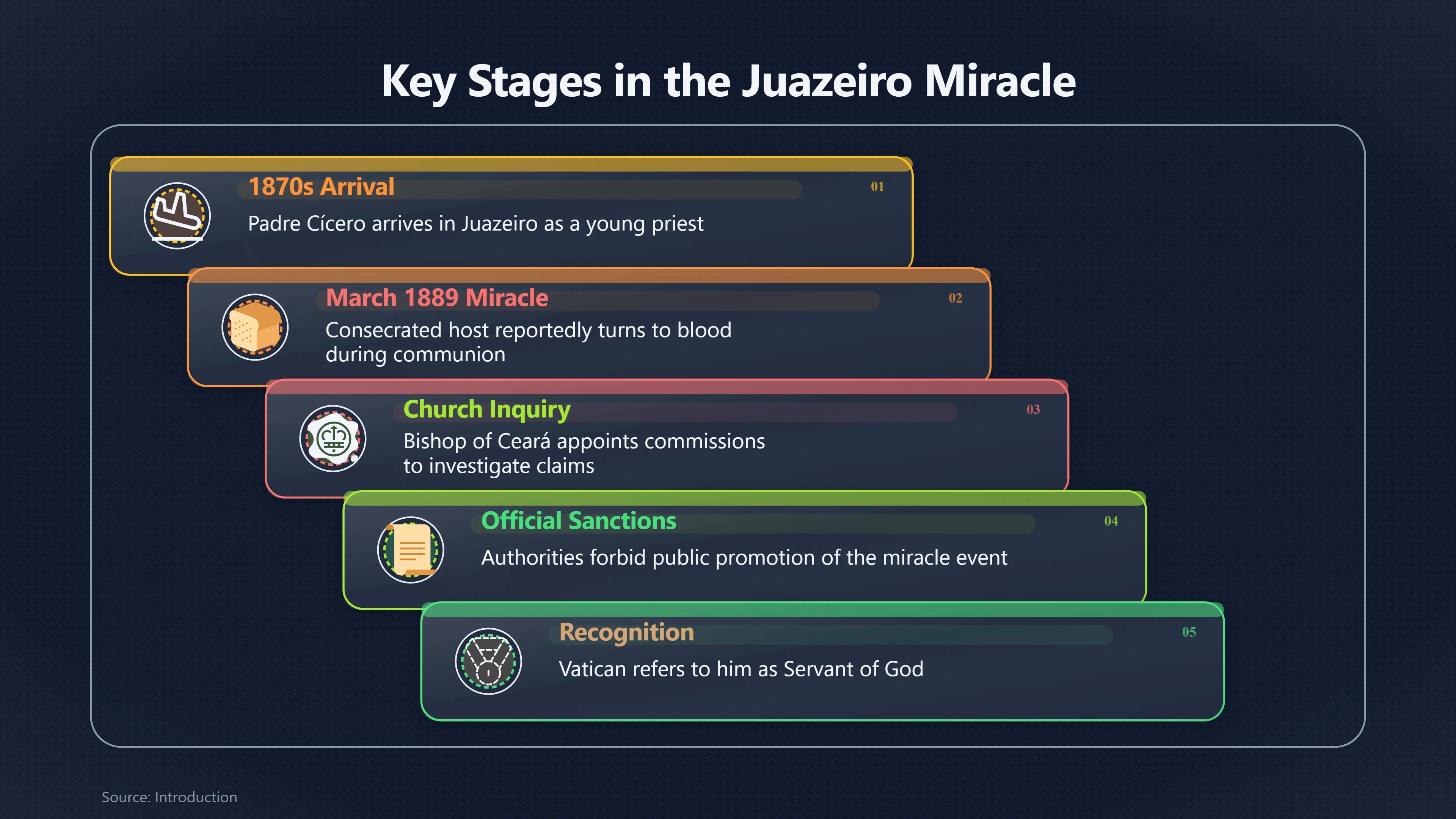
Padre Cícero Romão Batista (1844–1934) arrived in Juazeiro as a young priest in the 1870s. He quickly gained a reputation as a dedicated pastor whose preaching appealed to poor farming communities facing drought, insecurity and limited access to clergy. His influence rested less on formal church office than on personal trust.
Everything changed during Lent in March 1889. While distributing Holy Communion, Padre Cícero placed the consecrated host on the tongue of Maria de Araújo, a deeply religious lay woman. Witnesses reported that the host became blood inside her mouth. Similar episodes were said to occur repeatedly over the following months, attracting growing numbers of visitors who interpreted them as signs of divine intervention.[Portal de Revistas da USP]revistas.usp.bren related with Padre Cicero | Revista de História…
The reported miracle appeared at a moment of profound uncertainty. Brazil had recently abolished slavery and replaced the monarchy with a republic. Among many rural Catholics, rapid political and social change encouraged expectations that God might be sending extraordinary signs. Some believers interpreted the bleeding host as a call to repentance, while others connected it with apocalyptic expectations and divine judgement.[Vatican News]vaticannews.vaVatican News Padre Cícero, servo de DeusVatican NewsPadre Cícero, servo de Deus - Vatican News…
Unlike later episodes of mass panic, the central issue was not widespread fear but competing claims over religious truth. Could ordinary witnesses recognise a miracle before church authorities had ruled on it? Could local devotion outweigh episcopal judgement?
The Reported Miracle at Juazeiro
The Church responded cautiously. Catholic tradition allows for miracles but insists that extraordinary claims undergo careful investigation before receiving official recognition.
The Bishop of Ceará appointed commissions to investigate the reported events. An initial inquiry reportedly accepted testimony supporting the phenomenon, but a second commission reached the opposite conclusion. During further examinations Maria de Araújo no longer displayed the reported bleeding, and investigators concluded that the evidence did not justify recognising a supernatural event. The bishop accepted this judgement and imposed disciplinary measures on Padre Cícero, forbidding him from celebrating certain sacraments publicly and from promoting the miracle.[Pesquisa Escolar]pesquisaescolar.fundaj.gov.brPesquisa Escolar Padre Cícero Romão BatistaPesquisa EscolarPadre Cícero Romão Batista - Pesquisa EscolarApril 2, 2018…
The investigations never produced evidence capable of convincing the institutional Church that the phenomenon was genuinely miraculous. Equally, they never persuaded large numbers of pilgrims that the events had been fraudulent. The disagreement therefore became permanent.
Modern historians generally treat the episode as impossible to resolve conclusively. Contemporary testimony exists from believers, clergy, physicians and investigators, but the surviving evidence cannot establish with certainty whether a supernatural event occurred. Instead, historians focus on how different communities interpreted the same evidence according to different ideas of religious authority.[Tede Unicap]tede2.unicap.brOpen source on unicap.br.
Pilgrims, Clergy and Competing Authority
The conflict revealed two different models of Catholic authority.
For church leaders, miracles required institutional investigation because false claims could mislead the faithful. Careful scepticism protected both doctrine and public confidence in genuine miracles.
For many pilgrims, however, lived religious experience carried its own authority. Thousands believed they had witnessed healings, conversions or answered prayers associated with Padre Cícero. They regarded the bishop’s condemnation as a mistake rather than a final judgement.
This tension explains why devotion survived official sanctions.
Rather than disappearing, pilgrimage expanded. Travellers crossed long distances on foot to reach Juazeiro, seeking blessings, healing, confession and spiritual renewal. The priest’s reputation increasingly rested on the devotion of ordinary believers rather than ecclesiastical approval. His followers affectionately called him “Padim Ciço”, expressing an intimate relationship that formal church discipline could not erase.[UFAL Repository]repositorio.ufal.brUFAL Repository: Nos passos tão longos de pedra e areia: peregrinação e ritual ao túmulo de padre Cícero Romão, Juazeiro do Norte, CearáJ…
The dispute also demonstrated that religious authority in Brazil was not exercised solely from bishops’ offices. It was continually negotiated between clergy, lay believers, local traditions and regional identity.
How Devotion Reshaped Regional Identity
Whether or not the reported miracle was authentic, its social consequences are unmistakable.
Juazeiro evolved from a small settlement into one of Brazil’s largest pilgrimage centres, second only to Aparecida in annual religious tourism. Pilgrimages support local commerce, shape the city’s public spaces and reinforce a shared regional identity centred on Padre Cícero’s memory.[Portal de Periódicos]periodicos.ufal.brPortal de PeriódicosJuazeiro do Padre Cícero: o patrimônio, o turismo e a folkmuseografia | RITUR - Revista Iberoamericana de Turismo…
The city’s museums, monuments, annual pilgrimages and devotional practices preserve not only the memory of Padre Cícero but also the experience of generations of pilgrims who regarded Juazeiro as a sacred landscape. Anthropologists have shown that these journeys create enduring communities of devotion extending across north-eastern Brazil, where pilgrimage is understood as an expression of gratitude, repentance and belonging rather than simply tourism.[UFAL Repository]repositorio.ufal.brUFAL Repository: Nos passos tão longos de pedra e areia: peregrinação e ritual ao túmulo de padre Cícero Romão, Juazeiro do Norte, CearáJ…
The continuing vitality of these traditions illustrates that collective belief does not always depend upon official endorsement. Shared practice, memory and repeated pilgrimage can sustain a sacred landscape across generations.
What Happened to Padre Cícero’s Reputation?
For much of the twentieth century, Padre Cícero occupied an ambiguous position within the Catholic Church. Although never formally excommunicated, he remained under severe ecclesiastical restrictions, and the reported miracle continued to be rejected officially. Popular devotion nevertheless continued to grow.[Tede Unicap]tede2.unicap.brOpen source on unicap.br.
During the twenty-first century the Church’s approach became noticeably more conciliatory. Vatican officials and Brazilian bishops increasingly distinguished between the unresolved question of the 1889 miracle and Padre Cícero’s broader pastoral legacy. The Diocese of Crato began a formal process to reassess his historical treatment, while Church leaders acknowledged the importance of accompanying rather than dismissing the millions of faithful devoted to him. In 2022 the Vatican publicly referred to him as “Servant of God”, reflecting the opening stages of a possible canonisation process, although this does not constitute recognition either of sainthood or of the alleged miracle itself.[Vatican News]vaticannews.vaVatican News Padre Cícero, servo de DeusVatican NewsPadre Cícero, servo de Deus - Vatican News…
This distinction is significant. The Church can reassess a priest’s life without reversing earlier decisions about particular miraculous claims.
Why the Case Still Matters
Padre Cícero’s story is best understood not as an example of mass hysteria but as a dispute over religious authority and collective belief.
The central questions remain strikingly modern:
- Who decides whether extraordinary experiences are genuine?
- How should institutions investigate claims that inspire deep popular conviction?
- Can millions of sincere believers sustain a religious tradition even without official approval?
The battle over the Juazeiro miracle demonstrates that miracles are not judged solely by reports of extraordinary events. They are also shaped by institutions, local communities, historical circumstances and competing ideas about who has the right to recognise the sacred. In Brazil, the endurance of Padre Cícero’s devotion shows that popular religion can become a lasting cultural force even when official recognition remains cautious or incomplete.



Endnotes
1.
Source: revistas.usp.br
Link:https://revistas.usp.br/revhistoria/en/article/view/69204/165520
Source snippet
en related with Padre Cicero | Revista de História...
2.
Source: tede2.unicap.br
Link:https://tede2.unicap.br/items/628b05c4-c76e-4e01-ba15-fe507c2b2b43
3.
Source: repositorio.ufal.br
Link:https://www.repositorio.ufal.br/handle/riufal/6858
Source snippet
UFAL Repository: Nos passos tão longos de pedra e areia: peregrinação e ritual ao túmulo de padre Cícero Romão, Juazeiro do Norte, CearáJ...
4.
Source: periodicos.ufal.br
Link:https://periodicos.ufal.br/ritur/article/view/13485
Source snippet
Portal de PeriódicosJuazeiro do Padre Cícero: o patrimônio, o turismo e a folkmuseografia | RITUR - Revista Iberoamericana de Turismo...
5.
Source: periodicos.ufal.br
Title: br Juazeiro do Padre Cícero: o patrimônio, o turismo e a folkmuseografia | RITUR
Link:https://periodicos.ufal.br/index.php/ritur/article/view/13485?articlesBySimilarityPage=26
6.
Source: vaticannews.va
Title: Vatican News Padre Cícero, servo de Deus
Link:https://www.vaticannews.va/pt/igreja/news/2022-08/dom-orani-tempesta-padre-cicero-romao-batista.html
Source snippet
Vatican NewsPadre Cícero, servo de Deus - Vatican News...
7.
Source: pesquisaescolar.fundaj.gov.br
Title: Pesquisa Escolar Padre Cícero Romão Batista
Link:https://pesquisaescolar.fundaj.gov.br/en/artigo/padre-cicero-romao-batista/
Source snippet
Pesquisa EscolarPadre Cícero Romão Batista - Pesquisa EscolarApril 2, 2018...
Published: April 2, 2018
8.
Source: pesquisaescolar.fundaj.gov.br
Title: fundaj.gov.br Padre Cícero
Link:https://pesquisaescolar.fundaj.gov.br/pt-br/artigo/padre-cicero/
Source snippet
Cícero - Pesquisa EscolarMay 3, 2021 — PADRE CÍCERO Data Nasc.: 24/03/1844 Data de falecimento.: 20/07/1934 Ocupação: Sacerdote PADRE CÍC...
Published: May 3, 2021
9.
Source: pesquisaescolar.fundaj.gov.br
Title: fundaj.gov.br Padre Cícero Memorial
Link:https://pesquisaescolar.fundaj.gov.br/en/artigo/padre-cicero-memorial/
10.
Source: pesquisaescolar.fundaj.gov.br
Title: fundaj.gov.br Non-Canonical Catholic Saints in Northeast Brazil
Link:https://pesquisaescolar.fundaj.gov.br/en/artigo/non-canonical-catholic-saints-northeast-brazil/
Additional References
11.
Source: repositorio.ufpb.br
Link:https://repositorio.ufpb.br/jspui/handle/123456789/28634
Source snippet
UFPB RepositoryRepositório Institucional da UFPB: A história e a dimensão do turismo religioso em Juazeiro do Norte – CE...
12.
Source: youtube.com
Title: Father Cícero: The True Story of the Saint Whom the Church Forbade for 20 Years
Link:https://www.youtube.com/watch?v=Rg2LEZqlQuc
Source snippet
Father Cícero and his greatest miracle, witnessed even by Evangelicals...
13.
Source: youtube.com
Title: The Secrets of Father Cicero: Miracles, Politics, and Controversies
Link:https://www.youtube.com/watch?v=TdUgsMGa-80
Source snippet
Father Cícero: The True Story of the Saint Whom the Church Forbade for 20 Years...
14.
Source: youtube.com
Title: Father Cícero and his greatest miracle, witnessed even by Evangelicals
Link:https://www.youtube.com/watch?v=1Z5FL2tS_7Y
Source snippet
Who Was Father Cícero? The Priest Who Transformed a Nation Through Faith...
15.
Source: youtube.com
Title: THE MIRACLE PERFORMED by FATHER CÍCERO!
Link:https://www.youtube.com/watch?v=xDwp_AeiYe4
Source snippet
The Secrets of Father Cicero: Miracles, Politics, and Controversies...
16.
Source: 1library.org
Link:https://1library.org/article/as-romarias-tradi%C3%A7%C3%A3o-religiosa-juazeiro-norte-antecedentes-hist%C3%B3ricos.z1dn83vz
17.
Source: encyclopedia.com
Link:https://www.encyclopedia.com/religion/encyclopedias-almanacs-transcripts-and-maps/batista-cicero-romao
18.
Source: gvaa.com.br
Link:https://www.gvaa.com.br/revista/index.php/RBFH/article/view/2480
19.
Source: repositorio.ufpb.br
Link:https://repositorio.ufpb.br/jspui/handle/123456789/20001
20.
Source: youtube.com
Title: Who Was Father Cícero? The Priest Who Transformed a Nation Through Faith
Link:https://www.youtube.com/watch?v=3QrupTPQckI
Topic Tree