Within Kazakhstan Panics
When Did Security Policy Start Policing Belief?
Kazakhstan faced genuine militant threats, yet broad registration and extremism controls also placed peaceful believers under suspicion.
On this page
- Real militant threats and state security
- Registration, missionary controls and enforcement
- How to distinguish extremism from peaceful belief
Page outline Jump by section
Introduction
Kazakhstan has faced genuine security threats from violent Islamist organisations, including attacks during the 2010s and the departure of several hundred citizens to join the conflicts in Syria and Iraq. Those realities shaped a security policy that treats extremism as a major national concern. At the same time, the country’s legal framework has often gone beyond targeting violence alone. Since the adoption of a restrictive religion law in 2011, combined with broad counter-extremism legislation, many peaceful religious communities have found themselves subject to registration requirements, surveillance, fines or criminal investigations despite no evidence of advocating violence. Critics argue that this blurred the distinction between genuine militant threats and ordinary religious practice, while the government has maintained that strong controls are necessary to prevent radicalisation before it turns violent. Understanding this tension is essential to understanding modern Kazakhstan’s history of belief, fear and state power.
When Did Security Policy Start Policing Belief?
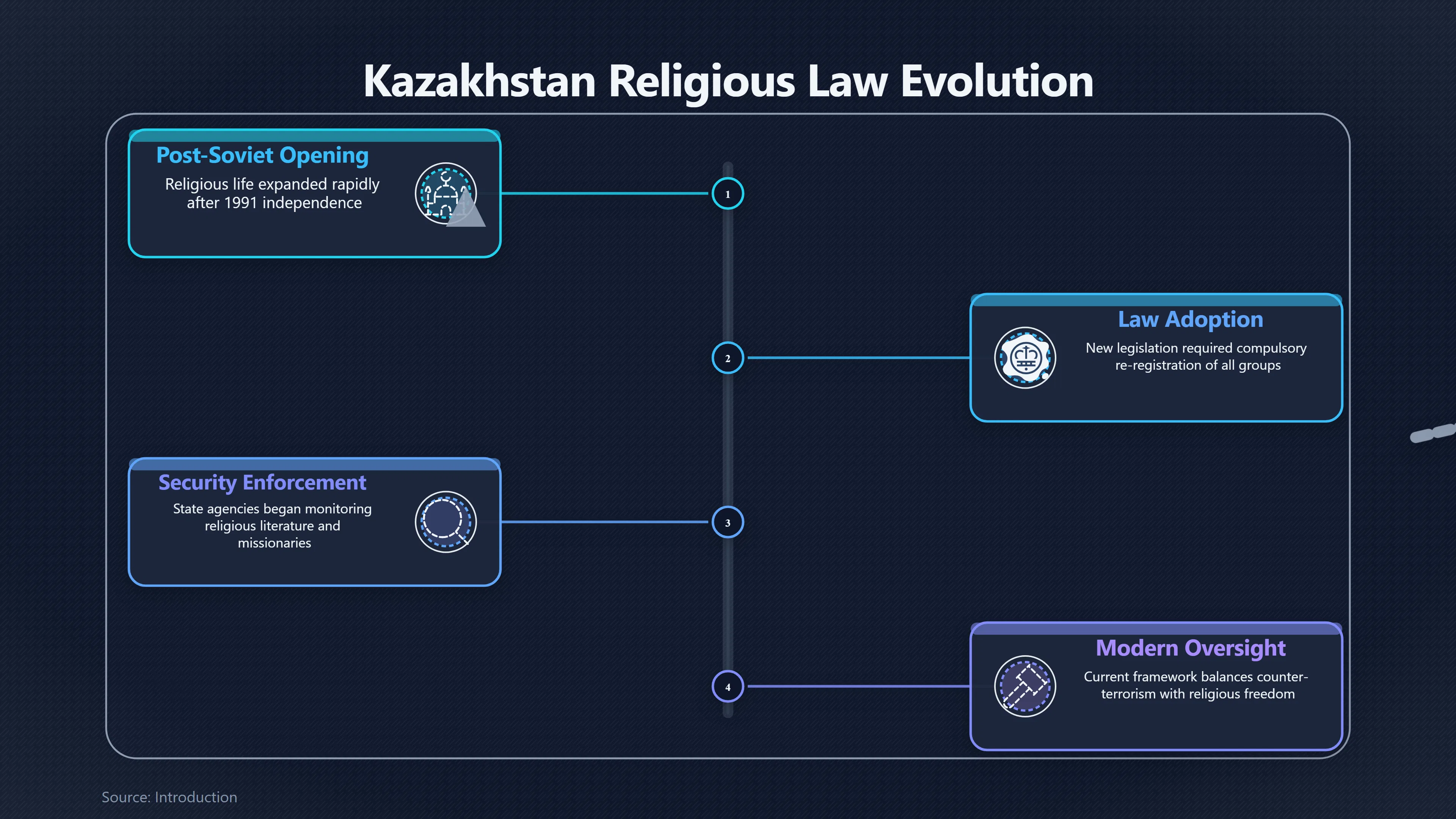
The roots of Kazakhstan’s current approach lie in the years after independence in 1991. Religious life expanded rapidly after decades of Soviet restrictions. Mosques reopened, Christian denominations established new congregations, foreign missionaries arrived and new religious movements appeared. This religious diversity coincided with concerns about regional instability, especially after militant Islamist movements emerged elsewhere in Central Asia.
The balance shifted decisively in 2011 with the adoption of the Law on Religious Activities and Religious Associations. The legislation required all religious organisations to undergo compulsory re-registration, prohibited unregistered religious activity, tightened controls over missionary work and introduced government review of religious literature. International observers warned at the time that these measures restricted freedom of religion beyond what international human rights standards allow.[OSCE ODIHR]odihr.osce.orgOSCE ODIHROSCE human rights chief expresses concern over restrictions in Kazakhstan’s new religion law | OSCE Office for Democratic Insti…
The government presented these reforms as preventive security measures. Officials argued that clear oversight of religious organisations would help identify extremist influences before they developed into violent networks. Critics accepted the legitimacy of combating terrorism but questioned whether broad administrative controls on peaceful believers actually contributed to public safety.
Real Militant Threats and State Security
Kazakhstan’s security concerns were not imaginary.
During the early 2010s the country experienced several violent attacks linked to Islamist militants, including bombings and shootings directed at security forces. Later, officials estimated that hundreds of Kazakh citizens travelled to territories controlled by the so-called Islamic State in Syria and Iraq. Preventing recruitment and violent radicalisation therefore became a central national security priority. International organisations have recognised that Kazakhstan faces genuine counter-terrorism challenges shared by many states in the region.[Adilet]adilet.zan.kzPromotion and protection of all human rights, civil, political, economic, social and cultural rights, including the right to develo…
These threats influenced both legislation and public messaging. Government agencies increasingly described unfamiliar religious groups, especially those operating outside official structures, as potential security risks. Public campaigns warned against “destructive religious movements”, while specialist government bodies were tasked with monitoring religious activity and providing expert assessments of religious materials.
The difficulty, according to many legal scholars and human rights organisations, was that the definition of extremism often extended beyond advocacy or preparation of violence. Vague legal concepts allowed peaceful religious expression to become entangled with national security enforcement, making it harder to distinguish between criminal conduct and unconventional belief.[Human Rights Watch]hrw.orgHuman Rights WatchPolitically Targeted, Economically Isolated: How Kazakhstan’s Financing Terrorism List Compounds Human Rights Harms | H…
Registration, Missionary Controls and Enforcement
The most distinctive feature of Kazakhstan’s system has been its reliance on administrative regulation rather than only criminal prosecution.
Every religious association has been required to register with the state, and failure to meet membership thresholds or administrative requirements has prevented many smaller communities from operating legally. Missionaries, including Kazakh citizens carrying out missionary activity, have also been required to obtain separate authorisation. Religious literature is subject to official review, and distribution is restricted to approved locations.[OSCE ODIHR]odihr.osce.orgOSCE ODIHROSCE human rights chief expresses concern over restrictions in Kazakhstan’s new religion law | OSCE Office for Democratic Insti…
These rules have had several practical consequences.
- Smaller congregations have sometimes dissolved because they could not satisfy registration requirements.
- Individuals have received fines for participating in or organising unregistered worship.
- Religious literature has been confiscated where officials judged its distribution to breach regulatory rules.
- Missionary activity without official approval has attracted administrative penalties.
Human Rights Watch, Forum 18 and United Nations experts have documented numerous cases in which peaceful believers—including Protestant Christians, Jehovah’s Witnesses, Muslims practising outside officially recognised structures and other minority communities—were investigated or sanctioned despite no allegation that they had promoted violence.[Human Rights Watch]hrw.orgHuman Rights WatchHuman Rights Watch Concerns and Recommendations on Kazakhstan | Human Rights WatchJune 14, 2016…
International criticism has generally focused less on Kazakhstan’s right to combat terrorism than on the breadth of its regulatory system. The concern has been that peaceful religious practice becomes unlawful simply because it falls outside state-approved procedures.
Why the Definition of “Extremism” Became Controversial
The debate has centred on the meaning of extremism itself.
International law clearly permits governments to criminalise terrorism, incitement to violence and participation in violent organisations. However, there is no universally accepted legal definition of “extremism”. This creates a risk that the term can be applied far more broadly than violent conduct alone.
United Nations special rapporteurs have repeatedly argued that Kazakhstan’s legal framework uses the language of extremism in ways that can restrict freedoms of religion, association and expression. They have recommended relying on ordinary criminal law to prosecute genuine violence while reducing restrictions on peaceful religious organisation. One UN report explicitly warned that banning peaceful religious groups is unlikely to reduce extremism and may instead undermine trust between communities and the state.[Adilet]adilet.zan.kzPromotion and protection of all human rights, civil, political, economic, social and cultural rights, including the right to develo…
More recent assessments have reached similar conclusions. The U.S. Commission on International Religious Freedom argues that Kazakhstan continues to enforce both its religion law and extremism legislation against peaceful religious activity, while Human Rights Watch has criticised the continued use of broad definitions that can affect non-violent conduct.[USCIRF]uscirf.govreleases report abuse extremism laws central asiaUSCIRF Releases Report on the Abuse of Extremism Laws in Central Asia | USCIRFDecember 31, 2024…
How to Distinguish Extremism from Peaceful Belief
Kazakhstan illustrates why careful distinctions matter when discussing religion and security.
Peaceful religious belief typically involves worship, teaching, prayer, missionary activity, charitable work or private religious study. None of these activities necessarily imply support for violence.
Violent extremism, by contrast, involves preparing, encouraging or carrying out acts of violence or coercion for ideological or religious purposes. Criminal investigations focus on conduct such as recruitment for terrorist organisations, financing violent groups or incitement to commit violent acts.
The controversy arises when administrative or criminal measures target peaceful activities because they occur outside official registration systems or because authorities regard certain beliefs as socially undesirable. Human rights bodies have consistently argued that governments should prosecute violent acts while avoiding restrictions based solely on religious identity, minority status or unconventional theology.[zan.kz]adilet.zan.kzPromotion and protection of all human rights, civil, political, economic, social and cultural rights, including the right to develo…
For readers interested in Kazakhstan’s wider history of collective fears, this distinction is crucial. Unlike classic moral panics driven mainly by rumour, the country’s experience reflects a complex interaction between genuine security threats and a regulatory system that, according to many observers, sometimes encouraged suspicion of peaceful religious minorities. The result has been an enduring debate over where legitimate counter-terrorism ends and the policing of belief begins.

Endnotes
1.
Source: odihr.osce.org
Link:https://odihr.osce.org/odihr/83191
Source snippet
OSCE ODIHROSCE human rights chief expresses concern over restrictions in Kazakhstan’s new religion law | OSCE Office for Democratic Insti...
2.
Source: uscirf.gov
Title: Religious Freedom Conditions in Kazakhstan | USCIRF
Link:https://www.uscirf.gov/countries/kazakhstan
Source snippet
Religious Freedom Conditions in Kazakhstan | USCIRF...
3.
Source: uscirf.gov
Title: releases report abuse extremism laws central asia
Link:https://www.uscirf.gov/news-room/releases-statements/uscirf-releases-report-abuse-extremism-laws-central-asia
Source snippet
USCIRF Releases Report on the Abuse of Extremism Laws in Central Asia | USCIRFDecember 31, 2024...
Published: December 31, 2024
4.
Source: uscirf.gov
Title: religious freedom kazakhstan remains poor despite government claims
Link:https://www.uscirf.gov/release-statements/religious-freedom-kazakhstan-remains-poor-despite-government-claims
5.
Source: odihr.osce.org
Link:https://odihr.osce.org/odihr/313091
6.
Source: uscirf.gov
Title: kazakhstan country update
Link:https://www.uscirf.gov/publications/kazakhstan-country-update
7.
Source: adilet.zan.kz
Link:https://www.adilet.zan.kz/eng/docs/O1500000001
Source snippet
Promotion and protection of all human rights, civil, political, economic, social and cultural rights, including the right to develo...
8.
Source: hrw.org
Link:https://www.hrw.org/report/2024/08/27/politically-targeted-economically-isolated/how-kazakhstans-financing-terrorism
Source snippet
Human Rights WatchPolitically Targeted, Economically Isolated: How Kazakhstan’s Financing Terrorism List Compounds Human Rights Harms | H...
9.
Source: hrw.org
Link:https://www.hrw.org/news/2016/06/14/human-rights-watch-concerns-and-recommendations-kazakhstan
Source snippet
Human Rights WatchHuman Rights Watch Concerns and Recommendations on Kazakhstan | Human Rights WatchJune 14, 2016...
Published: June 14, 2016
10.
Source: hrw.org
Link:https://www.hrw.org/news/2013/09/16/kazakhstan-letter-prosecutor-general-regarding-proposed-amendments-criminal-code
11.
Source: eifrf-articles.org
Link:https://www.eifrf-articles.org/Kazakhstan-UN-Special-Rapporteur-on-Freedom-of-Religion-or-Belief-releases-his-report_a168.amp.html
12.
Source: hrw.org
Title: Kazahkstan: Universal Periodic Review Submission | Human Rights Watch
Link:https://www.hrw.org/news/2014/03/18/kazahkstan-universal-periodic-review-submission
13.
Source: adilet.zan.kz
Title: kz On religious activities and religious associations
Link:https://adilet.zan.kz/eng/docs/Z1100000483
14.
Source: hrw.org
Link:https://www.hrw.org/node/83329
15.
Source: hrw.org
Title: Kazakhstan: Fulfill OSCE Commitments on Human Rights | Human Rights Watch
Link:https://www.hrw.org/news/2008/12/01/kazakhstan-fulfill-osce-commitments-human-rights
16.
Source: hrw.org
Title: freedom religion assembly and expression kazakhstan
Link:https://www.hrw.org/report/2008/12/01/atmosphere-quiet-repression/freedom-religion-assembly-and-expression-kazakhstan
17.
Source: hrw.org
Link:https://www.hrw.org/world-report/2017/country-chapters/kazakhstan
Additional References
18.
Source: youtube.com
Link:https://www.youtube.com/watch?v=LWhs2jimE60
Source snippet
Kazakhstan to amend national security laws | Silk way TV...
19.
Source: youtube.com
Title: CFJ-Monitored Trials Show Ongoing Misuse of Extremism Laws to Stifle Dissent
Link:https://www.youtube.com/watch?v=Kx2dAVlpP6M
Source snippet
LYNC Briefing Report - Kazakhstan National TV...
20.
Source: youtube.com
Title: Kazakhstan to amend national security laws | Silk way TV
Link:https://www.youtube.com/watch?v=6U5Z4A1-PJ4
Source snippet
CFJ-Monitored Trials Show Ongoing Misuse of Extremism Laws to Stifle Dissent...
21.
Source: youtube.com
Title: Kazakhstan passes restrictive religion law
Link:https://www.youtube.com/watch?v=JLGQPWrZGT8
Source snippet
An Astana resident received an eight-year sentence for promoting extremism on social media...
22.
Source: loc.gov
Link:https://www.loc.gov/item/global-legal-monitor/2011-10-17/kazakhstan-new-law-on-religion-enacted
23.
Source: spcommreports.ohchr.org
Title: Search Code
Link:https://spcommreports.ohchr.org/TmSearch/SearchCode?code=%3B+KAZ%2F2025
Source snippet
no. of communication | Mandates | Summary | Replies received --- | --- | --- | --- 05 Nov 2025 Kazakhstan JAL KAZ 5/2025 | * terrorism * fr...
24.
Source: ecoi.net
Link:https://www.ecoi.net/en/document/1241151.html
25.
Source: ecoi.net
Link:https://www.ecoi.net/en/document/1110184.html
26.
Source: youtube.com
Title: LYNC Briefing Report
Link:https://www.youtube.com/watch?v=QG0VO0-SRS8
27.
Source: spcommreports.ohchr.org
Title: Spcomm Reports
Link:https://spcommreports.ohchr.org/TmSearch/SummaryPrint?id=30414
Topic Tree