Within Burundi Beliefs
How Did Albinism Become a Target for Profit?
People with albinism were targeted when supernatural myths combined with poverty, criminal demand and weak protection.
On this page
- The myths attached to albinism
- Killers, brokers and cross border demand
- Protection, public education and criminal accountability
Page outline Jump by section
Introduction
From the late 2000s, people with albinism in eastern Burundi became targets of a wave of abductions and murders driven by a dangerous combination of supernatural belief, organised crime and cross-border trafficking. The victims were not attacked because of anything they had done. They were targeted because criminal networks exploited the false belief that the body parts of people with albinism could bring wealth, luck or political success when used in ritual practices. Although these myths existed in parts of the wider region, the violence in Burundi was closely linked to demand across the border in Tanzania, where a lucrative illicit market developed for human remains. International organisations and Burundian advocacy groups have consistently stressed that these crimes were motivated by profit as much as belief: myths created demand, but criminal brokers, killers and traffickers turned that demand into organised violence.[ecoi.net]ecoi.netUTSS - Under The Same Sun (Author), published by CAT – UN Committee Against Torture: “The Torture of People With Albinism in Burundi”, Do…
How Did Albinism Become a Target for Profit?
Albinism is a genetic condition that reduces or prevents the production of melanin, the pigment responsible for colouring skin, hair and eyes. It is neither contagious nor supernatural. Nevertheless, longstanding myths in parts of eastern and southern Africa have portrayed people with albinism as possessing extraordinary mystical properties. Some rumours claimed that body parts could be turned into charms promising prosperity, success in business, electoral victory or good fortune.
Human rights organisations emphasise that these beliefs were never universal within Burundi. Most Burundians rejected them. However, where poverty, weak law enforcement and criminal opportunity overlapped, a small number of individuals were willing to exploit the myths for financial gain. The result was not spontaneous mass violence but a market in which murders were commissioned, body parts removed and trafficked, and victims treated as commodities rather than human beings.[ohchr.org]ohchr.orgPEOPLE WITH ALBINISMPEOPLE WITH ALBINISM…
The spread of attacks also illustrates how rumours can become economically valuable. Rather than simply reflecting traditional belief, the crimes depended on people believing that someone else would pay large sums for human remains. That expectation encouraged brokers, intermediaries and hired killers to participate, regardless of whether they themselves accepted the supernatural claims.
The myths attached to albinism
Several false beliefs repeatedly appeared in investigations across the region:
- Body parts from people with albinism could supposedly bring wealth or commercial success.
- Charms containing bones, limbs or hair were believed by some clients to increase political influence or personal power.
- Some myths portrayed people with albinism as beings who did not die in the ordinary sense or whose remains possessed unusual spiritual value.
- Families could face stigma after the birth of a child with albinism, increasing isolation and vulnerability.
Researchers and the United Nations stress that there is no evidence whatsoever supporting these claims. They are forms of harmful superstition that have resulted in murder, mutilation, grave robbery and trafficking. The myths also reinforce everyday discrimination against people with albinism, who often face exclusion from education, employment and healthcare alongside the threat of physical violence.[right-docs.org]right-docs.orgRight Docs24/57 Persons with albinismRightDocs24/57 Persons with albinism - Report of the Office of the United Nations High Commissioner for Human Rights / RightDocs - Where…
Killers, brokers and cross-border demand
Burundi’s attacks cannot be understood solely as a domestic problem. Investigations from Burundian authorities, Reuters reporting and later United Nations analyses consistently linked many cases to demand originating in neighbouring Tanzania, where ritual markets for body parts had become internationally notorious during the late 2000s. Eastern Burundian provinces near the Tanzanian border experienced some of the worst attacks because traffickers could move remains across a relatively porous frontier.[ritualkillinginafrica.org]ritualkillinginafrica.orgOctober 5, 2018…
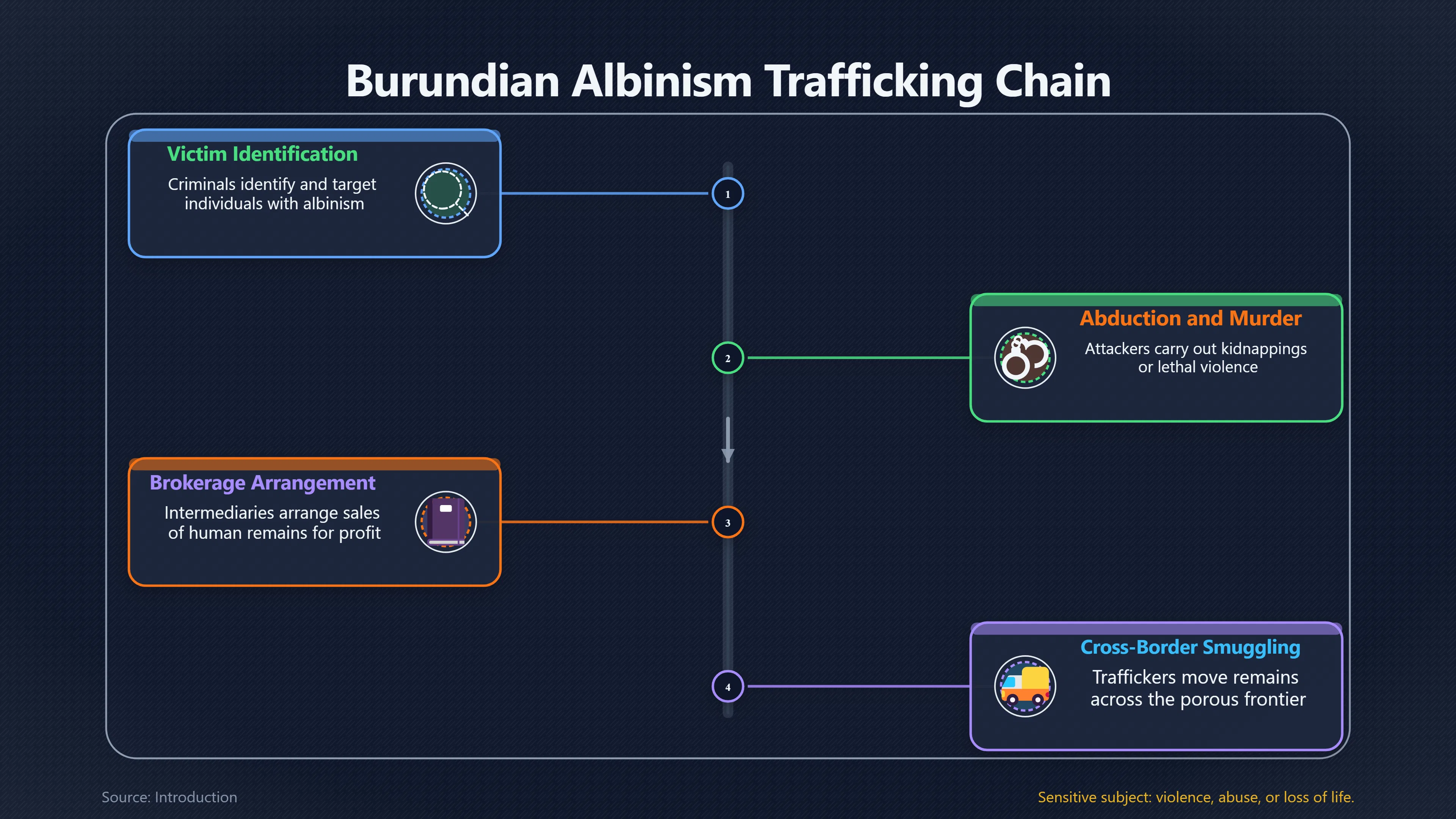
This cross-border dimension changed the nature of the crimes. Rather than isolated assaults motivated by local prejudice alone, many cases involved several participants:
- individuals identifying potential victims;
- attackers carrying out kidnappings or murders;
- brokers arranging sales;
- smugglers transporting body parts across borders;
- purchasers seeking ritual ingredients.
The resulting criminal chain resembled organised trafficking more than spontaneous mob violence. International human rights reports have therefore described attacks on people with albinism as involving elements of trafficking in persons, organ-related criminal activity and transnational organised crime alongside belief in supernatural rewards.[right-docs.org]right-docs.orgRight Docs24/57 Persons with albinismRightDocs24/57 Persons with albinism - Report of the Office of the United Nations High Commissioner for Human Rights / RightDocs - Where…
Violence along Burundi’s eastern border
The first major series of killings in Burundi emerged in 2008. Victims included adults and children whose bodies were mutilated after death. Some attacks took place inside family homes at night, while others involved abduction before murder. Families also reported grave robberies in which remains were stolen after burial.
By 2009, Burundian courts had convicted several people for murders and attempted murders of people with albinism, imposing sentences ranging from prison terms to life imprisonment. Police also arrested suspects found with human bones believed to belong to victims. Although prosecutions demonstrated that authorities were beginning to respond, advocacy organisations argued that many perpetrators and organisers remained beyond the reach of law enforcement, particularly when criminal networks crossed into neighbouring countries.[ritualkillinginafrica.org]ritualkillinginafrica.orgOctober 5, 2018…
Later United Nations reporting continued to identify Burundi among the East African countries where attacks, kidnappings and attempted abductions persisted after the initial wave. The problem therefore proved more resilient than early prosecutions alone could resolve.[ecoi.net]ecoi.netOHCHR – UN Office of the High Commissioner for Human Rights (Author): “High Commissioner Zeid Calls For Action After Surge In “Stunningly…

Protection, public education and criminal accountability
Burundi’s response gradually combined criminal enforcement with efforts to challenge the beliefs that made trafficking profitable.
Advocacy organisations representing people with albinism argued that policing alone could never eliminate the danger if myths continued to circulate. Public education campaigns therefore sought to explain that albinism is an inherited genetic condition, not a source of magical power. These campaigns also encouraged communities to reject rumours before they could be exploited by traffickers.[OHCHR]ohchr.orgPEOPLE WITH ALBINISMPEOPLE WITH ALBINISM…
Human rights organisations also pressed for practical protection measures, including:
- stronger security for individuals considered at immediate risk;
- faster investigation of disappearances and attacks;
- improved cooperation between Burundi and neighbouring states on cross-border investigations and extradition;
- consistent prosecution of organisers as well as direct attackers;
- support for survivors and affected families.
United Nations reports have repeatedly highlighted that cross-border trafficking requires regional cooperation rather than isolated national responses. Criminal networks can exploit differences in policing, evidence-sharing and extradition procedures if neighbouring countries do not coordinate investigations.[United Nations Digital Library System]digitallibrary.un.orgited Nations Digital Library System United Nationsited Nations Digital Library SystemUnited NationsApril 13, 2026…
Why this episode matters in Burundi’s history of collective belief
The persecution of people with albinism differs from many episodes discussed in histories of moral panic or mass hysteria. The victims were not persecuted because an entire society suddenly became convinced they posed a threat. Instead, a small but deadly market emerged in which supernatural myths created commercial value for human remains.
That distinction is important. The central mechanism was the interaction between belief and organised crime. False claims about magical power encouraged demand, while poverty, weak border controls and criminal networks supplied that demand through murder and trafficking. The episode therefore illustrates how dangerous collective beliefs can become when they are reinforced by financial incentives rather than remaining private superstition.
For Burundi, the attacks also exposed the limits of treating such violence purely as ordinary homicide. Effective responses required public education to undermine harmful myths, protection for an unusually vulnerable minority, and sustained cooperation with neighbouring countries to disrupt the cross-border trade that transformed superstition into organised violence.
Amazon book picks
Further Reading
Books and field guides related to How Did Albinism Become a Target for Profit?. Use these as the next step if you want deeper reading beyond the article.

The Spirit Catches You and You Fall Down
Explores the intersection of belief and health.
African religions and philosophy
Provides context for beliefs exploited by criminal networks.
Endnotes
1.
Source: ecoi.net
Link:https://www.ecoi.net/en/document/1323499.html
Source snippet
UTSS - Under The Same Sun (Author), published by CAT – UN Committee Against Torture: “The Torture of People With Albinism in Burundi”, Do...
2.
Source: ohchr.org
Title: PEOPLE WITH ALBINISM
Link:https://www.ohchr.org/sites/default/files/Documents/Issues/Albinism/Albinism_Worldwide_Report2021_EN.pdf
Source snippet
PEOPLE WITH ALBINISM...
3.
Source: ecoi.net
Link:https://www.ecoi.net/en/document/1313049.html
Source snippet
OHCHR – UN Office of the High Commissioner for Human Rights (Author): “People With Albinism: Navi Pillay Urges More Protection After Barb...
4.
Source: ritualkillinginafrica.org
Link:https://www.ritualkillinginafrica.org/2018/10/05/previous-ritual-murders-attacks-targeting-albinos-in-burundi/
Source snippet
October 5, 2018...
Published: October 5, 2018
5.
Source: ecoi.net
Link:https://www.ecoi.net/en/document/1059244.html
Source snippet
OHCHR – UN Office of the High Commissioner for Human Rights (Author): “High Commissioner Zeid Calls For Action After Surge In “Stunningly...
6.
Source: ecoi.net
Link:https://www.ecoi.net/de/dokument/1323499.html
7.
Source: ecoi.net
Link:https://www.ecoi.net/en/document/1051713.html
8.
Source: ecoi.net
Link:https://www.ecoi.net/en/document/1261407.html
9.
Source: spcommreports.ohchr.org
Link:https://spcommreports.ohchr.org/TmSearch/Mandates?m=32
10.
Source: right-docs.org
Title: Right Docs24/57 Persons with albinism
Link:https://www.right-docs.org/doc/a-hrc-24-57/
Source snippet
RightDocs24/57 Persons with albinism - Report of the Office of the United Nations High Commissioner for Human Rights / RightDocs - Where...
11.
Source: digitallibrary.un.org
Title: ited Nations Digital Library System United Nations
Link:https://digitallibrary.un.org/record/1664451/files/A_HRC_40_62-EN.pdf
Source snippet
ited Nations Digital Library SystemUnited NationsApril 13, 2026...
Published: April 13, 2026
12.
Source: un.org
Link:https://www.un.org/en/node/206380
Additional References
13.
Source: youtube.com
Title: Tanzanians with albinism targeted for [witchcraft]({{ ‘witchcraft/’ | relative_url }}) | UNICEF
Link:https://www.youtube.com/watch?v=ocwWzE6_u20
Source snippet
In the Shadow of the Sun Documentary | AfriDocs AnyTime Trailer...
14.
Source: scielo.org.za
Link:https://scielo.org.za/scielo.php?pid=S1727-37812015000400005&script=sci_arttext
15.
Source: researchgate.net
Link:https://www.researchgate.net/publication/40755705_Sociocultural_aspects_of_albinism_in_sub-Saharan_Africa_Mutilations_and_ritual_murders_committed_in_east_Africa_Burundi_and_Tanzania
16.
Source: ungeneva.org
Link:https://www.ungeneva.org/en/news-media/bi-weekly-briefing/2015/03/regular-press-briefing-information-service-1
17.
Source: un.tzembassy.go.tz
Link:https://www.un.tzembassy.go.tz/resources/view/un-tanzania-chief-condemns-abduction-and-murder-of-child-with-albinism
18.
Source: ungeneva.org
Link:https://www.ungeneva.org/en/news-media/bi-weekly-briefing/2013/03/regular-press-briefing-information-service-0
19.
Source: youtube.com
Title: Zeru Zeru The Ghosts
Link:https://www.youtube.com/watch?v=Psc9Wi4rrq8
Source snippet
Tanzanians with albinism targeted for witchcraft | UNICEF...
20.
Source: youtube.com
Title: In the Shadow of the Sun Documentary | Afri Docs Any Time Trailer
Link:https://www.youtube.com/watch?v=j9VjOmWZqAc
Source snippet
Albinos Murdered For Their Body Parts...
21.
Source: heraldnet.com
Title: Albinos killed in Burundi for ritual body parts | Herald Net.com
Link:https://www.heraldnet.com/2010/05/07/albinos-killed-in-burundi-for-ritual-body-parts/
22.
Source: refworld.org
Title: Report of the Working Group on the Universal Periodic Review
Link:https://www.refworld.org/reference/countryrep/unhrc/2009/en/64709
Topic Tree